



How to Get Cited by AI: 8 Ways B2B Brands Can Build Citation Authority
Your company has published dozens of articles, invested in SEO, and built a library of resources covering the topics your customers care about. Yet when someone asks ChatGPT, Google AI, or Perplexity a question related to your expertise, the answer cites your competitors instead of your website.
What are those competitors doing differently?
Perhaps they publish original research that provides information unavailable elsewhere. Maybe their content answers specific questions more clearly, or their websites make supporting evidence easier to find. In other cases, differences in how AI systems retrieve and select sources may explain the results.
There is no universal formula for earning AI citations. However, B2B brands can take practical steps to make their content more discoverable, credible, and useful to readers and systems that retrieve information.
This guide explains how to get cited by AI through eight strategies focused on original research, demonstrated expertise, content quality, technical accessibility, and relevant industry visibility.
The objective is not simply to generate more citations. It is to create information that deserves to be referenced.
Key Takeaways
- AI citations occur when AI-powered search or answer experiences reference information from a source, often through a visible link.
- A citation is different from a brand mention or product recommendation. Each represents a different type of visibility.
- Original research, practical experience, and verifiable evidence give B2B companies opportunities to contribute information that other sources may not provide.
- Clear content structure and technical accessibility make information easier to discover and understand, but do not guarantee AI citations.
- Credible industry coverage, customer evidence, and relevant third-party references can support broader brand discoverability.
- AI citation performance should be evaluated across relevant buyer questions, different platforms, and repeated tests.
- Citation quality and commercial relevance matter more than increasing citation counts without understanding their value.
What Does It Mean to Get Cited by AI?
An AI citation occurs when an AI-powered search or answer experience identifies a source supporting information in its response, often through a visible link to a webpage, research report, or other resource.
For example, imagine someone asking an AI assistant how organizations measure employee training effectiveness. The response might explain different evaluation methods and include a link to an original industry study published by an LMS vendor.
In that situation, the vendor's research has been cited as a supporting source.
However, being cited is not the same as having your brand mentioned or recommended.
An AI brand mention occurs when a response names your company. An AI recommendation occurs when the system presents your product or service as an option that may fit the user's requirements. A citation, meanwhile, connects information in the response to a particular source.
These outcomes can happen together, but they are not interchangeable.
An LMS company's research might be cited in an answer about employee onboarding without its software being recommended. Similarly, an AI-generated shortlist might mention a learning platform without linking directly to its website.
For B2B marketers, this distinction is important because each outcome serves a different purpose. Citations can help users discover supporting information, while recommendations may introduce products during vendor evaluation.
How Do AI Search Engines Choose Which Sources to Cite?
AI-powered search experiences do not all work the same way. Different platforms use different search systems, retrieval processes, and methods for generating answers.
However, search-grounded AI experiences generally follow a recognizable process.
A user asks a question, and the system may retrieve information from searchable or otherwise available sources. It then generates an answer using that information and its own processing. Depending on the platform and response, the interface may display links to supporting webpages, reports, or other resources.
This means the information available to the system matters. If a relevant page cannot be accessed, contains incomplete information, or fails to address the question, it may have limited usefulness as a retrieved source.
At the same time, being accessible does not guarantee selection.
Google's generative search features rely on established search systems and retrieval techniques, while ChatGPT Search has its own mechanisms for discovering web content. Other AI platforms may produce different citations for the same question.
The wording of the question, available sources, retrieval decisions, and platform-specific behavior can all affect which pages appear.
It is also important to understand that a citation is not a universal measure of authority. An AI system citing a page does not automatically mean that it considers the source the most credible or accurate available.
For businesses, the practical response is to improve the usefulness and accessibility of their information rather than search for a single citation-ranking formula.
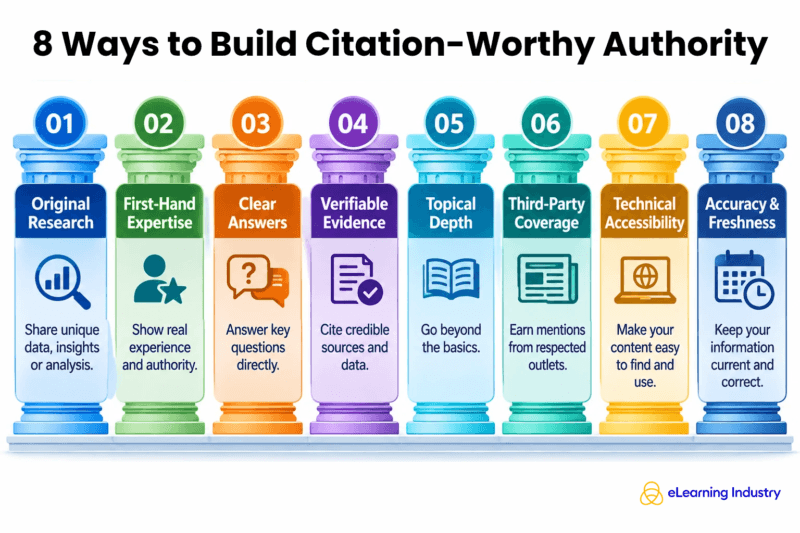
8 Ways B2B Brands Can Build Citation-Worthy Authority
If your company's content rarely appears as a source in AI-generated answers, publishing more articles is not necessarily the solution.
A stronger approach is to examine what your content contributes, how well it supports its claims, and whether relevant systems and readers can access it.
The following eight strategies can help B2B brands build a more useful and credible collection of information.
1. Publish Original Research and Proprietary Data
Original research is one of the clearest ways to contribute something new to an industry conversation.
Many companies publish articles summarizing the same trends, challenges, and recommendations. Although these resources may help readers understand a subject, they often provide little information that cannot be found elsewhere.
Research can change that by introducing findings based on evidence the company has collected or analyzed.
Useful formats include industry surveys, benchmark reports, anonymized customer data, market studies, documented experiments, and original comparisons.
Consider two hypothetical LMS vendors. One publishes a general article about the benefits of employee training. The other publishes a study examining how 150 organizations measure training effectiveness, including its methodology, findings, and limitations.
The second company provides specific evidence that other writers, researchers, buyers, and potentially AI systems may find relevant.
However, the value depends on research quality, not simply sample size. A survey of 150 organizations does not automatically represent the entire market, and an observed relationship does not establish causation.
What to do: Identify an unanswered question within your industry and investigate it using a transparent method. Explain who participated, how information was collected, what the findings show, and where the evidence is limited.
The goal is to create information that adds something meaningful to the conversation rather than repeat conclusions readers can already find elsewhere.
2. Demonstrate First-Hand Expertise and Experience
B2B companies often have access to practical knowledge that general industry articles cannot reproduce.
Customer projects, technical implementations, product development, and direct experience with business challenges can provide valuable material for content.
However, that knowledge needs to be documented and explained.
Instead of publishing another article about why LMS integrations are important, a learning technology company could examine an actual integration between its platform and a customer's HR information system.
The case study might describe the original requirements, technical challenges, decisions made during implementation, and measurable outcomes. It should also explain any limitations or conditions that influenced the results.
This gives readers a more complete understanding of what implementation involves.
The same approach applies to HR technology, SaaS, and other B2B sectors. A software provider can discuss lessons from customer onboarding, while a consulting company can explain a tested process or documented project.
What to do: Involve subject-matter experts in content development and use their experience to support practical explanations.
Rather than asking an executive for generic predictions, ask what they have observed, which decisions were difficult, and what evidence supports their conclusions.
For companies looking to share relevant customer experiences, eLearning Industry's Original Case Study solution provides a way to publish documented stories for an audience interested in workplace learning.
First-hand experience does not guarantee citations, but it can make your content more distinctive and useful.
3. Answer Specific Questions Clearly and Completely
Content should make it easy for readers to find the information they came looking for.
That may sound obvious, but many B2B articles spend considerable space introducing a topic without directly answering the question suggested by their title.
Clear writing helps readers understand what matters. It also makes information easier for search systems and other tools to interpret.
Start by identifying the specific question a page should answer. Then provide a direct explanation before expanding into examples, qualifications, and related considerations.
For instance, an article about LMS pricing should do more than explain that costs vary between vendors.
It could examine subscription models, per-user pricing, implementation expenses, support costs, integrations, and potential charges for additional services.
A worked example would make the explanation more useful by showing how those costs might be calculated for a particular organization.
Helpful content structures include:
- Descriptive headings that reflect genuine reader questions.
- Clear definitions and explanations of important concepts.
- Relevant examples, calculations, and practical comparisons.
- FAQs that address useful questions not already answered in the main article.
However, content clarity should not be confused with an AI optimization trick.
Breaking every paragraph into tiny sections, repeating question-based headings, or forcing keywords into sentences does not guarantee that an AI system will cite the page.
What to do: Organize information around what readers need to understand, and make the answer easy to identify without sacrificing depth or context.
The purpose of clear structure is to improve usability. Any benefit to AI-assisted discovery should be treated as a potential outcome rather than a guaranteed result.
4. Support Important Claims With Verifiable Evidence
Content becomes more useful when readers can understand where its claims come from and assess whether they are reliable.
A B2B article might include statistics, customer outcomes, performance comparisons, or statements about industry behavior. Without supporting evidence, those claims are difficult to evaluate.
For example, an HR technology vendor writing about employee turnover should identify the original research behind any statistics it uses.
Repeating a percentage from another blog post without checking the underlying study can spread outdated or misleading information.
If the company publishes its own research, it should explain how the results were calculated and what the findings do not establish.
Useful supporting information can include research methodologies, publication dates, definitions, calculations, attributed expert statements, and relevant limitations.
This is particularly important when discussing product capabilities or measurable business outcomes.
A claim that a training platform improves employee performance should be supported by appropriate evidence rather than treated as an established fact simply because it appears in a customer success story.
What to do: Review important claims before publication and make their supporting information accessible.
Clearly distinguish measured results from interpretations, predictions, and opinions. Where evidence is incomplete, explain the uncertainty rather than presenting a stronger conclusion.
Citation-worthy content should help readers verify what they are learning, not ask them to accept every statement at face value.
5. Build Topical Depth Around Your Core Expertise
Publishing across many unrelated topics may increase the size of your content library without making it particularly useful within any one subject.
For B2B brands, a more focused approach is to develop a connected collection of resources around the areas where the company has genuine expertise.
An LMS vendor, for example, might concentrate on employee onboarding, compliance training, learning analytics, customer education, or software implementation.
Within one of those areas, the company could publish several resources addressing different questions.
A vendor specializing in customer education might create an original benchmark report, an implementation guide, a measurement framework, a customer case study, and a software evaluation checklist.
Each resource serves a different purpose, but together they provide a more complete understanding of the subject.
Relevant internal links can help readers move between those resources and understand how the information connects.
However, topical depth should not become an excuse to publish dozens of near-identical pages.
Creating separate articles for every minor keyword variation can result in repetitive content that offers little additional value.
What to do: Identify the main questions your target audience asks within your area of expertise, then map those questions to useful resources.
Look for genuine information gaps rather than simply gaps in keyword coverage. If two pages answer essentially the same question, consider whether they should be improved or combined.
The objective is to become a useful source within a defined subject area rather than publish more content for its own sake.
6. Earn Relevant Third-Party Coverage and References
Your website is not the only place where buyers encounter information about your company.
Industry publications, research reports, podcasts, directories, expert interviews, and independent comparisons can introduce your expertise to audiences outside your existing channels.
For B2B brands, these references can also provide additional context about the subjects, products, and challenges associated with the business.
An LMS vendor, for example, could publish original findings about customer training, discuss those findings in an industry podcast, and contribute an expert article explaining their practical implications.
The original research remains available on the company's website, while independent coverage creates other opportunities for people to discover and reference it.
Relevant activities may include editorial contributions, industry research, conference presentations, podcast interviews, and expert discussions.
Resources such as eLearning Industry's Thought Leader Insights, Research & Insights solutions, and podcasts offer different ways for learning technology companies to participate in industry conversations.
Relevant industry directories and Top Lists can also support buyer discovery, although commercial participation and independent recognition should be distinguished.
What to do: Develop research, examples, and expert perspectives that provide genuine value to the publications and audiences you want to reach.
Focus on relevance and credibility instead of purchasing artificial mentions or pursuing backlinks without editorial purpose.
Third-party coverage does not guarantee that an AI platform will cite your website. Its value lies in expanding the useful, accessible information available about your company and expertise.
7. Make Your Content Technically Accessible and Easy to Discover
Even strong content can have limited value for search-grounded AI experiences if relevant systems cannot access it.
This is why technical SEO remains an important part of AI citation optimization.
Start by reviewing whether your important pages can be crawled and indexed. Check robots.txt settings, internal links, canonical URLs, and technical barriers that may prevent content from appearing in relevant search results.
Also examine how essential information is presented.
Product specifications, research findings, pricing explanations, and other important material should be available in accessible page content rather than hidden behind unnecessary restrictions or difficult rendering processes.
For Google's AI search features, pages generally need to satisfy the technical requirements for appearing in Google Search and be eligible for a search snippet.
ChatGPT Search uses OAI-SearchBot to discover web content. OpenAI documents this separately from GPTBot, allowing website owners to manage search discovery and model-training crawling through different controls.
These distinctions matter when reviewing how your website interacts with different AI services.
What to do: Work with your SEO and development teams to test critical pages, review crawl permissions, check indexing, and identify accessibility issues.
Use descriptive titles, logical internal links, and structured data that accurately reflects the visible page content.
However, do not assume that adding schema markup, creating an llms.txt file, or implementing a particular technical format guarantees AI citations.
Technical optimization helps establish accessibility and discoverability. It does not control which sources an AI system ultimately chooses to reference.
8. Keep Your Content Accurate, Updated, and Worth Revisiting
Publishing a useful resource is only the beginning.
B2B information changes as products evolve, regulations are updated, research develops, and market conditions shift. Content that was accurate when published may become misleading if it is not maintained.
Consider an LMS vendor that publishes a detailed implementation cost guide. Over time, pricing structures, integration requirements, and common implementation considerations may change.
If the guide is not updated, readers may encounter information that no longer reflects the market.
The same applies to product comparisons, technical documentation, research summaries, and articles relying on old statistics.
What to do: Establish a review schedule based on the type of information and how frequently it changes.
Update outdated figures, correct broken references, revise product descriptions, and review conclusions when new evidence becomes available.
Where multiple pages cover the same subject, consider consolidating overlapping resources into a clearer and more useful guide.
Publication and update dates can help readers understand the context of the information, but changing a date without improving the content does not make it more accurate.
Maintaining useful resources may require less effort than continually producing new articles, while helping ensure that existing content remains relevant to readers.
Citation-worthy authority depends on ongoing accuracy and usefulness, not just what was published recently.
What Types of B2B Content Are Most Worth Creating for AI Citations?
No content format is automatically more likely to receive AI citations across every platform and question.
What matters is whether the information helps answer a specific question and provides something useful that can be understood or verified.
For B2B companies, several types of content deserve consideration.
Original research and benchmark reports can provide new findings or comparison points. An LMS adoption study, for example, might offer data that industry writers and potential buyers cannot obtain from a general overview.
Expert guides and case studies provide depth through professional knowledge and documented experience. An enterprise LMS implementation guide can explain decisions, while a customer case study can show how those decisions worked in practice.
Comparison guides and practical frameworks help buyers evaluate options. A detailed explanation of LMS pricing models or a reusable training ROI framework can provide information that supports decision-making.
Technical documentation is valuable when people need precise information about a product, integration, or process. For software companies, accurate API documentation and implementation requirements may answer questions that marketing pages cannot.
Calculators and interactive tools can also provide useful outputs when the underlying assumptions and calculations are transparent. An LMS total cost calculator, for instance, may help buyers estimate expenses based on their requirements.
Rather than selecting formats because they are described as AI-friendly, choose the ones that best communicate your expertise and answer real audience questions.
How to Measure AI Citations and Citation Quality
AI citation measurement should help you understand whether your content is being referenced in relevant answers, not simply how many links appear across a selection of prompts.
Begin by identifying important buyer questions related to your products, industry, and expertise. Then test those questions across the AI search experiences most relevant to your audience.
Track several metrics together.
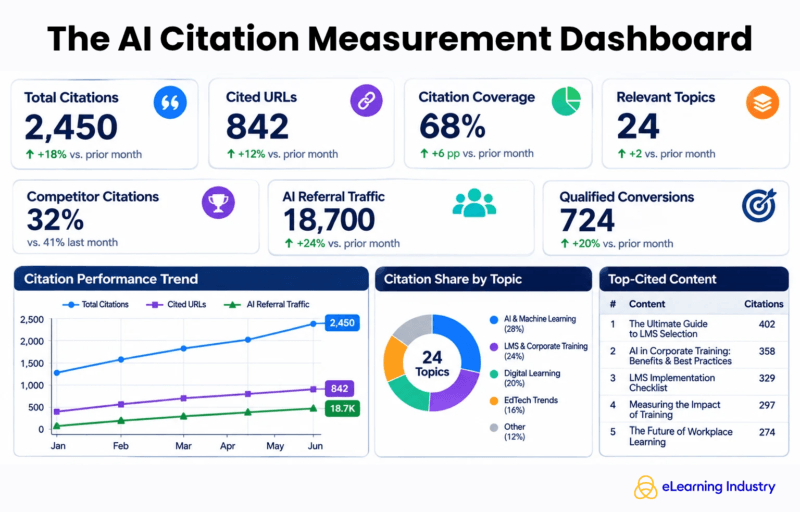
Total AI citations measures the number of observed references to your content. Cited pages identifies which URLs are appearing, while citation frequency shows how often individual resources are referenced within your selected test set.
Citation coverage measures the percentage of tested questions that produce a citation to your website.
For example, imagine testing 100 predefined questions across selected AI search experiences. If your website appears as a cited source in 18 of those responses, your observed citation coverage is 18%.
This is an internal measurement based on your test set, not a universal AI visibility score.
You should also track topic relevance and competitive citation presence. These reveal whether citations occur for subjects that matter to your customers and how often relevant competitors appear in the same tested responses.
Finally, review AI referral traffic and qualified conversions where attribution is possible. These measures connect source visibility with website discovery and potential business outcomes.
Platform reporting is also developing. Bing Webmaster Tools provides an AI Performance report showing citation activity, cited pages, and grounding query information across supported Microsoft AI experiences.
Google Search Console also includes a Generative AI performance report, with impression data for eligible pages appearing in Google AI search features. These impressions should not be treated as equivalent to Bing's citation counts.
Reporting capabilities vary, so no single platform provides a complete picture of all AI citations.
Repeat your tests and record the platform, date, market, prompt wording, and relevant testing conditions. AI-generated responses can change, making trends more useful than isolated results.
Most importantly, interpret the numbers in context. Ten citations in answers relevant to your ideal buyers may provide more useful visibility than many citations associated with unrelated topics.
Common Mistakes That Prevent B2B Content From Becoming Citation-Worthy
One of the biggest mistakes businesses make is assuming that increasing content production will automatically increase AI citations.
Publishing hundreds of generic articles may create more pages, but it does not necessarily contribute new knowledge or credible evidence.
Other common mistakes include:
- Repeating statistics without checking their original sources or publication dates.
- Making unsupported claims about product capabilities, customer results, or industry trends.
- Creating large numbers of near-identical pages targeting minor keyword variations.
- Treating schema markup or special AI-focused files as guaranteed citation mechanisms.
- Buying artificial brand mentions, manipulating reviews, or pursuing irrelevant links.
- Publishing research without explaining its methodology or limitations.
- Ignoring crawlability, indexing, or other technical accessibility issues.
- Confusing brand mentions and recommendations with actual source citations.
Measurement can create problems too. A company may celebrate increasing citation counts without checking whether the cited content relates to the questions its prospective customers ask.
Instead, focus on developing a smaller collection of reliable, distinctive resources that answer important questions and support their claims.
More AI citations are not automatically better. The goal is to earn credible references in answers relevant to your audience, industry, and expertise.
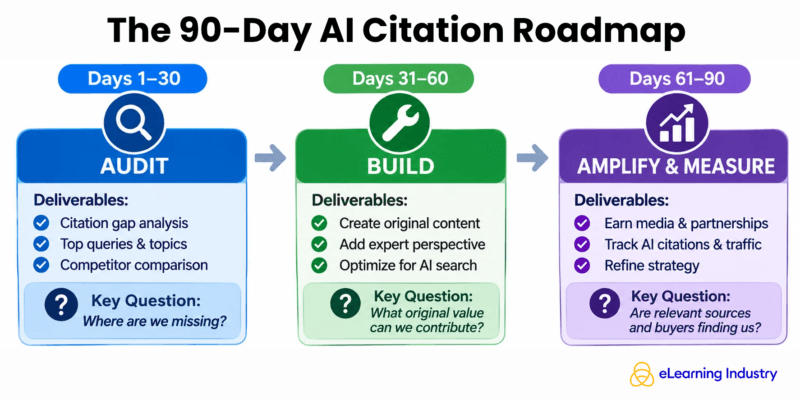
How to Build a 90-Day AI Citation Strategy
Improving your content's citation potential does not require changing everything at once.
A 90-day plan provides a manageable way to assess your current position, prioritize improvements, and establish a repeatable process.
Days 1–30: Audit and Prioritize
Start by identifying the questions your ideal customers ask and reviewing whether your content appears as a source in relevant AI-generated answers.
Test a representative set of questions, record the cited pages, and examine which competitors appear.
At the same time, review your existing content library. Identify pages containing original information, useful examples, research, or practical explanations that could be improved.
Check technical accessibility and prioritize the opportunities where the information gap is clear.
By the end of this stage, you should have a baseline, a list of promising content assets, and a small number of priorities.
Days 31–60: Create and Improve
Use the audit findings to strengthen content that already addresses relevant questions.
Improve explanations, add verifiable evidence, involve subject-matter experts, and correct outdated information.
Where your content library lacks distinctive material, develop one substantial new asset. This might be an original research report, benchmark study, detailed case study, or practical framework.
Also improve internal linking so related resources are easy to discover and navigate.
The objective is to improve the usefulness of your information rather than simply increase the number of published pages.
Days 61–90: Distribute and Measure
Once the improved content is available, introduce it to relevant industry audiences.
Share research findings, contribute expert commentary, and pursue appropriate editorial coverage or podcast discussions.
Repeat the original AI citation tests under comparable conditions and record any changes in citation coverage, cited pages, and competitive presence.
Review these findings alongside referral traffic and qualified business activity where available.
Ninety days provides a practical implementation period, not a guarantee that citations will increase within that timeframe.
The result should be a repeatable process for identifying gaps, creating useful information, and monitoring whether that information is being discovered.
Build Authority Where Buyers Are Looking
Your next buyer may encounter your industry insights through AI-powered search before visiting your website.
eLearning Industry helps LMS, Learning Tech, and HR Tech companies build relevant industry visibility through expert-led content, original research, thought leadership, and targeted marketing opportunities.
Conclusion
Getting cited by AI is becoming another important part of digital discoverability, but it does not replace the fundamentals of useful, credible publishing.
Original research, practical experience, clear explanations, supporting evidence, and technical accessibility all contribute to the quality of information a business makes available.
The strongest approach is not to publish more content simply because AI search is growing. It is to identify what your audience needs to know and provide information that adds something meaningful to the conversation.
You cannot force AI systems to cite your brand. But you can make your expertise easier to find, your claims easier to verify, and your content more valuable to reference.
That is where citation-worthy authority begins.
To increase your chances of getting cited by AI, focus on publishing original, useful, and verifiable information that directly answers relevant questions. This can include research reports, proprietary data, expert analysis, case studies, and practical guides. Make sure your content is technically accessible, clearly structured, and supported by credible evidence. Relevant industry coverage can also help expand your brand's visibility. However, no strategy can guarantee AI citations because source selection depends on the platform, the question, and the information available to the system.
Start by ensuring your website provides relevant, accessible, and reliable information. Review your technical SEO, make important pages easy to discover, and check that your website allows OpenAI's OAI-SearchBot to access content intended for ChatGPT Search. Then focus on creating resources that offer original research, first-hand expertise, clear explanations, and supporting evidence. ChatGPT may retrieve different sources depending on the question and search context, so making your content available does not guarantee a citation. Regularly test relevant questions to understand where your website appears.
To improve your chances of being cited in Google AI Overviews, follow foundational SEO practices and create helpful, reliable content that answers specific search questions. Your pages must be indexed, eligible to appear in Google Search with a snippet, and included in Google's generative AI search features. Clear headings, accessible content, original insights, and verifiable information can make your pages more useful to readers. However, Google does not offer a guaranteed method for earning AI Overview citations, and special GEO markup or formatting techniques are not required.
E-E-A-T stands for Experience, Expertise, Authoritativeness, and Trustworthiness. It is a framework Google uses to assess content quality, but it is not a standalone numerical ranking factor or a direct AI citation score. Demonstrating first-hand experience, identifying qualified authors, providing original research, and supporting claims with evidence can make your content more credible and useful. These practices align with the qualities of reliable information, although following E-E-A-T principles does not automatically result in citations from Google AI Overviews, ChatGPT, or other AI platforms.
Relevant backlinks and brand mentions can support broader online discoverability, credibility, and industry recognition. Editorial links help readers and search engines discover useful resources, while mentions in trusted publications can provide additional context about a company's expertise. However, there is no established rule that earning more backlinks or brand mentions directly increases AI citations across platforms. The strongest approach is to earn relevant references through original research, expert contributions, and useful information rather than pursuing mentions solely to influence AI-generated answers.
You can track AI citations by combining platform reporting, third-party AI visibility monitoring tools, and structured prompt testing. Bing Webmaster Tools provides an AI Performance report showing citation activity, cited pages, and grounding queries across supported Microsoft AI experiences. Google Search Console's Generative AI performance report provides impression data for AI Overviews and AI Mode, although these impressions are not the same as citation counts. For platforms such as ChatGPT and Perplexity, use relevant buyer questions to monitor which sources appear, recording citations, competitors, and changes over time. Third-party tools can automate parts of this process, but no single tool provides a complete record of every AI-generated response.
