

Why Do Most Email Pitches Fail?
Most email pitch examples focus on what you should write, but the bigger question is whether your recipient has a reason to keep reading. According to Muck Rack's 2026 State of Journalism report, 43% of journalists say they rarely receive pitches that are relevant to their coverage. Relevance clearly plays a major role in whether your outreach gets attention.
So, why do most pitch emails fail before the recipient reaches the second paragraph? The problem usually isn't grammar, but relevance. Journalists receive pitches that have nothing to do with their beat. Podcast hosts receive requests from guests who haven't listened to the show. Partnership teams receive emails explaining what the sender wants without explaining what's in it for them.
Strong outreach reverses that logic. Before you start thinking about how to write a pitch email, you need to understand who you're contacting, what they care about, and why your idea fits their goals. Your opening should make that connection clear instead of forcing the recipient to search for it.
A good pitch quickly establishes five things, including why you, why this idea, why them, why now, and what's in it for the recipient. Whether you're sending a PR pitch, exploring a collaboration, or using a B2B partnership email template, the same principle applies. Your email should give the recipient enough context to understand the opportunity. Even your brand strategy can influence how you approach outreach, especially when you're trying to build long-term relationships rather than secure a one-off mention.
In this guide, you'll find 15 email pitch examples covering PR, partnerships, podcasts, content collaborations, thought leadership, events, and other B2B outreach scenarios. You'll also learn how to personalize each pitch, strengthen your value proposition, and turn a simple outreach email into the start of a professional relationship.
Key Takeaways
- Strong pitches focus on the recipient's audience or objectives before the sender's.
- Personalization should demonstrate relevance, not simply insert someone's first name.
- Pitch emails should usually communicate one clear idea and one clear next step.
- PR, partnership, podcast, and contributor pitches require different value propositions.
- Proof strengthens a pitch, but long company introductions weaken it.
- Templates should provide structure and not identical copy sent to hundreds of people.
- Follow-ups can improve outreach performance when they add value rather than simply repeat the original request.
In This Guide, You Will Find...
- What Makes A Good Email Pitch?
- How To Structure A Pitch Email
- 15 Email Pitch Examples For B2B Outreach
- Email Pitch Subject Lines That Get The Point Across
- Personalization: What It Actually Means
- How AI Can Help You Write Pitch Emails Without Making Them Worse
- How And When To Follow Up
- Common Email Pitch Mistakes
- How To Measure B2B Pitch Outreach
What Makes A Good Email Pitch?
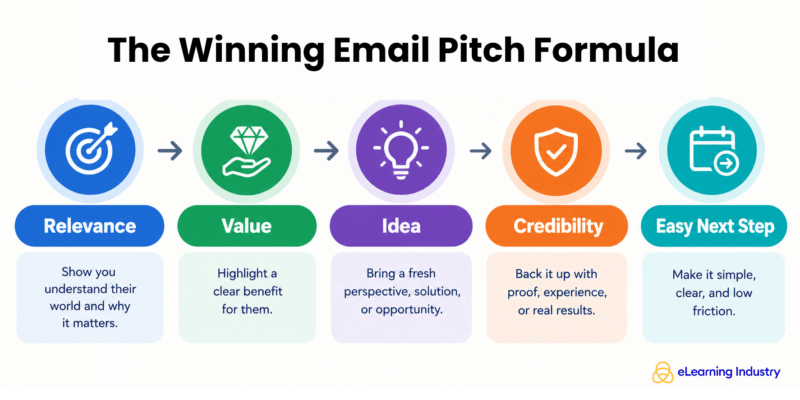
A good email pitch gives the recipient enough information to understand the opportunity without making them work to find the point. Before you send your message, check whether it answers six practical questions.
-
Relevance
Why are you contacting this specific person? Show that you understand their role, audience, content, or business priorities. If you're learning how to pitch a journalist by email, for example, make sure your idea connects directly to their beat.
-
Value
What does the recipient gain? Your pitch should explain the benefit for their audience, business, publication, podcast, or network. A strong PR pitch email, for example, can offer an expert perspective or useful data rather than simply asking for coverage.
-
Specificity
What exactly are you proposing? Don't make the recipient guess whether you want an interview, partnership, guest appearance, content exchange, or introduction.
-
Credibility
Why are you or your company qualified? Add relevant experience, results, research, or expertise without turning your pitch into a company biography.
-
Timing
Why does the idea matter now? Connect your proposal to a current trend, upcoming event, new research, product launch, or timely business need.
-
Low-Friction CTA
What's the easiest logical next step? Keep your call to action simple and give the recipient an easy way to respond.
Ultimately, this formula creates a pitch that supports relationship building while fitting naturally into your brand strategy for growth.
How To Structure A Pitch Email
Before you look at specific pitch email examples, it helps to have a simple structure you can adapt to almost any outreach situation. Whether you're contacting a journalist, podcast host, potential partner, or industry expert, the goal remains the same: give the recipient a clear reason to keep reading.
-
Subject Line
Make it specific enough for the recipient to understand the opportunity immediately. Avoid vague subjects like “Quick question” and focus on the topic, person, or opportunity you're offering.
-
Opening
Start by establishing relevance. Show that you understand the recipient's work, audience, recent content, or priorities. If you're wondering how to pitch someone via email, personalization should start here.
-
Pitch
State your idea quickly. Explain what you're proposing without adding unnecessary background information. Keep the focus on the opportunity rather than your company.
-
Recipient Value
Explain why the idea matters to them or their audience. For example, a collaboration could give their audience useful expertise, original research, or a fresh perspective.
-
Credibility
Add one or two relevant proof points. Mention a client, result, publication, expertise, or previous project that supports your pitch. In media outreach, this can help establish why you're qualified to contribute.
-
CTA
End with one simple request. Ask whether they're interested, available for a short call, or open to discussing the idea.
The ideal principle is simple: Write enough to create interest, not enough to answer every possible question. Some pitches need more context than others, so don't force every email into the same length or format.
15 Email Pitch Examples For B2B Outreach
Example 1: PR / Media Story Pitch
Best for: Newsworthy media stories.
Subject: New research reveals only 23% of HR teams are prepared for [trend]
Template:
Hi [Name],
Our research found that only 23% of HR teams are prepared for [trend], based on [number] responses.
We can share the findings and make [expert] available for comment. Relevant to your coverage?
Why it works: Lead with the finding, not your company. Strong media pitch examples make the angle clear.
Example 2: Original Research Pitch
Best for: Proprietary research.
Subject: New data: What 500 L&D leaders say about AI adoption
Template:
Hi [Name],
We surveyed 500 L&D leaders about AI adoption and found [strongest finding].
The study also found [second finding]. I can send the report or connect you with [expert].
Why it works: Original data gives the recipient something concrete to reference.
Example 3: Expert Commentary Pitch
Best for: Expert commentary.
Subject: Expert source: Why AI adoption is stalling
Template:
Hi [Name],
I noticed you're covering [topic]. [Name], our CEO, has led [X] enterprise AI implementations and can explain why adoption is stalling.
They can comment on [topic 1] and [topic 2]. Would an interview be useful?
Why it works: Explain what the expert can discuss, not simply that they're available.
Example 4: Guest Article / Contributor Pitch
Best for: Industry publications.
Subject: Article idea: [Proposed title]
Template:
Hi [Editor Name],
I'd like to propose “[Proposed title]” for [Publication], addressing [reader problem] with [three takeaways].
The author, [Name], has [relevant expertise]. Would this fit your editorial calendar?
Why it works: A strong thought leadership pitch email gives the topic, audience value, and credentials upfront. Positioning the idea as B2B thought leadership can help clarify its relevance to an industry publication without making the pitch overly promotional.
Example 5: Podcast Guest Pitch
Best for: Podcast appearances.
Subject: Podcast idea: Why scaling breaks before revenue does
Template:
Hi [Host Name],
I've been following [Podcast Name], especially your episode on [topic].
I'd like to suggest [Guest Name] for a conversation about why companies encounter operational problems before revenue. They could discuss [topic 1], [topic 2], and solutions.
Would this interest your audience?
Why it works: Podcast hosts book conversations, not job titles. If you're considering why be a podcast guest, focus on audience value.
My podcast, Scaling Leadership, is now live and I would love to hear from leaders in the industry who would like to have a conversation either on my show or yours.
Example 6: Podcast Guest Invitation
Best for: Podcast invitations.
Subject: Invitation: [Podcast Name] — [Topic]
Template:
Hi [Name],
Your work on [topic] would make an interesting conversation for our audience.
We'd like to invite you to [Podcast Name] for a [30/45]-minute discussion about [topic]. We'll handle recording and promotion.
Would you be interested?
Why it works: When considering how to pitch a podcast guest, explain why you chose them, the topic, and what they can expect.
Example 7: Strategic Partnership Pitch
Best for: Complementary companies.
Subject: Partnership idea: [Company A] + [Company B]
Template:
Hi [Name],
We serve [audience X], while your team serves [audience Y]. There's an overlap around [shared need].
We could combine our [capability] with your [capability] to create [opportunity].
Open to exploring it?
Why it works: Effective partnership pitch email examples explain the shared opportunity first. A business pitch email should show value for both sides.
Example 8: Co-Marketing Collaboration Pitch
Best for: Joint marketing projects.
Subject: Co-marketing idea: [Report/Webinar/Guide]
Template:
Hi [Name],
Our audiences overlap around [topic], so we could create something useful together.
We're proposing a [report/webinar/guide]. Your team contributes [expertise], while we handle [production/distribution].
Interested?
Why it works: Be specific about the project and each side's contribution.
Example 9: Webinar Collaboration Pitch
Best for: Webinar co-hosts.
Subject: Webinar idea: [Topic] for [Audience]
Template:
Hi [Name],
We're planning a webinar for [audience] about [topic], and your experience with [area] would add a valuable perspective.
You'd cover [role]; we'll manage [promotion/registration/production]. Interested?
Why it works: Lead with the audience and conversation, not the need for a speaker. If you're interested in hosting a webinar, visit our website to discover how we can increase your visibility.
Example 10: Research Collaboration Pitch
Best for: Co-created research.
Subject: Research collaboration: [Topic]
Template:
Hi [Name],
We're exploring a study around [research question] and think [Company] could be a strong partner.
We'd contribute [research/distribution], while your team provides [data/expertise]. We could produce a benchmark report for [audience].
Open to discussing it?
Why it works: A research project can create original content and useful findings for both organizations.
Example 11: Industry Expert Collaboration Pitch
Best for: B2B industry experts.
Subject: Collaboration idea: [Specific concept]
Template:
Hi [Name],
I've been following your work on [topic], particularly [example].
We're creating [report/webinar/podcast] about [topic] and would like your perspective. We'd handle [production/distribution].
Interested?
Why it works: Generic requests are easy to ignore. Industry leaders receive many collaboration opportunities that can build professional and business relationships but are framed the wrong way.
Example 12: Event / Conference Speaker Pitch
Best for: Speaking opportunities.
Subject: Session proposal: [Specific topic]
Template:
Hi [Organizer Name],
I'd like to propose “[Session Title]” for [Event], helping [audience] understand [problem] and leave with [three takeaways].
[Speaker Name] has [relevant expertise] in [area]. Would this fit your program?
Why it works: Pitch the session, not the résumé. Show what attendees will learn.
Example 13: Cross-Promotion Pitch
Best for: Complementary audiences.
Subject: Cross-promotion idea for [Audience]
Template:
Hi [Name],
Our audiences both care about [topic], but we approach it differently.
Could we exchange [action] for [reciprocal action]? Both audiences would gain relevant resources.
Open to discussing it?
Why it works: Make the audience benefit explicit.
Example 14: Warm Introduction / Referral Pitch
Best for: Warm introductions.
Subject: Introduction via [Mutual Connection]
Template:
Hi [Name],
[Mutual Connection] suggested I reach out because we're both working on [topic].
We're exploring [opportunity], and I see a connection between [Company A] and [Company B].
Open to a short conversation?
Why it works: Use the connection naturally. Good personalization explains the mutual relevance.
Example 15: Follow-Up Pitch Email
Best for: Follow-ups with new information.
Subject: Re: [Original subject] — one additional finding
Template:
Hi [Name],
I wanted to follow up with one detail that may make the idea more relevant.
Since my original email, we've found [new statistic/development/expert perspective] about [topic].
I can send the update or connect you with [expert].
Why it works: Follow up with value, not pressure. A new finding or expert gives the recipient a reason to reconsider a cold pitch email or media outreach email template.
Email Pitch Subject Lines That Get The Point Across
Your subject line should tell the recipient what the email is about without making them work to understand it. Across these email pitch examples, the strongest subject lines stay specific, relevant, and easy to scan.
-
PR
New data: 67% of [audience] now [finding]
-
Research
Research for [Publication]: [interesting finding]
-
Thought Leadership
Article pitch: Why [contrarian idea]
-
Podcast
Podcast idea: What [audience] gets wrong about [topic]
-
Partnership
Partnership idea: [Brand A] × [Brand B]
-
Webinar
Webinar idea for [audience]: [topic]
-
Collaboration
Idea for a joint [research/report/event] on [topic]
Avoid clickbait or vague promises. When you review outreach email examples, notice how the subject line often gives you enough context to decide whether the message deserves your attention. If you're learning how to write a pitch email, focus on relevance rather than cleverness. The goal isn't simply an open. It's an open from someone who immediately understands why your email may be relevant to them.
Personalization: What It Actually Means
AI has made fake personalization incredibly easy. You can now add a recipient's name, mention a recent article, and send the same generic pitch to hundreds of people. That may look tailored, but it rarely feels relevant.
Bad personalization sounds like: “Hi Sarah, I loved your recent article!” followed by a generic pitch. A stronger approach connects your idea to something the recipient actually cares about: “Your recent analysis of AI adoption focused heavily on implementation costs. Our new dataset suggests governance is now the biggest barrier among enterprise L&D teams.”
Basically, personalization should change the substance of your pitch, not just the greeting. When reviewing email pitch examples, research the recipient's role, beat, recent work, audience, company, existing partnerships or content, and current interests. These details help you understand how your idea fits their priorities.
Tools such as Clay can help you research prospects and build more relevant outreach at scale, but automation should support your research rather than replace it. Whether you're learning how to pitch someone via email or planning a brand awareness campaign, ask yourself: Could I send this exact opening to 200 other people? If yes, improve it.
How AI Can Help You Write Pitch Emails Without Making Them Worse
AI can make your outreach faster, but you still need to understand the person you're contacting. Used well, it can help you organize information, explore angles, and improve a draft. Used carelessly, it can make every message sound identical. Whether you're creating a B2B outreach email or reviewing pitch email examples, use AI as a writing assistant rather than a replacement for research.
AI can help with:
- Research synthesis: Turn notes and sources into useful talking points.
- Subject-line variants: Generate several options you can refine.
- Shortening copy: Remove repetition and unnecessary details.
- Tone adjustments: Make a draft more conversational or professional.
- Relevant angles: Identify connections between your idea and the recipient's interests.
- Proof points: Organize statistics, examples, and supporting evidence.
- First drafts: Create a starting point for your own writing.
However, don't let AI:
- Invent familiarity or fabricate compliments.
- Make up recipient interests or statistics.
- Send identical “personalized” pitches.
- Overwrite your human voice.
- Automate relationships blindly, whether for thought leadership marketing or journalist outreach.
How And When To Follow Up
A good follow-up respects their time while keeping the opportunity open. Think of it as a nudge, not a sales sequence.
- Give them reasonable time. Wait before checking in.
- Keep it relevant. If the opportunity has passed, another message may not add value.
- Keep it shorter. A follow-up email should take less time to read than the pitch.
- Add something useful. Share a new detail, data point, quote, deadline, or update instead of asking whether they saw your email.
- Make opting out easy. “If this isn’t relevant, no worries” gives them room to decline.
- Know when to stop. Public relations examples and business email pitch examples work when persistence stays respectful.
Common Email Pitch Mistakes
1. Sending Generic Mass Emails
If your pitch could go to 100 companies unchanged, it probably needs more research and personalization.
2. Writing A Long Company Introduction
Skip the company history. Explain the relevant context in a sentence or two, then move to the recipient.
3. Leading With What You Want
Don't open with a request for coverage, a meeting, or a collaboration. Start with the value you can offer.
4. Offering No Clear Value
Your email pitch examples should show why the recipient's audience, readers, listeners, or business benefits.
5. Showing No Research
Mention something specific about their work, audience, recent content, or brand sentiment. Generic praise doesn't count.
6. Making Multiple Unrelated Requests
One email should have one clear purpose. Don't combine a guest post, backlink, partnership, and interview request.
7. Using Weak Subject Lines
Keep the subject specific and useful. Avoid vague phrases that give the recipient no reason to open.
8. Faking Personalization
Replacing someone's name isn't personalization. Reference something genuinely relevant to their work.
9. Sounding Overly Promotional
Write like a professional introduction, not an advertisement.
10. Sending Irrelevant Attachments
Don't add files unless they directly support the pitch and the recipient needs them.
11. Asking Journalists For Backlinks
Journalists need a relevant story or source, not a backlink request disguised as partnership outreach.
12. Ignoring The Podcast
Before using a partnership email template, listen to the show and understand its topics, format, and audience.
13. Calling Everything “Exciting”
Show why the idea matters instead of relying on empty adjectives.
14. Following Up Excessively
Send a reasonable follow-up, then give the recipient space.
15. Using Unreviewed AI Copy
AI can help draft an email, but you still need to check accuracy, tone, and personalization.
16. Complicating The CTA
Ask for one simple next step. If your email contains “We're excited to announce…” before you've explained why the recipient should care, rewrite it.
How To Measure B2B Pitch Outreach
Don't obsess over open rate. It can give you a rough signal, but it doesn't tell you whether your outreach creates meaningful conversations or business opportunities. Instead, measure your pitch performance from initial delivery through the outcomes that matter to your team.
-
Outreach: Track The Basics
Start with emails sent, delivery rate, and response rate. These numbers show whether your list, contact data, and initial messaging are reaching real people.
-
Quality: Measure Meaningful Engagement
Track positive response rate, qualified conversations, and acceptance rate. For editor outreach, for example, a reply only matters if it moves the conversation forward.
-
Outcomes: Track What Your Pitches Create
Measure media placements, accepted articles, podcast bookings, partnerships, webinars, and research collaborations. If your earned media strategy generates backlinks or brand mentions, record those too, along with referral traffic.
-
Business Impact: Connect Outreach To Growth
Look beyond individual placements. Track relationships developed, audience growth, leads generated, influenced pipeline, new partnerships, and changes in brand authority. For example, how to write a collaboration email becomes more useful when you can connect successful outreach to an actual partnership or qualified opportunity.
-
Review Performance By Pitch Type
Compare results across PR, podcasts, partnerships, guest articles, webinars, and research outreach. This helps you identify which approaches create the strongest conversations and outcomes for your business.
Key Takeaway
A strong B2B pitch gives the recipient a clear reason to care. Whether you're reaching out to a journalist, podcast host, potential partner, editor, or industry expert, start with their audience, priorities, and interests. Then, explain your idea clearly, show why you're qualified, and make the next step easy.
The best email pitch examples also share another quality: they feel relevant rather than mass-produced. Personalization should change the substance of your message, while proof points should support your credibility without turning the pitch into a company biography. At the same time, keep each email focused on one idea and one clear action.
You should also measure more than opens and replies. Track qualified conversations, placements, accepted articles, podcast bookings, partnerships, research collaborations, referral traffic, and the relationships you build over time. A well-written media outreach email template or one of your article pitch examples only creates value when it leads to a meaningful opportunity.
Ultimately, effective outreach supports long-term media relations, partnerships, thought leadership, and business growth. Treat every pitch as the beginning of a professional relationship rather than a one-time request, and you'll have a stronger foundation for consistent B2B visibility.
eLearning Industry helps Learning Tech, HR Tech, EdTech, AI, and workplace-learning companies turn expertise into visibility through thought leadership, research collaborations, webinars, podcasts, customer stories, and targeted content campaigns. For executives and brands looking to share meaningful expertise with L&D, HR, and business decision-makers, opportunities such as podcast conversations, webinars, contributed expertise, and original research can turn a single pitch into much broader authority.
FAQAn email pitch is a concise message designed to present an idea, product, service, collaboration, or opportunity to a specific recipient and encourage them to take a next step.
Keep it personalized and focused on the recipient. Clearly explain the value of your idea or offer, provide relevant evidence or context, and end with a simple call to action.
A pitch email should generally be brief, often around 100–200 words. Include only the information needed to explain the opportunity and make the recipient interested in learning more.
The subject line should be specific, relevant, and easy to understand. It can highlight the proposed opportunity or benefit without using exaggerated or misleading language.
Explain why you are contacting the company, what you are proposing, and how the partnership could benefit both sides. Include a clear next step, such as a short call or meeting to discuss the idea.
A common approach is to send 2–3 follow-ups if you haven't received a response, spacing them several days apart. If there is still no reply, it's usually best to stop following up and move on.