

Build A MarTech Stack: Digital Arsenal For Future Growth
It is a fact that MarTech stacks have evolved rapidly over the past decade. What was once a manageable set of tools has turned into a complex ecosystem spanning CRM systems, automation platforms, analytics tools, content engines, and now AI-driven solutions. For many organizations, especially in B2B and SaaS, the stack has become both a competitive advantage and a source of friction.
The truth is that the core issue is not the availability of technology. It is rather how that technology is adopted and managed.
In the current market state, many companies build their marketing technology stack reactively. For instance, a new campaign requires a tool, so one gets added or a reporting gap appears, so another platform is introduced. In sales, they ask for better visibility, and a new integration is layered on top. Over time, the stack grows without a clear structure or guiding strategy.
Eventually, this method creates a set of familiar problems:
- Disconnected systems that do not communicate
- Fragmented and unreliable data
- Misalignment between marketing and sales
- Rising costs without proportional returns
In reality, the consequence is not just inefficiency. It is business growth that your company misses out on.
In business, a poorly designed MarTech stack slows down execution, limits visibility, and makes it harder to generate and convert demand effectively. In contrast, a well-structured stack becomes a growth engine. Overall, it supports faster decision-making, better targeting, and more efficient pipeline development.
In this article, we focus on how to build that kind of system: not a collection of tools, but a strategic infrastructure designed for scalability, alignment, and long-term demand generation.
Key Takeaways
- A MarTech stack should be built around business outcomes, not tools.
- Integration and data flow are critical for performance.
- A strong stack supports demand generation, pipeline growth, and measurement.
- Companies that optimize their MarTech stack improve efficiency and scalability.
In This Article, We Explore…
- What A MarTech Stack Really Is (And What It Isn't)
- Why MarTech Stacks Fail
- The Core Layers Of A High-Performing MarTech Stack
- How To Build A MarTech Stack Step By Step
- The Role Of AI In Modern MarTech Stacks
- Common MarTech Stack Mistakes
- How MarTech Stacks Support Demand Generation And Pipeline Growth
- MarTech Stack Examples By Vendor Type
- Why External Platforms Are Part Of The Modern MarTech Stack
What A MarTech Stack Really Is (And What It Isn't)
There is a common misunderstanding about a MarTech stack, which is often seen as a list of tools used by the marketing team. While tools are part of it, that definition misses the point by a long shot.
At its core, a MarTech stack is a system. To be precise, it is a coordinated set of technologies that work together to support marketing, sales, and revenue growth. Therefore, the emphasis is not on individual tools, but on how those tools connect, share data, and enable processes across the organization.
In business, a well-built marketing technology stack supports the entire customer lifecycle, including:
- Capturing demand
- Nurturing leads
- Enabling sales interactions
- Measuring performance and outcomes
It is also worth mentioning that what a MarTech stack is not is just as important. A MarTech stack is not a collection of disconnected platforms purchased over time without a clear plan. We witness many organizations fall into the trap of adding tools whenever a new need arises, without considering how those tools fit into the broader system. Eventually, this leads to fragmentation and inefficiency.
Moreover, it is also not a strategy where more tools equal better results. In fact, the opposite is often true, as too many tools can create confusion, duplicate functionality, and reduce adoption.
The real value of a MarTech stack comes from orchestration. When tools are integrated properly, data flows seamlessly across systems. Marketing can see how campaigns impact pipeline. Sales can access context about leads. Leadership can measure performance with confidence.
In this sense, your MarTech stack is not just technology. It is infrastructure. And like any infrastructure, its effectiveness depends on design, integration, and alignment with the goals it is meant to support.
Why MarTech Stacks Fail
More and more every year, we see companies investing a significant amount of resources in marketing technology. However, despite significant investment in marketing technology, many organizations fail to realize the full value of their MarTech stack. Here, the reasons are rarely technical; they are structural.
One of the most common issues is tool overload. To be precise, organizations accumulate platforms over time, often driven by immediate needs rather than long-term planning. In essence, different teams adopt their own tools, leading to overlapping functionality and unnecessary complexity.
Another major issue is lack of integration. In practice, when systems do not communicate properly, data becomes siloed. As a result, marketing platforms may track engagement, but that data never reaches the CRM, and sales teams operate without visibility into campaign history.
Here is a list of several root causes that tend to show up repeatedly:
- No clear ownership of the stack
- Inconsistent or poor-quality data
- Tools selected without strategic alignment
- Limited visibility into performance
No clear ownership is a critical gap. Without clear responsibility, tools are underutilized or misconfigured. For instance, marketing operations, demand generation, and revenue teams may all interact with the stack, but without defined roles, accountability becomes blurred.
Data quality is equally important, since duplicate records, missing fields, and inconsistent tracking lead to flawed insights and wasted spend.
Finally, many stacks fail because they are not aligned with business goals. If the system is not built around pipeline growth, revenue targets, and customer expansion, it will not deliver meaningful results.
The Core Layers Of A High-Performing MarTech Stack
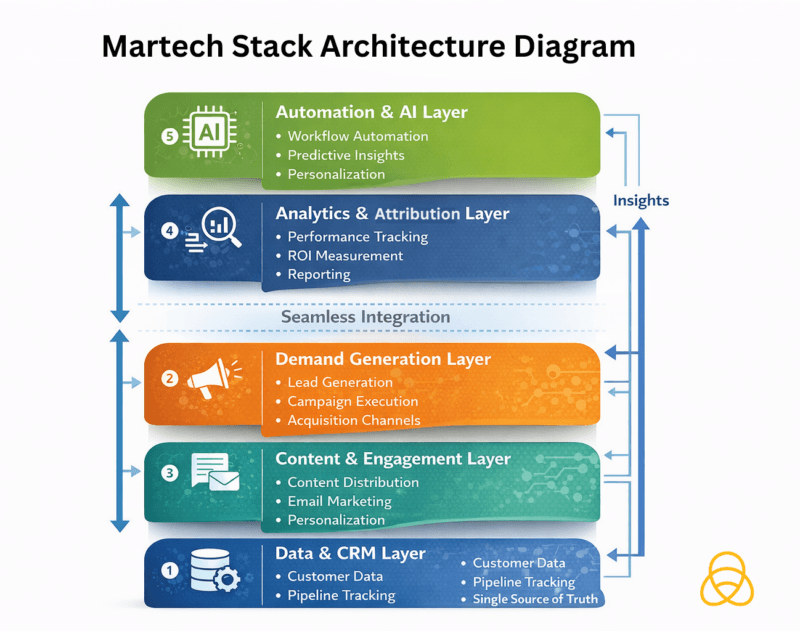
Now it is time to move to the critical layers of a high-performing MarTech stack. At its core, a high-performing MarTech stack is structured, not random. Mainly, it is built in layers, with each layer serving a specific function and contributing to the overall system.
In a nutshell, here is the list of core layers of a MarTech stack:
- Data and CRM layer
- Demand generation layer
- Content and engagement layer
- Analytics and attribution layer
- Automation and AI layer
Let us explore each layer below.
The foundation of the MarTech stack is the data and CRM layer. This is exactly where customer and prospect information is stored, managed, and updated. This first layer acts as the single source of truth. Every other component of the stack depends on the accuracy and accessibility of this data.
Above that first layer sits the demand generation layer, which is responsible for bringing new prospects into the system. This part includes acquisition channels and campaign execution platforms. To showcase its importance, we should note that without this layer, there is no growth input into the system.
The content and engagement layer comes next. This is the place where leads are nurtured and guided through the buying journey. Here, email marketing, content platforms, and personalization tools all contribute to building relationships and driving conversion.
Next is the analytics and attribution layer, which provides visibility. It connects activities to outcomes and allows teams to measure performance. Without it, optimization becomes guesswork rather than a data-driven process.
Finally, the automation and AI layer enables scale. This layer reduces manual work and improves precision across the stack.
Across all layers, one principle matters most: data must flow seamlessly between systems.
Consequently, when these layers are properly integrated, the stack functions as a cohesive system rather than a set of isolated tools.
How To Build A MarTech Stack Step By Step
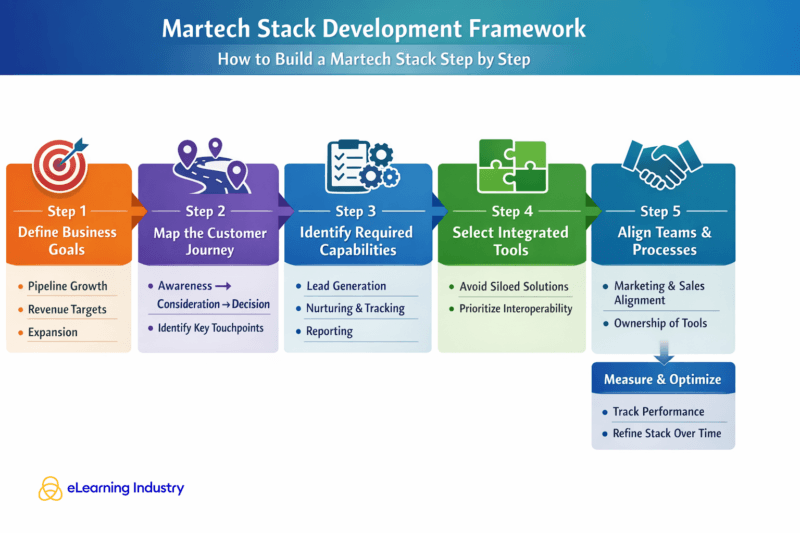
Now it is vital to see how to build a MarTech stack step by step. Building a MarTech stack requires a structured approach. That said, starting with tools is a common mistake. Instead, the process should begin with a strategy.
In building a MarTech stack, the first step is defining business goals, which anchor every decision that follows. Whether the focus is pipeline growth, revenue expansion, or market penetration, the stack must support those outcomes directly.
The next step is mapping the customer journey. In this step, understanding how prospects move through awareness, consideration, and decision stages reveals where technology needs to support engagement.
Once the journey is clear, organizations should identify the capabilities required to support it. These typically include:
- Lead generation
- Lead nurturing
- Campaign execution
- Tracking and reporting
After this section, you will understand why companies should choose which tools to use only after defining capabilities. At this important stage, integration becomes the key criterion. For the stack to work, tools must be able to communicate and share data effectively. On the other hand, platforms that operate in isolation create friction and limit visibility.
In business, aligning teams and processes is equally important. Marketing and sales must work together, and responsibilities for managing each part of the stack should be clearly defined.
Finally, the stack must be continuously optimized. Performance should be tracked, gaps identified, and improvements made over time.
In simple terms, the process follows a clear progression:
- Define goals
- Map the journey
- Identify capabilities
- Select tools
- Optimize continuously
The Role Of AI In Modern MarTech Stacks
AI adoption is a common theme in all areas of business. At the same time, Artificial Intelligence is becoming a crucial part of modern marketing technology. As a result, what was once seen as an advanced feature is now becoming standard.
AI, by definition, improves many aspects of the stack, but its main value lies in its ability to enhance decision-making and operational processes.
For example, using AI allows for more advanced personalization. These days, marketers have moved beyond static segmentation. They're crafting messages that respond to what's happening right now, in real-time, based on how people are behaving and interacting. The result? More meaningful interactions and, ideally, a boost in conversion rates.
AI is also a game-changer when it comes to forecasting. By digging into past data, AI can pinpoint which leads are most likely to convert and which campaigns are poised for success. This gives teams a clearer picture, allowing them to focus their efforts where they'll have the biggest impact.
In practical terms, AI is most often applied to:
- Personalization and segmentation
- Predictive analytics and lead scoring
- Workflow automation
- Content generation support
Automation is a major area where AI is making its mark. AI-driven systems can adjust to user behavior, moving beyond fixed workflows and making marketing more agile.
The real change is that AI is no longer just an add-on. It's becoming integrated throughout the entire process, from data analysis to how campaigns are actually run.
Ultimately, organizations that use AI thoughtfully gain an edge in terms of speed, accuracy, and scalability.
Common MarTech Stack Mistakes
Even well-funded teams make consistent mistakes when building and managing their MarTech stack, and these mistakes often reduce effectiveness without being immediately obvious.
One of the most common issues is overcomplication. Specifically, as new needs arise, teams add more tools without removing or consolidating existing ones. Over time, this creates unnecessary complexity that slows down execution.
Tool redundancy is another frequent problem in the market. Different platforms end up serving similar functions, leading to wasted budget and confusion about which system to use.
Another issue is the lack of integration. This one continues to be a major barrier. In short, without integration, tools do not communicate properly, workflows become fragmented, and data must be handled manually.
In a nutshell, a few recurring pitfalls include:
- Overlapping tools with similar functionality
- Limited integration between systems
- Poor data hygiene practices
- No clear long-term strategy
Data tells the truth. That is why it is vital to analyze quality data to reach success. Therefore, ignoring data quality is particularly costly. Even the best tools cannot compensate for inaccurate or incomplete data.
To wrap this up, perhaps the most significant mistake is the absence of a clear strategy. Without defined goals, the stack becomes reactive, meaning companies add tools based on short-term needs rather than long-term impact.
In short, avoiding these mistakes requires discipline and a focus on simplicity, integration, and alignment.
How MarTech Stacks Support Demand Generation And Pipeline Growth
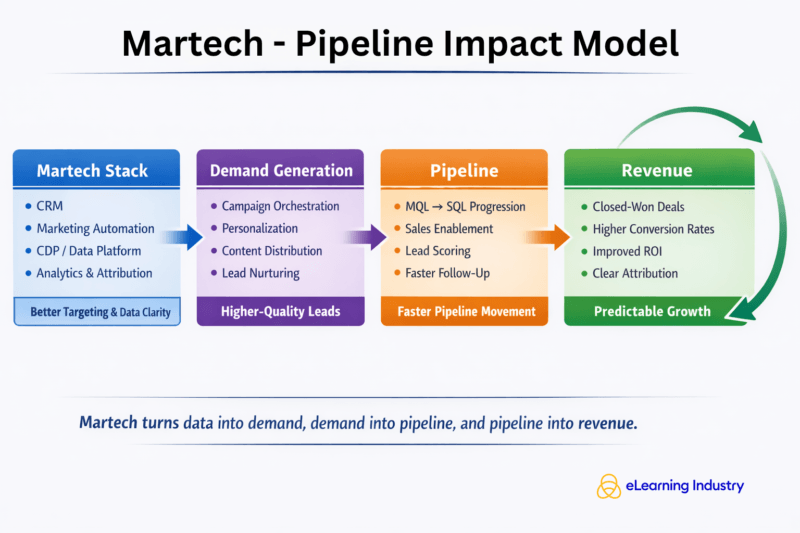
A well-designed MarTech stack plays a direct role in driving demand generation and accelerating pipeline growth by connecting marketing efforts to measurable business outcomes.
One of the biggest advantages is improved marketing targeting. That is because with integrated data, marketers gain a clearer understanding of their audience, allowing for more precise segmentation and messaging.
Lead quality also improves with a well-structured MarTech. In short, stronger data and better nurturing processes ensure that only qualified prospects move into the pipeline, increasing conversion rates.
The MarTech stack also helps accelerate pipeline movement. Here, automation ensures timely follow-ups, while engagement tools keep prospects active throughout the buying process.
Overall, this impact can be seen in a few key areas:
- More accurate targeting and segmentation
- Higher-quality leads entering the funnel
- Faster movement from lead to opportunity
- Clearer attribution across channels
Another critical benefit in this section is visibility. A strong stack tracks the full customer journey, allowing teams to understand which efforts drive results. This ties directly into a broader strategy:
- A strong stack supports full-funnel execution.
- Pipeline performance depends on your infrastructure.
- Benchmarking helps evaluate effectiveness.
Ultimately, the MarTech stack becomes a bridge between marketing activity and revenue outcomes.
MarTech Stack Examples By Vendor Type
It is important to mention some MarTech examples by vendor type. As per the definition, the structure of a MarTech stack varies depending on the company's stage and complexity. Different vendors require different levels of sophistication.
Consider, for example, a fledgling learning technology company. These businesses usually concentrate on visibility and kick-starting demand. Their operational setup is straightforward, often built around a CRM, basic automation, and content marketing. The main goal is to get noticed and start collecting initial leads.
Conversely, a mid-market HR tech vendor operates at a different stage. As demand generation efforts expand, the need for more precise targeting and measurement becomes apparent. So, companies at this level typically invest in more sophisticated automation, analytics, and account-based marketing tools. Here, integration becomes more important as multiple channels are used simultaneously.
At the enterprise level, learning platforms require a fully integrated stack. In this market, organizations manage large volumes of data and complex customer journeys. They rely on advanced analytics, sophisticated attribution models, and AI-driven insights to optimize performance.
Across all stages, one pattern stands out: high-performing vendors extend their capabilities beyond internal systems.
They typically combine their stack with external demand generation channels such as:
- Industry directories
- Content platforms
- Webinars and virtual events
- Targeted lead generation campaigns
This combination allows them to scale visibility and pipeline more effectively.
Why External Platforms Are Part Of The Modern MarTech Stack
Another common misconception to tackle here is that a MarTech stack consists only of internal tools. In reality, internal systems are only part of the equation.
To be fair, internal tools help manage processes by tracking data, automating workflows, and measuring performance. However, they do not generate demand on their own. External platforms fill this gap.
External tools provide access to existing audiences, allowing companies to reach potential buyers more efficiently. Instead of building an audience from scratch, organizations can tap into ecosystems where their target customers are already active.
All these external platforms typically offer:
- Built-in distribution
- Access to high-intent audiences
- Established credibility and trust
Eventually, this significantly improves visibility and engagement.
When integrated properly, external platforms become an extension of the MarTech stack. In short, internal systems handle execution and tracking, while external platforms drive awareness and lead generation.
The key idea is simple:
- Internal tools optimize
- External platforms amplify
Therefore, companies that combine both create a more complete and effective growth system.
Conclusion
A MarTech stack is not just a technical setup. It is a strategic asset that directly influences growth.
Organizations that treat it as a collection of tools often struggle with inefficiency and limited scalability. Those who approach it as a structured, integrated system gain a clear advantage.
The difference comes down to a few core principles:
- Align tools with business goals
- Prioritize integration over accumulation
- Maintain high data quality
- Combine internal systems with external demand generation
As technology evolves, the importance of the MarTech stack will only increase. AI, automation, and advanced analytics are reshaping how marketing operates. The companies that succeed will be those that build flexible, connected systems designed for long-term growth.
Building a MarTech stack is only part of the equation. Generating demand and reaching the right audience is what drives real results.
Companies that combine strong internal infrastructure with high-intent visibility accelerate pipeline growth and improve marketing ROI.
eLearning Industry helps LMS and HR tech vendors extend their MarTech stack with powerful demand generation solutions, including targeted campaigns, industry visibility, and content-driven lead generation.
FAQA MarTech stack is a system of integrated marketing technologies designed to support demand generation, customer engagement, and revenue growth. It connects tools across marketing, sales, and analytics to create a unified, data-driven approach to growth.
Building a MarTech stack starts with strategy, not tools. The process typically includes:
- Defining business goals
- Mapping the customer journey
- Identifying required capabilities
- Selecting integrated tools
- Continuously optimizing performance
The focus should always be on outcomes, not platforms.
A MarTech stack usually includes tools across several key areas:
- CRM and data management
- Demand generation and acquisition
- Content and engagement
- Analytics and attribution
- Automation and AI
The exact tools depend on company size, goals, and growth stage.
MarTech stacks often fail due to poor planning and lack of integration. Common reasons include:
- Too many disconnected tools
- Poor data quality
- Lack of ownership
- Misalignment with business goals
Without a clear strategy, even strong tools underperform.
The most important part of a MarTech stack is the data and CRM layer. It serves as the single source of truth and enables all other systems to function effectively. Without clean, centralized data, the rest of the stack loses value.
A well-built MarTech stack supports demand generation by enabling:
- Better audience targeting
- Consistent lead nurturing
- Multi-channel campaign execution
- Accurate performance tracking
This leads to higher-quality leads and stronger pipeline growth.
AI enhances a MarTech stack by improving personalization, automation, and predictive insights. It helps marketers:
- Identify high-intent leads
- Optimize campaigns
- Automate workflows
- Scale content and engagement
AI is increasingly becoming a core part of modern marketing infrastructure.
There is no ideal number of tools. The right stack includes only the tools needed to support your strategy. Fewer, well-integrated tools are often more effective than a large, disconnected set of platforms.
A marketing automation stack is a subset of a broader MarTech stack. While automation focuses on workflows, nurturing, and campaign execution, the full MarTech stack includes data management, analytics, demand generation, and other layers.
External platforms play a key role in generating demand and expanding reach. While internal tools manage processes, external platforms provide:
- Access to high-intent audiences
- Built-in distribution
- Increased visibility
Combining both creates a more complete and effective growth system.
