

What Is Share Of Voice? How To Measure And Boost Brand SoV
In competitive markets, visibility matters a lot. It doesn't matter how strong your product is if buyers never see it. Every day, prospects are exposed to search results, articles, social posts, industry reports, podcasts, webinars, media coverage, and now AI-generated recommendations. If your brand isn't appearing in those places, another brand is. That's where Share of Voice (SoV) comes in.
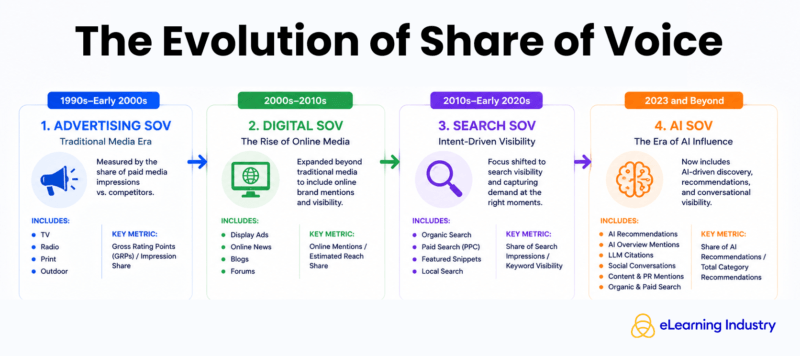
For years, marketers have used Share of Voice to measure advertising presence. The idea is simple: compare your advertising activity against competitors and calculate how much attention your brand captures within the market.
Today, the concept is much broader. Modern Share of Voice includes search engines, content marketing, media coverage, social conversations, thought leadership, and AI-powered discovery platforms. It helps companies understand how visible they are compared to competitors and whether they are becoming more or less influential in their category.
Ultimately, this matters because visibility often shapes perception, and perception influences consideration. Buyers tend to trust and evaluate the companies they encounter most often. As a result, Share of Voice has become more than a marketing metric. It has become a strategic indicator of market presence, authority, and competitive strength.
Therefore, organizations that consistently increase their Share of Voice often improve brand awareness, generate more demand, and strengthen their market position over time.
In this guide, we'll explain what Share of Voice is, why it matters, how to measure it across different channels, and what companies can do to increase it.
Key Takeaways
- Share of Voice measures brand visibility relative to competitors.
- Higher Share of Voice often correlates with stronger market performance.
- SEO, content marketing, PR, and thought leadership help increase Share of Voice.
- AI visibility is becoming a new form of Share of Voice measurement.
- Brands that dominate conversations often dominate buyer consideration.
In This Article, We Cover…
- What Is Share Of Voice?
- Why Share Of Voice Matters
- Share Of Voice vs Market Share
- The Different Types Of Share Of Voice
- How to Measure Share Of Voice
- How Leading Brands Increase Share Of Voice
- Why Thought Leadership Is A Share Of Voice Multiplier
- The Rise Of AI Share Of Voice
- Common Share Of Voice Mistakes
- How To Build A Share Of Voice Strategy
- The Future Of Share Of Voice
What Is Share Of Voice?
Share of Voice measures how visible a brand is compared to competitors across channels such as search, content, media, social platforms, and AI-powered discovery engines.
Traditionally, marketers calculated it using a simple formula:
Share of Voice = Brand Mentions ÷ Total Market Mentions × 100
For instance, if your company received 500 mentions during a period and all competitors combined received 2000 mentions, your Share of Voice would be 25%.
Therefore, the higher your percentage, the larger your presence within the conversation.
For decades, this metric was primarily associated with advertising. Brands compared media spend, impressions, and advertising exposure to determine who owned the biggest share of attention.
However, the digital landscape changed everything. Today's buyers don't rely solely on advertising. On the contrary, they discover brands through search engines, review sites, industry publications, social platforms, podcasts, webinars, newsletters, communities, and AI-generated answers.
As a result, modern Share of Voice extends far beyond paid media.
Today, companies measure Share of Voice across:
- Organic search visibility
- Paid search visibility
- Content marketing performance
- Social media conversations
- Media coverage
- Industry thought leadership
- AI search and recommendation engines
Consequently, this evolution has made Share of Voice one of the most useful indicators of competitive visibility. Instead of measuring how loudly a company advertises, it measures how often buyers encounter that company throughout their decision-making journey.
A brand might spend less on advertising than competitors yet maintain a larger Share of Voice through strong SEO, valuable content, and consistent media exposure.
That's why many growth-focused organizations now view Share of Voice as a leading indicator rather than a lagging metric.
Overall, revenue tells you what has happened, while Share of Voice helps explain what may happen next.
Why Share Of Voice Matters
It is true that many executives focus on leads, pipeline, and revenue. While those metrics matter for sure, they often appear late in the buying process.
Meanwhile, Share of Voice helps measure something that happens much earlier: visibility. To put it into perspective, before a buyer becomes a customer, they must first become aware of your brand. And in order to become aware of your brand, they must encounter it somewhere.
This is exactly why Share of Voice is important. It helps answer questions such as:
- Are we visible in our market?
- Are competitors dominating key conversations?
- Is our authority growing or shrinking?
- Are buyers more likely to encounter our brand or someone else's?
Overall, the brands that consistently appear across multiple channels tend to gain an advantage. Buyers often interpret visibility as credibility.
When prospects repeatedly see a company ranking in search results, publishing insights, appearing in industry media, and being referenced by experts, they begin to associate that company with leadership.
That doesn't guarantee a purchase, but it does increase the likelihood of consideration, and consideration is often where market share begins.
Share of Voice also acts as an early warning system. A decline in visibility may indicate that competitors are publishing more content, earning more coverage, improving their SEO, or increasing investment in thought leadership.
Overall, by identifying these shifts early, marketing leaders can respond before revenue is affected.
Key Insight
Brands that are seen more often are typically chosen more often.
Visibility doesn't guarantee success. But invisibility almost guarantees missed opportunities.
Share Of Voice Vs. Market Share
It is true that one of the biggest misconceptions in marketing is that Share of Voice and market share are the same thing. Even though they are related, they measure different outcomes.
Market Share measures revenue. It tells you how much of the market's sales your company accounts for.
Share of Voice measures attention. It tells you how much visibility your company has compared to competitors.
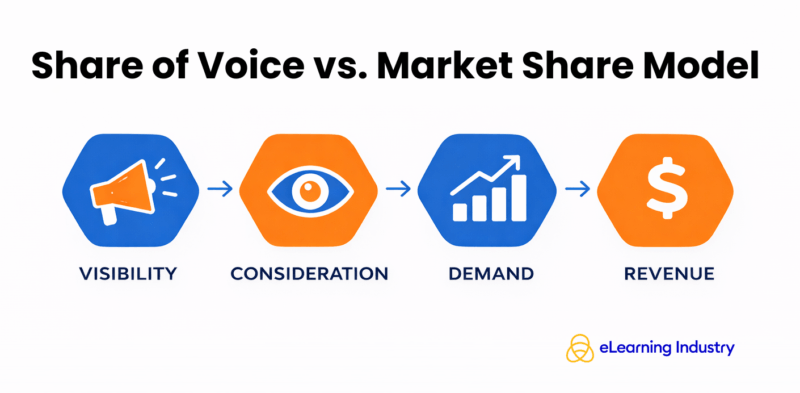
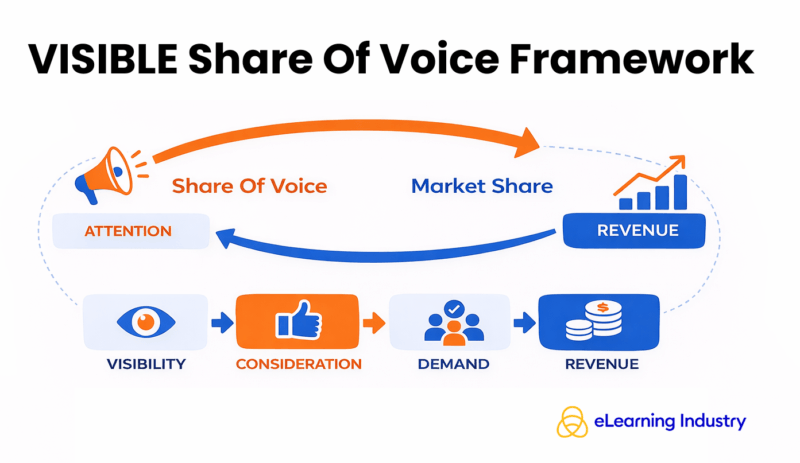
You may think of market share as the outcome, and Share of Voice as one of the factors that influences that outcome.
For instance, a company may have a large market share today because of years of strong visibility, brand building, customer loyalty, and product adoption. Likewise, a smaller company may have a rapidly growing Share of Voice while still holding a modest market share.
In general, this distinction is important because changes in Share of Voice often occur before changes in revenue.
When a company starts appearing more frequently in search results, media coverage, industry conversations, and AI recommendations, awareness increases.
Overall, awareness leads to consideration while consideration creates demand. After that, demand contributes to revenue growth.
Many marketers refer to the concept of "Excess Share of Voice," which occurs when a brand's Share of Voice exceeds its market share. Historically, brands with excess Share of Voice often outperform competitors over time because they are capturing more attention than their current market position would suggest.
Key Insight
Higher Share of Voice often precedes higher market share.
Companies that consistently own attention frequently strengthen their market position over time.
The Different Types Of Share Of Voice
It is important to note that not all Share of Voice metrics measure the same, as different channels represent different forms of visibility. Understanding these categories helps organizations identify where they are strong and where competitors may be outperforming them.
Search Share Of Voice
In general, Search Share of Voice measures how visible a brand is in search engine results compared to competitors.
This is often calculated using:
- Keyword rankings
- Search visibility
- Organic traffic potential
- Competitor ranking share
For many B2B companies, search visibility represents one of the most important forms of Share of Voice because it captures buyers actively researching solutions.
If your competitors dominate search results, they often become the first brands buyers evaluate.
Paid Search Share Of Voice
In another field, Paid Search Share of Voice focuses on advertising visibility.
Some metrics commonly include:
- Impression share
- Ad coverage
- Auction competitiveness
- Paid search visibility
This measurement helps marketers understand whether competitors are occupying valuable advertising real estate.
A low paid Share of Voice may indicate underinvestment or increased competition.
Social Share Of Voice
Social Share of Voice measures brand mentions and conversations across social platforms.
Organizations typically evaluate:
- Mentions
- Engagement
- Hashtag visibility
- Conversation volume
While social visibility is useful, it should not be viewed as the only Share of Voice metric.
Many brands mistakenly focus entirely on social activity while ignoring search and content visibility.
Media Share Of Voice
Media Share of Voice tracks earned coverage across publications, news outlets, and industry websites.
It often includes:
- Brand mentions
- Media placements
- Interview opportunities
- Press coverage
- Earned backlinks
Strong media visibility can significantly increase brand authority and credibility.
Content Share Of Voice
Content Share of Voice measures how much valuable information a brand contributes to industry conversations.
This includes:
- Educational content
- Research reports
- Industry analysis
- Guides and resources
- Thought leadership articles
Companies that consistently publish useful content often expand their visibility well beyond advertising channels.
AI Share Of Voice
AI Share of Voice is one of the newest and fastest-growing categories. It measures how often brands appear in AI-generated answers and recommendations.
This includes visibility within AI platforms such as:
- ChatGPT
- Gemini
- Perplexity
- Claude
As buyers increasingly use AI tools to research products, vendors, and solutions, AI visibility is becoming a critical part of competitive positioning. A company may rank highly in traditional search yet remain largely absent from AI-generated recommendations. That creates a new visibility gap.
Key Insight
AI Share of Voice may become one of the most important visibility metrics of the next decade.
How To Measure Share Of Voice
Understanding Share of Voice is one thing, but measuring it accurately is another.
Many companies track a single channel and assume they have a complete picture of their visibility. In reality, modern Share of Voice spans multiple touchpoints.
A prospect might discover your company through a search engine, read your content, see a social post, hear your executives on a podcast, encounter your brand in industry media, and later ask an AI assistant for recommendations. Each interaction contributes to visibility.
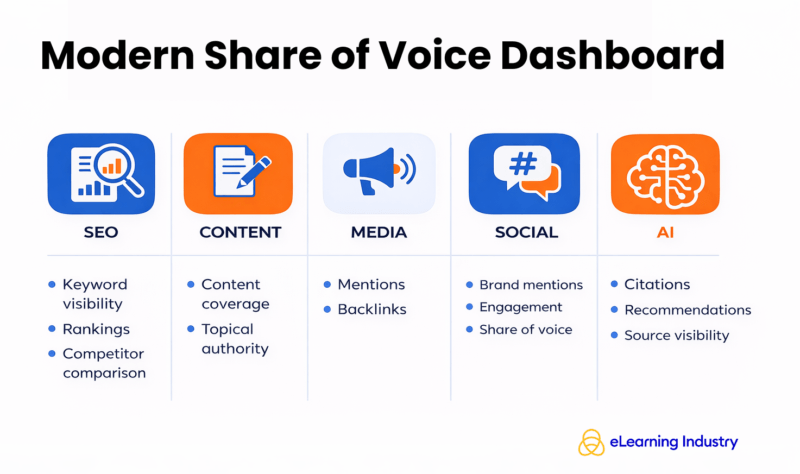
That's why the most effective measurement approach combines several sources rather than relying on one metric.
Measuring SEO Share Of Voice
SEO Share of Voice focuses on search visibility compared to competitors.
The goal is to understand how much of the available search opportunity your brand owns.
Most organizations measure SEO SoV by tracking:
- Keyword rankings
- Search visibility scores
- Organic traffic potential
- Competitor rankings
- SERP coverage
For example, if your company ranks highly across dozens of high-value industry keywords while competitors occupy fewer positions, your Share of Voice is likely increasing.
SEO tools often calculate this automatically by assigning visibility scores based on ranking positions and estimated search volume.
But rankings alone don't tell the whole story. You should also look at:
- Featured snippets
- People Also Ask visibility
- Video results
- Image results
- Branded search growth
The more search real estate your company controls, the larger your search Share of Voice becomes.
Measuring Content Share Of Voice
Content Share of Voice measures how much authority your organization owns within important industry topics. This goes beyond traffic. The goal is to understand whether your company is contributing meaningfully to market conversations.
Common metrics include:
- Number of published assets
- Topic coverage
- Organic keyword ownership
- Content engagement
- Backlinks earned
- Content citations
A useful question to ask is simple: "When buyers research our category, how often do they encounter our expertise?"
Organizations with strong content Share of Voice tend to dominate important industry topics rather than publishing random content. Depth matters as much as volume. Ten authoritative articles often outperform one hundred shallow posts.
Measuring Media Share Of Voice
Media Share of Voice focuses on earned attention.
This includes visibility generated through:
- Industry publications
- News sites
- Analyst coverage
- Podcasts
- Interviews
- Guest contributions
Measurements often include:
- Brand mentions
- Media placements
- Share of media coverage
- Backlink acquisition
- Publication authority
Many PR teams compare their total mentions against key competitors. If competitors receive 1000 mentions and your company receives 300, your media Share of Voice remains relatively low. The goal is not publicity for its own sake. The goal is to increase visibility among the audiences that matter.
Measuring Social Share Of Voice
Social Share of Voice tracks conversations across social platforms.
Key measurements include:
- Mentions
- Brand tags
- Hashtag usage
- Engagement levels
- Share of conversations
Social listening tools can compare your visibility against competitors and identify whether discussion volume is increasing or decreasing over time.
While useful, social metrics should be viewed as one component of a broader Share of Voice strategy. A company can have a strong social presence and still struggle with search visibility or industry authority.
Measuring AI Share Of Voice
AI Share of Voice is becoming a critical metric for modern marketing teams.
The concept is straightforward: How often does your brand appear in AI-generated answers compared to competitors?
Measurement approaches may include:
- Brand citations
- Recommendation frequency
- Source mentions
- AI answer visibility
- Category inclusion rates
For example, a learning technology vendor may ask AI platforms:
- Best LMS platforms
- Employee training software
- Learning experience platforms
- Corporate learning tools
The frequency with which a brand appears within those answers contributes to its AI Share of Voice. This area is still evolving. But companies that start measuring AI visibility today will have a significant advantage as AI-powered discovery becomes more common.
How Leading Brands Increase Share Of Voice
The companies with the highest Share of Voice rarely depend on a single channel. Rather, they build visibility across multiple touchpoints.
When buyers encounter the same brand repeatedly in different places, recognition grows naturally, which creates momentum.
The most effective Share of Voice strategies combine search, content, media, thought leadership, and community engagement.
Content Marketing
Content remains one of the most reliable ways to increase visibility. Every article, guide, report, video, or resource creates another opportunity for discovery.
Strong content helps companies:
- Rank in search engines
- Earn backlinks
- Attract media attention
- Generate social engagement
- Build topical authority
The key is consistency. Many organizations publish occasionally and expect immediate results. The brands that dominate visibility typically publish continuously for years.
Thought Leadership
Thought leadership helps companies become known for expertise rather than promotion. This includes:
- Industry commentary
- Expert insights
- Research-based content
- Executive perspectives
- Trend analysis
When buyers associate a company with expertise, visibility becomes more valuable because it carries credibility.
PR And Media Coverage
Earned media remains one of the fastest ways to expand visibility. A mention in a respected industry publication often reaches audiences that would otherwise be difficult to access.
PR efforts can generate:
- Brand awareness
- Industry authority
- Backlinks
- Referral traffic
- Trust signals
Companies that regularly contribute insights to industry media often maintain a stronger Share of Voice than competitors that remain silent.
Webinars
Webinars create visibility while also building trust. Unlike short-form content, webinars allow brands to demonstrate expertise in depth.
They also create assets that can be repurposed into:
- Articles
- Social content
- Videos
- Reports
- Podcast episodes
One webinar can support visibility across multiple channels.
Podcasts
Podcasts continue to grow as a discovery channel.
Appearing as a guest on industry podcasts helps organizations reach engaged audiences while reinforcing thought leadership.
Podcast appearances also contribute to:
- Brand mentions
- Search visibility
- Media coverage
- AI citations
Many AI systems increasingly reference podcast discussions and transcripts as part of their information ecosystem.
Original Research
Few visibility assets are more powerful than original data. Research creates something competitors cannot easily replicate.
When organizations publish proprietary findings, they often attract:
- Journalists
- Industry analysts
- Bloggers
- Event organizers
- Influencers
Original research generates citations, backlinks, mentions, and authority. It often becomes a long-term source of Share of Voice growth.
Key Insight
The most effective Share of Voice strategy combines multiple channels.
Companies that rely on one channel may grow visibility temporarily.
Companies that build visibility everywhere create stronger competitive advantages.
Why Thought Leadership Is A Share Of Voice Multiplier
Many visibility tactics generate attention. B2B thought leadership generates attention and authority at the same time. That's why it often acts as a multiplier.
A single expert insight can appear in search results, social feeds, newsletters, media articles, podcasts, webinars, conference presentations, and AI-generated answers. The reach extends far beyond the original content.
Thought leadership works because buyers trust expertise.
When executives, practitioners, and industry experts consistently share useful perspectives, people begin to associate their organization with knowledge and credibility. This influences how prospects evaluate vendors. It also influences how journalists, analysts, and AI systems identify authoritative sources.
Expertise Creates Visibility
The process usually starts with expertise.
Organizations develop unique knowledge through:
- Customer experience
- Industry specialization
- Product innovation
- Market observations
- Research
The challenge is not generating expertise; it is publishing it.
Knowledge that stays inside the organization creates no visibility. Knowledge that is shared creates opportunities.
Visibility Creates Authority
As expertise becomes content, visibility increases. Buyers begin encountering the same perspectives repeatedly. Over time, repeated exposure creates familiarity which often contributes to trust.
This is why some organizations become known as category leaders even when competitors offer similar products. They are simply more visible.
Authority Increases Share Of Voice
Authority attracts attention naturally. Media outlets seek expert commentary, conference organizers invite speakers, podcasts request interviews, industry communities reference insights, and AI systems surface authoritative sources.
Each of these outcomes increases Share of Voice, and each visibility gain creates opportunities for additional authority. The cycle becomes self-reinforcing.
The Rise Of AI Share Of Voice
A major shift is happening in how buyers discover information. For years, search engines were the primary gateway to research, whereas today, AI assistants are becoming part of that journey.
Instead of browsing dozens of pages, users increasingly ask AI systems direct questions.
Examples include:
- What is the best LMS for enterprise training?
- Which HR software vendors are growing fastest?
- What are the leading learning platforms?
- Which employee onboarding tools should I evaluate?
The answers provided by AI systems influence awareness and consideration. That creates a new visibility category: AI Share of Voice.
AI Share of Voice measures how often a brand appears within AI-generated recommendations, summaries, citations, and category discussions. This is different from traditional SEO.
A company may rank highly in search results but receive few mentions within AI-generated responses. Likewise, some brands with strong authority may receive disproportionate visibility because AI systems view them as trusted sources.
The New Citation Economy
AI discovery relies heavily on citations and source credibility.
Brands that earn visibility through:
- Research
- Expert content
- Media mentions
- High-quality backlinks
- Industry authority
These are often more likely to appear in AI-generated answers.
In many ways, AI visibility is becoming an extension of authority. The more trustworthy and visible your organization becomes across the web, the more likely AI systems are to surface it.
Why AI Share Of Voice Matters
The importance of AI visibility will continue to grow for a simple reason: buyer behavior is changing and people want faster answers. They increasingly expect recommendations rather than lists of links.
As AI adoption expands, visibility within AI-generated responses may influence buying decisions long before users visit a website.
Organizations that start measuring and improving AI Share of Voice now will be better positioned as this shift accelerates.
For many industries, AI visibility may soon become as important as traditional search visibility.
Common Share Of Voice Mistakes
Many organizations understand the value of visibility. But they often measure or manage Share of Voice incorrectly. The result is an incomplete picture of market presence.
A company may believe it is performing well because one channel looks strong, while competitors quietly gain ground across multiple channels.
Understanding the most common mistakes can help marketing leaders avoid blind spots and build a more accurate visibility strategy.
Measuring Only Social Media
One of the biggest mistakes is treating social media as the entire Share of Voice picture.
Social platforms can provide useful signals. They reveal conversations, engagement levels, and brand awareness trends. But social visibility is only one part of the market.
A company might generate thousands of social interactions while remaining largely invisible in search results, industry media, and AI recommendations. If buyers are researching solutions through Google, analyst reports, publications, or AI assistants, social metrics alone won't tell the full story.
Ignoring Competitors
Share of Voice is a comparative metric. Measuring your own visibility without benchmarking competitors limits its value. For example, increasing website traffic by 20% sounds positive. But if competitors increased visibility by 50% during the same period, your relative market position may have weakened.
Share of Voice only becomes meaningful when viewed within a competitive context.
Organizations should continuously monitor:
- Direct competitors
- Emerging competitors
- Industry leaders
- New market entrants
Visibility shifts often happen gradually before they become obvious in revenue numbers.
Focusing Only On Advertising
Traditional Share of Voice was heavily tied to advertising spend.
Many companies still rely on paid media to increase visibility. Advertising can be effective. But once spending stops, visibility often declines.
Organic visibility tends to create longer-term advantages. Content, SEO, media coverage, thought leadership, and industry authority continue generating exposure long after publication.
The strongest Share of Voice strategies balance paid and organic channels.
Ignoring Search Visibility
Search remains one of the most important discovery channels for B2B buyers. Yet, many organizations focus heavily on social media and paid campaigns while neglecting organic search. This creates a significant gap.
When prospects search for industry problems, solutions, comparisons, or vendors, companies with strong search visibility consistently capture attention.
Organizations that ignore SEO often surrender a large portion of their potential Share of Voice.
Ignoring AI Visibility
Perhaps the newest mistake is failing to monitor AI-driven discovery, as AI assistants are increasingly influencing how buyers research products, vendors, and industry topics.
Many companies still have no process for measuring:
- AI mentions
- AI recommendations
- AI citations
- AI visibility trends
That may be acceptable today for some industries. It may become a serious disadvantage tomorrow.
As AI adoption grows, organizations that fail to monitor AI Share of Voice risk losing visibility in one of the fastest-growing discovery channels.
How To Build A Share Of Voice Strategy
Increasing Share of Voice doesn't happen by accident. It requires a structured approach. The goal is not simply to publish more content or gain more mentions, but to increase meaningful visibility in the places where buyers make decisions.
One practical framework is the VISIBLE model.
V - Visibility Audit
Start by understanding your current position.
Evaluate visibility across:
- Organic search
- Paid search
- Social media
- Industry publications
- Content performance
- AI-generated recommendations
The audit should answer one question: "How visible are we compared to competitors?"
Without a baseline, improvement becomes difficult to measure.
I - Identify Competitors
Many organizations focus only on direct competitors.
But buyers often evaluate a wider set of alternatives.
Identify:
- Direct competitors
- Category leaders
- Emerging challengers
- Adjacent solutions
These companies form your true visibility landscape.
Understanding who owns attention is essential before attempting to compete for it.
S - Search Presence
Search remains one of the most scalable visibility channels.
Assess:
- Keyword coverage
- Ranking positions
- Topic ownership
- Organic traffic opportunities
- Competitor visibility gaps
The goal is to identify areas where your company can earn visibility that competitors currently control.
I - Industry Authority
Authority influences visibility.
Organizations viewed as trusted sources often receive disproportionate attention from search engines, media outlets, buyers, and AI systems.
Strengthen authority through:
- Research
- Expert commentary
- Speaking engagements
- Industry contributions
- Educational content
Authority makes future visibility easier to earn.
B - Brand Mentions
Track how often your company is discussed across the market.
Monitor:
- Media mentions
- Social mentions
- Backlinks
- Citations
- Community discussions
Mentions help reveal whether your visibility is expanding beyond owned channels.
L - Leadership Content
Create content that demonstrates expertise.
This includes:
- Industry analysis
- Research reports
- Benchmark studies
- Executive insights
- Trend forecasts
Leadership content often produces the highest long-term Share of Voice impact because it generates citations and discussion.
E - Expand Reach
Visibility compounds when content reaches multiple channels.
Repurpose successful assets into:
- Articles
- Videos
- Podcasts
- Webinars
- Social content
- Newsletter content
Every additional channel creates new opportunities for discovery.
The Future Of Share Of Voice
The concept of Share of Voice will continue evolving. For years, marketers focused on advertising exposure. Then the focus shifted toward digital channels, search engines, and social media.
Now another transition is underway. AI-powered discovery is changing how information is found, evaluated, and recommended.
As this shift continues, the definition of visibility will expand. Tomorrow's market leaders will not simply dominate search rankings. They will dominate the broader information ecosystem.
That includes:
- Search results
- Industry conversations
- Expert commentary
- Media coverage
- Knowledge sources
- AI-generated recommendations
Visibility is becoming increasingly interconnected. In fact, a research report may generate media coverage. Also, media coverage may generate backlinks, which may improve search visibility. On its end, search visibility may influence AI recommendations.
Overall, each channel strengthens the others. This means Share of Voice will become an even stronger indicator of future competitive performance.
Organizations that invest in visibility today are effectively building assets that continue generating attention tomorrow.
And as markets become more crowded, attention will become even more valuable.
The brands that consistently earn visibility, trust, and authority across channels will have a significant advantage over those that rely solely on advertising or short-term campaigns.
Conclusion
Share of Voice is no longer just a marketing metric. It has become a measure of visibility, authority, and competitive influence.
In today's market, buyers discover brands through many different channels. They search online, read articles, listen to podcasts, engage with social content, follow industry experts, and increasingly rely on AI-generated recommendations. Every one of these touchpoints contributes to how visible a company becomes.
The organizations that consistently appear across those environments gain an advantage. They are more likely to be remembered, considered, and trusted during the buying process.
That's why Share of Voice deserves attention from CEOs, CMOs, growth leaders, and category builders. It provides a clearer view of competitive positioning than traffic metrics or campaign performance alone. More importantly, it often signals future opportunities before they appear in revenue reports.
Companies that invest in content, thought leadership, search visibility, media coverage, and AI discoverability create a durable competitive advantage. They don't simply attract clicks; they become part of the conversation.
And as AI-powered search continues to reshape how buyers discover information, that advantage may become even more valuable.
The brands that dominate conversations today are likely to be the brands buyers trust tomorrow.
FAQShare of Voice (SoV) measures how visible a brand is compared to its competitors across channels such as search engines, social media, content marketing, media coverage, advertising, and AI platforms.
The traditional formula is:
Share of Voice = Brand Mentions ÷ Total Market Mentions × 100
Today, marketers also calculate SoV using search visibility, media mentions, social conversations, and AI citations.
Share of Voice helps organizations understand their competitive visibility. Brands with higher visibility are often more likely to be discovered, considered, and trusted by buyers.
Market share measures revenue or sales performance. Share of Voice measures attention and visibility. In many cases, increases in Share of Voice occur before increases in market share.
SEO Share of Voice measures a brand's visibility in search engine results compared to competitors. It is usually based on keyword rankings, search visibility scores, and estimated traffic potential.
Organizations typically track keyword rankings, organic visibility, SERP features, and competitor performance across important search terms to determine their relative search presence.
AI Share of Voice measures how often a brand appears in AI-generated recommendations, citations, and answers within platforms such as ChatGPT, Gemini, Claude, and Perplexity.
Companies can improve Share of Voice through:
- SEO
- Content marketing
- Thought leadership
- Digital PR
- Original research
- Podcasts and webinars
- Media outreach
- AI visibility optimization
A modern Share of Voice analysis should include:
- Organic search
- Paid search
- Content marketing
- Social media
- Media coverage
- Brand mentions
- AI visibility
Not automatically. Product quality, customer experience, pricing, and sales execution still matter. However, higher Share of Voice often increases awareness and consideration, which can contribute to stronger business growth over time.
