



 ChatGPT
 Perplexity
 Claude
 Grok
AI Visibility for LMS Vendors: Why Your LMS Isn't Showing Up in AI Search
Imagine a potential customer asking ChatGPT, "Which LMS platforms are best for training employees in a mid-sized healthcare company?"
The AI assistant generates a shortlist of learning management systems, explains their capabilities, and suggests which products might fit the organization's requirements. Several competitors appear in the response, but your LMS is nowhere to be found.
You have invested in SEO, published content, improved your platform, and built a recognizable brand. Yet when a buyer uses AI to research software, your product is missing from the conversation.
Why does this happen?
The answer is not always straightforward. Your website may lack relevant information, your product positioning may be unclear, or competitors may have stronger evidence supporting their suitability for that particular use case. Technical accessibility and differences between AI platforms can also affect the results.
AI visibility for LMS vendors is not simply about optimizing a website. It is about making your product discoverable, understandable, and verifiable across the information sources buyers and AI systems encounter.
This guide explains why LMS platforms may be missing from AI-generated recommendations, how to identify visibility gaps, and what vendors can do to improve their chances of being considered.
Key Takeaways
- AI search is becoming another channel through which potential LMS buyers discover and compare vendors, alongside traditional search, software directories, and industry recommendations.
- An LMS may be missing from AI-generated answers because of unclear positioning, limited relevant content, technical problems, or insufficient information supporting specific buyer requirements.
- Ranking well in traditional search does not guarantee inclusion in ChatGPT, Google AI Overviews, Google AI Mode, or Perplexity responses.
- LMS vendors should evaluate their visibility across different buyer questions, industries, use cases, and AI platforms rather than testing only generic searches.
- Clear product information, relevant content, customer reviews, accurate directory listings, and credible third-party coverage can support discoverability and buyer confidence.
- A successful AI visibility strategy should focus on relevant recommendations and qualified business opportunities, not simply generating more brand mentions.
Struggling with your Online Reputation Monitoring strategy?
In this article, we explore...
- What Is AI Visibility for LMS Vendors?
- Why Isn't Your LMS Showing Up in AI Search?
- How to Check Your LMS Visibility in AI Search
- 7 Ways LMS Vendors Can Improve Their AI Search Visibility
- How to Measure AI Visibility for Your LMS
- Can LMS Directories, Reviews, and Top Lists Improve AI Visibility?
- Common AI Visibility Mistakes LMS Vendors Should Avoid
What Is AI Visibility for LMS Vendors?
AI visibility for LMS vendors refers to how frequently and accurately a learning management system is discovered, mentioned, cited, compared, or recommended in AI-generated responses to relevant software-buying questions.
Traditionally, LMS marketing teams have focused much of their search activity on keyword rankings, organic traffic, and website conversions. These metrics remain important, but AI-assisted discovery introduces additional ways for buyers to encounter software.
Someone researching employee onboarding platforms may ask an AI assistant to recommend suitable products, compare two vendors, or explain which LMS capabilities matter for a particular industry.
The answer may contain several brands, references to supporting sources, and explanations of their potential suitability.
However, three outcomes need to be distinguished.
A brand mention occurs when the AI response names your LMS. A citation occurs when it references your website or another page containing relevant information. A recommendation occurs when the platform presents your LMS as an option for the buyer's requirements.
These outcomes are related but not interchangeable. Your website may be cited without your product being recommended, while your LMS may appear in a shortlist without receiving a direct citation.
AI search experiences also work differently. Some use live search results or retrieved web pages, while others may draw on information available through their underlying models. There is no single ranking formula that determines visibility across every platform.
For LMS vendors, the objective is to understand which buying conversations include their product and whether the information presented is accurate and relevant.
Why Isn't Your LMS Showing Up in AI Search?
When an LMS fails to appear in AI-generated recommendations, it is tempting to assume the company needs more backlinks, better keywords, or a specific GEO technique.
However, there are several possible explanations, and the right response depends on identifying which ones apply.
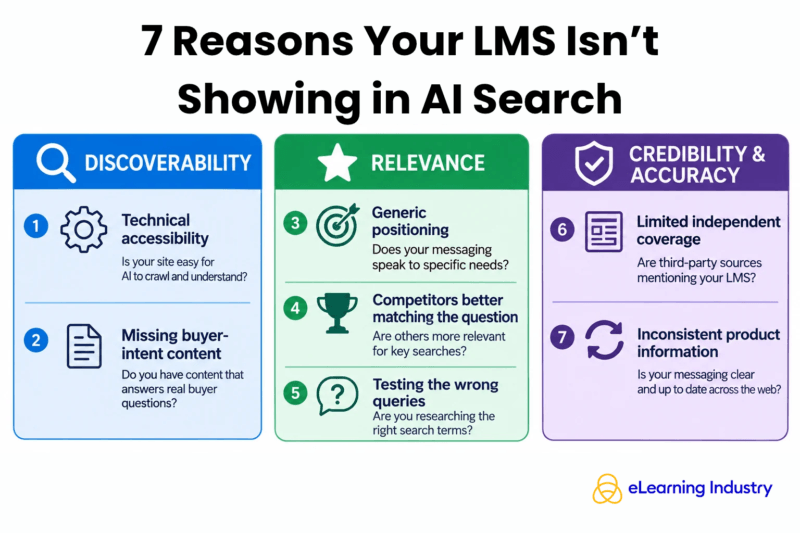
1. Your LMS Positioning Is Too Generic
Many LMS websites use similar language to describe their products. Phrases such as "an innovative platform that transforms learning experiences" may sound appealing, but they provide little concrete information about who the software serves or what it does.
Compare that with a description such as:
"An LMS designed for healthcare organizations managing employee onboarding, compliance training, and certification tracking."
The second version communicates a specific audience and several identifiable use cases.
This clarity helps buyers understand the product. It also provides more useful information to systems retrieving and evaluating relevant pages.
What to do: Review your homepage, product pages, and main descriptions. Make sure they clearly identify your target customers, supported use cases, and relevant capabilities without relying on broad marketing claims.
2. You Don't Have Enough Content Addressing Specific Buyer Needs
LMS buyers rarely evaluate platforms using only the term "learning management system." Their research often includes requirements related to industry, company size, training delivery, integrations, implementation, and reporting.
For example, someone looking for an LMS for customer training has different priorities from a healthcare organization evaluating compliance training software.
If your website focuses almost entirely on generic LMS benefits, it may provide limited evidence for these more specific questions.
What to do: Identify the use cases that matter most to your ideal customers and create detailed content explaining how your platform supports them. Include relevant capabilities, examples, limitations, and implementation considerations.
3. Your Brand Has Limited Independent Industry Coverage
Your website explains what your LMS offers, but buyers may also look for information from other sources.
Industry publications, software reviews, editorial comparisons, research reports, directories, and customer experiences can provide additional context about a platform.
For a mid-market LMS vendor competing with established brands, limited visibility across these sources may create a gap in the publicly available information about its product.
This does not mean that third-party mentions automatically generate AI recommendations. However, accurate independent information gives buyers, publishers, and potentially AI-assisted research systems more material to evaluate.
What to do: Review where your LMS appears outside your website and identify credible publications, directories, and industry conversations relevant to your product.
4. Your Product Information Is Inconsistent
Imagine your website describing your software as an enterprise LMS, while a major directory categorizes it primarily as an authoring tool. Elsewhere, an outdated comparison may list integrations you no longer support.
These inconsistencies can confuse prospective customers and create conflicting descriptions across the sources they use for research.
AI-generated answers may also reproduce outdated or inaccurate product information when those sources are encountered.
What to do: Audit your main directory profiles, product listings, comparison pages, and public company descriptions. Correct outdated details wherever you can and maintain consistent terminology for your core capabilities.
5. Your Website Has Technical Accessibility Problems
Even useful content may struggle to support AI-assisted discovery if search systems cannot access it properly.
Common issues include crawl restrictions, indexing problems, important information hidden behind authentication, JavaScript rendering difficulties, weak internal linking, and inconsistent canonical URLs.
Google's AI search features continue to rely on established search infrastructure, while ChatGPT Search uses its own search crawler for discovering web content.
What to do: Review indexing and crawl accessibility, test important pages, and ensure essential product information is available in accessible page content.
6. Competitors Provide More Relevant Evidence for the Question
An LMS might be suitable for several industries, but that does not mean every AI system will recognize it as a strong match for every question.
A buyer asking about healthcare compliance training may receive different recommendations from someone looking for a platform to sell courses online.
A competitor could appear because its available information addresses the requested requirements more directly.
What to do: Compare your content and public product evidence with competitors appearing in the responses. Look for meaningful differences in use-case coverage, not simply differences in keyword frequency.
7. You're Measuring the Wrong Questions
Testing only "What are the best LMS platforms?" provides a limited picture of AI visibility.
A specialist vendor may rarely appear in broad recommendations but perform better when buyers ask about manufacturing training, customer education, franchise training, or regulated industries.
That distinction matters because the most commercially valuable questions are not necessarily the broadest ones.
What to do: Build your visibility audit around the industries, use cases, and buyer requirements your company actually serves.
Your LMS may not have a general AI visibility problem. It may have a visibility problem within the specific buying conversations that matter most to your business.
How to Check Your LMS Visibility in AI Search
Before changing your website or investing in additional content, establish where your product currently appears.
A structured AI visibility audit can help separate real gaps from assumptions based on a handful of responses.
Step 1: Identify Your Most Valuable Buyer Questions
Start with the questions potential customers ask when researching learning management systems.
Build a representative set covering different stages of the buying process:
- Category: "Which LMS platforms are suitable for mid-sized companies?"
- Industry: "What are the best LMS platforms for healthcare employee training?"
- Use case: "Which LMS software supports customer education and external training?"
- Features: "What LMS platforms offer advanced reporting and Salesforce integration?"
- Comparisons: "What are the main differences between LMS A and LMS B?"
- Budget: "Which LMS options should a company with 500 employees consider?"
Include questions that reflect your ideal customer profile rather than selecting prompts only because your brand already performs well.
Step 2: Test Multiple AI Platforms
Evaluate relevant questions across ChatGPT Search, Google AI Overviews, Google AI Mode, and Perplexity.
These experiences do not necessarily return identical answers. Their responses may differ according to the question, available sources, language, location, and other conditions.
Where a particular feature does not appear for a query, record that outcome rather than treating it as a missing recommendation.
Step 3: Record What Appears
For each response, document whether your LMS is mentioned, recommended, or cited. Also record competing brands, linked sources, and any important claims about product features.
Review the accuracy of the information. An AI assistant may name your platform but misunderstand its capabilities or describe an outdated version.
That creates a different problem from being absent entirely.
Step 4: Repeat the Tests
AI-generated responses can change between sessions and over time. One result should not be treated as a permanent ranking.
Use consistent questions and testing conditions where possible. Record dates, platforms, and relevant settings so you can compare results more meaningfully.
Manual testing provides a directional assessment of selected prompts, not a statistically reliable picture of every buyer's experience.
Step 5: Identify the Visibility Gaps
Group your findings by platform, industry, use case, buyer stage, and competitor.
For example, you may discover that your LMS appears regularly in employee onboarding discussions but rarely in conversations about healthcare compliance.
That finding provides a clearer starting point than simply concluding that your overall AI visibility is poor.
7 Ways LMS Vendors Can Improve Their AI Search Visibility
Once you understand where your LMS is missing or misrepresented, you can prioritize improvements.
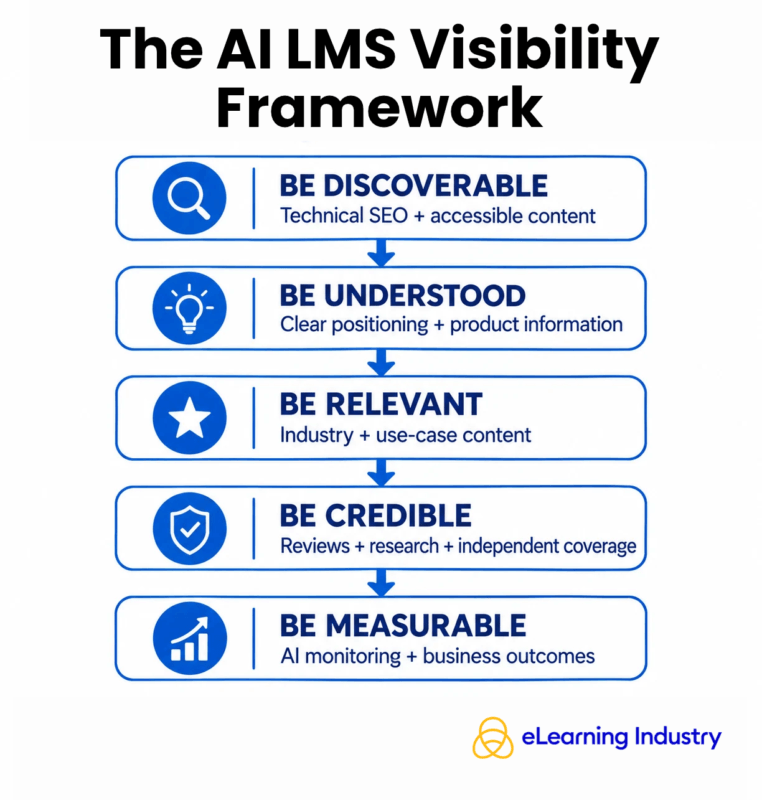
The strongest approach combines technical accessibility, clear product positioning, relevant content, credible external information, and ongoing measurement.
1. Make Your LMS Positioning More Specific
Your website should make it easy to understand who your product is designed for and which problems it solves.
Start with the homepage and main product pages. Clearly explain your target customers, supported industries, training use cases, and differentiating capabilities.
For example, if your LMS specializes in external training, explain how organizations can use it for customer onboarding, partner enablement, or certification programs, where those capabilities genuinely apply.
Support these descriptions with product details instead of relying on claims such as "the most advanced learning platform."
Specific positioning can help buyers evaluate whether your software fits their needs. It also creates clearer information for search systems and third-party publishers referencing your product.
2. Create Content Around Real LMS Buying Questions
A strong content strategy should reflect the decisions customers make before selecting a platform.
Rather than publishing dozens of broadly similar articles about LMS benefits, focus on useful topics such as healthcare training, customer education, compliance management, partner training, integrations, implementation, and software evaluation.
A detailed guide to choosing an LMS for healthcare organizations, for example, could explain training requirements, certification tracking, administration, reporting, and relevant evaluation criteria.
Where appropriate, show how your product supports those requirements through screenshots, demonstrations, and customer examples.
Be transparent about limitations. If a feature requires an integration or a particular plan, explain that clearly.
The objective is to provide information that helps buyers make decisions, not to create separate pages for every possible keyword variation.
3. Strengthen Your Presence in Relevant LMS Directories
Software directories are important discovery resources because they allow buyers to explore and compare platforms within a defined category.
For LMS vendors, a complete directory profile should explain what the product does, which organizations it serves, and which features are currently available.
Include accurate descriptions, supported use cases, relevant integrations, pricing information where appropriate, customer evidence, and current product details.
For example, eLearning Industry's LMS Directory helps buyers discover and compare learning management systems.
A directory listing does not guarantee that ChatGPT or another AI system will recommend your platform. However, maintaining accurate public listings makes your product easier for buyers to research and adds to the information available beyond your website.
4. Build Credibility Through Authentic Customer Reviews
Vendor-created content is useful for explaining capabilities, but buyers also want to understand what happens when organizations use the software.
Customer reviews can provide that perspective.
A detailed review explaining how a company implemented an LMS, which features worked well, and what challenges it encountered may offer more useful information than a general statement that the product is excellent.
Encourage customers to share genuine experiences through relevant review platforms. Focus on helpful detail rather than asking for uniformly positive ratings.
Reviews should represent actual customer opinions, including limitations and criticism where relevant.
They can support buyer trust and provide independent product context, but review volume or ratings should not be treated as a guaranteed route into AI recommendations.
5. Earn Relevant Third-Party Coverage
Industry visibility matters because your website is not the only place buyers encounter information about learning technology.
Original research, expert commentary, contributed articles, podcast interviews, conference presentations, and relevant editorial coverage can introduce your company to audiences outside its existing channels.
For example, a vendor specializing in employee development could conduct research on LMS implementation challenges and offer useful findings to industry publications.
An executive could also contribute practical insights from supporting learning technology implementations.
The goal is to become a credible participant in relevant industry discussions rather than pursue brand mentions without context.
Our guide to Earned Media Strategy explains how to develop this approach.
For companies looking for more structured support, eLearning Industry's GEO and AI Visibility solutions focus on identifying visibility gaps and strengthening brand presence across relevant content and discovery channels.
6. Improve Technical SEO and Content Accessibility
Generative engine optimization should not replace technical SEO.
Search-grounded AI experiences still depend on systems being able to discover and process relevant information. That makes crawlability, indexing, internal linking, and accessible content important.
Review whether your main product and use-case pages can be crawled and indexed. Check for important information hidden behind login requirements, rendering problems, or technical configurations that limit access.
Where relevant, review crawler permissions for services such as ChatGPT Search and ensure your robots.txt settings reflect your intended visibility.
Also make product content easy to navigate through descriptive headings, logical page structures, and relevant internal links.
Structured data can provide additional machine-readable information when implemented accurately, but it is not a shortcut to AI inclusion.
Avoid creating unnecessary AI-specific files, publishing thin content at scale, or buying artificial mentions in the hope of influencing generated responses.
7. Monitor AI Visibility and Improve Continuously
AI visibility is not something a company can optimize once and consider finished.
Product capabilities change, competitors publish new information, and AI-generated responses can vary as systems and available sources evolve.
Build a recurring review process using the buyer questions identified during your initial audit.
Track which questions mention your LMS, which sources are cited, how competitors appear, and whether the descriptions of your product remain accurate.
Then connect those findings to your website analytics, qualified referral traffic, and sales conversations where attribution is possible.
The goal is to prioritize improvements based on recurring patterns rather than react to every individual AI response.
Together, these activities create a practical LMS AI visibility framework built around five priorities: discoverability, clarity, relevance, credibility, and measurement.
How to Measure AI Visibility for Your LMS
Measuring AI visibility requires a broader approach than checking whether your company appears in one generated answer.
Start with a defined set of relevant buyer questions and track performance across platforms and repeated tests.
AI mention rate measures the percentage of tested responses that include your LMS. You can calculate it by dividing the number of responses mentioning your platform by the total number of relevant responses tested and multiplying by 100.
Recommendation rate measures how often your LMS is presented as a suitable option rather than simply named.
Competitive presence shows which competitors appear alongside your product and how frequently they are included across the same test set.
Citation rate helps you understand how often responses reference your website or relevant third-party pages. However, a citation does not necessarily indicate a positive recommendation.
Product accuracy evaluates whether the descriptions reflect your actual capabilities, positioning, and supported use cases.
Finally, review AI referral traffic and qualified conversions where these can be identified. These measures help connect visibility with actual buyer activity.
Keep in mind that mention and recommendation rates calculated from your own prompt tests are internal audit metrics, not universal AI ranking scores.
A higher mention rate is not automatically better if the questions have little relevance to your ideal customers.
The most useful measurement asks whether your LMS is becoming more visible and accurately represented in the buying conversations that matter to your business.
Can LMS Directories, Reviews, and Top Lists Improve AI Visibility?
Directories, reviews, Top Lists, and industry publications can help buyers discover learning management systems beyond vendor websites.
However, they serve different purposes.
Directories organize software products into relevant categories and make it easier to compare features, positioning, and suitability.
Customer reviews provide accounts of real product experiences, including implementation, usability, support, and limitations.
Top Lists bring together selected products according to the publication's evaluation criteria and participation terms. Their usefulness depends on the relevance and transparency of the selection process.
Industry publications provide additional context through research, commentary, comparisons, and analysis.
These resources can contribute to the publicly available information surrounding an LMS. They may also be encountered during AI-assisted research, although no individual listing or mention guarantees inclusion in a generated response.
For LMS vendors, the practical opportunity is to make product information consistent, accurate, and useful wherever potential customers research software.
That includes maintaining relevant directory profiles, encouraging authentic reviews, and pursuing appropriate industry recognition.
Resources such as eLearning Industry's Best LMS Top List can help buyers explore learning management systems, while vendors should review the applicable editorial criteria and any commercial participation requirements separately.
The wider benefit of third-party visibility is not simply another brand mention or backlink. It is giving buyers more opportunities to discover, understand, and evaluate your product through sources beyond your own marketing.
Common AI Visibility Mistakes LMS Vendors Should Avoid
One of the biggest mistakes LMS vendors make is treating GEO as a completely separate discipline from SEO.
AI search introduces additional discovery and measurement challenges, but foundational SEO remains important, particularly for systems that retrieve information from search indexes.
Another mistake is focusing exclusively on broad questions such as "What are the best LMS platforms?" These searches are highly competitive and may not reflect the buying situations where a specialist vendor has the strongest offering.
Other common problems include:
- Publishing large volumes of thin, AI-generated content without adding useful information.
- Relying exclusively on vendor-authored claims while ignoring independent customer experiences.
- Allowing outdated product information to remain on important third-party listings.
- Confusing AI citations, brand mentions, and recommendations.
- Assuming paid placements or purchased backlinks guarantee visibility in AI search.
- Measuring performance using a single prompt or one AI platform.
- Reporting brand mentions without examining whether they lead to relevant buyer consideration.
The most sustainable approach is to make accurate product information accessible, provide useful evidence, and maintain a credible presence across sources buyers actually use.
The objective is not to manipulate AI into mentioning your LMS. It is to make your platform easier to discover, accurately understand, and confidently evaluate.
Conclusion
AI search is introducing new ways for potential customers to discover and compare learning management systems. However, the fundamentals of effective LMS marketing still matter.
A platform needs clear positioning, accessible product information, relevant content, credible evidence, and a strong understanding of its ideal customers.
Improving AI visibility therefore requires more than updating a few pages or pursuing additional brand mentions. Vendors need a repeatable process that connects visibility gaps with meaningful improvements.
Start by auditing the questions that matter to your buyers. Identify where your LMS is missing or inaccurately represented, improve the available information, strengthen your industry presence, and measure progress over time.
Your LMS does not need to appear in every AI-generated answer. It needs to become a credible, relevant option in the buying conversations that matter most to your business.
Be Seen Where LMS Buyers Are Looking
When potential customers research learning management systems, your visibility should extend beyond your website.
eLearning Industry helps LMS vendors strengthen their industry presence through targeted content, software directories, customer reviews, thought leadership, and AI visibility initiatives.
For practical guidance on improving your brand's presence in AI-assisted discovery, explore The Learning Tech Guide to AI Visibility and GEO.
You can also learn more about eLearning Industry's SEO and AI Visibility solutions to identify visibility gaps and explore relevant opportunities for your LMS.


