

Corporate AI Strategy: How Winning Enterprises Embed AI
Many companies today can say they've adopted AI. Far fewer can say they've embedded it across the organization in a meaningful, lasting way.
In large enterprises, AI often begins as a set of promising experiments. A data science team builds models. Marketing tests personalization. Operations explores automation. These initiatives can deliver value in isolation, but they rarely change how the company fundamentally operates.
The gap between adoption and embedding is where most organizations struggle.
Embedding AI means something very different. It means AI is not confined to a team or a project but becomes part of how work gets done across the business. Also, it shapes decisions, supports workflows, and connects functions. It becomes invisible in the best sense. It is simply how the organization runs. This is where competitive advantage starts to emerge.
Global companies that lead in AI are not necessarily those with the most advanced models. They are the ones that integrate AI into their operating fabric. They align leadership, redesign processes, and build shared capabilities that can scale across functions.
This article focuses on that shift. It explains how corporate AI strategy moves beyond isolated initiatives and becomes an organization-wide capability. The emphasis is not on tools or implementation steps, but on structure, alignment, and transformation.
If enterprise AI strategy is about governance and AI business strategy is about outcomes, corporate AI strategy is about making AI real across the organization.
Corporate AI strategy succeeds when AI is embedded across functions, workflows, and decision-making, not isolated in technical teams.
Key Takeaways
- Corporate AI strategy is about embedding AI into how the organization operates, not just adopting it.
- Cross-functional alignment determines whether AI scales or stalls.
- Operating models, leadership, and culture must evolve together.
- Companies that operationalize AI consistently outperform those that treat it as experimentation.
In This Article, We Explore...
- Why AI Adoption Alone Is Not Enough
- What Corporate AI Strategy Really Means
- The Shift From AI Projects To AI Capabilities
- Embedding AI Across Core Business Functions
- The Role Of Leadership In Corporate AI Strategy
- The Corporate AI Operating Model
- Cultural And Organizational Change
- Common Barriers To Embedding AI
- How Corporate AI Strategy Drives Competitive Advantage
- The Role Of Learning And HR Tech In Corporate AI Strategy
Why AI Adoption Alone Is Not Enough
Despite widespread AI adoption amongst companies, meaningful impact remains uneven. In fact, many organizations report dozens or even hundreds of AI initiatives, yet struggle to point to measurable enterprise-wide transformation. The root issue is fragmentation.
To this day, AI efforts often emerge organically. Different business units identify opportunities and pursue them independently. Eventually, this leads to a landscape of disconnected pilots, overlapping capabilities, and inconsistent results.
For example, a solid marketing team may build a customer segmentation model while a separate analytics team develops a similar model for another purpose. Both deliver value, but neither is designed for reuse. Over time, this duplication increases cost and complexity.
There is also another challenge, the "pilot trap." Teams prove that AI can work, but the solution never scales. Rather, it remains tied to specific data, processes, or individuals. When those conditions change, the value disappears.
There is also a visibility problem in the market. Leadership sees activity but cannot clearly connect it to strategic outcomes. AI becomes something the organization "does," rather than something that drives performance.
Hence, adoption without integration creates a ceiling. It generates local wins but not systemic change.
A corporate AI strategy addresses this by connecting initiatives, aligning priorities, and creating pathways for scaling. It ensures that AI is not just present across the organization, but coordinated.
The shift is subtle but important. Instead of asking, "Where can we use AI?" organizations begin asking, "How does AI shape how we operate?" That is where real value begins to accumulate.
This gap between experimentation and implementation is also evident in L&D. According to eLearning Industry's latest research, 59% of L&D teams are actively exploring AI tools and 41% are evaluating them, yet only 37% are actively implementing AI. Even fewer (33%) are developing a formal AI strategy.
What Corporate AI Strategy Really Means
Corporate AI strategy is often confused with technology strategy or innovation strategy. In reality, it sits at a different level. To make things clear, it is about how AI becomes embedded into the structure and functioning of the organization itself.
At its core, corporate AI strategy aligns three dimensions: business priorities, organizational design, and AI capabilities. It ensures that these elements reinforce each other rather than evolve separately. For instance, a defining characteristic is that it is business-led. AI is not pursued for its own sake. On the contrary, it is tied directly to how the company creates value, whether through customer experience, operational efficiency, or new offerings.
It is also inherently cross-functional and does not respect organizational boundaries. A forecasting model, for example, may be relevant to finance, operations, and supply chain simultaneously. Corporate AI strategy recognizes this and designs for shared use rather than duplication.
Another critical element is workflow integration. AI is not an external layer. It is built into processes so that employees interact with it naturally. This could mean AI-generated insights embedded in dashboards, recommendations integrated into decision tools, or automation built into operational systems.
Equally important is scalability. Capabilities are designed to extend across business units, geographies, and use cases. It helps to distinguish this from adjacent strategies.
Large organizations must align governance and scale. That is the role of enterprise AI strategy. AI must translate into revenue and profit. That is the role of AI business strategy. Corporate AI strategy connects these. It ensures that governance structures and business goals are actually reflected in how the organization operates day to day.
The Shift From AI Projects To AI Capabilities
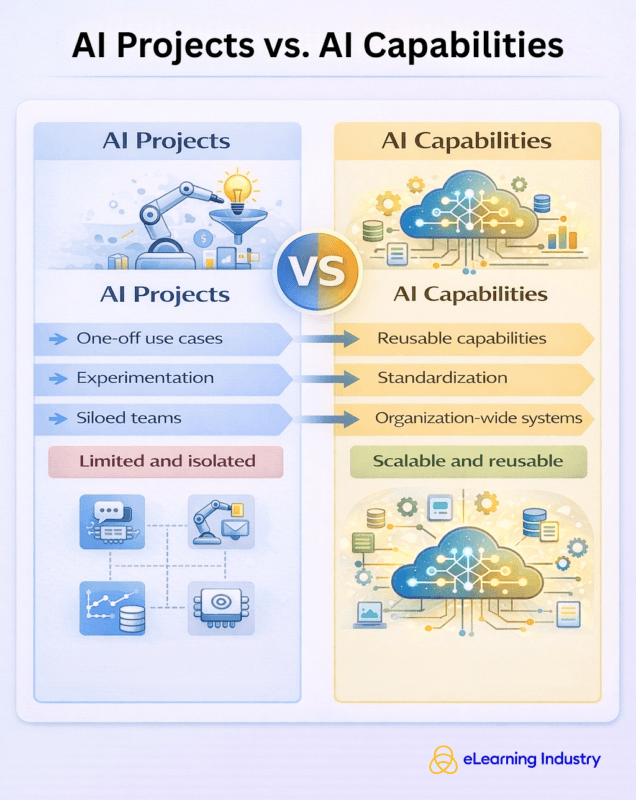
It is true that most organizations begin their AI journey with projects. This is a natural starting point where a specific problem is identified, a model is developed, and a solution is deployed.
That said, projects are useful for learning, but they do not scale well on their own. Over time, companies tend to realize the hard way that building AI one use case at a time leads to inefficiency. That happens because each project requires new data preparation, new model development, and new integration work. Even when successful, the impact remains localized.
The shift to capabilities changes the equation. Instead of focusing on individual solutions, organizations invest in reusable building blocks. In this sense, these capabilities can support multiple use cases across different functions.
For example, a recommendation engine built as a capability can be used in eCommerce, strategic marketing campaigns, and customer service. A forecasting platform with AI can support finance, operations, and inventory planning.
Therefore, this approach creates leverage. In detail, the cost of building each additional use case decreases, while consistency and quality improve. It also enables standardization. Best practices can be embedded into shared systems, reducing variability and risk.
There is another benefit, which is speed. With AI, teams no longer start from scratch. They can build on existing capabilities, accelerating time-to-value.
However, this shift requires a different mindset. It requires thinking beyond immediate use cases and investing in infrastructure and design that supports reuse.
Embedding AI Across Core Business Functions
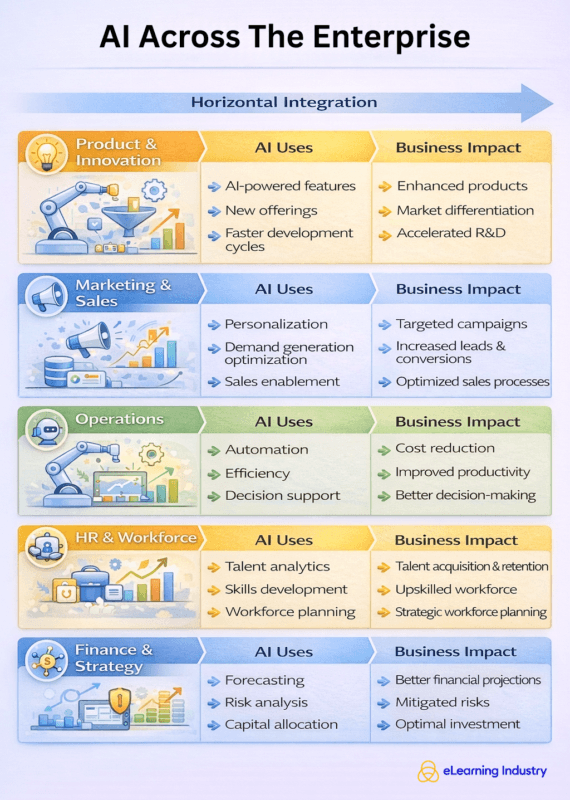
Embedding AI across functions is where corporate AI strategy becomes tangible. It is not enough to have strong capabilities. They must be integrated into how each function operates.
To be specific, in product and innovation, AI enables new interesting types of offerings. With AI, products become adaptive and intelligent in the market. Moreover, development cycles become faster through data-driven insights and automated testing. Do not forget that AI is not a feature; it becomes part of the product's core value.
Specifically in marketing and sales, AI shifts the focus from broad targeting to precise engagement. Personalization moves from segments to individuals. Therefore, campaigns are continuously optimized, with sales teams receiving insights that guide prioritization and improve conversion rates.
Moving on to operations, AI enhances efficiency and resilience. Here, processes are automated, but more importantly, they become adaptive. With AI, systems can respond to changes in demand, supply, or external conditions in real time. So, decision-making becomes more data-driven and less reactive.
In the department of HR and workforce management, AI changes how organizations understand and develop talent. Skills become more visible, learning becomes more personalized, and workforce planning becomes more dynamic. It is vital to know that this is critical because AI adoption depends heavily on people, not just technology.
Finally, in finance and strategy, AI improves forecasting and decision-making. With this advanced technology, leaders can model scenarios, assess risks, and allocate resources with greater confidence. Eventually, this process leads to more proactive and informed strategic choices.
The common thread across all functions is integration. Companies should not just use AI occasionally, but they should embed it into daily workflows.
The Role Of Leadership In Corporate AI Strategy
Leadership alignment is one of the most important and most underestimated factors in corporate AI strategy. In essence, embedding AI across an organization requires decisions that cut across functions, budgets, and priorities. Therefore, without strong leadership alignment, these decisions become fragmented or delayed.
In this area, the CEO plays a central role in setting direction. Strong leadership must position AI as a strategic priority and not just as a technical initiative. This process signals its importance to the rest of the organization.
At the same time, a single executive cannot own the whole AI strategy. That is because a solid strategy requires collaboration across the C-suite. The CIO or CTO may lead technology efforts, but business leaders must define use cases and drive adoption. Moreover, the CHRO plays a critical role in workforce transformation and skills development.
Putting it simply, clear ownership is essential. Organizations need defined accountability for driving AI across functions, not just within technical teams.
In an AI strategy, leadership must also be willing to make trade-offs. Embedding AI often requires reallocating resources, redesigning processes, and challenging existing ways of working. All these changes can be difficult, especially in large organizations with established structures.
Another key responsibility worth mentioning is maintaining momentum. AI transformation is not a one-time effort since it requires sustained commitment over time.
In general, when leadership is aligned, AI initiatives reinforce each other. When it is not, they compete. In practice, the difference between success and stagnation often comes down to how well leaders coordinate and commit.
The Corporate AI Operating Model
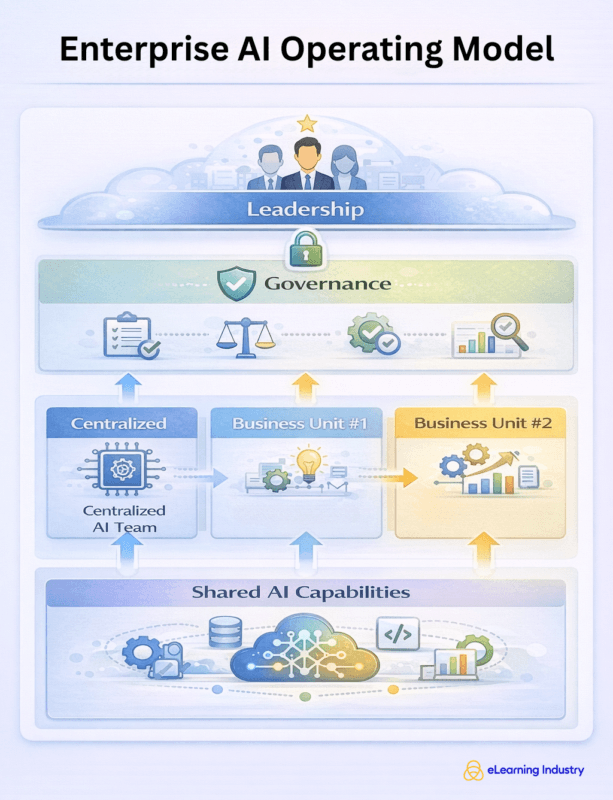
It is true that an effective operating model allows AI to scale beyond individual teams. Without such a model, even strong capabilities and leadership alignment struggle to translate into consistent execution. This solid operating model defines how AI-related work is structured across the organization while it balances centralization and distribution.
A great example and common approach here is a hybrid model. This model places a central team at the helm, tasked with developing shared capabilities, establishing standards, and maintaining consistency. Simultaneously, individual business units integrate AI into their particular workflows and applications. This approach enables organizations to scale effectively, all while staying attuned to local requirements.
Another critical layer here is governance, which ensures that AI is used responsibly and consistently. This case includes data standards, model validation, and risk management. At the end of the day, strong governance builds trust and enables broader adoption.
Another factor is cross-functional collaboration that is built into the operating model. In short, AI initiatives often require input from multiple teams. Consequently, clear processes and communication channels are needed to support this collaboration.
Shared capabilities are the foundation. Data platforms, model development tools, and analytics systems must be accessible across the organization. This reduces duplication and accelerates development.
In short, here are the top priorities of the hybrid model:
- Leadership alignment
- Shared capabilities
- Governance
- Cross-functional collaboration
- Analytics systems
The goal of this model is not rigidity. It is coherence. The operating model should provide enough structure to enable scale, while remaining flexible enough to support innovation.
Cultural And Organizational Change
We all know that technology can be built relatively quickly. However, culture takes longer. Embedding AI requires a shift in how people think and work. Without this shift, even the best-designed strategy will struggle to gain traction.
For a successful cultural and organizational change, you need to focus on the following:
- AI literacy
- Change management
- Skills development
- AI adoption mindset
Let's dive into each one of these below.
AI literacy is a foundational element. In essence, employees need to understand what AI can do, where it adds value, and how to use it effectively. This does not mean turning everyone into a data scientist. On the contrary, it means building confidence and familiarity.
Change management is equally important. AI often changes workflows and decision-making processes. This can create uncertainty. Therefore, clear communication, training, and support help reduce resistance and build trust.
Also, skills development is a long-term effort. Organizations need to invest in both technical and non-technical skills. This includes data skills, but also critical thinking and the ability to interpret AI-driven insights.
Ultimately, an adoption mindset is what determines success. Employees need to see AI as a tool that enhances their work, not one that replaces it. This requires leadership messaging, incentives, and visible success stories.
Cultural change is not a side effort, but central to embedding AI. Organizations that treat it as an afterthought often struggle with low adoption, even when the technology is strong.
Common Barriers To Embedding AI
Organizations encounter several predictable challenges, even with a well-defined strategy for AI integration.
Here is a list of some common barriers that many companies face:
- Organizational silos
- Lack of alignment
- Resistance to change
- Data fragmentation
- Weak leadership
Let's explore every barrier below.
In general, one of the most enduring obstacles is the existence of organizational silos. In most companies, the independent functioning of various departments impedes the sharing of data, capabilities, and insights, thereby restricting scalability and fostering redundancy.
Furthermore, a lack of alignment presents another significant hurdle. When teams lack a common vision and unified objectives, they tend to prioritize their individual projects. This, in turn, results in disjointed activities and variable outcomes.
Resistance to change can also impede the implementation of new systems. Employees might be reluctant to embrace Artificial Intelligence or modify their established work practices, particularly if the advantages are not effectively conveyed.
Sure, data fragmentation is a technical challenge, but it is also an organizational challenge. That is because data is often spread across systems and owned by different teams. Therefore, without integration, building scalable AI solutions becomes difficult.
Lastly, weak leadership commitment can undermine progress since AI transformation requires sustained focus and investment. So, if leadership attention shifts, initiatives lose momentum.
The challenges aren't only organizational. eLearning Industry's research found that 48% of learning technology vendors cite keeping pace with AI innovation as a major challenge, while 45% point to integration complexity and 41% report resource constraints related to budget, staffing, or development time.
Addressing these barriers is not a simple task. It requires a combination of structural, cultural, and leadership interventions. There is no single solution that does not require teamwork and effort. However, organizations that anticipate these challenges are better positioned to overcome them.
How Corporate AI Strategy Drives Competitive Advantage
When AI is embedded across the organization successfully, its impact compounds over time.
Below is a list of benefits of a solid corporate AI strategy:
- Faster innovation
- Decision-making
- Efficiency gains
- Revenue growth
- Clearer market segmentation
One of the most immediate benefits is faster innovation. With AI, shared capabilities and aligned teams reduce the time required to develop and deploy new solutions. Consequently, ideas move from concept to execution more quickly.
Decision-making is another aspect that improves as well. In essence, leaders and teams have access to richer data and predictive insights. Eventually, this leads to more informed and proactive decisions.
Efficiency gains are another major advantage. That is because AI automation and optimization reduce costs and improve performance. Ultimately, processes become more streamlined and less dependent on manual effort.
Another benefit is revenue growth that follows. AI enables new products, services, and business models, and enhances existing offerings, making them more competitive.
At the same time, market segmentation becomes much clearer. For example, companies that embed AI effectively operate differently because they respond faster, adapt more easily, and deliver better experiences.
The key takeaway here is consistency. The competitive edge offered by Artificial Intelligence doesn't stem from a single, major innovation. Instead, it arises from the widespread and ongoing application of AI throughout an organization.
The Role Of Learning And HR Tech In Corporate AI Strategy
Learning and HR technology are essential components of a corporate AI strategy. That is because they bridge the gap between strategic planning and practical implementation by equipping the workforce to function effectively in an AI-enhanced setting. Upskilling initiatives are therefore a key focus.
Essentially, employees must acquire new skills to thrive alongside AI. And learning platforms offer the solution: they provide focused, scalable training tailored to a company's specific requirements.
It is true that AI further improves this approach. All these new systems can customize content, suggest learning paths, and adjust based on how each person is doing. This makes the learning experience more pertinent and impactful.
HR technology also supports broader workforce transformation. Skills intelligence platforms help organizations understand what capabilities they have and what they need. This informs hiring, development, and workforce planning. Talent mobility becomes more dynamic. Employees can move into roles where their skills are most valuable, supported by data-driven insights. Eventually, this aligns directly with a broader reality. That is, workforce readiness is critical for AI success.
Therefore, organizations that invest in Learning and Development are better positioned to embed AI at scale. On the other hand, those that do not often face bottlenecks, even when the technology is available.
Conclusion
Corporate AI strategy is ultimately about integration.
To be precise, it is about moving from isolated initiatives to organization-wide capability. From experimentation to operationalization. From technical projects to business transformation.
The companies that succeed in this matter are those that align leadership, design effective operating models, invest in culture, and build capabilities that scale. Overall, they treat AI as part of how the organization works, not as something separate from it or as a new product feature.
Over time, this creates a compounding advantage. AI becomes embedded in decisions, workflows, and strategy. That is where they realize its full potential.
FAQA corporate AI strategy defines how an organization embeds AI across its entire business, not just within isolated teams or projects. It focuses on integrating AI into workflows, decision-making, and core functions so it becomes part of how the company operates. Unlike technical or experimental approaches, it is business-led, cross-functional, and designed to scale across the enterprise.
Enterprise AI strategy typically focuses on governance, infrastructure, and scaling frameworks across large organizations. Corporate AI strategy, on the other hand, focuses on embedding AI into everyday operations across functions. It connects governance with real-world execution by ensuring AI is actually used across the business.
Most companies struggle because their AI efforts remain fragmented. Initiatives are often siloed within departments, built as one-off projects, and not designed for reuse. Without alignment, shared capabilities, and leadership direction, AI cannot scale beyond pilots or limited use cases.
Embedding AI means integrating it into workflows, systems, and decision-making processes across departments. Instead of being used occasionally or experimentally, AI becomes a consistent part of how teams operate, make decisions, and deliver value.
Leadership is critical. Embedding AI requires alignment across the C-suite, clear ownership, and sustained commitment. Leaders must set priorities, allocate resources, and ensure collaboration across functions. Without strong leadership alignment, AI initiatives tend to remain disconnected and ineffective.
An AI operating model defines how AI capabilities are structured and managed across the organization. It includes the balance between central and distributed teams, governance mechanisms, and shared platforms. A strong operating model enables coordination, scalability, and consistency in AI efforts.
Corporate AI strategy transforms how each function operates. Marketing becomes more personalized and data-driven, operations become more efficient and adaptive, HR becomes more focused on skills and workforce planning, and finance gains better forecasting and decision support. The impact is both functional and cross-functional.
Common barriers include organizational silos, lack of cross-functional alignment, resistance to change, fragmented data, and weak leadership commitment. These challenges prevent AI from scaling and limit its overall impact on the business.
It creates advantage by enabling faster innovation, better decision-making, improved efficiency, and new revenue opportunities. Companies that embed AI across the organization can operate more effectively and adapt more quickly than those that treat AI as isolated experimentation.
AI success depends on people as much as technology. Employees need the skills, confidence, and mindset to work with AI effectively. Without investment in learning, upskilling, and change management, even the best AI strategy will struggle to scale across the organization.