

Pipeline Velocity In Learning Tech: Vital CMO Metrics To Track
It is common knowledge in business that pipeline size always looks good in board decks. That is because it includes big numbers, lots of opportunities, and a sense of momentum. However, there is a catch here. Pipeline size does not necessarily equal revenue.
A bloated, slow-moving pipeline is one of the most expensive problems a learning tech company can face. It often leads to deals stalling. As a result, CAC creeps up, forecasts slip, and pressure builds higher over time.
Yet, even though a bloated pipeline often results in decreased revenue, many LMS and HR tech companies still focus heavily on generating more leads. What is more surprising is that they do it without paying enough attention to how quickly those leads actually turn into revenue.
That is exactly where pipeline velocity comes in. Pipeline velocity measures how quickly deals move through the funnel and is one of the most important indicators of revenue efficiency in B2B SaaS.
In the following article, we break down how to measure pipeline velocity, identify what actually drives it, and guide CMOs on how to improve it in a way that directly impacts revenue performance.
Key Takeaways
- Pipeline velocity determines how quickly revenue is generated.
- It depends on deal size, win rate, sales cycle length, and opportunity volume.
- Improving velocity often drives faster growth than increasing lead volume.
- CMOs need tight alignment with sales to optimize pipeline flow.
In This Article, We Cover...
- What Pipeline Velocity Really Means
- Why Pipeline Velocity Matters More Than Lead Volume
- The Four Core Metrics That Drive Pipeline Velocity
- What Slows Down Pipeline Velocity In Learning Tech
- How CMOs Can Improve Pipeline Velocity
- Why Visibility And Authority Accelerate Pipeline
- The Role Of Demand Generation In Pipeline Speed
- Benchmarking Pipeline Velocity In LMS And HR Tech
- How To Measure And Track Pipeline Velocity
- Common Mistakes CMOs Make
What Pipeline Velocity Really Means
The initial step in the process is to properly define pipeline velocity. At its core, pipeline velocity is about the speed at which leads move through the pipeline. That is not activity, not volume, not potential, but speed.
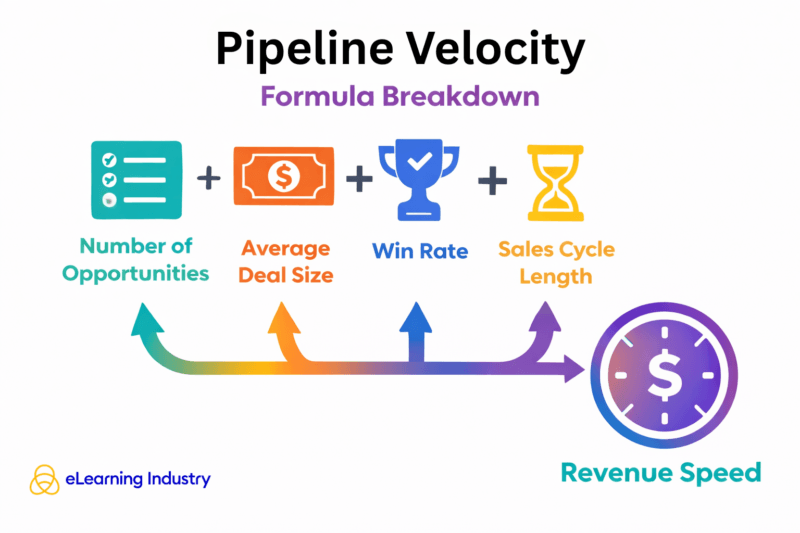
If we can create a formula, it would be this simple:
Pipeline Velocity = (Number of Opportunities × Average Deal Size × Win Rate) ÷ Sales Cycle Length
In this formula, each variable represents a constraint in your revenue engine.
- Opportunities reflect how effectively you generate pipeline.
- Deal size shows how much value you capture.
- Win rate reveals how strong your positioning and execution are.
- Sales cycle length exposes friction in the buying process.
The power of your pipeline velocity comes from how these factors interact.
Consider the following two companies as an example:
- Company A: €10M pipeline, 10% win rate, 180-day cycle
- Company B: €6M pipeline, 25% win rate, 60-day cycle
Despite having less pipeline, Company B generates revenue faster and more predictably. That is due to the speed of the movement within the pipeline.
That is the shift pipeline velocity forces. It turns a pipeline from a static number into a dynamic system that generates revenue.
Moreover, pipeline velocity highlights trade-offs. Let us not forget that increasing deal size can slow cycles. Also, increasing volume can reduce quality. Therefore, improving the win rate may require more targeted targeting rather than a broader audience.
Especially for CMOs, this is exactly where pipeline velocity becomes strategic. That is because it connects marketing decisions directly to revenue timing.
At the end of the day, the goal is not to maximize each variable. Rather, it is to optimize the system so that revenue flows consistently and quickly. Put simply, it is another win in the quality-over-quantity dispute.
Why Pipeline Velocity Matters More Than Lead Volume
The truth is that lead volume is easy to measure...and easy to celebrate. It is a metric that creates a sense of progress. Many leads come into the pipeline, and that, at first, seems like more revenue.
However, lead numbers can also create a false sense of security. A growing pipeline does not guarantee growing revenue. The problem here is that many teams only realize this when forecasts start slipping, despite strong top-of-funnel performance.
That gap is a velocity problem.
Pipeline velocity comes in to fill that gap by focusing on how efficiently pipeline converts into revenue. Ultimately, it shifts attention from input to output.
The truth is that most revenue issues are not caused by a lack of leads. They are caused by friction inside the funnel.
Therefore, by improving velocity, you create the following compounding benefits:
- Revenue is recognized faster
- Customer acquisition costs decrease
- Forecasting becomes more reliable
Moreover, you have a leadership impact since velocity also influences the following:
- Hiring plans
- Budget allocation
- Growth projections
Let us not completely throw lead volume out of the window. It is definitely a solid metric that works as a pipeline growth signal. However, pipeline velocity is a key metric that works as a performance signal. And performance is what you should be looking at.
For instance, a 20% increase in leads produces incremental growth. However, a 20% improvement in win rate or cycle length can significantly accelerate revenue timing.
In general, slow pipelines increase cost through longer engagement, more touchpoints, and higher drop-off rates. Faster pipelines reduce all of that.
Ultimately, you do not always need more pipeline. You often need a successful pipeline that moves better and faster. That is when you'll see the real impact on revenue.
The Four Core Metrics That Drive Pipeline Velocity
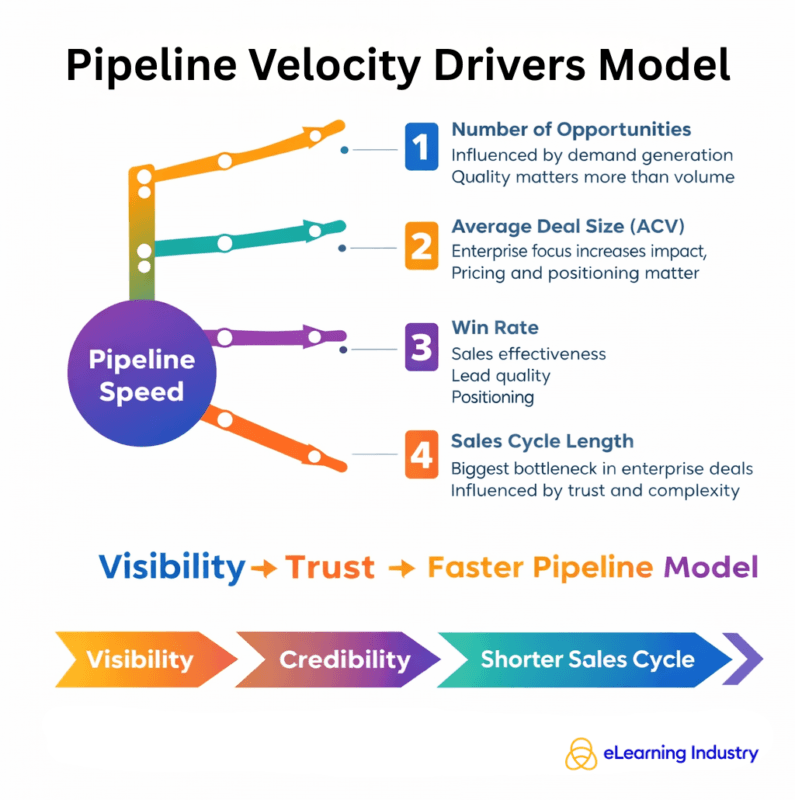
There are four important interconnected levers that drive pipeline velocity for your business. These are the number of opportunities, average deal size, win rate, and sales cycle length. Let us explore each of these below and see how they affect your pipeline.
1. Number Of Opportunities
The number of opportunities is basically your pipeline volume.
However, volume alone can often be misleading because poor-fit opportunities create drag. They also consume time, lower win rates, and extend cycles.
Instead, high-performing teams focus on:
- ICP clarity
- Intent signals
- Strict qualification
As a result, a smaller, focused pipeline often moves faster and converts better.
2. Average Deal Size (ACV)
The average deal size metric determines how much revenue each deal generates. Especially in learning tech businesses, increasing ACV often means moving upmarket.
Enterprise deals bring:
- Larger revenue impact
- More stakeholders
- Longer decision timelines
The goal here is not simply increasing deal size. It is mainly ensuring your brand positioning and sales motion support larger deals without slowing velocity excessively.
3. Win Rate
Win rate is a metric that reflects how effectively opportunities convert into revenue.
It is mostly influenced by:
- Lead quality
- Messaging clarity
- Competitive differentiation
- Sales execution
Overall, low win rates signal inefficiency. Sales teams spend time on deals that never close, slowing overall pipeline movement. For this reason, improving the win rate often requires fixing upstream issues, not just improving closing tactics.
4. Sales Cycle Length
Sales cycle length is often the biggest bottleneck in businesses. Specifically in LMS and HR tech, cycles are extended due to multiple stakeholders, procurement processes, and risk considerations.
One benefit of reducing cycle length is that it accelerates revenue without increasing pipeline size.
In general, all the above-mentioned metrics are interconnected and affect sales pipeline management directly. In a nutshell:
- Increasing ACV may extend cycles
- Increasing volume may reduce quality
- Tightening qualification may reduce pipeline but increase speed
Remember that pipeline velocity is a system, not a checklist.
What Slows Down Pipeline Velocity In Learning Tech
The learning tech market introduces unique friction in pipeline performance. Mostly, that is due to the complexities that deals present in the market.
Buyers in this market don't just purchase software. They make big decisions that impact employees, compliance, and organizational performance. Those decisions involve risk, which can directly affect the companies. This raises the stakes and slows the decision-making process.
Here are some common sources of friction in this market:
- Unclear positioning
- Weak differentiation
- Low trust
- Long evaluation cycles
- Multiple stakeholders
Moreover, there are some category-specific challenges that showcase friction:
- High switching costs for LMS platforms
- Complex integrations with HR systems
- Internal change management concerns
Especially in enterprise deals, buyers with multiple stakeholders are evaluating risk as much as value. If that risk is not addressed early, deals slow down. None of these buyers is willing to risk damage to their company if a safer option is available.
As a result, friction compounds. Then you have the lack of clarity that leads to more stakeholders. Eventually, more stakeholders require more validation, and more validation extends timelines. Consequently, extended timelines increase cost and damage.
In a nutshell, the goal is not to eliminate complexity, but to reduce unnecessary friction so decisions can happen faster and increase revenue.
How CMOs Can Improve Pipeline Velocity
It is a fact that improving velocity starts upstream. Specifically, CMOs have the potential to improve pipeline velocity and witness firsthand its effect on their business. It is not about pushing deals harder at the end. It is more about making them easier to close from the beginning.
Let us explore in this section the ways CMOs affect pipeline velocity directly.
Improve Lead Quality
One way for the C-suite to improve velocity is by improving the lead quality. As a rule, better targeting leads to faster conversion.
Overall, improving lead quality includes:
- Clear ICP definition
- Intent-based demand generation
- Strong qualification criteria
In many cases, reducing lead volume improves overall performance. You need to keep in mind that you want more quality leads in your pipeline and not more leads in general.
Strengthen Positioning And Messaging
Brand strategy with positioning and messaging is vital for pipeline velocity since clarity accelerates decisions.
Also, better positioning your services in the market will increase your chances of attracting quality leads. Potential buyers will know exactly what you offer and, hence, will approach you only if they really need you.
In short, buyers move faster when they immediately understand your value. Therefore, messaging should focus on outcomes, not features.
Build Trust Earlier
In general, trust reduces perceived risk. That is why it is critical to start building trust at the earliest stage.
Here are some effective trust builders that may help your company:
- Case studies
- Customer proof
- Independent validation
When trust exists early, fewer validation steps are needed later. Consequently, deals close faster and revenue increases.
Align Marketing And Sales
It is true that marketing and sales are two different departments with different goals. However, their goals are often interconnected for the ultimate goal of revenue. That is why it is important to align marketing and sales since pipeline velocity depends on alignment.
This alignment often includes:
- Shared KPIs
- Joint pipeline ownership
- Continuous feedback loops
Do not forget that velocity improvement is not a campaign, but an operating model shift.
Why Visibility And Authority Accelerate Pipeline
In the current state of the market, buyers are self-directed. They research extensively before engaging with vendors. By the time a sales conversation happens, a significant portion of the decision is already shaped. Most buyers shortlist 2–4 vendors before even speaking to anyone. If your brand is not visible early, you are either excluded entirely or forced to fight harder later in the process.
That is exactly where visibility becomes a velocity driver. Visibility creates:
- Familiarity
- Credibility
- Reduced perceived risk
All those three factors directly influence how quickly a deal moves.
If a buyer already knows your brand, the funnel compresses in the early stages. In short, less time is spent on basic education, and fewer internal objections surface. Therefore, the conversation moves faster toward evaluation and decision.
It is worth mentioning that authority takes this a step further, acting as a shortcut in the decision-making process. Buyers do not need as much proof when they already trust your expertise. This is especially important in learning tech, where perceived risk is high.
A large portion of this influence happens in what's often called the "dark funnel":
- Peer communities
- Review platforms
- Industry conversations
All these channels rarely appear in attribution reports, yet they heavily influence buyer confidence.
When visibility and authority are strong, sales cycles shorten because buyers enter the funnel already informed and partially convinced.
The Role Of Demand Generation In Pipeline Speed
There is confusion around demand generation that is often misunderstood as a lead generation function. In reality, its biggest impact is on buyer readiness.
Strong demand generation does not just create leads. It creates well-informed, confident buyers who move faster through the funnel. Demand generation does this by:
- Educating the market about the problem
- Building familiarity with your brand
- Establishing credibility before sales engagement
This process shifts where effort happens in the buying journey. Instead of spending time explaining the category, sales teams can focus on differentiation and value.
Demand generation compresses the timeline. To be specific, it does not just remove steps; it moves them forward.
For example:
- A buyer who discovers your content months before engaging will require less education.
- A buyer who has seen customer proof is more confident during evaluation.
- A buyer who trusts your brand is less likely to stall late in the process.
This is often referred to as the "known vendor advantage."
Here are the key benefits of known vendors:
- Convert faster
- Win more often
- Require fewer touchpoints
In contrast, unknown vendors must build trust from scratch during the sales cycle. That adds time and friction.
The fastest deals are rarely created at the moment of conversion. They are built long before the first sales interaction.
Benchmarking Pipeline Velocity In LMS And HR Tech
Depending on context, pipeline velocity may vary significantly. Especially in the LMS and HR tech market, without proper segmentation, benchmarking often becomes misleading.
In this scenario, the goal is not to match industry averages, but to understand what is normal for your specific motion and where your bottlenecks seem to be.
Here are some benchmarking scenarios.
By Deal Size
- Enterprise deals
- High ACV, longer cycles, complex stakeholder environments
- Mid-market deals
- More balanced across speed, volume, and deal size
- SMB deals
- Faster cycles, lower ACV, higher volume
Depending on the deal size, each segment requires a different velocity expectation.
By Motion Type
- Inbound
- Higher intent, shorter sales cycles, stronger conversion rates
- Outbound
- Lower initial trust, longer education phase, slower movement
Judging by the motion type, inbound typically produces faster velocity because buyers are already problem-aware.
By Product Complexity
- Point solutions
- Easier to evaluate, faster decisions
- Platform solutions
- Require deeper validation, longer timelines, more stakeholders
When it comes to product complexity, the most useful benchmarking approach is internal comparison.
The goals are simple: look at velocity across segments within your own pipeline. Then, identify where deals slow down and why.
Always keep in mind that trends over time are more valuable than single data points and that velocity improvement is about removing bottlenecks, not chasing averages.
How To Measure And Track Pipeline Velocity
Even if we achieve solid pipeline velocity, we need to measure it properly to make it count. Measuring pipeline velocity is straightforward in theory but difficult in practice without discipline. The first requirement for a successful measurement is consistency.
For consistency, teams must align on:
- What qualifies as an opportunity
- When a deal enters the pipeline
- What defines a closed deal
Without consistent definitions, velocity becomes unreliable.
The second requirement is clean data. Some common issues with data include:
- Inflated opportunity counts from weak qualification
- Deals staying open long after they’ve effectively stalled
- Missing or inaccurate close dates
Overall, these issues distort the metric and lead to poor decisions.
The third requirement is regular tracking. That said, velocity should be monitored on a consistent cadence:
- Monthly for strategic analysis
- Weekly for operational visibility
Moving on, we have segmentation. Here, segmentation is critical for measurement. In short, analyze pipeline velocity by:
- Deal size
- Source (inbound vs outbound)
- Region or market
This segmentation reveals where friction exists.
It is worth mentioning one important mindset shift: clean data is not just an operations concern. Instead, it directly impacts revenue forecasting, planning, and strategy. If your data is wrong, your conclusions will be too.
Common Mistakes CMOs Make
As we mentioned, pipeline velocity is often a challenging process to achieve. In the market, we witness even experienced teams fall into patterns that slow pipeline velocity.
- Focusing only on lead volume. Lead volume can often be misleading. That is because it creates the illusion of growth while masking inefficiencies in conversion and speed.
- Ignoring sales cycle length. Sales cycle length is vital for pipeline velocity. Ignoring this metric may lead to delayed revenue recognition and missed targets, even when pipeline appears healthy.
- Poor alignment with sales. Another common issue is the misalignment of marketing and sales. This one results in inconsistent messaging, weak handoffs, and slower deal progression.
- Not tracking velocity. CMOs often care more about the leads than the velocity. This preference prevents visibility into where the funnel is breaking down.
- Weak positioning. Positioning in the market makes things easier for both the buyer and the seller. Weak positioning forces buyers to spend more time comparing options, extending decision cycles.
- Treating symptoms instead of causes. Many teams react to slow revenue by increasing lead generation instead of fixing underlying inefficiencies.
Most velocity issues are not caused by a single problem; rather, they are the result of small inefficiencies compounding across the funnel. Fixing them requires a system-level view.
Conclusion
In this article, we covered the importance of pipeline velocity in the market and presented a guide to help you track this metric for your business.
In short, pipeline velocity is one of the most important revenue metrics in learning tech because it reflects how efficiently your go-to-market system converts effort into revenue.
Unlike pipeline size, which measures potential, velocity measures execution. That distinction matters a lot. Especially in complex B2B environments, growth does not come from doing more. Instead, it comes from doing things better and faster.
Therefore, improving pipeline velocity delivers:
- Faster revenue realization
- Lower acquisition costs
- More predictable growth
It also creates alignment across teams. While marketing focuses on quality and positioning, sales focuses on execution and progression. Leadership, on the other hand, gains clarity on performance.
Ultimately, the companies that win are not the ones with the biggest pipelines. They are the ones whose pipelines move efficiently. Because in the end, revenue is not just about how much demand you create. It is about how quickly you convert it.
FAQPipeline velocity measures how quickly opportunities move through the sales funnel and convert into revenue. It reflects the efficiency of your entire go-to-market system, not just how much pipeline you generate.
Pipeline velocity is calculated as:
(Number of Opportunities × Average Deal Size × Win Rate) ÷ Sales Cycle Length
This formula shows how different factors combine to determine how fast revenue is generated.
Pipeline velocity helps CMOs understand how marketing impacts revenue timing, not just lead generation. It connects demand generation efforts directly to business outcomes like revenue growth and forecasting accuracy.
Pipeline size measures potential revenue. Pipeline velocity measures how fast that potential turns into actual revenue. A large pipeline with slow movement can underperform a smaller, faster one.
Pipeline velocity is driven by four main factors:
- Number of opportunities
- Average deal size
- Win rate
- Sales cycle length
Improving any of these can impact overall revenue speed.
You can improve pipeline velocity by:
- Increasing lead quality
- Strengthening positioning and messaging
- Building trust earlier in the funnel
- Aligning marketing and sales teams
The goal is to reduce friction and help deals move faster.
Common causes include:
- Long evaluation cycles
- Multiple stakeholders
- Weak differentiation
- Low buyer trust
- Complex integrations and implementation concerns
These factors increase friction and delay decision-making.
Not necessarily. More leads can actually slow velocity if they are low quality. Improving lead quality and conversion rates is often more effective than increasing volume.
Pipeline velocity should be tracked regularly, typically:
- Weekly for operational visibility
- Monthly for strategic analysis
Consistent tracking helps identify bottlenecks early.
There is no universal benchmark. Pipeline velocity varies by:
- Deal size (enterprise vs SMB)
- Sales motion (inbound vs outbound)
- Product complexity
The most useful approach is to benchmark internally and track improvements over time.