

Share Of Voice SEO: The Ultimate Guide
Ranking for a few keywords is no longer enough. Search has changed. Buyers no longer discover brands through a single Google search and move straight to a purchase. Instead, they research across multiple channels, compare vendors, read industry content, browse directories, and increasingly ask AI tools for recommendations.
As a result, visibility has become a much broader concept.
For instance, a company might rank first for several valuable keywords and still struggle to gain market attention. Another company might rank across hundreds of relevant searches, appear in industry publications, earn mentions in expert articles, and show up in AI-generated recommendations. That company is likely capturing far more visibility, even if it doesn't dominate every individual keyword.
This is where SEO Share of Voice becomes important. SEO Share of Voice (SoV) measures how much organic search visibility your brand owns compared to competitors across a defined set of keywords, topics, or categories. Rather than focusing on isolated rankings, it evaluates your overall presence within the search landscape.
Especially for marketing leaders, SEO teams, SaaS companies, LMS vendors, and HR technology providers, Share of Voice offers a more strategic view of performance. Generally, it helps answer questions that traditional SEO metrics often miss:
- How visible are we compared to competitors?
- Which topics do we truly own?
- Where are competitors outperforming us?
- Which content gaps are limiting growth?
- How prepared are we for AI-driven search experiences?
As search continues to evolve, success is becoming less about ranking for individual terms and more about being consistently discovered wherever buyers seek answers.
SEO Share of Voice measures the percentage of organic search visibility a brand owns compared to competitors across a defined set of keywords and topics.
Key Takeaways
SEO Share of Voice measures visibility rather than rankings alone. In essence, it compares your organic search presence against competitors across a market or topic area.
Generally, a higher Share of Voice often correlates with stronger brand awareness, greater authority, and increased demand generation opportunities.
Hence, the brands that own topics tend to outperform brands that focus only on individual keywords. And as AI search grows, a new layer of visibility is emerging: AI Share of Voice.
Tomorrow's search leaders may be measured not only by rankings, but also by citations, recommendations, and references generated by AI systems.
In This Guide, You Will Find…
- What Is SEO Share of Voice?
- Why SEO Share of Voice Matters
- SEO Share of Voice vs Traditional SEO Metrics
- How to Calculate SEO Share of Voice
- The Different Types of SEO Share of Voice
- How High-Performing Brands Increase SEO Share of Voice
- Common SEO Share of Voice Mistakes
- SEO Share of Voice and Demand Generation
- How GEO Is Expanding the Meaning of Share of Voice
- Tools for Measuring SEO Share of Voice
- How to Build a Share of Voice SEO Strategy
- The Future of Search Visibility
What Is SEO Share Of Voice?
As per the definition, SEO Share of Voice is a measurement of how much visibility your brand owns within search results compared to competing organizations.
Most SEO reports focus on metrics such as rankings, traffic, clicks, and conversions. While those metrics remain important, they only show individual pieces of the puzzle.
Share of Voice takes a broader view. Instead of asking, "Where do we rank?" it asks, "How much of the search conversation belongs to us?" That difference matters a lot.
For example, imagine two companies operating in the same market. The first ranks number one for several high-volume keywords but has limited visibility beyond those terms. On the other hand, the second ranks consistently across hundreds of related searches covering the entire customer journey.
Although the first company may generate strong traffic from a handful of keywords, the second company often captures more overall attention because it appears wherever buyers are researching.
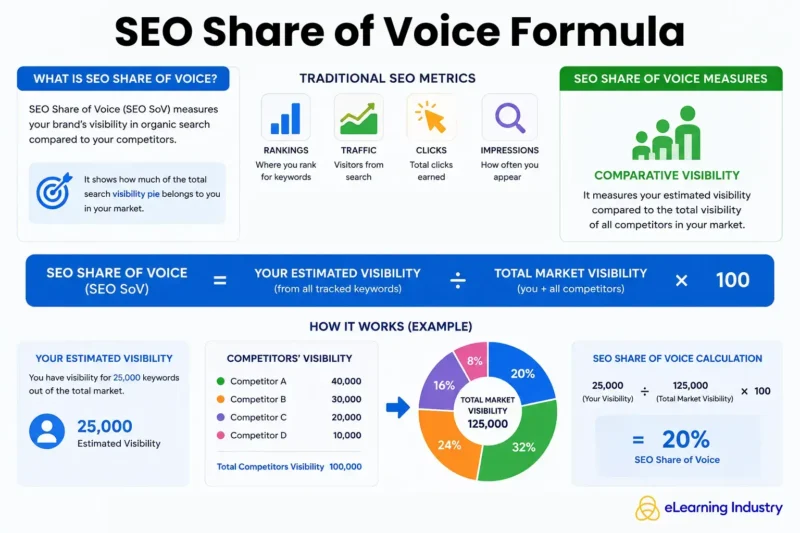
This is what Share of Voice measures. The calculation itself is straightforward:
SEO Share of Voice = Your Estimated Visibility ÷ Total Market Visibility × 100
If your brand owns 25,000 visibility points within a market containing 100,000 total visibility points, your Share of Voice equals 25%.
The formula is simple and the insight is powerful. Rankings tell you where pages appear. Share of Voice tells you how much of the market's attention your brand controls.
As search becomes more competitive and fragmented, that perspective becomes increasingly valuable.
Key Insight
SEO Share of Voice measures visibility, not rankings. It reveals how much of the search conversation your brand owns compared to competitors.
Why SEO Share Of Voice Matters
SEO is often viewed as a traffic channel. However, before it drives traffic, it creates visibility. Meanwhile, visibility influences awareness, trust, consideration, and ultimately revenue. This is why Share of Voice has become such an important metric for modern marketing teams.
The first reason is competitive positioning. Most organizations know how their own rankings are performing. Far fewer understand how much visibility they control relative to competitors.
A company may celebrate ranking improvements while competitors quietly expand into adjacent topics and capture larger portions of market attention.
Share of Voice exposes these shifts. Hence, it shows who is gaining ground, who is losing momentum, and where opportunities exist.
The second reason is brand awareness. In this area, people rarely buy from brands they have never encountered. This means that every appearance in search results creates an opportunity for familiarity. Over time, repeated exposure builds recognition and trust.
A prospect researching employee onboarding software may discover the same company through blog posts, guides, comparison pages, reviews, and industry resources. Each touchpoint reinforces awareness. Share of Voice helps measure how often those opportunities occur.
The third reason is demand generation. Here, many marketers focus on capturing demand that already exists but visibility also helps create demand. When organizations consistently appear across important industry topics, they shape conversations and influence how buyers think about solutions.
And finally, Share of Voice helps measure topic ownership. Modern SEO rewards expertise. Search engines increasingly prioritize organizations that demonstrate comprehensive knowledge of a subject rather than isolated keyword targeting.
Companies that build authority across an entire topic area typically achieve stronger long-term visibility than companies focused on individual rankings.
Key Insight
Ranking first for one keyword doesn't mean you own the conversation. Owning a topic does.
SEO Share Of Voice Vs Traditional SEO Metrics
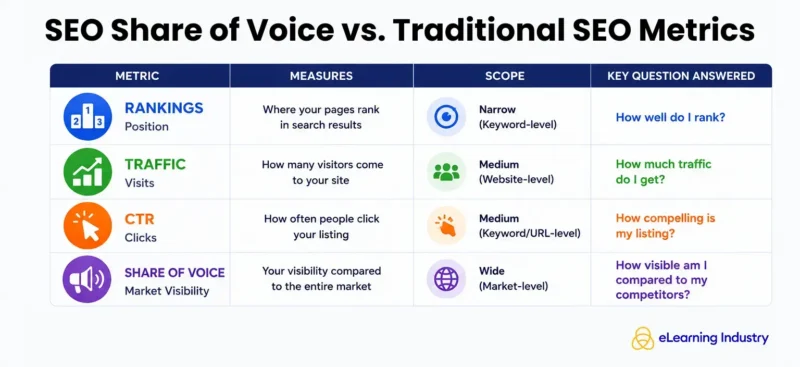
Traditional SEO metrics remain valuable. However, each serves a different purpose. In essence, rankings help you understand where pages appear within search results. On the other hand, traffic shows how many visitors arrive through organic search.
Click-through rate reveals how effectively your listings attract attention. Conversions measure business outcomes. Share of Voice operates at a higher level. Rather than evaluating individual pages or keywords, it measures overall market visibility.
This distinction becomes important because rankings can sometimes create a false sense of progress. A company may improve positions for several keywords while competitors expand their content footprint across dozens of related topics.
Often, traffic can also be misleading. In many ways, traffic growth may look impressive, but it does not necessarily indicate stronger market ownership. Competitors could be growing faster.
Share of Voice introduces context by showing how your visibility compares against the broader competitive landscape.
For executives and marketing leaders, this often provides a more meaningful measure of strategic performance than rankings alone.
How To Calculate SEO Share Of Voice
Calculating Share of Voice starts with defining the market you want to measure.
The first step here is identifying your keyword universe. This should include the keywords that matter most to your category, customer journey, and business goals. A narrow keyword set may produce misleading results, while a broad keyword universe provides a more accurate picture of visibility.
For example, an LMS provider might track terms related to Learning Management Systems, compliance training, employee onboarding, skills development, learning analytics, and certification management.
The second step is identifying competitors. Importantly, SEO competitors are not always the same as business competitors.
Review sites, directories, educational publishers, and industry resources often compete for search visibility even if they do not sell competing products.
The third step involves calculating visibility.
Most SEO platforms assign visibility scores based on ranking positions, search volume, and estimated click-through rates. Higher rankings receive greater visibility value because they attract more clicks. Lower rankings receive smaller values. These scores are then combined across the keyword set to create an overall visibility score.
The final step is benchmarking.
Once visibility has been calculated for all competitors, each organization's percentage of total market visibility can be determined. That percentage becomes its Share of Voice.
The process may sound technical, but the goal is simple: understand how much search attention your brand owns compared to everyone else competing for the same audience.
The Different Types Of SEO Share Of Voice
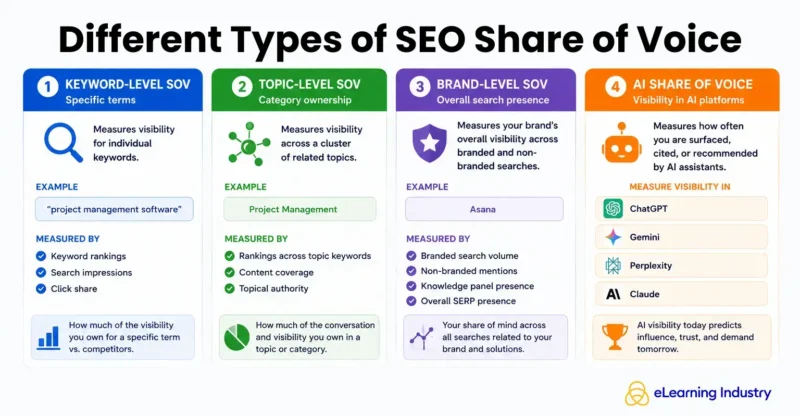
Not all Share of Voice measurements are the same.
Many organizations track a single visibility score and assume it tells the entire story. In reality, Share of Voice can be measured at multiple levels, each providing different insights into market performance.
Understanding these different layers helps marketing teams identify where they are strong, where they are vulnerable, and where the greatest opportunities exist.
Keyword-Level Share Of Voice
Keyword-level Share of Voice focuses on visibility for specific search terms. This is often the starting point for many SEO teams because it provides a clear picture of performance around high-priority keywords.
For example, an LMS vendor may want to understand its visibility for searches such as "learning management system," "employee training software," or "compliance training platform."
Tracking Share of Voice at the keyword level helps identify which competitors dominate important commercial terms and where ranking improvements could generate meaningful visibility gains.
However, keyword-level analysis has limitations.
Buyers rarely conduct a single search before making a purchasing decision. They explore dozens of related questions throughout their journey. Focusing exclusively on individual keywords can create a narrow view of market visibility.
Topic-Level Share Of Voice
Topic-level Share of Voice provides a broader perspective. Instead of measuring visibility around individual keywords, it measures visibility across entire subject areas. This approach aligns more closely with how search engines evaluate expertise today.
A company that publishes comprehensive content around onboarding, compliance training, learning analytics, skills development, and workforce enablement is building visibility across a broader learning and development ecosystem.
Topic-level analysis reveals whether a brand truly owns a category or simply ranks for isolated keywords. For many organizations, this is where the most valuable insights emerge because buyers don't think in keywords. They think in problems, challenges, and goals.
Topic ownership allows brands to appear throughout those conversations.
Brand-Level Share Of Voice
Brand-level Share of Voice measures overall visibility across all tracked topics and keywords. This creates a market-wide view of performance.
Executives often find this measurement particularly useful because it connects SEO efforts to broader brand visibility objectives.
Instead of focusing on hundreds of individual rankings, leadership teams can evaluate whether the organization is gaining or losing overall market presence.
Over time, changes in brand-level Share of Voice can reveal important competitive trends long before they appear in revenue reports.
AI Share Of Voice
A newer category is beginning to emerge: AI Share of Voice.
As buyers increasingly use AI assistants to research products, compare solutions, and discover vendors, visibility is expanding beyond traditional search engines.
Platforms such as ChatGPT, Google Gemini, Perplexity, and Claude are becoming discovery channels in their own right. Instead of presenting a list of links, these systems generate recommendations. That changes the visibility equation. The question is no longer only, "Do we rank?" The question becomes, "Are we being recommended?"
Organizations that appear consistently within AI-generated responses are developing a new form of Share of Voice that extends beyond traditional rankings.
Key Insight
Tomorrow's search leaders may be measured by recommendations, not rankings.
How High-Performing Brands Increase SEO Share Of Voice
The companies with the highest Share of Voice rarely achieve it through isolated SEO tactics. They build systems that create authority over time.
One of the most effective approaches is developing content clusters. Rather than publishing disconnected articles, high-performing brands create interconnected content ecosystems around strategic topics.
Each article supports a larger theme, helping search engines understand the depth and breadth of expertise within that subject area. Topical authority is another major factor.
Search engines increasingly reward organizations that consistently publish useful, comprehensive content covering a topic from multiple angles. This doesn't necessarily mean producing more content. It means producing more complete coverage.
Internal linking also plays an important role. Strong internal linking structures help distribute authority across content assets while reinforcing topical relationships. This improves discoverability for both users and search engines.
Thought leadership contributes as well. Companies that publish expert perspectives, industry analysis, and unique insights often attract stronger engagement and authority signals than companies focused solely on keyword-driven content.
Original research remains one of the most effective visibility drivers available. When organizations publish proprietary data, benchmark reports, or industry surveys, they create assets that naturally attract links, mentions, citations, and references.
Digital PR amplifies these efforts. Earned media placements, expert contributions, podcast appearances, interviews, and industry coverage help expand visibility beyond owned channels.
Together, these activities strengthen authority and increase the likelihood of appearing in both traditional search results and AI-generated recommendations.
Key Insight
The goal isn't more content. It's greater topic ownership.
Common SEO Share Of Voice Mistakes
Many organizations track Share of Voice incorrectly.
The most common mistake is focusing exclusively on rankings. Rankings are useful, but they represent only one component of visibility. Companies that obsess over position changes often miss larger competitive shifts occurring across broader topic areas.
Another mistake is tracking too few keywords. A small keyword set may produce an incomplete picture of market visibility. Effective Share of Voice measurement requires a representative sample of searches spanning the entire customer journey.
Ignoring competitors is another frequent issue. According to guidance from Semrush, Share of Voice becomes significantly more valuable when measured within a competitive context. Visibility gains are meaningful only when viewed against competing organizations.
Many companies also overlook branded search visibility. Branded searches often indicate awareness and market demand. Excluding them can distort visibility calculations and hide important trends.
Perhaps the biggest emerging mistake is ignoring AI visibility. Organizations may achieve strong rankings while remaining largely absent from AI-generated recommendations. As AI-driven discovery continues growing, this gap will become increasingly important.
Companies that monitor only traditional SEO metrics risk missing a rapidly expanding visibility channel.
SEO Share Of Voice And Demand Generation
One of the biggest misconceptions about SEO is that its primary purpose is generating traffic.
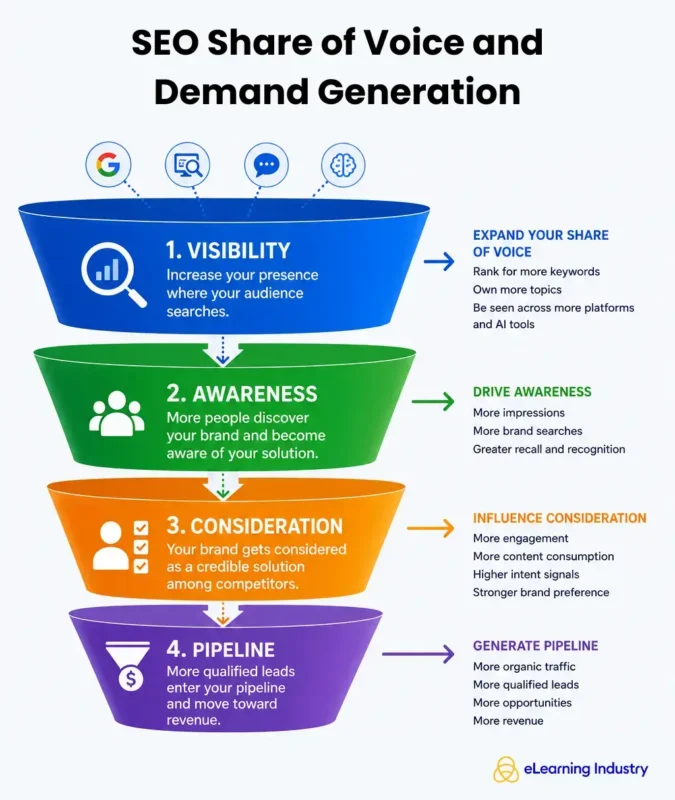
Yes, it is true, traffic matters but visibility often matters first. Because, before buyers click, they discover. And, before they request a demo, they become aware. At the end, before they enter a sales pipeline, they develop familiarity and trust.
This is where Share of Voice connects directly to demand generation. Organizations with stronger visibility typically generate more opportunities to influence buying decisions throughout the customer journey.
When prospects repeatedly encounter a brand during research, awareness grows. As awareness grows, consideration increases. As consideration increases, more opportunities enter the pipeline.
The relationship is not perfectly linear, but the pattern is consistent.
Brands that dominate visibility often become the brands buyers think of first. This is particularly important in complex B2B markets where purchasing decisions involve extensive research and multiple stakeholders.
A stronger Share of Voice creates more opportunities to shape those conversations before competitors do.
How GEO Is Expanding The Meaning Of Share Of Voice
For years, SEO Share of Voice focused primarily on Google rankings. Today, that definition is expanding.
Generative Engine Optimization (GEO) introduces a new layer of visibility that traditional SEO metrics often fail to capture. Instead of measuring rankings alone, GEO focuses on how often brands are referenced, cited, and recommended within AI-generated responses.
This shift changes what marketers should track. A company might rank highly in search results while receiving few AI mentions. Another organization may have moderate rankings but receive frequent recommendations because it is consistently referenced across trusted sources. This is why third-party validation has become increasingly important.
Mentions across industry publications, expert roundups, top lists, directories, analyst reports, podcasts, forums, and communities help establish credibility signals that AI systems can interpret as consensus.
Large language models learn from vast amounts of human-generated content. When a brand appears consistently across trusted sources, that repetition strengthens its perceived authority.
In contrast, companies that rely exclusively on self-published content often struggle to earn recommendations for non-branded queries because there is little independent validation supporting their claims.
For learning technology and HR technology vendors, this creates a significant opportunity.
Industry visibility initiatives such as inclusion in top lists, expert articles, directory placements, and sponsored content can contribute not only to SEO performance but also to future AI discoverability.
Useful resources include:
Key Insight
Companies should begin tracking AI Share of Voice alongside traditional SEO Share of Voice. The brands most frequently cited today are often the brands most likely to be recommended tomorrow.
Tools For Measuring SEO Share Of Voice
There is no single platform that provides a complete view of modern Share of Voice. Instead, organizations typically combine several categories of tools.
SEO platforms help track rankings, visibility, and keyword performance across competitors.
Competitive intelligence platforms provide insight into market positioning, content gaps, and emerging opportunities.
AI visibility tools are beginning to emerge as organizations seek to understand how frequently they appear within AI-generated responses and recommendation engines.
The most important factor is not the tool itself, but establishing a consistent measurement framework that allows visibility to be tracked over time. The goal is to identify trends, opportunities, and competitive shifts before they impact growth.
How To Build A Share Of Voice SEO Strategy
It is true that measuring Share of Voice is useful. However, improving it is where the real value lies.
Many organizations collect visibility data but struggle to turn those insights into action. They know where competitors are outperforming them, yet they lack a structured process for closing the gap.
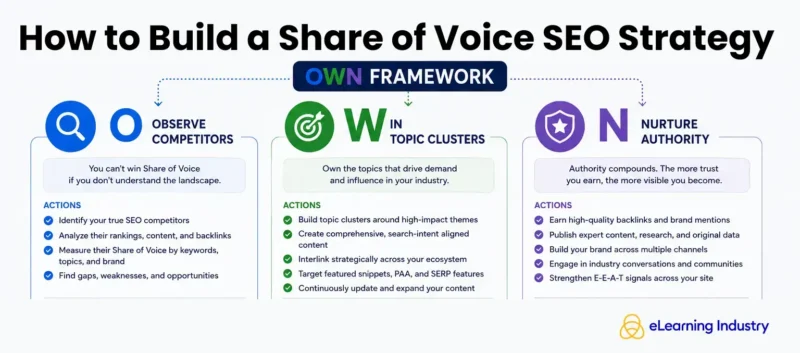
One practical approach is to build a Share of Voice strategy around what we call the OWN Framework. The framework focuses on three core activities that drive sustainable visibility growth.
O - Observe Competitors
The first step is understanding the competitive landscape, and it goes beyond monitoring rankings.
Organizations should analyze which topics competitors dominate, which content formats perform best, where competitors earn backlinks, and how they position themselves within the market.
The goal is not to copy competitors but to identify opportunities they have already validated.
Competitive analysis often reveals content gaps, emerging themes, and underserved audience needs that can quickly become visibility opportunities.
Organizations that consistently monitor competitors tend to react faster to market shifts and uncover growth opportunities before they become crowded.
W - Win Topic Clusters
The next step is expanding topic ownership.
Many brands create content around isolated keywords. High-performing brands build topic ecosystems. So, rather than targeting a single search phrase, they create interconnected content that covers a subject comprehensively.
For example, an LMS provider might create a content cluster around employee training that includes onboarding, compliance, skills development, learning analytics, certification programs, and training measurement.
This approach helps search engines understand expertise while increasing visibility across a broader range of searches. More importantly, it aligns with how buyers actually research solutions. People don't search for a single keyword and stop; they explore topics. Winning topic clusters helps ensure your brand appears throughout that journey.
N - Nurture Authority
Visibility growth is difficult without authority.
Authority is built through consistent expertise, trusted references, and third-party validation.
This includes:
- Publishing original research
- Contributing expert insights
- Earning media coverage
- Securing industry mentions
- Building high-quality backlinks
- Participating in industry conversations
Authority also plays an increasingly important role in AI visibility.
Recommendation engines and large language models often rely on patterns of trust and consensus when determining which brands to reference. The stronger your authority signals become, the greater your potential visibility across both traditional search and AI-driven discovery platforms.
The Future Οf Search Visibility
Search visibility is entering a new phase.
For more than two decades, rankings have been the dominant measurement of SEO success, but that is beginning to change.
Search engines are increasingly incorporating AI-generated experiences into search results. At the same time, standalone AI platforms are becoming research tools for buyers evaluating products, services, and vendors. As a result, visibility is expanding beyond blue links.
The next generation of search visibility will likely include four interconnected layers.
The first layer remains rankings.Organizations still need strong organic performance because search engines continue to play a central role in discovery.
The second layer is citations. Brands that earn mentions across trusted publications, directories, communities, and expert resources strengthen their authority footprint.
The third layer is recommendations.
As AI systems increasingly provide direct answers, recommendations become a new form of visibility. Appearing within a recommendation may prove more valuable than earning a traditional ranking position.
The fourth layer is AI references.
Organizations will increasingly measure how often they are cited, referenced, and recommended by AI-powered platforms. This evolution does not mean traditional SEO is disappearing. It means SEO is expanding.
Visibility is becoming a broader discipline that combines search performance, authority building, digital PR, content strategy, and AI discoverability.
The organizations that understand this shift early will have a significant advantage.
Key Insight
Brands that dominate search conversations today are likely to dominate AI recommendations tomorrow.
Conclusion
SEO Share of Voice is one of the most valuable metrics for understanding market visibility and competitive positioning. Unlike rankings, which focus on individual keywords, Share of Voice reveals how much of the overall search conversation belongs to your brand.
This broader perspective helps organizations identify growth opportunities, benchmark competitors, prioritize content investments, and measure progress toward topic ownership.
As search continues evolving, visibility can no longer be measured solely through rankings and traffic.
Buyers discover brands through search engines, industry publications, directories, communities, reviews, and increasingly through AI-powered recommendation systems.
Organizations that want to lead their categories must understand how visible they are across all of these channels.
The future belongs to brands that are consistently discovered, cited, and recommended wherever buyers search for answers. That is what modern Share of Voice is really measuring.
FAQSEO Share of Voice is a metric that measures how much organic search visibility a brand owns compared to competitors. It evaluates a company's presence across a defined set of keywords or topics and expresses that visibility as a percentage of the total market visibility available.
SEO Share of Voice is calculated by dividing your estimated visibility by the total visibility of all competitors within a keyword set and multiplying the result by 100. Most SEO platforms use ranking positions, search volume, and estimated click-through rates to calculate visibility scores.
There is no universal benchmark because Share of Voice varies by industry and market size. In highly competitive markets, even a 10-15% Share of Voice can be significant. Generally, a growing Share of Voice is often more important than the absolute percentage because it indicates increasing market visibility.
Rankings measure the position of a page for a specific keyword. Share of Voice measures overall visibility across multiple keywords, topics, and competitors. It provides a broader view of market presence and competitive positioning.
AI Share of Voice measures how frequently a brand appears in AI-generated recommendations, citations, and responses across platforms such as ChatGPT, Gemini, Claude, and Perplexity. It represents an emerging layer of visibility that extends beyond traditional search rankings.
Improving Share of Voice typically requires expanding topic coverage, building topical authority, strengthening internal linking, publishing original research, earning quality backlinks, generating third-party mentions, and increasing visibility across trusted industry publications and directories.
Share of Voice helps organizations understand their competitive position within search results. It reveals how much visibility they own compared to competitors and highlights opportunities to improve authority, awareness, and market influence.
While it is not a direct revenue metric, many studies have found a relationship between visibility, brand awareness, and business growth. Organizations that consistently increase Share of Voice often improve brand recognition and create more opportunities for future demand generation.
Yes. Branded searches often reflect existing awareness and demand, while non-branded searches reveal how effectively a company attracts new audiences. Tracking both provides a more complete picture of visibility performance.
Generative Engine Optimization expands the concept of Share of Voice beyond rankings. It focuses on increasing visibility within AI-generated responses by strengthening authority signals, earning third-party mentions, and creating content that AI systems are more likely to reference and recommend.
