

10 Best Competitor Analysis Tools To Measure Your eLearning Or HR Tech Brand
In competitive markets like eLearning and HR tech, visibility alone is not enough. That is because dozens of vendors often offer similar features, target the same audiences, and compete across the same channels. Therefore, standing out requires more than good messaging or a polished website. It requires context.
eLearning and HR tech companies need to understand how they compare against competitors across traffic, positioning, content, and demand generation. They need to see what their competition does and what they miss. Yet many teams still rely on assumptions. In detail, they guess at competitors' moves, copy surface-level tactics, or focus solely on internal metrics without a clear benchmark.
That approach slows growth significantly.
Competitor analysis is not just about tracking others. It is mainly about understanding where you stand in the market and identifying where you can win. When companies do it properly, it helps teams uncover gaps, refine positioning, and prioritize the channels that actually drive results.
In this article, we break down the best competitor analysis tools for marketing and growth teams in eLearning and HR tech. More importantly, we show how to use them for real benchmarking, not just data collection.
As a rule, competitor analysis tools help companies benchmark performance, identify market gaps, and refine positioning by analyzing competitors' traffic, content, ads, and visibility strategies.
Key Takeaways
- Competitor analysis tools provide insights into traffic, SEO, ads, and positioning.
- The best tools combine data with actionable insights.
- Benchmarking helps companies identify gaps and growth opportunities.
- High-performing vendors use competitor data to refine strategy and accelerate growth.
In This Article, You Will Find...
- Why Competitor Analysis Matters In eLearning And HR Tech
- What To Look For In A Competitor Analysis Tool
- The 10 Best Competitor Analysis Tools For eLearning And HR Tech Vendors (By Category)
- How To Use These Tools For Real Competitive Benchmarking
- What Most Companies Get Wrong About Competitor Analysis
- Beyond Tools: Where Real Competitive Advantage Comes From
- Why Visibility Platforms Matter For Competitive Benchmarking
- How High-Performing Vendors Combine Tools With Market Presence
Why Competitor Analysis Matters In eLearning And HR Tech
Before presenting the competitor analysis tools, we need to establish why this analysis is important in the market. As you know, the eLearning and HR tech space is crowded. This means new vendors enter the market regularly, and established players continue expanding their offerings. On the surface, many solutions look similar since they promise better learning outcomes, improved engagement, or streamlined HR processes.
Overall, this creates a challenge for buyers. In the meantime, it also creates a bigger challenge for marketers.
It is true that buying cycles in this space are long. That is mainly because decision-makers compare multiple vendors, review content, analyze features, and often involve several stakeholders before making a choice. That means your brand is not evaluated in isolation, but it is always compared to others in the market.
Having all this in mind, without competitive insight, teams operate in the dark. For instance, they may invest heavily in content that competitors already dominate. Also, they may miss emerging trends or fail to address key buyer concerns. Even worse, they may position themselves in ways that sound identical to everyone else.
Solid competitive intelligence changes that. In general, it helps teams understand how competitors attract traffic, what messages they use, where they invest, and how they are perceived. With that context, companies can make smarter decisions. They can position more clearly, target overlooked opportunities, and respond faster to market shifts.
In short, competitor analysis is not just a research exercise. It is a growth driver.
What To Look For In A Competitor Analysis Tool
As it happens, in every market, not all competitor analysis tools serve the same purpose. Some tools focus on SEO while others track ads, monitor messaging, or provide high-level market insights. Choosing the right mix depends on what you are trying to learn.
Still, there are a few core capabilities every strong tool should offer:
- Traffic insights
- Keyword tracking
- Content analysis
- Ad intelligence
- Benchmarking capabilities
- Ease of use
First, there are traffic insights. With this metric, you understand how competitors generate visibility. Where does their traffic come from? Organic search, paid campaigns, referrals, or direct visits? This helps you see where demand exists and how it is captured.
Second, keyword tracking. This is a metric that strong SEO competitor analysis tools show, which keywords competitors rank for, where gaps exist, and how rankings change over time. This is a metric essential for building a content strategy that competes effectively.
Third, we have content analysis. As you know, it is not enough to know what keywords competitors target. You also need to see what types of content perform well. That is, blog posts, guides, landing pages, and thought leadership all play different roles in the funnel.
Fourth, there is ad intelligence. Paid campaigns reveal where competitors invest budget and how they position their offers. Messaging, creative formats, and targeting signals all provide valuable clues.
Fifth, benchmarking capabilities. In the market, the best tools allow you to compare multiple competitors side by side. This metric helps you understand your relative position instead of looking at isolated data points.
Finally, ease of use. Data is only useful if teams can actually interpret it. The best tools should surface insights clearly and support decision-making, not overwhelm users with raw information.
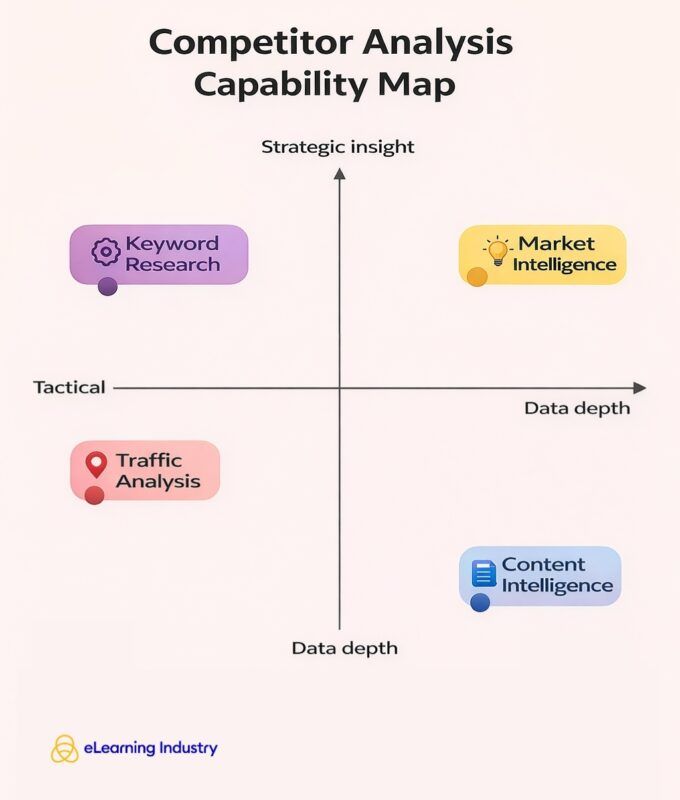
The 10 Best Competitor Analysis Tools For eLearning And HR Tech Vendors (By Category)
Not all competitor analysis tools solve the same problem. Some help you understand how competitors generate traffic. Others track their moves, reveal customer perception, or show where they invest marketing budget.
The most effective teams do not rely on a single tool. Instead, they build a system that combines multiple perspectives.
Category 1: SEO And Traffic Intelligence Tools (Understand Competitor Visibility)
In this category, we have tools that help us understand competitor visibility in the market. In short, these tools focus on how competitors attract traffic and build authority online.
1. Semrush
What it does: Semrush is an all-in-one SEO and competitive research platform.
Key features include:
- Keyword gap analysis
- Traffic insights
- Domain comparisons
Best for: This platform is best for understanding how competitors generate organic traffic and where gaps exist.
Strategic value: Overall, Semrush helps identify opportunities to outrank competitors and capture demand that already exists in your market.
2. Ahrefs
What it does: Ahrefs is an SEO and backlink analysis platform.
Key features include the following:
- Backlink tracking
- Content gap analysis
- Keyword research
Best for: This tool is good for analyzing competitor authority and link-building strategies.
Strategic value: Ahrefs reveals how competitors build credibility over time, especially through backlinks and content performance.
3. Similarweb
What it does: Similarweb is a traffic and audience intelligence platform.
Key features:
- Traffic sources
- Audience insights
- Competitor benchmarking
Best for: Similarweb is a platform known for understanding where competitor traffic comes from and how users behave.
Strategic value: Overall, Similarweb provides a high-level view of market positioning and digital performance across competitors.
Category 2: Competitive Intelligence And Monitoring Tools (Track Moves In Real Time)
In this category, we have tools that help you stay updated on competitor activity and strategic changes.
4. Crayon
What it does: Crayon is a competitive intelligence platform for tracking market movements.
Key features:
- Competitor updates
- Messaging tracking
- Sales insights
Best for: This tool is best for staying informed about competitor positioning and changes.
Strategic value: Overall, Crayon enables faster reactions to market shifts and helps teams refine positioning proactively.
5. Kompyte
What it does: Kompyte is a real-time competitor monitoring and sales enablement tool.
Key features:
- Competitor alerts
- Battlecards
- Strategy tracking
Best for: This tool is ideal for aligning marketing and sales around competitor insights.
Strategic value: Overall, Kompyte improves win rates by giving teams clear, actionable competitive intelligence.
6. SpyFu
What it does: SpyFu is a competitor keyword and ad tracking tool.
Key features:
- Paid search insights
- Keyword tracking
- Competitor ad history
Best for: This tool is ideal for understanding competitor paid strategies.
Strategic value: In general, SpyFu reveals where competitors invest in demand generation and how their paid strategies evolve.
Category 3: Review And Comparison Platforms (Understand Buyer Perception)
In this section, we have platforms and directories that influence how buyers evaluate and shortlist vendors.
7. G2
What it does: G2 is a software marketplace based on user reviews and category rankings.
Key features:
- Verified reviews
- Category positioning
- Competitor comparisons
Best for: G2 is best for understanding how customers perceive competitors.
Strategic value: Overall, G2 highlights strengths, weaknesses, and buyer sentiment at scale.
Limitation: This platform is primarily review-driven, with less focus on strategic positioning or storytelling.
8. Capterra / GetApp
What it does: Capterra and GetApp are software discovery platforms that help users compare tools.
Key features:
- Vendor listings
- Category filters
- User reviews
Best for: These tools are best for analyzing how competitors appear in software directories.
Strategic value: Overall, these platforms provide visibility into how competitors position themselves across broader categories.
Limitation: The downside of these platforms is that their broad focus can make it harder for niche learning solutions to stand out.
Category 4: Ad Intelligence And Market Signals (Track Demand And Budget)
These are tools that show how competitors invest in paid acquisition.
9. LinkedIn Ads Library / Meta Ads Library
What it does: LinkedIn and Meta provide public databases of active ads.
Key features:
- Ad creatives
- Messaging
- Targeting signals
Best for: This feature is best for understanding campaign strategies and positioning.
Strategic value: They reveal where competitors are investing and how they communicate value.
10. Google Alerts And Brand Monitoring Tools
What it does: Google gives you the tools to track mentions, PR activity, and brand visibility.
Key features:
- Real-time alerts
- Media mentions
- Brand tracking
Best for: These tools are ideal for monitoring competitor announcements and visibility.
Strategic value: Overall, these tools provide insight into partnerships, PR strategies, and market activity.
Category 5: Industry-Specific Visibility Platforms (Where Buyers Actually Choose Vendors)
In fact, this is the layer many teams overlook.
While tools help you analyze competitors, visibility platforms determine whether you are even considered in the first place.
eLearning Industry
What it does: eLearning Industry is a specialized platform connecting eLearning and HR tech vendors with high-intent buyers.
Key capabilities:
- Vendor listings in niche directory categories
- Top lists and rankings
- Content-driven visibility (articles, eBooks, webinars)
- Targeted lead generation campaigns
Best for: This industry-specific platform is ideal for reaching decision-makers actively researching solutions.
Strategic value: One of the strong points of eLearning Industry is that it positions vendors directly in front of their ideal audience during the evaluation phase.
Key Insight
- Competitor analysis tools tell you what your competitors are doing.
- Industry platforms determine whether you are part of the conversation.
This combination of tools and platforms allows companies not only to analyze competitors, but also to act on those insights through visibility, positioning, and demand generation.
How To Use These Tools For Real Competitive Benchmarking
Now it is time to learn how to use these tools in practice for competitive analysis. As you know, having access to competitor analysis tools is one thing. However, using them effectively is what creates impact.
In this area, the goal is not to collect more data. Instead, it is to turn insights into clear lead generation benchmarks and actions across your marketing strategy.
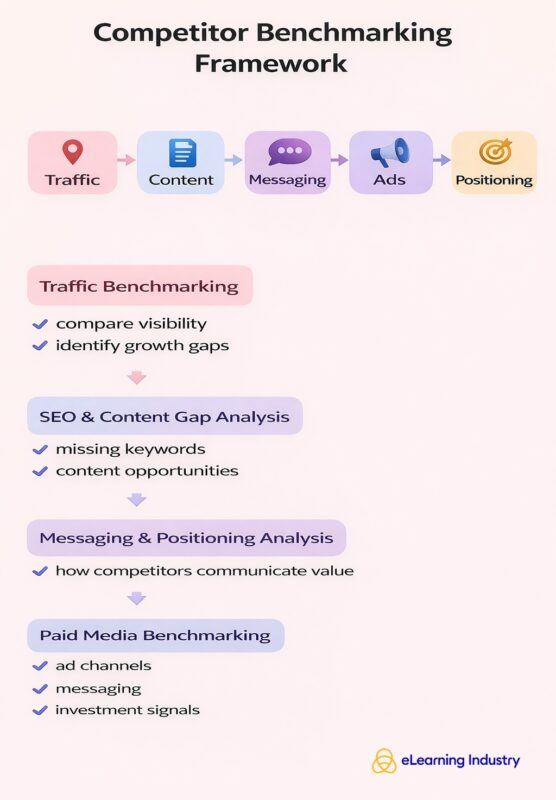
Traffic Benchmarking
The first thing to see here is traffic benchmarking. Start by comparing your visibility against key competitors. Then, look at overall traffic volume, but also break it down by source. Always remember that organic search, paid campaigns, referrals, and direct traffic each tell a different story.
For example, if a competitor drives a large share of traffic from organic search while you rely heavily on paid campaigns, that gap highlights a long-term opportunity. On the other hand, strong referral traffic may point to partnerships or distribution channels you have not explored.
The objective here is simple. Identify where competitors outperform you and understand why.
SEO And Content Gap Analysis
Next, we have SEO and content gap analysis. Here, you need to analyze keyword and content gaps. For instance, tools like Semrush and Ahrefs make this relatively straightforward.
For SEO content strategy purposes, look for keywords your competitors rank for that you do not. Focus especially on high-intent terms tied to product evaluation, comparisons, and use cases. These often sit closer to conversion.
Then review the type of content supporting those rankings. Ask yourself: Are competitors publishing detailed guides, case studies, or landing pages? Are they addressing specific buyer concerns that your content ignores?
This is where many SaaS competitor analysis tools provide real value. They help you prioritize content that drives pipeline, not just traffic.
Messaging And Positioning Analysis
Yes, data tells the truth. However, data alone will not show how competitors communicate value. For that, you need to analyze messaging across websites, ads, and sales materials.
Make sure that you pay attention to how competitors describe their products, what benefits they emphasize, and how they differentiate themselves. Do they focus on ROI, ease of use, scalability, or innovation? Patterns will emerge quickly.
If multiple competitors lean heavily on similar claims, that creates an opportunity to position differently. If a key buyer pain point is consistently addressed elsewhere but missing from your messaging, that is a gap worth fixing.
Paid Media Benchmarking
Paid media benchmarking is equally important to non-paid channels. In fact, paid channels reveal intent and investment.
Using tools like SpyFu or ad libraries, you can see which keywords competitors bid on, what messaging they use in ads, and how frequently campaigns change. Essentially, this gives you a sense of where they are allocating budget and what offers they prioritize.
For example, consistent investment in bottom-of-funnel keywords suggests strong confidence in conversion. Therefore, frequent creative changes may indicate testing and optimization.
Overall, this insight helps you refine your own paid strategy instead of guessing what might work.
What Most Companies Get Wrong About Competitor Analysis
As a rule, many companies invest in competitive analysis tools but still struggle to see results. The issue here is that the problem is rarely the tools themselves. Instead, it is how they are used.
For example, one common mistake is focusing only on data collection. Teams gather reports, track competitors, and monitor dashboards, but never translate that information into decisions. Consequently, without clear actions, even the best insights lose value.
Another issue is treating competitor analysis as a one-time exercise. Markets evolve quickly, especially in SaaS and HR tech. New entrants appear, messaging shifts, and strategies change. Competitive intelligence needs to be continuous, not occasional.
A more subtle mistake is copying competitors too closely. We know that it is tempting to replicate what seems to work. Especially, if a competitor ranks well for certain keywords or uses a specific message, the instinct is to follow.
However, this often leads to sameness.
In detail, when multiple vendors adopt identical positioning, differentiation disappears. Then, buyers struggle to see meaningful differences, and decisions become harder.
Finally, many teams fail to connect competitor insights with their own strategy. To define, data should inform positioning, content priorities, and channel investment. Without that alignment, analysis becomes disconnected from growth.
Overall, the goal is not to mirror competitors. It is better to understand them well enough to make smarter, more distinct choices.
Beyond Tools: Where Real Competitive Advantage Comes From
It is a fact that competitor analysis tools are powerful, but they are only part of the equation. That is because they show you what is happening. However, they do not determine what happens next.
Instead, the real competitive advantage comes from how you use those insights and where you show up in the market.
On this note, tools help you understand competitor behavior. They reveal traffic patterns, keyword strategies, messaging trends, and campaign activity. Overall, this is essential for building an informed strategy.
But insight alone does not create growth. Therefore, to compete effectively, you need visibility. In short, you need to be present where buyers research, compare, and make decisions. If your competitors are visible in those environments and you are not, the gap is not just strategic. It is practical.
In reality, this is where many companies fall short. That is because they invest heavily in analysis but underinvest in distribution and presence.
Think of it this way: tools tell you what competitors are doing, but platforms determine whether buyers ever consider you alongside them.
Consequently, the companies that outperform their competitors do both well. They use data to guide decisions, and they ensure their brand appears where it matters most.
That combination is what turns competitive intelligence into real market impact.
Why Visibility Platforms Matter For Competitive Benchmarking
In the market, most competitor benchmarking strategies focus heavily on tools. In these scenarios, teams analyze traffic, keywords, ads, and messaging. Overall, they build detailed reports and track performance over time.
But there is a critical piece often missing.
That is, buyers do not make decisions based only on what companies publish on their own channels. Instead, they rely on trusted environments where multiple vendors are presented side by side. All these include review platforms, comparison sites, and industry-specific hubs.
This is exactly where visibility platforms play a central role.
Especially in eLearning and HR tech, buyers frequently shortlist vendors based on what they see in curated directories, rankings, and expert-driven content. Hence, if your brand is not present in these spaces, it may never enter the consideration set, regardless of how strong your product or marketing is.
Visibility shapes perception.
In reality, when a vendor appears consistently in relevant categories, publishes thought leadership, and participates in industry conversations, it signals credibility. This credibility creates familiarity before direct engagement even begins.
This tactic has a direct impact on benchmarking. That is because you are not only comparing performance metrics anymore. You are comparing presence.
If competitors dominate high-intent platforms while you focus only on owned channels, the gap becomes difficult to close. On the other hand, being visible in the same environments allows you to compete more directly and influence how buyers evaluate options.
How High-Performing Vendors Combine Tools With Market Presence
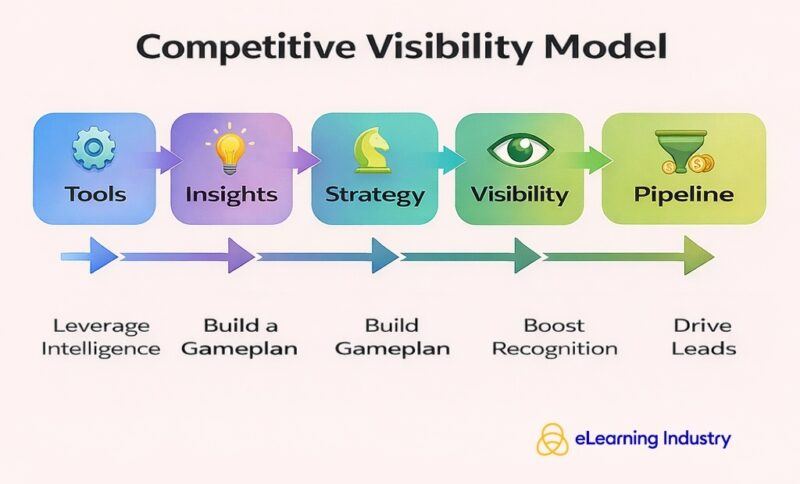
The most effective eLearning and HR tech vendors in the market do not treat competitor analysis as a standalone function. Instead, they integrate it into a broader growth system.
It usually starts with intelligence: teams use competitor research tools to benchmark performance, identify gaps, and understand how others attract and convert demand. In detail, they look at traffic sources, keyword strategies, messaging patterns, and paid campaigns to build a clear picture of the landscape.
From there, they move to strategy by translating insights into decisions:
- Which keywords to prioritize?
- What content to create?
- How to position the product?
- Which channels deserve more investment?
Instead of guessing, teams act with direction.
But this is where many companies stop, while high-performing vendors go further. They focus on distribution and visibility.
They ensure their brand appears where buyers are actively researching solutions. Overall, this includes industry platforms, review sites, and content ecosystems that influence decision-making. Hence, they publish valuable content, participate in rankings, and run targeted campaigns to stay visible throughout the buying journey.
Content plays a key role here. Not just for SEO, but for authority. Moreover, thought leadership, case studies, and practical guides help shape perception and build trust before a sales conversation begins.
The result is a more complete competitive strategy.
Instead of reacting to competitors, these companies position themselves proactively. They identify gaps, show up where it matters, and create consistent touchpoints with their audience.
That combination is what drives stronger pipelines and higher win rates.
Conclusion
It is a fact that competitor analysis is no longer optional in eLearning and HR tech. In markets where products are similar and buying cycles are long, understanding how you compare is essential.
Competitor analysis tools provide the foundation. In detail, they give you visibility into traffic, SEO performance, messaging, and paid strategies. Moreover, they help you identify gaps and uncover opportunities that would otherwise go unnoticed.
But tools alone are not enough.
The real value comes from how you use the insights they provide. Benchmarking should lead to action. It should inform your positioning, guide your content strategy, and shape your investment decisions across channels.
Beyond that, companies need to think about where they appear in the market. Visibility platforms, industry directories, and trusted comparison environments play a major role in how buyers evaluate options. Being present in these spaces is often the difference between being considered and being ignored.
The companies that outperform their competitors do not just analyze the market. They actively position themselves within it. They combine data with visibility, insight with execution, and strategy with presence. In competitive industries, that is what turns benchmarking into growth.
FAQCompetitor analysis tools are platforms that help businesses track and evaluate their competitors' marketing strategies, including traffic sources, keyword rankings, content performance, ads, and overall market positioning. They provide the data needed to benchmark performance and identify growth opportunities.
In crowded markets with similar products and long buying cycles, competitor analysis tools help companies understand how they compare. They reveal gaps in visibility, messaging, and demand generation, allowing teams to refine positioning and make more informed strategic decisions.
Some of the best competitor analysis tools include Semrush, Ahrefs, Similarweb, Crayon, Kompyte, SpyFu, G2, Capterra, LinkedIn Ads Library, and Google Alerts. Each tool serves a different purpose, from SEO analysis to competitive intelligence and buyer perception tracking.
To benchmark competitors in B2B, compare performance across key areas such as traffic, SEO rankings, content strategy, messaging, and paid media. Use multiple tools to gather data, then identify where competitors outperform you and where opportunities exist to differentiate.
Look for tools that offer traffic insights, keyword tracking, content analysis, ad intelligence, and benchmarking capabilities. Ease of use and the ability to turn data into actionable insights are equally important for effective decision-making.
Start by examining their traffic sources, keyword rankings, and top-performing content. Then analyze their messaging, ad campaigns, and positioning across channels. The goal is to understand not just what they are doing, but why it works and how you can improve on it.
Competitor analysis tools typically focus on data such as SEO, traffic, and ads. Competitive intelligence tools go a step further by tracking real-time updates, messaging changes, and strategic moves, helping teams respond quickly to market shifts.
Competitor benchmarking tools highlight performance gaps and uncover missed opportunities. By understanding where competitors succeed, companies can optimize their content, improve targeting, refine messaging, and allocate budget more effectively.
No. While these tools provide valuable insights, they do not guarantee visibility or market presence. Companies also need to invest in distribution channels and platforms where buyers actively research and compare vendors.
Visibility platforms place your brand in front of high-intent buyers during the evaluation phase. While competitor analysis tools help you understand the market, visibility platforms ensure you are part of the conversation when buyers compare solutions.