

Are Your Lead Generation Results Actually Good?
From paid ads and content campaigns to events and webinars, most LMS and HR tech vendors invest heavily in marketing, but they still struggle to answer a deceptively simple question: Are our lead generation results actually effective? Without solid lead generation benchmarks, that question is almost impossible to answer. Vendors often find themselves fumbling in the dark, unsure whether their cost per lead (CPL) is efficient, lead conversion rates stack up against competitors, and pipeline coverage is healthy enough to fuel predictable revenue growth.
The reality is sobering, as the average cost per lead across B2B industries hovers around $198, with technology and SaaS leads often topping $200+ per lead due to increased competition and longer decision cycles. Meanwhile, only a small percentage of marketers feel confident in their lead conversion rates, with just 12% saying they’re satisfied with their ability to convert targeted leads into opportunities.
In other words, most companies are spending significant budgets to generate leads, but few have a reliable way to know if those investments are actually translating into competitive performance. So before you commit another dollar to paid campaigns or publish your next lead magnet, it’s time to answer the most critical question of all: How do your lead generation benchmarks compare with industry norms, and what does that mean for your ability to generate high-quality, targeted leads?
In This Guide, You Will Find...
- Why Benchmarks Matter For B2B Lead Generation
- The Lead Generation Funnel For LMS & HR Tech Vendors
- Key Lead Generation Benchmarks Vendors Should Track
- What Top-Performing Learning Tech Vendors Do Differently
- Common Lead Generation Mistakes LMS Vendors Make
- How Vendors Can Improve Lead Generation Performance
- The Role Of Industry Platforms In Lead Generation
Why Benchmarks Matter For B2B Lead Generation
When it comes to B2B marketing, many vendors operate on instinct rather than insight. They launch campaigns, invest in paid ads, and nurture prospects, but often lack a clear picture of how their efforts compare to industry standards. Without SaaS lead generation benchmarks, it’s nearly impossible to know whether your marketing dollars are delivering results or simply being spent. Benchmarks provide a reality check, turning assumptions into actionable intelligence.
-
Evaluate Marketing Efficiency
Benchmarks allow you to measure whether your cost per lead and campaign performance align with industry norms. Are your paid campaigns producing competitive returns, or are you overspending on low-quality leads? Knowing where you stand enables smarter campaign adjustments.
-
Allocate Budgets More Effectively
By understanding typical CPLs and conversion performance, marketing leaders can prioritize initiatives that deliver the highest ROI. Benchmarks guide resource allocation and help teams avoid pouring funds into underperforming channels.
-
Identify Weak Stages In The Funnel
Comparing your performance to peers highlights bottlenecks, whether in lead capture, nurturing, or conversion. Early detection allows you to refine processes, improve messaging, and convert more targeted leads into opportunities.
-
Align Marketing And Sales Expectations
Benchmarks set a shared understanding of what constitutes success. They prevent misalignment between marketing and sales teams, fostering collaboration and improving pipeline predictability, especially important when pursuing global expansion strategies.
The Lead Generation Funnel For LMS & HR Tech Vendors
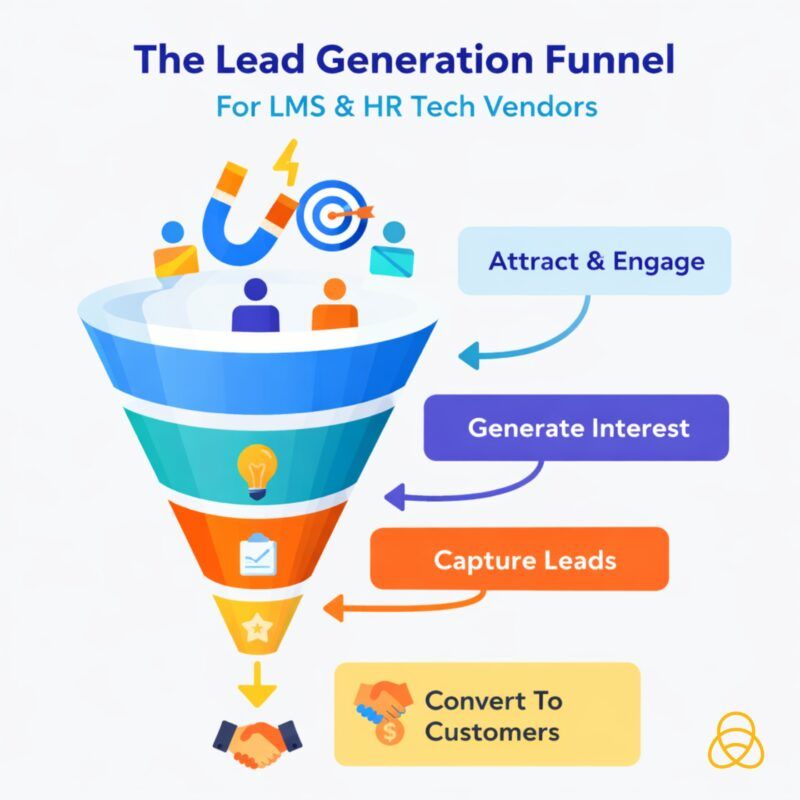
1. Traffic/Awareness
The first stage of the funnel focuses on attracting potential customers. LMS and HR tech vendors often rely on content marketing, paid campaigns, social media, webinars, and industry events to drive traffic. High-performing campaigns are designed to reach the right audience with messaging that resonates. B2B lead generation benchmarks show that vendors with targeted content and optimized ad spend can achieve significantly higher engagement rates, setting a strong foundation for downstream conversion. At this stage, it’s crucial to measure reach, impressions, and website visits to gauge whether your lead gen campaigns are effectively capturing attention.
2. Leads Captured
Once traffic is generated, the next step is converting visitors into leads. This typically involves gated content, demo requests, or newsletter sign-ups. Conversion rates here indicate the effectiveness of CTAs, landing pages, and content relevance. Benchmarks in this stage provide insight into whether your capture forms, offers, and targeting are competitive. A strong lead capture process ensures the funnel remains full, enabling predictable flow toward more qualified stages.
3. Marketing Qualified Leads (MQLs)
Leads that meet predefined criteria, such as job title, company size, or engagement level, are considered MQLs. Tracking performance against marketing qualified leads benchmarks helps vendors understand whether their nurturing and scoring processes are effective. A high-quality MQL segment ensures that sales teams spend time on prospects with genuine interest and potential, reducing wasted effort and increasing overall funnel efficiency.
4. Sales Qualified Leads (SQLs)
SQLs are MQLs that have passed additional qualification checks, typically involving a deeper evaluation of fit and readiness. Effective handoffs between marketing and sales depend on clear definitions, scoring, and communication. Properly tracked SQLs improve forecast accuracy and strengthen relationships between teams.
5. Opportunities
Opportunities are leads that have entered the sales pipeline with active engagement and a realistic chance of closing. Monitoring conversion from SQL to opportunity against SaaS pipeline benchmarks allows vendors to identify friction points, optimize follow-ups, and ensure strong pipeline velocity.
6. Closed Deals
In the final stage, you should measure revenue realized from the funnel. Tracking closed deals alongside earlier stages and comparing against B2B lead generation benchmarks reveals the true ROI of lead gen campaigns and highlights where improvements are needed. Efficient funnels turn targeted leads into measurable business growth.
Key Lead Generation Benchmarks Vendors Should Track
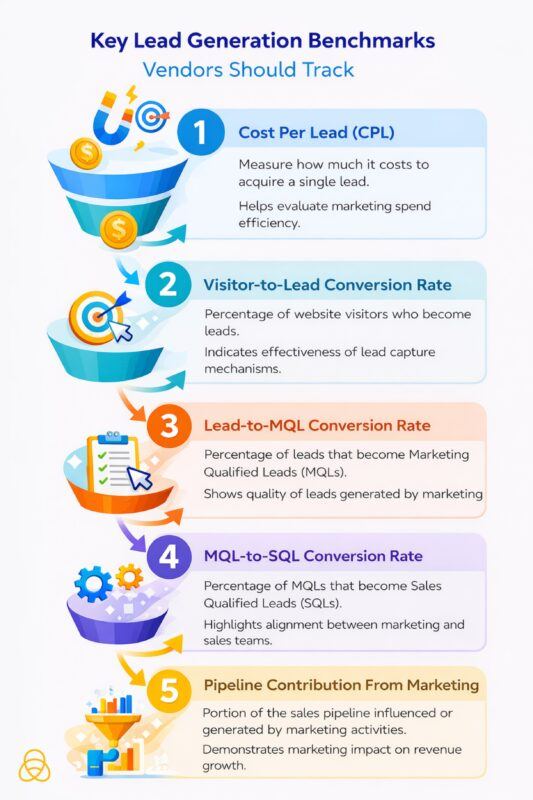
1. Cost Per Lead (CPL)
Measuring cost per lead is one of the most fundamental lead generation benchmarks for LMS and HR tech vendors. CPL varies widely depending on the channel used to attract prospects:
- Content marketing: Blog posts, whitepapers, and eBooks typically produce leads at a lower cost, often ranging from $50–$150 per lead, depending on reach and engagement.
- Webinars: While more expensive to run, webinars often generate higher-intent leads, with CPL averaging $150–$300, but these leads tend to convert more readily into opportunities.
- Paid advertising: Paid search, display ads, and social campaigns can push CPLs higher, frequently $200–$400 per lead, especially in competitive SaaS or HR tech verticals.
- Directories and review platforms: Listing your company on niche directories often costs between $100–$250 per lead, but these leads are highly targeted and pre-qualified.
2. Visitor-to-Lead Conversion Rate
The next critical metric tracks how effectively website visitors become leads. For B2B SaaS and HR tech lead generation, typical visitor-to-lead conversion rates range from 2%–6%, depending on website design, content relevance, and CTA placement.
Conversion improves dramatically with the right content assets:
- Guides and reports: Offer in-depth resources that solve specific problems.
- Webinars: Encourage live interaction and position your brand as an authority.
- Templates and tools: Provide actionable value that users can implement immediately.
3. Lead-To-MQL Conversion Rate
Once leads are captured, evaluating how many become marketing qualified leads is essential. Lead-to-MQL conversion rates often reveal targeting accuracy, ICP alignment, and overall campaign relevance. Low performance in this stage typically indicates that campaigns are reaching the wrong audience, or the messaging is not aligned with prospect pain points. Regularly reviewing these rates against B2B demand generation benchmarks ensures marketing efforts focus on business opportunity leads with genuine potential.
4. MQL-To-SQL Conversion Rate
The transition from MQL to SQL is a critical alignment metric between marketing and sales. Poor conversion here can signal:
- Low-quality leads entering the funnel
- Unclear or inconsistent qualification criteria
- Messaging mismatch between marketing and sales
Tracking this metric ensures that lead nurturing strategies are effectively guiding leads toward purchase readiness. For HR tech and LMS vendors, MQL-to-SQL rates often range from 30%–50%, depending on lead quality and alignment of marketing and sales teams.
5. Lead Velocity Rate (LVR)
LVR measures the growth in qualified leads month over month and indicates whether your SaaS lead generation is building momentum. It is calculated as the percentage increase in MQLs compared to the previous month. For LMS lead generation, an LVR of 10%–20% monthly growth is often considered healthy.
Monitoring LVR helps vendors predict pipeline growth, spot dips early, and adjust lead gen strategies before revenue targets are affected. A consistent upward trend in LVR signals that marketing efforts are successfully generating business opportunity leads at a sustainable pace.
6. Customer Acquisition Cost (CAC) Per Channel
While CPL measures cost per lead, CAC per channel tracks how much it costs to turn leads into paying customers through each channel. By evaluating CAC for content marketing, paid ads, webinars, and review platforms, vendors can determine which channels deliver the highest ROI.
For example, leads from webinars often have a higher CPL but lower CAC because they convert faster into closed deals. Comparing CAC to B2B demand generation benchmarks allows teams to identify which channels are most efficient at producing revenue, not just volume. This metric also informs budget allocation and helps optimize the marketing mix for both short-term wins and long-term growth.
7. Pipeline Contribution From Marketing
Finally, marketing’s impact on the sales pipeline is a key benchmark. On average, marketing should contribute 30%–50% of the total pipeline, though ratios vary depending on inbound vs. outbound strategies. Monitoring this ensures that campaigns generate sufficient business opportunity leads to sustain growth and revenue targets. Comparing performance to lead generation benchmarks allows teams to adjust spend, optimize campaigns, and strengthen the collaboration between sales and marketing.
What Top-Performing Learning Tech Vendors Do Differently
Top-performing learning tech vendors don’t just generate leads. They generate high-quality, actionable opportunities by treating visibility, credibility, and alignment as integral parts of their marketing strategy. Across the industry, certain patterns consistently emerge among the leaders, providing clear lessons for LMS and HR tech vendors aiming to outperform competitors.
-
Narrow ICP Targeting
High performers focus relentlessly on their ideal customer profile (ICP). Instead of casting a wide net, they segment audiences based on factors like company size, vertical, role, and buying stage. This targeted approach ensures that every campaign reaches prospects who are most likely to engage and convert. By aligning content and campaigns with a precise ICP, top vendors reduce wasted spend, improve lead generation metrics, and increase the likelihood of passing marketing qualified leads to sales teams.
-
Thought Leadership Content
Rather than producing generic marketing materials, leading vendors invest in thought leadership marketing that addresses specific industry pain points. Whitepapers, expert webinars, and insightful reports position the company as an authority and build trust with potential buyers. And thought leadership content doesn’t just educate. It also serves as a lead-generation driver by attracting high-intent prospects who are actively seeking solutions.
-
Industry Authority Positioning
Top-performing vendors actively establish themselves as industry authorities through partnerships, speaking engagements, top lists and awards, and recognized certifications. This positioning reinforces credibility, improves brand recall, and ensures that prospects consider their solutions first when evaluating vendors. Visibility and authority work hand in hand, turning the brand itself into a lead magnet.
-
Integrated Demand Generation Campaigns
Leaders treat campaigns as demand generation best practices rather than isolated marketing tactics. Multi-channel campaigns combine email nurture sequences, retargeting ads, webinars, and social engagement, and therefore, create a consistent and persistent presence in the marketplace. Every touchpoint is designed to move prospects through the funnel while maintaining brand authority and relevance.
By applying these strategies, you can align your marketing spend with measurable outcomes. When you benchmark performance against B2B marketing benchmarks, continually test and refine messaging, and track lead generation metrics, you optimize every stage of the funnel. The result is not just more leads, but better leads that convert into long-term customers.
Common Lead Generation Mistakes LMS Vendors Make
-
Chasing Volume Over Quality
Many LMS vendors focus on generating as many leads as possible, treating every website form submission or webinar registration as a win. While this can boost raw numbers, it often results in low-quality leads who aren’t a good fit for your product. Campaigns that prioritize quantity over relevance typically show high CPL and poor lead conversion rates, as sales teams spend time following up with contacts unlikely to move through the funnel. In contrast, aligning campaigns with lead generation benchmarks ensures that efforts focus on generating high-quality business leads that can be converted into opportunities and revenue.
-
Weak Positioning
Vendors sometimes fail to clearly articulate their value proposition or differentiate themselves from competitors. Without strong positioning, prospects may not understand why they should engage with your solution, leading to disengaged leads and low conversion. A weak brand or unclear messaging diminishes the effectiveness of all marketing channels, from content to email outreach, reducing the ROI of lead gen campaigns.
-
Inconsistent Content Strategy
Another common mistake is producing content sporadically or without a coordinated plan. Inconsistent posting schedules, mixed messaging, and disjointed topics prevent vendors from building authority and nurturing leads over time. Without a steady stream of targeted, educational content, leads lose interest, and conversion suffers.
-
Relying Solely On Paid Ads
Many LMS vendors depend exclusively on paid campaigns to drive leads. While ads can generate quick volume, they are expensive, and the leads often lack engagement or context. Without complementary tactics like organic content, thought leadership, and nurturing campaigns, paid ads produce high CPL and limited long-term impact. Multi-channel campaigns consistently outperform single-channel approaches in both lead quality and conversion.
-
Neglecting Lead Nurturing
Failing to nurture leads is a critical oversight. Leads captured without follow-up sequences, educational content, or personalized outreach tend to stagnate, lowering the chance they become converted leads. Consistent nurturing is essential to move prospects from initial interest to sales-qualified opportunities.
-
Ignoring Funnel Analytics
Vendors often overlook tracking SaaS metrics at each stage of the funnel, from traffic to closed deals. Without monitoring lead conversion rates, MQL-to-SQL ratios, and CPL by channel, it’s impossible to identify bottlenecks or optimize campaigns. Ignoring analytics leads to repeated mistakes and wasted spend.
-
Poor ICP Alignment
Finally, targeting the wrong audience or broadening the funnel too much can create a mismatch between marketing efforts and sales priorities. Leads may enter the funnel but fail to convert because they don’t match the ideal buyer profile, reducing overall campaign efficiency and inflating CPL.
How Vendors Can Improve Lead Gen Performance
-
Align Marketing And Sales Metrics
Establish shared definitions for MQLs, SQLs, and pipeline contribution. Track performance against SaaS marketing benchmarks to ensure both teams are working toward the same revenue goals.
-
Focus On High-Intent Audiences
Prioritize campaigns targeting decision-makers who match your ideal customer profile (ICP). Segment by role, company size, and industry to generate LMS lead generation that converts efficiently.
-
Use Educational Content Assets
Offer whitepapers, guides, webinars, templates, and interactive demos to nurture prospects. Educational assets position your brand as a trusted authority while providing value that encourages engagement.
-
Leverage Trusted Industry Platforms
Publish on reputable directories, review sites, and forums relevant to learning tech. These platforms increase visibility among prospects actively researching solutions.
-
Implement Multi-Channel Campaigns
Combine email, social media, retargeting ads, and organic content to reach leads consistently across multiple touchpoints.
-
Audit And Optimize Lead Capture Forms
Simplify forms to reduce friction, collect the right information for lead scoring, and improve conversion from visitor to lead.
-
Track And Refine Funnel Metrics
Monitor conversion rates, CPL, MQL-to-SQL progression, and pipeline contribution regularly. Use data to identify bottlenecks and refine campaigns.
-
Leverage Testimonials And Case Studies
Highlight success stories from existing clients to build credibility and trust with new prospects.
-
Invest In Lead Nurturing Strategies
Automate personalized email sequences and follow-ups to keep leads engaged until they’re sales-ready.
-
Test And Iterate Campaigns Continuously
Run iterative testing on messaging, creative, and CTAs to optimize results over time.
The Role Of Industry Platforms In Lead Generation
Many B2B buyers start their research within trusted industry directories, comparison sites, and expert content platforms rather than a vendor’s website. These environments attract high-intent audiences who are actively evaluating solutions, making them critical for lead generation. For LMS and HR tech vendors, appearing in these ecosystems ensures visibility where it matters most and improves the quality of leads entering the funnel.
Industry directories allow buyers to compare features, pricing, and vendor reputation in one place. Maintaining a detailed, up-to-date profile signals credibility and helps your solution stand out. Comparison sites provide side-by-side evaluations that can influence purchase decisions. Vendors who highlight differentiators, include client testimonials, and maintain authoritative content gain a competitive advantage.
Expert content platforms, including webinars, forums, and thought leadership portals, engage prospects seeking guidance and insights. Publishing guest articles, interviews, or case studies positions your brand as an industry authority while nurturing potential leads. Tracking engagement from these platforms against lead generation benchmarks helps teams identify which channels produce the most qualified prospects.
Even when using PPC lead generation, integrating industry platforms boosts lead quality. Paid traffic may generate volume, but visibility in high-intent ecosystems ensures prospects are better qualified, more engaged, and more likely to convert into long-term customers.
Key Takeaway
Measuring the effectiveness of your marketing efforts requires more than intuition. It requires a clear understanding of B2B lead generation benchmarks. By comparing your campaigns against industry standards, LMS and HR tech vendors can see how their cost structures, targeting, and messaging perform relative to peers. Tracking cost per lead benchmarks across channels ensures that marketing spend drives high-quality business leads rather than just raw volume.
Equally important is monitoring lead conversion rates at every stage of the funnel. From initial website visits to MQLs, SQLs, and closed deals, understanding where leads are dropping off allows teams to refine messaging, optimize campaigns, and prioritize channels that consistently deliver results. High performers combine these insights with multi-channel campaigns, thought leadership content, and precise ICP targeting to maximize both reach and engagement.
Using the right tools and platforms further strengthens outcomes. Incorporating top lead generation tools, leveraging industry directories, and publishing on authoritative content platforms increases visibility among high-intent audiences, improving overall lead quality.
eLearning Industry helps LMS and HR tech vendors generate qualified leads through targeted campaigns, thought leadership content, and high-intent industry visibility, connecting vendors with decision-makers actively researching learning solutions. Book a call to learn more from our experts.
FAQYou can measure effectiveness by tracking metrics like visitor-to-lead conversion, cost per lead (CPL), and the percentage of leads that become qualified (MQLs/SQLs). Comparing these against industry benchmarks helps identify gaps.
A Marketing Qualified Lead (MQL) shows interest and fits your target audience, while a Sales Qualified Lead (SQL) is ready for direct engagement by sales, usually after additional qualification.
Lead generation performance should be reviewed at least monthly to spot trends, optimize campaigns, and ensure your metrics stay aligned with industry standards.
Paid ads can be effective if targeted correctly, especially for niche audiences. Tracking CPL and ROI is essential to ensure campaigns contribute meaningfully to your pipeline.
Mistakes include unclear CTAs, poor lead nurturing, ignoring funnel analytics, overreliance on a single channel, and targeting the wrong audience.
Platforms like eLearning marketplaces or HR tech directories connect vendors with engaged audiences, increase visibility, and often provide data for benchmarking lead quality.