

Trust Wins Clients, Not Claims
Buyers don't make decisions based on claims anymore. They look for proof, and they want that proof to feel real, specific, and tied to outcomes that matter. That's exactly why case study examples for sales and marketing sit at the center of high-performing B2B and B2C strategies today. They don't just describe success, but show it in a way that reduces risk and builds confidence before a buyer even speaks to sales.
Research shows that around 73% of B2B buyers say case studies strongly influence their purchasing decisions, especially in the final stages of evaluation. That tells you something simple: when buyers compare vendors, they don't rely on positioning or messaging alone. They look for evidence that someone else already achieved the result they want.
The problem is that most case studies don't do that job well. They read like company timelines instead of decision-making tools. They describe what happened but don't explain why it matters to the next buyer. So they end up sitting on websites instead of driving revenue conversations.
However, strong case studies work differently. They connect the problem, the decision trigger, and the measurable outcome in a way that mirrors how buyers think. They also support thought leadership marketing by positioning a company as a credible source of outcomes, not just ideas. When done right, they become more than content assets. They turn into customer success stories that sales teams can actively use in conversations, proposals, and follow-ups to move deals forward faster and with less friction.
Key Takeaways
- Case studies are one of the most powerful conversion assets for B2B.
- The best case studies focus on outcomes, not features.
- Storytelling structure significantly impacts effectiveness.
- Companies that use case studies strategically close deals faster.
Why Case Studies Are Critical In B2B Sales
-
Reduce Risk
Buyers in B2B don't move forward on messaging alone, they look for evidence that reduces uncertainty and supports confident decision-making. This is where case study examples for sales and marketing become a core asset, because they translate product claims into real-world outcomes that buyers can evaluate against their own situation.
-
Validate Claims
Case studies reduce risk by showing how similar companies solved the same problem, which lowers perceived uncertainty in the buying process. They validate claims by backing up marketing messages with measurable results, customer quotes, and concrete implementation details.
-
Support Decision-Making
They support decision-making by giving stakeholders across different roles something tangible to align on during internal discussions. In a strong B2B case study strategy, the goal is not to tell a story but to mirror the buyer's evaluation process step by step, including pain points, decision triggers, implementation steps, and outcomes.
-
Sales Enablement Impact
Case studies also work as leverage points in sales conversations, because they shorten the time needed to build trust with new prospects. Sales teams use them when credibility needs reinforcement or when competing vendors make similar claims, especially during proposal and negotiation stages.
-
Role In Market Positioning
When integrated into branded content, case studies extend beyond sales enablement and become part of how a company communicates authority in the market. They reinforce positioning by showing outcomes instead of describing capabilities, building cumulative trust over time.
-
Core Principle
Case studies function as proof, not content, because their job is to remove doubt and accelerate commitment rather than inform or entertain.
What Makes A Case Study For Sales And Marketing Actually Convert
-
Clear Problem Definition
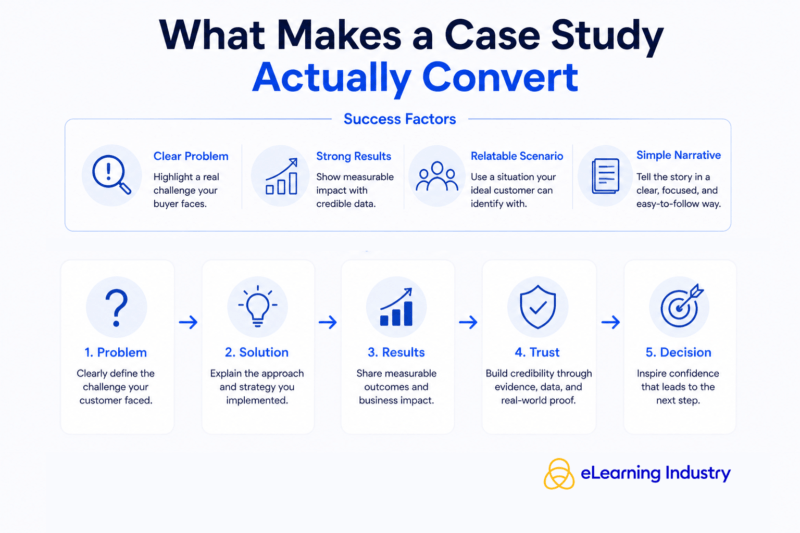
Strong case study examples for sales and marketing always start with a clearly defined problem. The buyer should immediately recognize the pain point without needing extra explanation. The more specific the problem, the easier it becomes for prospects to map it to their own situation.
-
Strong, Measurable Results
Conversion-driven case studies focus heavily on outcomes. They highlight numbers, impact, and transformation in a way that feels concrete and verifiable. Without measurable results, the story loses its persuasive power and becomes generic content.
-
Relatable Scenario
High-performing case studies mirror real-world environments. They reflect industry context, company size, and operational challenges that feel familiar to the reader. This relatability helps buyers mentally place themselves inside the story, which increases engagement and trust.
-
Simple Narrative Flow
Effective storytelling removes complexity. It follows a straightforward structure: problem, approach, solution, and outcome. Overloading the narrative with unnecessary detail reduces clarity and weakens conversion impact.
-
Buyer Identification Effect
The most important insight in case studies for lead generation is that buyers don't just consume the content, they project themselves into it. When they see a situation that mirrors their own, the case study shifts from information to persuasion.
-
Trust Acceleration Mechanism
Case studies reduce friction in the buying journey by validating decisions that prospects are already considering. They act as proof points that move conversations forward faster, especially when sales teams are targeting high-intent leads who are close to conversion.
-
Decision Reinforcement Role
Strong case studies don't introduce new ideas. They reinforce existing intent and give buyers the confidence to justify decisions internally. That reinforcement often becomes the final trigger in competitive deals.
Real Case Study Examples For Sales And Marketing That Drive Results
Lead Generation Growth (HubSpot)
- Challenge: Low pipeline and inconsistent inbound leads.
- Solution: Inbound content strategy, SEO, and campaigns.
- Result: Scalable lead growth and stronger conversion rates, positioning it as one of the strongest case study examples for sales and marketing in SaaS growth strategies.
- Insight: This shows how structured content turns awareness into predictable pipeline growth because it aligns content structure with buyer intent at every stage across the entire funnel journey flow.
- Impact: It also proves that consistency in publishing matters more than campaign bursts when building long-term acquisition systems.
Operational Efficiency (Slack Automation)
- Challenge: Manual workflows slowing teams.
- Solution: Automation via integrations and workflows.
- Result: Reduced operational time and improved efficiency across teams, commonly highlighted in marketing case study examples from Slack customers.
- Insight: Automation removes friction and improves cross-team execution speed especially in distributed teams working at scale.
- Impact: This type of improvement compounds over time because small time savings per task multiply across entire organizations.
Customer Engagement (Airbnb Hosting Experience)
- Challenge: Low host engagement and retention.
- Solution: Education content and host training programs.
- Result: Improved retention and engagement across hosts, demonstrating principles behind how to write a case study.
- Insight: Engaged users convert and stay longer when education is structured which increases trust and improves conversion probability significantly.
- Impact: Education-led engagement also reduces support load and increases platform reliability perception.
Cost Reduction (AWS Cloud Optimization)
- Challenge: High infrastructure costs and inefficiency.
- Solution: Migration to cloud infrastructure optimization.
- Result: Reduced costs and improved scalability, widely used in B2B thought leadership narratives.
- Insight: Cost optimization directly impacts profitability and long-term competitiveness especially in enterprise systems with high operational overhead.
- Impact: These savings often get reinvested into growth initiatives, accelerating overall business expansion.
Revenue Growth (Shopify Merchant Success)
- Challenge: Limited online revenue growth potential.
- Solution: eCommerce optimization and platform tools.
- Result: Increased revenue and stronger brand scaling across merchants.
- Insight: Revenue growth accelerates when platforms simplify scaling for merchants because simplicity reduces barriers to market expansion.
- Impact: This also strengthens ecosystem loyalty, making churn significantly lower over time.
The Case Study Framework That Closes Deals
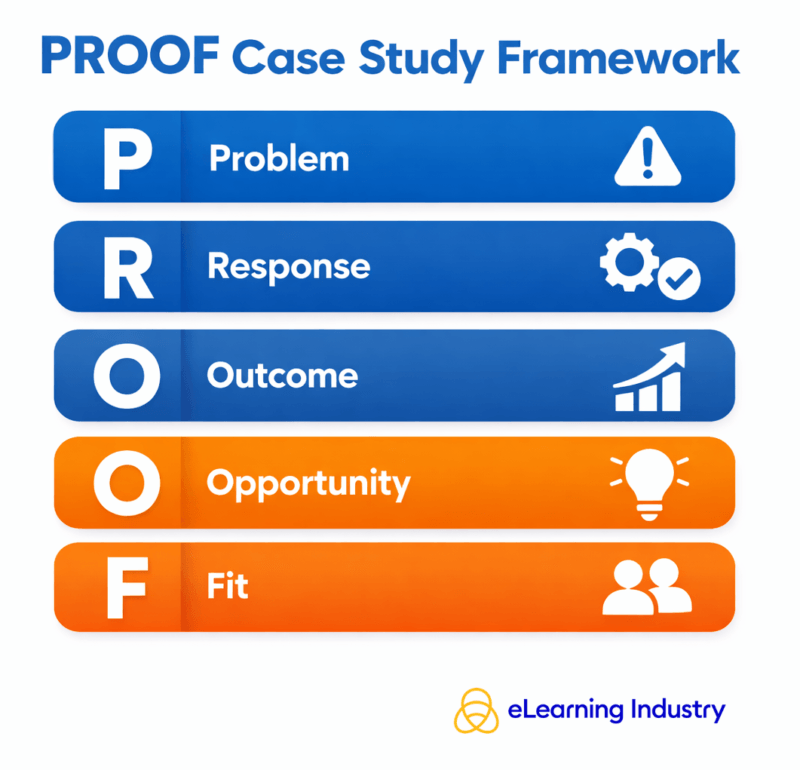
P — Problem
You define the challenge in sharp, specific terms. No vague descriptions. You focus on the real business pain, the cost of inaction, and the trigger that pushed the company to act. This is where attention locks in because the buyer immediately checks if the problem matches their own situation.
R — Response
You explain what was actually done. Not the theory, not the internal process drama. Just the actions taken, the approach used, and the logic behind the solution. In strong case study marketing, this section shows competence without over-explaining.
O — Outcome
You highlight measurable results. Revenue impact, cost reduction, time savings, or performance gains. This is the section that turns interest into trust because numbers remove doubt and anchor credibility.
O — Opportunity
You extend the story into what becomes possible next. This creates momentum and shows scalability. It helps buyers see long-term value instead of a one-off win, which strengthens perceived strategic fit.
F — Fit
You clarify who this applies to. Industry, company size, and use case matter here. This is where strategic marketing for CEOs becomes relevant because it connects outcomes to executive-level decision criteria and investment logic.
How To Write Case Studies For Sales Vs. Marketing
Marketing Case Studies
Marketing case studies exist as the starting point of a full-funnel marketing strategy, attracting attention and bringing new audiences. They focus on clarity, speed, and emotional relevance. You highlight outcomes in a way that feels easy to understand at first glance, so prospects quickly connect the story to their own challenges. In strong case study marketing, the goal is visibility and interest, not deep evaluation. You use them across websites, ads, emails, and lead gen campaigns to create awareness and build early trust before any sales conversation happens.
Sales Case Studies
Sales case studies go deeper and work at the point of decision. They are built to address objections, remove doubt, and reinforce confidence. You include detailed proof like implementation steps, performance metrics, and real-world constraints. The focus shifts from storytelling to validation. Buyers use them internally to justify decisions, so every detail needs to support clarity and credibility during the closing stage.
Key Difference In Purpose
Marketing case studies pull people in. On the other hand, sales case studies push decisions forward. One creates interest, while the other removes friction. Both serve different stages of the buyer journey, and mixing them incorrectly weakens their impact.
Best Approach
The most effective strategy is to design case studies that serve both functions. You start broad enough to attract attention, then layer depth for decision-making. This dual structure ensures no stage of the funnel is left unsupported.
Execution Principle
If you want to master how to write a case study, think in layers. First capture attention, then build trust, then support conversion. Every section should serve a purpose in the buyer journey, not just describe what happened. When you align structure with intent, case studies stop being content assets and start becoming revenue tools.
If you want to receive weekly updates and eLearning marketing tips and recommendations, subscribe to our newsletter.
Where Case Studies Fit In The Funnel
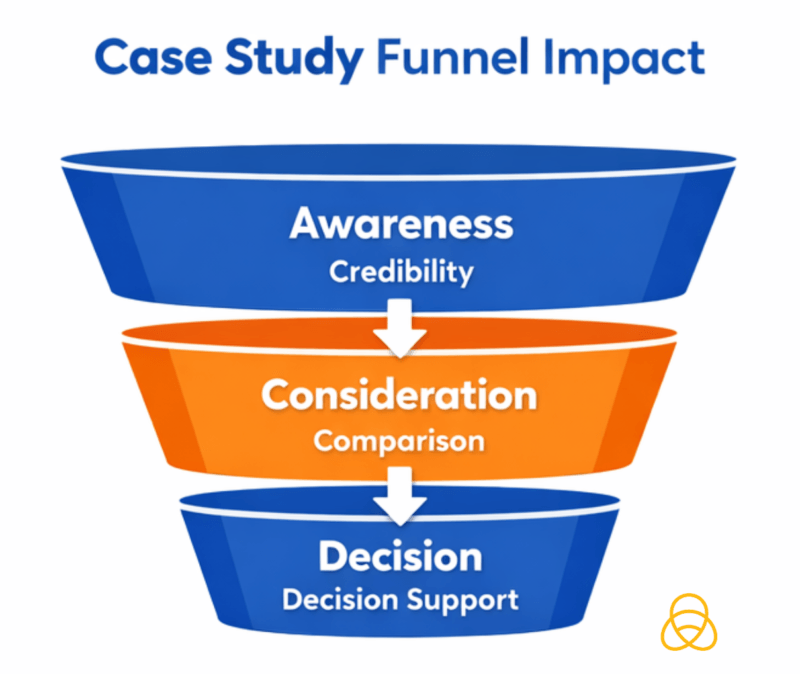
TOFU (Top of Funnel) — Credibility
At the top of the funnel, case studies work as attention and trust builders. You don't try to sell here. You show proof that your solution works in the real world. These case study examples for sales and marketing usually focus on high-level outcomes, strong brand names, and simple transformations. Think short success snapshots like "how a SaaS company doubled sign-ups in 90 days" or "how a training platform improved engagement by 40%." The goal is to create instant credibility and stop scroll behavior in business lead generation ideas across ads, social, and blog content.
Example: HubSpot's Slack case study shows how a fast-growing SaaS company scaled communication and collaboration globally. The focus sits on credibility and trust rather than evaluation, helping audiences understand how large teams maintain alignment and culture during rapid expansion.
MOFU (Middle of Funnel) — Comparison
In the middle of the funnel, buyers start evaluating options. Here, case studies become comparative tools. You shift into deeper detail: implementation process, challenges, and why your approach worked better than alternatives. A strong case study template at this stage includes problem breakdowns, solution mapping, and measurable benchmarks. This is where case studies for lead generation play a major role because buyers use them to compare vendors side by side and validate internal shortlists.
Example: Zendesk customer stories show how companies like Shopify and Uber improved customer support efficiency through structured ticketing and automation. Buyers at this stage compare platforms based on workflow improvements, resolution speed, and service quality, making these case studies ideal for evaluation and shortlist decisions.
BOFU (Bottom of Funnel) — Decision Support
At the bottom of the funnel, case studies remove final objections. These are detailed, proof-heavy narratives designed for decision-makers. They include ROI breakdowns, timelines, stakeholder alignment, and risk reduction proof. This is where case studies directly influence revenue outcomes because they support final approval meetings and procurement discussions.
Example: Spotify's partnership with Google Cloud highlights how the platform migrated its data infrastructure to improve scalability, personalization, and performance at global scale. This type of case study supports final decision-making by validating technical fit, long-term reliability, and enterprise-level capability.
How To Use Case Studies Across Channels
-
Website
Case studies on websites work as conversion drivers. You place them on landing pages and product pages to reinforce trust at the exact moment buyers evaluate your offer. Strong case study examples for sales and marketing here focus on outcomes, proof, and relevance to the visitor's intent. This placement directly supports both discovery and decision-making because it removes doubt at the point of highest attention.
-
Sales Enablement
Sales teams use case studies in presentations, proposals, and follow-ups to strengthen credibility during conversations. Instead of relying on claims, they rely on proof from real customers. In a strong B2B case study strategy, this becomes a core asset that helps reps handle objections, shorten sales cycles, and increase close rates by showing real-world validation during negotiations.
-
Content Marketing
Case studies also work as high-value content assets across blogs, reports, and downloadable materials. This is where you position them as educational resources while still driving demand. A strong B2C case study strategy uses storytelling to connect emotionally, while B2B formats stay more structured and ROI-focused. In both cases, case studies attract qualified traffic and feed lead generation systems with trust-building content.
-
Webinars & Podcasts
Webinars and podcasts turn case studies into conversational authority assets. Instead of just publishing results, you discuss them, break them down, and expand the narrative. This builds deeper trust with audiences who prefer long-form insights. From one case study, you can create multiple distribution assets like LinkedIn posts, newsletters, and short-form videos, which multiplies reach and visibility.
Common Case Study Mistakes
-
Too Generic
Most weak case studies fail because they stay too surface-level. They describe what a company does instead of showing what changed. In strong case study examples for sales and marketing, specificity drives impact. When the story feels generic, buyers can't connect it to their own situation, so the content loses conversion power immediately.
-
No Data
Another common mistake is ignoring measurable outcomes. Without numbers, case studies turn into narratives instead of proof assets. Buyers need clarity on impact, not just process. Metrics like revenue growth, time saved, or conversion improvement turn customer success stories into decision-making tools instead of brand storytelling.
-
Too Long Or Too Complex
Many case studies try to include everything and end up overwhelming the reader. When structure is unclear, attention drops quickly. The most effective approach keeps the flow simple: problem, action, result, and relevance. Complexity reduces clarity, and clarity is what drives conversions.
-
Product-Focused Instead Of Outcome-Focused
Some case studies spend too much time explaining features instead of outcomes. Buyers don't evaluate features in isolation, they evaluate results. The focus should always stay on business impact rather than product detail.
-
Weak Strategic Positioning
Case studies also fail when they are not aligned with broader business goals. For example, companies often overlook how these assets support positioning in high-stakes moments like preparing for acquisition, where proof of traction and performance becomes critical.
From Case Study Examples To Sales And Marketing Pipeline Growth
-
Build Trust
Case studies turn uncertainty into confidence. Buyers don't rely on claims when budgets are on the line, they rely on proof. Strong sales case study examples show real outcomes from real customers, which creates immediate credibility. When prospects see similar companies achieving results, trust builds faster and objections weaken before the sales conversation even starts.
-
Reduce Friction
Case studies remove unnecessary doubt from the buying process. Instead of asking "does this work?", buyers focus on "how will this work for us?". Clear narratives supported by data help stakeholders align internally without long discussions. This is where well-structured marketing case study examples play a key role, because they simplify evaluation and reduce hesitation across multiple decision-makers.
-
Shorten Sales Cycles
When trust is already established, deals move faster. Sales teams don't need to repeatedly justify value because the proof already exists in the case study. This reduces back-and-forth conversations and accelerates approvals. Case studies act as pre-built validation tools that support every stage of the pipeline, from first contact to final negotiation.
-
Pipeline Impact
When used correctly, case studies directly contribute to revenue growth. They don't sit as passive content assets. They actively support lead nurturing, qualification, and conversion. In modern business growth strategies, they function as leverage points that increase efficiency across both marketing and sales teams.
Key Takeaway
Case studies win deals when they move from static content into active proof systems that support every stage of the buyer journey. However, most companies still treat them like isolated assets. Their real value shows up when they sit inside case study marketing ecosystems that feed awareness, nurture evaluation, and support final conversion decisions at scale. Because buyers don't trust claims. They trust outcomes they can verify. That's why case study examples for sales and marketing consistently outperform most content formats in influencing purchase behavior.
At the same time, case studies only perform when distributed correctly. That's where business lead generation ideas become essential. One case study can fuel landing pages, sales decks, email sequences, webinars, and social content. Each channel reinforces the same proof from a different angle, which compounds credibility and keeps messaging consistent across touchpoints. The biggest shift happens when companies stop treating case studies as content and start using them as revenue infrastructure. Every strong story becomes a reusable asset that supports pipeline growth, accelerates decisions, and strengthens positioning in competitive markets.
Let's not forget, though, that case studies are effective only when they reach the right audience. Companies that turn customer success into visible, high-impact content gain a significant advantage in competitive markets. eLearning Industry helps AI solution providers, eLearning companies, and HR tech vendors transform their success stories into powerful case study campaigns, podcasts, webinars, and content experiences, connecting them with decision-makers actively evaluating solutions. If you want your results to drive real business growth, it's time to make your success stories visible.
FAQA marketing case study is a structured story showing how a product or service helped a real customer solve a problem and achieve measurable results.
Most effective case studies are 800–1,500 words, or 2–5 pages, depending on complexity and whether they're written, visual, or video-based.
Clear problem-solution structure, specific data or results, a relatable customer story, and easy-to-scan formatting make it effective.
They build trust by proving real-world success, helping prospects visualize outcomes, and often acting as decision-stage content that supports conversions.
B2B case studies focus on ROI, business impact, and complex solutions, while B2C case studies emphasize personal experience, emotional outcomes, and lifestyle benefits.
Case studies work best on landing pages, sales decks, email nurturing campaigns, proposal documents, and near the bottom of the funnel where buyers are evaluating options.
