
Companies That Use AI: Solid Examples Across Industries
AI adoption in business is not a future-proof addition anymore. It is rather a must-have feature to survive in the market today. Businesses that understand its value are going to have a competitive advantage.
Nowadays, across many industries like retail, financial services, healthcare, enterprise software, and manufacturing, companies are integrating AI into operations, products, and customer experiences. However, despite its potential, AI adoption alone does not guarantee value.
For further understanding it let us separate the market into two categories:
- Companies that use AI
- Companies that monetize AI
The distinction here is far from technological. It is strategic.
For instance, some organizations experiment with AI pilots, automate isolated workflows, or embed machine learning into back-office processes. Others treat AI as a revenue engine by redesigning pricing models, accelerating product innovation, improving retention, and expanding margins. Truth is, the financial results between these two approaches differ dramatically.
The common theme now is that many companies use AI today, but far fewer convert AI investments into measurable revenue growth and profit expansion.
In this article, we cover the following:
- Real-world examples of companies that use AI successfully
- How those investments translate into revenue and P&L impact
- The strategic models behind profitable AI adoption
- Why some organizations fail to generate ROI
- How HR tech and learning tech companies can apply these lessons
The goal is not to list AI tools or explain implementation mechanics. The goal is to understand how AI becomes a business growth strategy.
Companies that use AI successfully treat it as a revenue engine, not a technology experiment.
In a nutshell:
- Leading companies use AI to increase revenue, reduce costs, or create new monetization models.
- AI profitability depends on strategic alignment, not adoption speed.
- The strongest AI business strategies link investment directly to pricing power and growth.
- AI creates a competitive advantage when embedded into value creation—not operations alone.
- Monetization clarity separates leaders from adopters.
What Separates AI Adoption From AI Monetization
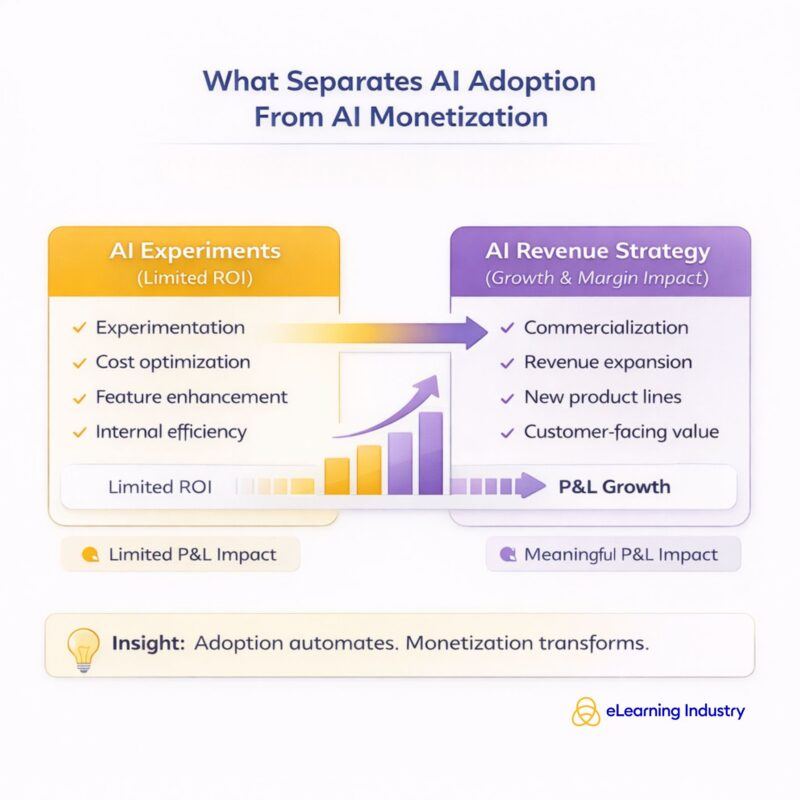
As we have established so far, AI adoption and AI monetization are two different things. Even though AI adoption is widespread, AI monetization seems to be rare in the market. If we want to understand the difference between these two, we need to shift from a technology lens to a financial one.
1. Experimentation Vs. Commercialization
The first step is to explore the experimentation vs. commercialization aspect. Following, we present all you need to know.
Experimentation focuses on capability testing:
- Can we automate this process?
- Can we generate insights faster?
- Can we improve internal efficiency?
On the contrary, commercialization focuses on business impact:
- Does this increase revenue per customer?
- Can we charge more?
- Does it reduce churn?
- Does it expand market share?
Therefore, companies that use AI strategically move from experimentation to commercialization quickly.
2. Cost Optimization Vs. Revenue Expansion
Our next stop on this journey is to see the cost optimization vs. revenue expansion. While some companies implement AI to reduce costs, others do it to expand.
For example, many organizations deploy AI primarily to reduce costs:
- Automating support tickets
- Improving internal workflows
- Reducing fraud losses
- Optimizing inventory
Sure, cost savings matter, but revenue expansion creates far greater enterprise value.
On this note, revenue-oriented AI initiatives include:
- Personalized recommendations that increase basket size
- AI-powered upsell suggestions
- Premium AI-enabled product tiers
- Faster R&D commercialization
Therefore, when AI directly influences growth rate or pricing leverage, its ROI compounds.
3. Feature Enhancement Vs. New Product Lines
How a company views AI adoption affects its impact directly. Some companies use it for feature enhancement, while others do it for new product lines. Definitely, adding AI as a feature may improve competitiveness but embedding AI as a product pillar changes market positioning.
To help you understand, consider the difference:
"We now use AI in our software."
versus
"Our AI platform increases customer revenue by 20%."
The second statement drives monetization, not novelty.
4. Internal Efficiency Vs. Customer-Facing Value
We all know that AI adoption has automation and efficiency perks that streamline reporting operations. However, AI also improves customer outcomes, increases retention, upsell, and brand strength.
In this area, the most profitable AI business strategies prioritize:
- Customer experience improvement
- Predictive personalization
- Revenue intelligence
- Decision automation that drives measurable business outcomes
In other words, AI creates value when it changes how customers perceive and pay for your offering.
Companies That Use AI To Drive Revenue Growth
Now that we have established the foundations of AI adoption, we move from theory to real-world AI examples across industries. All these companies do not just use AI, they integrate it into value creation.
Retail & eCommerce
Amazon
Amazon is one of the biggest enterprises in the market right now. The enterprise AI strategy they showcase is deeply embedded in revenue generation.
For instance, their recommendation engines analyze:
- Browsing behavior
- Purchase history
- Similar customer patterns
- Seasonal trends
The result:
- Increased basket size
- Higher conversion rates
- Improved cross-selling
Moreover, AI powers dynamic pricing models and inventory forecasting. Here is the revenue impact of this:
- Personalized recommendations are estimated to drive a significant percentage of total sales.
- Improved logistics and fulfillment efficiency increase margin control.
Consequently, Amazon's AI implementation is not an experiment; it is core revenue infrastructure.
Netflix
Another colossus in the market that utilizes AI is Netflix. Netflix uses AI primarily for personalization and retention.
In a nutshell, its algorithms determine:
- Content recommendations
- Homepage layout
- Thumbnail selection
- Viewing suggestions
In this scenario, the revenue impact is indirect but still powerful:
- AI personalization reduces churn
- Reduced churn increases lifetime value (LTV)
- Higher LTV improves subscription economics
It is safe to say here that AI does not simply enhance user experience; it protects recurring revenue. This is a classic example of AI driving profit through retention rather than direct sales.
Enterprise Software & SaaS
Salesforce
Moving on to enterprise software and SaaS companies, we have Salesforce. Salesforce is a SaaS company that embeds AI into its CRM platform through predictive insights and opportunity scoring.
Here is the strategic impact of AI adoption in Salesforce:
- Sales teams prioritize high-probability deals
- Upsell and cross-sell opportunities are identified earlier
- Pipeline forecasting improves accuracy
In this case, AI becomes a customer value multiplier. More importantly, AI features increase platform stickiness and justify premium pricing tiers.
Salesforce monetizes AI both:
- Internally (improving sales outcomes)
- Externally (embedding AI into paid offerings)
Adobe
The next company in this category is Adobe. Adobe integrates AI into its creative and marketing cloud platforms.
Some of the AI capabilities enable:
- Automated design suggestions
- Content personalization
- Intelligent marketing analytics
This process creates two monetization levers:
- Premium product differentiation
- Subscription growth and retention
The key takeaway here is that AI enhances productivity for users, which strengthens willingness to pay. In Adobe's case, AI is not a feature add-on; it reinforces subscription value and competitive positioning.
Financial Services
JPMorgan Chase
Now we can explore the benefits of AI in the financial industry. The first example is JPMorgan Chase, one of the most advanced examples of enterprise AI adoption in financial services. Specifically, this company uses AI across multiple high-value areas:
- Fraud detection and prevention
- Credit risk modeling
- Algorithmic trading
- Customer insights and personalization
- Contract analysis and document automation
While fraud detection and risk modeling are often framed as operational improvements, their financial impact is significant.
Business impact:
- Reduced financial losses from fraud
- Lower compliance and risk exposure
- Faster loan decisioning and customer onboarding
- Improved customer experience and retention
At its core, AI enables the bank to operate at scale with tighter risk controls protecting both revenue and margin.
Especially in highly regulated industries, AI-driven risk reduction is not just a cost saver. It protects growth capacity by enabling faster, safer customer acquisition.
Manufacturing & Industrial Operations
Siemens
From software to practice, manufacturing companies also benefit from AI. A solid example in this area is Siemens. Siemens uses AI to transform industrial operations through predictive maintenance and smart manufacturing systems.
Some of the key applications include:
- Predicting equipment failures before they occur
- Optimizing production processes
- Monitoring energy usage and operational efficiency
- Enabling digital twins for simulation and planning
Revenue and profit impact:
- Reduced downtime for customers
- Lower maintenance costs
- Higher equipment lifespan
- New service-based revenue models
To be precise, predictive maintenance does more than improve internal efficiency. That is because it allows Siemens to offer value-added services, shifting from product sales to recurring service revenue.
This is a critical strategic shift of AI in the market: AI enables servitization by turning industrial products into ongoing revenue streams.
Healthcare & Life Sciences
Pfizer
Last in this section is the healthcare and life sciences industry. In pharmaceuticals, time-to-market is one of the most important revenue drivers. Pfizer uses AI to accelerate drug discovery and development by:
- Identifying promising compounds faster
- Analyzing clinical trial data
- Improving patient recruitment for trials
- Modeling treatment effectiveness
Financial impact:
- Faster R&D cycles
- Reduced development costs
- Earlier commercialization
- Extended patent-protected revenue windows
In this context, AI increases profit not only through efficiency but also by accelerating the timeline for revenue generation.
Especially for industries with long innovation cycles, speed is one of the most powerful monetization levers AI can unlock.
AI As A Revenue Multiplier Vs. Cost Reducer
Despite the differences across industries, AI creates value in two primary ways. The first one is as a revenue multiplier, and the other one is as a cost reducer. Hence, it is vital to understand the differences between them, as this helps executives prioritize investments with the strongest financial impact.
The best way to present the effects of AI in both ways is to understand the following five categories.
1. Direct Revenue Growth
The first category is the direct revenue growth. In this case, AI drives new or increased revenue when it:
- Improves conversion rates (Amazon recommendations)
- Enables upsell and cross-sell (Salesforce insights)
- Supports premium pricing (Adobe AI features)
- Expands product capabilities or new offerings
As a result, this category produces the highest long-term enterprise value because it improves growth rate and customer lifetime value.
2. Margin Improvement
The effects of AI do not stop at revenue. AI also improves profitability by reducing operational costs:
- Fraud reduction (JPMorgan)
- Predictive maintenance (Siemens)
- Process automation
- Resource optimization
While cost savings are valuable, they typically produce one-time or linear benefits, whereas revenue-driven AI compounds over time.
3. New Product Creation
Some companies can take it a step further and utilize AI for expansion of their services or the development of new products. Here are some examples:
- AI-powered analytics platforms
- Automation services
- Data intelligence products
- Decision-support tools
This use of technology shifts AI from an internal capability to a market-facing revenue engine.
4. Market Expansion
As we have mentioned so far, AI is not only a new feature to add to your products. It is also a strategic partner that can enable companies to serve new segments by:
- Automating onboarding for smaller customers
- Supporting self-service models
- Delivering personalized experiences at scale
Not only does this lower customer acquisition costs, but it also expands the total addressable market.
5. Customer Lifetime Value Growth
AI features like AI-driven personalization, forecasting, and insights are impactful in the customer lifetime value growth. Specifically, they can improve:
- Retention
- Expansion revenue
- Product usage
- Customer satisfaction
Especially in subscription-based industries, even small retention improvements can produce significant profit gains.
The Business Models Behind Profitable AI
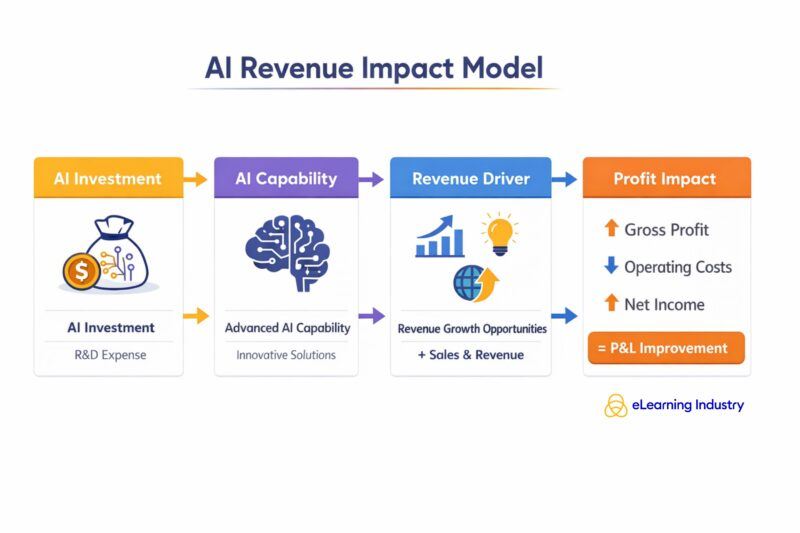
While checking the list of companies we mentioned, we can spot some repeatable monetization patterns.
That is because the organizations generating the strongest AI ROI are not experimenting randomly. On the contrary, they are applying clear business models.
1. AI As An Embedded Feature
AI as an embedded feature is the most common approach in the market. This way, companies integrate AI directly into the product experience to improve outcomes. For example:
- Recommendations (Amazon)
- Predictive insights (Salesforce)
- Intelligent workflows (Adobe)
So, the value comes from:
- Higher retention
- Increased usage
- Competitive differentiation
This model works best when AI improves measurable customer results.
2. AI As A Premium Tier
Many SaaS companies are introducing AI as a higher-priced product layer.
This method creates:
- Immediate monetization
- Upsell opportunities
- Clear value differentiation
However, there is a key requirement: the AI capability must produce tangible ROI for customers.
3. AI As A New Product Line
Many winning companies in the market take it a step further and utilize AI as a new product line. In essence, they launch entirely new AI-powered offerings like:
- Advanced analytics platforms
- Predictive intelligence services
- Decision automation tools
The use of this model transforms AI from an enhancement into a growth engine.
4. AI As A Data Monetization Engine
Some companies have large proprietary datasets. These companies can use AI to extract insights that become valuable commercial products.
Some examples include:
- Market intelligence
- Benchmarking platforms
- Performance prediction tools
Therefore, in this model, data and AI become a defensible competitive moat.
5. AI As An Ecosystem Advantage
AI can also be extremely useful for SaaS businesses. In platform businesses, AI strengthens the entire ecosystem by:
- Improving partner outcomes
- Increasing customer dependency
- Raising switching costs
This method reinforces long-term revenue stability and expansion potential.
In a nutshell, here are some key insights:
AI creates the most value when it changes one of the following:
- Pricing power
- Growth rate
- Customer lifetime value
- Market position
If none of these change, the investment is unlikely to produce a meaningful financial impact.
Why Some Companies Use AI But Fail To Increase Profit
We already know by now the benefits and capabilities of AI. However, despite widespread AI adoption, many organizations still struggle to translate investment into measurable financial results. Here, the issue is rarely the technology itself. The problem is strategic alignment.
The analysis across industries showcases five common patterns that explain why AI initiatives fail to deliver meaningful ROI.
1. No Clear Monetization Model
The most common case is the absence of a clear monetization model. That said, many companies launch AI features without answering a fundamental question:
How will this increase revenue or margin?
Here are some common symptoms:
- AI added as a "checkbox" capability
- No pricing changes or packaging adjustments
- No measurable impact on customer value
As a result, if customers don't experience meaningful business outcomes, AI becomes a cost center rather than a growth driver.
2. AI Disconnected From Business Strategy
Another big issue companies face is that AI teams often operate separately from product, revenue, or market strategy.
Eventually, this leads to:
- Innovation without commercial relevance
- Internal experimentation with no customer-facing impact
- Technical success but business ambiguity
On the other hand, successful companies align AI initiatives with strategic priorities such as:
- Increasing customer lifetime value
- Entering new markets
- Improving win rates
- Enabling premium positioning
3. No Pricing Leverage
Definitely, AI improves products and services. However, even when AI improves product performance, many companies fail to monetize the improvement.
Here are some common mistakes:
- Including AI in base plans without price adjustments
- Positioning AI as a feature instead of a value driver
- Avoiding premium tiers due to competitive pressure
The most successful AI business strategies treat advanced capabilities as opportunities to increase pricing power.
4. Misaligned Incentives
There needs to be an alignment when implementing AI. If revenue teams are not incentivized to sell AI-enabled value, adoption stalls.
Here we have some examples:
- Sales compensation tied only to base products
- Marketing messaging focused on features instead of outcomes
- Customer success teams lacking expansion targets tied to AI usage
In general, monetization requires organizational alignment, not just product innovation.
5. Overinvestment Without Focus
It is vital to remember that overexcitement can be costly. AI infrastructure, data platforms, and experimentation programs can become expensive quickly.
Therefore, without clear prioritization:
- Costs rise faster than returns
- Projects multiply without measurable impact
- Leadership loses confidence in AI initiatives
How Learning Tech And HR Tech Companies Can Apply These Lessons
For learning technology and HR tech vendors, AI represents one of the largest growth opportunities of the next decade. But the opportunity is not in adding AI features. Rather, it is in designing AI for revenue.
Several high-impact applications are already emerging.
AI-Driven Skills Intelligence
Platforms can use AI to:
- Identify skill gaps across organizations
- Predict future workforce needs
- Recommend personalized development paths
Revenue impact:
- Enterprise differentiation
- Strategic positioning with CHROs and L&D leaders
- Expansion into workforce planning and talent strategy budgets
AI-Powered Personalization
Adaptive learning, intelligent content recommendations, and dynamic learning paths increase:
- Engagement
- Completion rates
- Demonstrated ROI for customers
Higher measurable outcomes support:
- Premium pricing
- Upsell opportunities
- Stronger retention
AI-Enabled Workforce Insights
Analytics that connect learning activity to business performance create powerful executive value.
Examples:
- Learning impact on productivity
- Skills development linked to business KPIs
- Talent mobility predictions
When AI connects learning to business outcomes, platforms shift from training tools to strategic systems.
AI Advisory And Strategic Services
There are vendors in the market that are expanding beyond software by offering:
- AI maturity assessments
- Workforce transformation and AI strategy consulting
- Data strategy and skills planning services
Eventually, this expansion creates high-margin services revenue while strengthening long-term customer relationships.
Key Takeaway For Learning Tech And HR Tech
AI should not be positioned as innovation alone.
It should be positioned as:
- Better workforce outcomes
- Measurable business impact
- Strategic decision support
Putting it simply, AI is not just feature innovation; it is revenue design.
Turning AI Investments Into Revenue And Profit
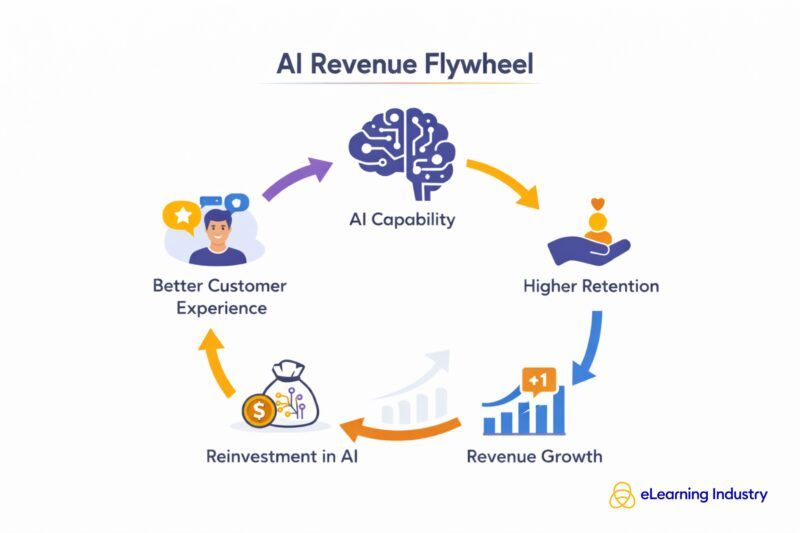
For executive teams, the question is no longer whether to invest in AI. Nowadays, the question is more like how to ensure those AI investments produce measurable financial outcomes.
For this purpose, there are four strategic principles separating high-performing organizations from those still experimenting.
1. Align AI With Customer Value And ICP Needs
We cannot state enough how important alignment is when it comes to AI. On this note, the highest-return AI initiatives solve high-value problems for core customers.
Ask yourself:
- Does this capability improve customer revenue, efficiency, or risk outcomes?
- Will our ideal customers pay more for this?
- Does it strengthen our position in our core segment?
At the end of the day, AI that solves strategic problems creates pricing power and expansion opportunities.
2. Define Monetization Before Implementation
It is vital to define monetization way before AI implementation. Therefore, before building, leadership should define:
- Pricing model (premium tier, usage-based, bundled, or standalone)
- Revenue targets
- Expansion or retention impact
- Sales positioning
This proactive process ensures AI development supports business outcomes, not just technical progress.
3. Track Revenue-Linked KPIs
AI is not effective if you cannot track the right KPIs and improve its processes.
For revenue effects, executives should monitor:
- Revenue from AI-enabled features
- Average deal size impact
- Expansion revenue tied to AI
- Retention differences between AI users and non-users
- Gross margin impact
This analytic process reinforces accountability and guides future investment.
4. Communicate AI Value Clearly To The Market
Buyers need to understand where and how you utilize AI. Even high-value AI capabilities fail commercially if buyers don't understand their business impact.
Strong positioning focuses on:
- Outcomes, not algorithms
- ROI, not innovation
- Business transformation, not technical sophistication
Especially in competitive markets, perceived value drives monetization as much as actual capability.
Conclusion
There is no doubt that AI adoption is now widespread across industries. We witness it every day, from retail and entertainment to finance, healthcare, and enterprise software, companies that use AI are reshaping how they operate and compete.
But adoption alone does not create an advantage. This is why the organizations achieving the strongest results share a common approach:
- They link AI investments to revenue and profit.
- They design monetization alongside capability.
- They focus on customer value rather than technical experimentation.
- They treat AI as a business model shift, not a feature upgrade.
At the end of the day, many companies use AI. Far fewer turn it into durable financial performance.
The leaders do not ask, "Where can we apply AI?" They ask, "Where can AI change our growth rate, pricing power, or customer lifetime value?"
That revenue-first mindset is what separates AI adopters from AI leaders.
FAQMany global organizations actively use AI to improve operations and drive revenue, including companies in retail, streaming, finance, healthcare, logistics, and enterprise software. AI is now embedded in recommendation systems, fraud detection, predictive analytics, automation, and customer experience platforms.
Companies increase revenue with AI by improving personalization, optimizing pricing, automating sales processes, identifying upsell opportunities, and enhancing customer retention. The strongest financial impact comes when AI directly influences customer lifetime value or pricing power.
Retail, financial services, healthcare, manufacturing, logistics, and enterprise software currently see the strongest measurable ROI from AI. These industries leverage AI for predictive analytics, automation, risk reduction, and operational efficiency.
AI is used for both, but leading companies focus on revenue growth. While automation and efficiency reduce costs, the highest strategic value comes from AI-driven personalization, smarter decision-making, and monetizable product enhancements.
Companies often fail when AI initiatives are disconnected from business strategy, lack a monetization model, or are treated as innovation experiments rather than revenue-driving capabilities. Without alignment to pricing, sales, and customer value, AI becomes an expense rather than a growth engine.
AI performance should be measured through revenue-linked KPIs such as average deal size, expansion revenue, retention rates, margin improvement, and AI-attributed revenue growth, not just usage metrics or model accuracy.
AI leaders align AI initiatives with strategic growth goals, define monetization before implementation, track revenue impact, and communicate business outcomes clearly. AI adopters often experiment without integrating AI into their core revenue strategy.
AI creates competitive advantage by enabling better customer insights, faster decision-making, improved personalization, predictive capabilities, and scalable automation , all of which strengthen differentiation and pricing power.
HR and learning platforms can use AI for skills intelligence, personalized learning paths, workforce analytics, predictive talent insights, and advisory services. When connected to business outcomes, these capabilities support premium positioning and enterprise expansion.
Revenue-driven AI strategy means designing AI initiatives around measurable financial outcomes, such as higher retention, increased deal size, new pricing tiers, or entry into new markets, rather than deploying AI for experimentation alone.