

AI Startups Are Innovating At An Unprecedented Level
AI innovation is driven not by well-established AI conglomerates but by the hottest AI startups. Why do we say that, though? These startups don't have as much money or workforce. For starters, they move fast by adopting new technologies and experimenting with new tools without letting legacy systems slow them down. Also, emerging AI startups take risks, tackling niche problems that haven't been fully explored by other companies. That's why they attract top talent that is liberated by the lack of micromanagement and the freedom.
Therefore, they come up with brand-new AI solutions, forcing the biggest AI companies to adapt quickly, accelerating the overall technological progress. But how do we define the term "hottest" AI startups? First, they combine cutting-edge technology, like generative AI, Large Language Models, and autonomous systems, with high growth potential in markets ripe for disruption.
Additionally, they demonstrate strong traction through early adoption, partnerships, and user engagement, while offering innovation-driven solutions that create new value. That's why they are so popular among investors. Let's check out 20 of the top trending, fast-growing AI companies and what they are working on right now.
In This Guide, You Will Find...
- What Makes An AI Startup "Hot" In 2026?
- The AI Startup Landscape in 2026
- The 20 Hottest AI Startups That Are Paving The New Way
- Why These AI Startups Matter To Enterprises And Investors
- Hottest AI Startups vs. Biggest AI Companies
- Key Startup Trends Defining 2026
- What To Watch Next: Which Startups Will Break Out
What Makes An AI Startup "Hot" In 2026?
The AI landscape is evolving fast, and some startups stand out for their innovation, traction, and bold experimentation. Maybe some of them are one step closer to enforcing global expansion strategies.
- Fast adoption: Hot AI innovation startups grow quickly, showing real-world usage and early traction.
- Funding momentum: Recent investment signals confidence in their vision and ability to scale.
- Product differentiation: They create new categories or solve problems in ways others haven't.
- Early enterprise pilots: Strong customer engagement proves their solutions work in practical settings.
- Ecosystem visibility: Recognition among developers, operators, and buyers boosts credibility.
- Experimentation culture: These startups thrive on testing bold ideas, iterating fast, and prioritizing momentum over sheer size.
The AI Startup Landscape In 2026
AI is everywhere, and the race isn't just ChatGPT vs. Google anymore. The hottest AI startups are moving fast, showing real traction, and creating new ways for humans and machines to work together.
- Explosion of AI-native companies: More startups are being built from the ground up with AI at their core.
- Lower barriers to building AI products: Tools, frameworks, and cloud access make experimentation faster than ever.
- Rise of vertical AI startups: Niche solutions for healthcare, finance, and logistics are thriving.
- Shift from AI tools to AI coworkers, agents, and copilots: Products now assist rather than just automate.
- Faster go-to-market cycles: Startups can launch and iterate in months, not years.
- Enterprises testing startups earlier: Companies are adopting new solutions quickly, giving startups traction and visibility.
The 20 Hottest AI Startups That Are Paving The New Way
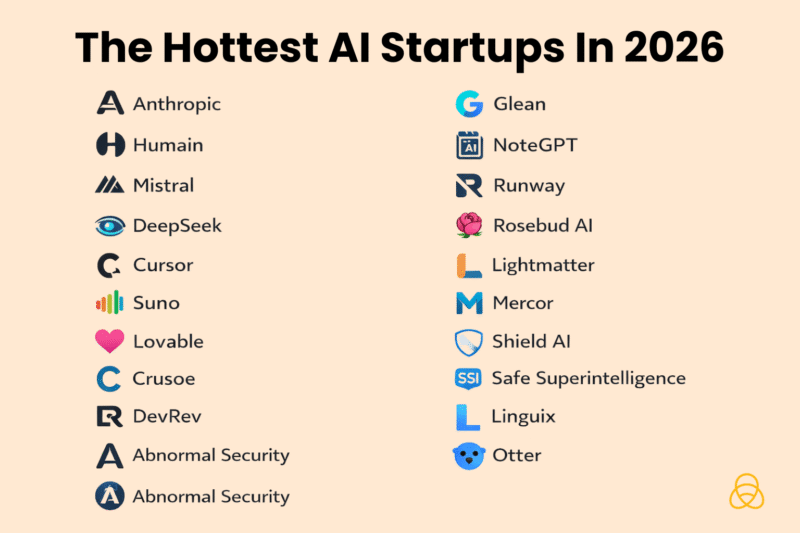
1. Anthropic
- A San Francisco‑based AI research company that was founded in 2021 by Dario and Daniela Amodei (CEO/President).
- Anthropic builds the Claude family of Large Language Models focused on safe and scalable AI systems.
- It has raised over $18.2B in funding and competes with major LLM developers.
2. Humain
- A Riyadh‑based generative AI startup that focuses on regional dialogue systems, notably an Arabic‑centric chatbot tailored for Arab and Muslim users.
- It has significant capital backing from the Saudi Public Investment Fund, but detailed public funding totals and founder data remain limited.
3. Mistral
- Arthur Mensch, Guillaume Lample, and Timothée Lacroix founded the fast-growing AI startup in Paris.
- It is building open, efficient AI models and tools.
- It has raised over $1B from top investors and competes as Europe's leading homegrown AI model maker.
4. DeepSeek
- Liang Wenfeng founded DeepSeek in China, making it one of the hottest AI startups.
- Tech experts often cite it as a top GenAI contender, and is known for unified multimodal models and advanced reasoning architectures.
- The company hasn't relied on traditional AI startup funding. Instead, its parent company, High-Flyer, has funded DeepSeek entirely.
5. Cursor
- MIT graduates, Michael Truell, Aman Sanger, Sualeh Asif, and Arvid Lunnemark, founded the startup in 2022 in San Francisco.
- Cursor is an AI‑assisted coding platform aimed at helping developers write better code faster (often associated with "vibe coding").
- It has raised $2.3 billion in a November 2025 Series D round. It has been backed by investors including Google, Nvidia, Accel, and Coatue.
6. Suno
- It was founded in 2023 by Mikey Shulman, Georg Kucsko, Martin Camacho, and Keenan Freyberg, and is operated through Warner Music.
- Suno is a creative AI platform that generates music and audio using machine intelligence.
- The platform has raised $250 million in a Series C funding round as of November 2025, reaching a valuation of $2.45 billion.
7. Lovable
- Stockholm's Lovable, founded by Anton Osika, is one of the hottest AI companies.
- It was built to let users create full apps using natural language prompts.
- As of late 2025, the company has raised over $500 million in total funding.
8. Crusoe
- Based in Denver, Colorado, Crusoe was founded by Chase Lochmiller and Nitin Perumbeti.
- It is a vertically integrated AI infrastructure company that builds and operates data centers powered by energy sources.
- It has raised over $1.37B in funding with a valuation above $10B.
9. DevRev
- The San Francisco‑based enterprise AI startup was founded by Venkat Rangan.
- It builds platforms to unify customer support, product, and engineering teams through intelligent automation.
- It has received a total of $158M over 3 rounds.
10. Abnormal Security
- One of the most emerging AI startups, it was co‑founded by Evan Reiser and is headquartered in San Francisco.
- Abnormal uses AI behavioral models to defend against email and cloud threats.
- It closed a $250M Series D at a $5.1B valuation, part of $500M+ in total funding.
11. Glean
- It was founded by Arvind Jain in Palo Alto.
- Glean builds AI‑powered enterprise search and knowledge tools that help employees find and act on data across systems.
- The company has raised dozens of millions across rounds and most recently secured $150M in Series F funding at a $7.2B valuation.
12. NoteGPT
- The Singapore-based AI startup was founded by Hongyuan Cao and Pierre Peng.
- NoteGPT is an emerging AI note‑taking and summarization startup focused on automating meeting and document insights.
- There is no official information on funding.
13. Runway
- Runway is based in New York and was co‑founded by Cristóbal Valenzuela, Alejandro Matamala-Ortiz, and Anastasis Germanidis.
- As one of the top AI startups to watch, it uses AI for media creation, letting users generate and edit videos and images from text.
- It's raised $308 million with a $3B valuation.
14. Rosebud AI
- Founded by Lisha Li, it is an AI company creating 3D games, assets, and visual content using AI.
- It is also known for "vibe coding" games from text prompts.
- Data shows that it has raised approximately $8.8 million.
15. Lightmatter
- Nicholas Harris, Dr. Darius Bunandar, and Thomas Graham founded the Boston-based company in 2017.
- The hot AI startup is designing photonic chips to accelerate AI workloads.
- It has secured over $850 million in funding, with a valuation of $4.4B.
16. Mercor
- Brendan Foody, Adarsh Hiremath, and Surya Midha founded Mercor in San Francisco.
- The company matches expert talent to train AI models and chatbots.
- It raised $350M in a Series C at a $10B valuation, making its young founders some of the world's youngest self‑made billionaires.
17. Shield AI
- Brandon and Ryan Tseng built one of the hottest AI companies, Shield AI, in San Diego.
- The AI startup is building autonomous systems for military and security clients.
- It has raised over $240M with a valuation of $5.3B.
18. Safe Superintelligence
- Ilya Sutskever (former OpenAI chief scientist and current CEO), Daniel Gross (former Apple AI lead), and Daniel Levy founded the company in 2024.
- The startup focuses on building super-intelligent AI systems that are safe and aligned with human values.
- Investors have poured an astonishing ~$3 billion into the company, including a massive $2 billion round that lifted its valuation to about $30 billion, despite the company not having released a commercial product yet.
19. Linguix
- Roman Malykh founded the company in Miami.
- The AI writing assistant helps users improve grammar, clarity, and style across documents, emails, and web text.
- Linguix first raised around $350,000 in early funding in 2019 and later secured a $1 million pre-seed round led by investors like Grishin Robotics and Antler New York, bringing total known funding to roughly $1.35 million.
20. Otter
- Sam Liang and Yun Fu built one of the hottest AI startups in California in 2016.
- Otter turns speech into written text for meetings, interviews, lectures, and calls with high accuracy, powered by Machine Learning.
- The company raised a $50 million Series B led by Spectrum Equity, with participation from Horizons Ventures and others, and has continued to grow its feature set. Recently, Otter reported surpassing $100 million in annual recurring revenue.
Why These AI Startups Matter To Enterprises And Investors
The hottest AI startups aren't just chasing trends. They're redefining how companies think about productivity, creativity, and growth. What makes this new generation stand out is their adoption velocity and ability to move from concept to impact faster than traditional enterprise vendors. These early-stage AI companies are building tools that slot directly into existing AI workflows, helping organizations automate repetitive tasks, make smarter decisions, and unlock new forms of customer engagement.
- Faster ROI: Startups focus on delivering immediate business value with lightweight AI integrations that don't require full system overhauls.
- Innovation at speed: Their smaller size means they can experiment, learn, and ship updates faster, setting the pace for entire industries.
- Scalable success: Once these solutions gain traction, they spread quickly across sectors like healthcare, finance, and manufacturing.
- Talent advantage: The best researchers and engineers are leaving big tech to join startups where they can build, not just optimize.
- Investment magnetism: Venture capital firms are pouring billions into this space, betting that nimble innovation will outpace scale.
Hottest AI Startups Vs. Biggest AI Companies
The gap between the hottest AI startups and the biggest AI companies has never been wider, or more complementary. On one side, venture-backed AI startups are driving speed, experimentation, and bold thinking. On the other, established giants dominate with infrastructure, distribution, and global trust. Together, they shape an AI startup ecosystem that blends momentum with stability.
In general, startups thrive on speed and momentum, pushing boundaries before markets are fully defined. They're constantly testing, pivoting, and chasing product-market fit, a stage where every user insight can redefine their roadmap. This agility gives them an edge in emerging sectors like AI adoption in L&D, where companies seek tools that evolve as fast as their workforce.
By contrast, the biggest AI companies focus on scale and dominance. They prioritize reliability, compliance, and platform strength. Their innovations set the standards others follow, but their size often limits how fast they can move.
In essence, the top AI startups embody innovation-first thinking, while tech giants remain infrastructure-first operators. One experiments in the unknown; the other stabilizes what works. And when they meet, through acquisitions, partnerships, or ecosystem collaboration, the result is a faster, safer, and more accessible AI landscape for everyone.
Key Startup Trends Defining 2026
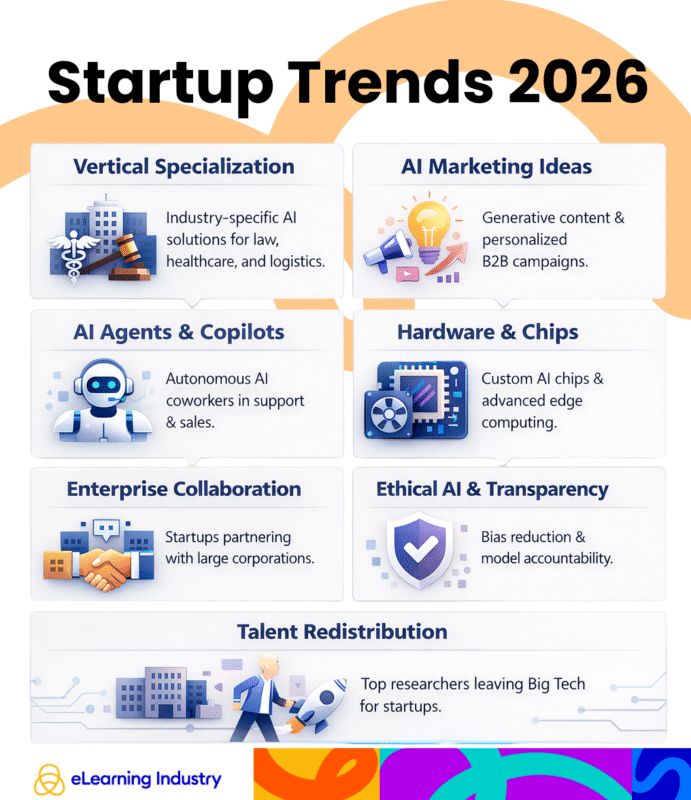
The AI landscape in 2026 is dynamic, experimental, and more commercially mature than ever. From research labs to boardrooms, AI innovation startups are reshaping how businesses build, sell, and scale. Here are the trends defining this next wave.
eLearning Industry's report found that 59% of L&D buyers cite data privacy/GDPR compliance as an AI concern, while 54% are concerned about ethical issues and bias. It concludes that competitive differentiation may increasingly depend on governance, transparency, and trust rather than simply offering more AI features.

-
Vertical Specialization
Startups are no longer building one-size-fits-all models. They're creating tailored AI for industries like law, healthcare, and logistics, offering deep domain expertise and faster deployment.
AI is revolutionizing digital marketing. Startups now use generative tools to produce content, ad copy, and visuals in seconds, personalizing B2B marketing campaigns for every audience segment.
-
Rise Of AI Agents And Copilots
From customer support to sales, intelligent agents are evolving from assistants into autonomous coworkers who can make decisions and complete tasks.
-
Hardware Meets Intelligence
Fast-growing AI companies are investing in custom chips, efficient cooling systems, and edge computing to manage massive model demands.
-
Enterprise Collaboration
Corporations are co-developing with startups to integrate agile innovation into legacy systems, bridging speed and scale.
-
Ethical AI And Transparency
Startups are embedding ethics into design, auditing data sources, reducing bias, and publishing model accountability reports.
-
Talent Redistribution
Researchers and engineers are leaving big tech to join startups, driving innovation at startup speed.
What To Watch Next: Which Startups Will Break Out
The next wave of AI disruption won't come from the biggest players, but from the hottest AI startups quietly refining their models, building loyal user bases, and proving real-world impact. These companies are moving past buzzwords and into measurable results, focusing on practical deployment and adoption across industries.
-
Which Categories Are Heating Up
Generative AI continues to dominate, but newer subfields, like multimodal learning, AI infrastructure, and generative engine optimization (GEO), are emerging as core growth areas. GEO, in particular, is helping brands and content creators optimize visibility within AI-driven search engines, creating an entirely new marketing discipline.
-
Signals That A Startup Is About To Scale
Keep an eye on strong pilots and early enterprise adoption. When large organizations start testing a startup's models or workflows, it's often the first sign of a breakthrough moment.
-
What Enterprises Should Monitor
Beyond model accuracy, watch for startups that prioritize usability, integration, and security. The breakout players of 2026 will be those that blend innovation with reliability, solving real business problems while positioning themselves at the heart of how AI gets discovered, distributed, and used.
Key Takeaway
The AI landscape has reached a tipping point where innovation outpaces tradition. The hottest AI startups are no longer fringe disruptors. They're shaping the direction of enterprise technology, data strategy, and automation. Their impact is visible not only in how companies operate but also in how professionals adapt and grow new AI skills to stay competitive. These startups are fueling a new wave of creativity and problem-solving, pushing businesses to rethink their AI strategy from the ground up. By prioritizing agility over bureaucracy, they're showing that speed and smart risk-taking are now the ultimate competitive advantages.
At the same time, the rise of vertical AI startups is transforming niche industries with precision-built solutions for healthcare, logistics, education, and more. These focused innovators are proving that deep domain knowledge can drive greater efficiency than one-size-fits-all AI tools. As enterprises continue testing pilots and early enterprise adoption, we'll see which technologies prove scalable and which fade into experimentation. But one thing is clear: 2026 belongs to the builders, the startups that can turn bold ideas into tangible outcomes and redefine how businesses harness the full potential of Artificial Intelligence.
FAQAI startups offer high-growth potential by addressing emerging problems with automation, predictive analytics, and intelligent solutions, often disrupting traditional industries.
Top sectors include generative AI, healthcare AI, autonomous systems, AI-powered cybersecurity, and AI-driven enterprise tools.
They push the boundaries of technology, experiment faster than large corporations, and introduce new products and processes that transform industries.
By leveraging cutting-edge research, agile development, and niche applications that large companies may overlook or move too slowly to adopt.
Data acquisition, regulatory compliance, scaling AI models, talent shortage, and intense competition from both other startups and tech giants.
AI startups optimize operations, reduce costs, improve decision-making, and create new services in sectors like finance, healthcare, logistics, and media.
Emerging trends include specialized generative AI, AI for climate and sustainability, autonomous agents, low-code AI platforms, and increased collaboration between startups and enterprise AI teams.