

The AI Landscape In 2026
Have you ever wondered how many AI companies are operating? 212,230 companies, of which 62,184 are startups. Not only that, but approximately 2049 new companies are founded annually. However, the majority of power and money is sitting on the laps of a few of the biggest AI companies that dominate our lives and whose products we use daily without even realizing it. When popular AI platforms first appeared, they were exciting, allowing us to seek answers and create images. But we've gone way beyond this very early stage. Now, AI tools are transforming many sectors.
For instance, in medicine, AI helps diagnose patients and determine the most personalized medication plan. In finance and banking, AI detects potential fraud, assesses risks, automates compliance, and offers personalized advice. In education, top AI companies offer personalized learning solutions, offering fully accessible options and empowering educators to focus on providing direction rather than grading papers. Also, in manufacturing, AI sensors predict maintenance needs before equipment fails, while helping companies optimize their supply chain.
AI skills are no longer optional. Your company has probably already adopted an AI solution. Knowing the biggest AI companies and their products helps you navigate this path and excel in your position.
In This Guide, You Will Find...
- What Makes An AI Company "Big" In 2026?
- Biggest AI Companies At A Glance
- The Most Influential AI Companies That Dominate
- Generative AI Leaders In 2026
- How The Biggest AI Companies Shape The Future Of Artificial Intelligence
- Why Enterprise Buyers Gravitate Toward The Biggest AI Companies
- Risks And Challenges Facing The Biggest AI Companies
- Future Trends Shaping AI Companies
What Makes An AI Company "Big" In 2026?
1. Deep And Distinctive AI Foundations
- The biggest AI market leaders stay ahead because they control and constantly improve the models that power everything else.
- They're not just AI users; they're the builders, shaping massive systems that understand text, images, and even sound.
- Mid-sized companies are thriving by focusing on specific areas, like healthcare, law, robotics, and engineering, creating specialized models that solve narrow but valuable problems.
- Efficiency is now the new arms race. Success depends on running smaller, smarter systems that cost less, process faster, and balance work between the cloud and edge devices.
2. Seamless Integration Into Everyday Work
- The era of "look what our AI can do" demos is over. Winning companies are now embedding AI right into the tools people already use.
- Their strength lies in context awareness: the AI understands your goals, your data, and how your team works.
- APIs and plug-ins make adoption simple, like custom GPTs or enterprise integrations that create AI workflows with no friction.
The rapid expansion of AI products doesn't necessarily mean organizations are integrating them at the same pace. eLearning Industry's research into the learning technology market found that 42% of learning technology vendors have fully integrated AI into their offerings, compared with just 7.5% of L&D buyers who say AI is fully integrated into their learning environments. However, another 45% of buyers are actively planning AI adoption, suggesting a significant wave of implementation may still be ahead.
3. Smarter, Scalable Business Models
- The early $20-a-month subscription trend is fading fast. Companies that last are the ones with flexible, usage-based, or enterprise-tier pricing.
- Corporate clients care less about novelty and more about privacy, reliability, and governance.
- As a result, enterprise-grade AI platforms are dominating the market over basic public chatbots.
4. Trust, Safety, And Data Transparency
- Regulation has arrived, and it's reshaping the AI landscape. The EU, US, and several Asian countries now have real frameworks guiding how AI is built and used.
- Companies that can show their data sources, prove their models are safe, and deliver reliable outputs are ahead of the curve.
- Transparency and ethical accountability have become competitive advantages for the biggest AI companies in the world.
As AI capabilities become more widespread, having AI features alone may no longer be enough to stand out. eLearning Industry's research indicates that L&D buyers are placing increasing emphasis on trust, transparency, governance, data privacy, explainability, and user control. This suggests that competitive advantage may increasingly depend on how responsibly companies implement AI, not simply on how many AI capabilities they offer.
5. Global Reach With Local Understanding
- AI may be global, but the best companies know how to think locally. They're building developer ecosystems filled with APIs, SDKs, fine-tuning tools, and marketplaces that encourage innovation.
- They also adapt to local languages, cultures, and regulations instead of trying to force a one-size-fits-all model.
6. Building AI Around People
- The best AI experiences feel natural.
- Companies winning in this space design products that are intuitive, emotional, and genuinely helpful, whether through voice, visuals, or personality-driven interfaces.
- Those who truly understand how humans build trust and collaborate with AI are setting themselves apart for the long term.
7. Learning From Every User
- The most successful AI systems never stop learning. They evolve safely by understanding how people use them, what they need, and what can be improved.
- Companies that let users shape their own AI personalization tools foster deeper loyalty.
- Once AI adapts to you, it becomes a lasting part of your workflow.
8. Winning Through Collaboration
- No one builds AI alone anymore. Artificial Intelligence companies partner with chipmakers like NVIDIA and AMD, work with regulators, and connect across industries.
- They also balance open-source collaboration with proprietary innovation, giving back to the community while protecting their edge.
- The real power comes from ecosystems, not isolation. Those who build bridges are defining the next phase of AI growth.
Biggest AI Companies At A Glance
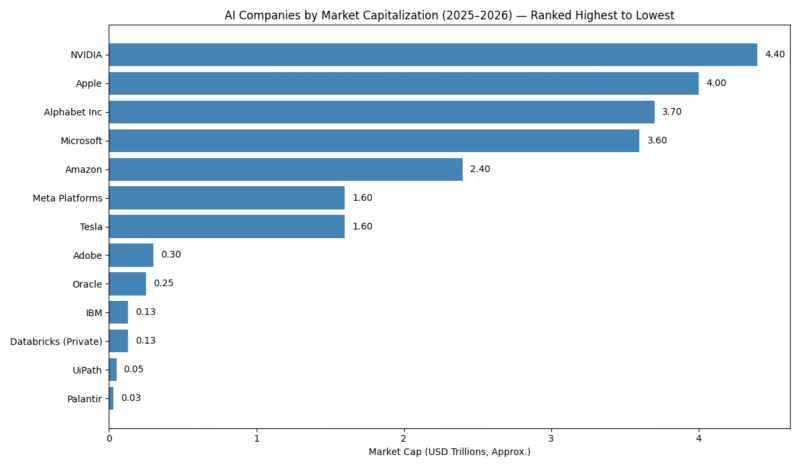
No single company dominates the AI landscape. Market leaders contribute in different ways in today's growing market, whether it's powering AI infrastructure or creating enterprise platforms and autonomous technologies. With leading companies focusing on innovation and development across cloud computing, hardware, enterprise software, and consumer technology, it has become important to understand each of their strengths to see how the industry is actually evolving. The table below highlights leading AI companies, their core AI specializations, flagship offerings, and the primary industries where they are making the biggest impact.
| Company | AI Category | Flagship AI Product | Primary Industry |
| NVIDIA | AI Hardware | GPUs | Infrastructure |
| Microsoft | Enterprise AI | Copilot | Productivity |
| Alphabet | Foundation Models | Gemini | Search and Cloud |
| Amazon | Cloud AI | AWS AI | Cloud |
| Meta | Open Models | Llama | Social Media |
| Apple | Consumer AI | Apple Intelligence | Consumer Devices |
| IBM | Enterprise AI | WatsonX | Enterprise Software |
| Oracle | Enterprise AI | Oracle AI | Enterprise Cloud |
| Adobe | Creative AI | Firefly | Creative Software |
| Tesla | Autonomous AI | Full Self-Driving | Automotive |
The Most Influential AI Companies That Dominate
1. NVIDIA
NVIDIA is basically the engine behind modern AI and one of the leading AI companies shaping the industry today. Its GPUs, like the H100 and Blackwell series, power everything from massive research models to enterprise AI systems. It has maintained roughly a 92–94% share, far ahead of competitors like AMD and Intel, which gives it near-monopoly power in the hardware that fuels AI workloads.
Beyond hardware, NVIDIA provides software tools like CUDA and TensorRT that help developers optimize AI performance across industries including healthcare, robotics, and autonomous vehicles. This combination of hardware and software makes NVIDIA a cornerstone for anyone serious about AI.
Pros: One big advantage is the unmatched performance of its chips, widely adopted across the world. Additionally, its strong ecosystem makes it easier for developers to plug in, scale, and experiment.
Cons: NVIDIA's GPUs can be expensive, which may block smaller SaaS startups from accessing the latest tech. Supply chain delays occasionally slow delivery, and competitors are developing alternative hardware solutions that could challenge NVIDIA's dominance.
2. Microsoft
Microsoft has successfully embedded AI into almost everything it touches, and it's consistently counted among the biggest AI companies in the world. Tools like Microsoft 365 Copilot make Word, Excel, and Outlook smarter, while GitHub Copilot helps developers write code faster, and Azure AI gives enterprises tools to build, deploy, and manage models at scale. A major marker of its influence is revenue: Microsoft's cloud business generated over $75 billion in annual revenue, a cornerstone of its AI and cloud strategy.
Pros: One big advantage is its massive reach, as AI is already in the hands of millions through Microsoft's software and cloud products. Another pro is the strong security and compliance, which large organizations rely on.
Cons: Microsoft's sprawling portfolio can feel overwhelming for smaller businesses that are just starting with AI, and its pricing and licensing aren't always crystal clear. It also faces intense competition from Amazon Web Services and Google Cloud, both investing heavily in AI infrastructure and cloud tools.
3. Apple
Apple takes a slightly different approach to AI than some of the other largest AI companies, focusing on privacy, seamless integration, and user experience. Its Apple Intelligence powers features across iPhones, iPads, and Macs, improving Siri, predictive text, photography, and personalization. Apple's custom chips, like the Neural Engine in the A-series and M-series, enable powerful on-device AI while keeping data private.
The company's Services segment, which includes the App Store, iCloud, and Apple Music, recently generated around $100 billion in annual revenue, showing how AI-enhanced features contribute to both user experience and business growth.
Pros: Tight hardware-software integration, strong privacy protections, and a massive global user base giving new features instant reach.
Cons: The ecosystem is relatively closed, limiting third-party developer access. Some AI capabilities lag behind cloud-first competitors, and software updates roll out more slowly than on other platforms.
4. Alphabet Inc.
Google has embedded AI into much of our daily lives, making it one of the AI revenue leaders. Its core products, Search, YouTube recommendations, Gmail, and Gemini models, use AI to provide faster, smarter experiences. Developers and businesses can use Vertex AI to build custom models, while TensorFlow remains a staple for Machine Learning projects. Alphabet reported over $100 billion in total revenue in 2025, with Google Cloud contributing more than $15 billion, largely from AI-powered services and enterprise solutions.
Pros: Google's AI scale allows it to compete effectively in ChatGPT vs. Google, powering products that millions rely on daily. Its deep data access and research talent are unmatched.
Cons: Ongoing privacy concerns, regulatory scrutiny, and fierce competition from AWS and Azure.
5. Meta Platforms
Meta Platforms, another of the biggest AI companies, uses AI extensively to power content recommendations, ad targeting, moderation, and immersive experiences through its Reality Labs division. In 2025, Meta reported tens of billions in quarterly revenue, driven mostly by advertising that's increasingly optimized with AI‑based algorithms to improve engagement and conversion. The company is also investing heavily in next‑generation models like LLaMA and building massive AI infrastructure, with capital expenditures estimated at around $64–72 billion for the year.
Pros: Massive reach with billions of daily users across its platforms, strong ad-driven revenue growth enhanced by AI, and bold infrastructure investments positioning it for future AI innovations.
Cons: Heavy reliance on advertising, which makes revenue sensitive to market shifts; large AI spending, which can strain profits; and ongoing regulatory and privacy scrutiny. Some AI initiatives, like advanced LLaMA releases and Metaverse hardware, have also struggled to meet expectations.
6. Tesla
Tesla started as an electric car maker, but today it's also one of the AI market leaders thanks to its work on autonomous driving and robotics. Its Full Self‑Driving (FSD) software uses advanced neural networks and real‑world data from millions of vehicles to improve automation and navigation logic, and Tesla recently expanded into robotaxi services in select US cities. In Q3 2025, Tesla reported $28.1 billion in revenue, with growth driven by automotive, energy storage, and services revenue.
Pros: Tesla's massive fleet provides a rich source of real‑world data that fuels its AI models, and its brand recognition helps it attract talent and attention in both electric vehicles and autonomous systems. The company is also branching into energy products and other AI‑enhanced solutions beyond cars.
Cons: Tesla has seen vehicle deliveries and profits face pressure, and it lost its position as the world's top EV seller in 2025 amid intense competition. FSD adoption remains limited and controversial, with regulatory scrutiny and consumer hesitancy slowing both monetization and deployment.
7. Adobe
Adobe has fully embraced generative AI, and its tools are central to a category of generative AI companies transforming creative workflows. Products like Photoshop, Premiere Pro, Illustrator, and others now include AI‑powered features from Adobe's Firefly models that help users generate or enhance images, video, and design elements automatically. In 2025, Adobe reported record revenue of about $23.77 billion, with much of that growth credited to the integration of AI capabilities that boost productivity and unlock new creative possibilities for individuals and enterprises.
Pros: Its AI tools help eliminate repetitive tasks and accelerate creative work, and many customers view them as indispensable for professional content creation. The company also benefits from long‑term subscription revenue that creates financial stability.
Cons: Some critics worry that generative AI could erode artistic originality and devalue creative labor. Adobe's stock performance has been mixed, and competition from newer, more nimble AI-native creative tools means it must keep innovating to stay ahead.
8. Palantir
Palantir is known for its powerful data analytics and integration platforms, including Gotham and Foundry, which serve government, defense, and commercial clients. It's often included with AI cloud providers that help organizations make sense of massive datasets and operationalize Machine Learning insights at scale. In 2025, Palantir raised its full‑year revenue guidance, projecting around $4.1 billion to $4.4 billion, driven by strong demand for its AI‑linked services across sectors and record quarterly performances that topped $1 billion in revenue.
Pros: Deep specialization in complex data environments and long‑term, high‑value contracts, especially with government agencies that provide revenue stability. Also, its AI platforms and tools are highly customizable for mission‑critical use cases.
Cons: Palantir's solutions can be expensive and complex to implement, which can limit adoption among smaller organizations. Its association with sensitive government work also draws ethical scrutiny and regulatory complexity.
9. Amazon
Amazon is one of the biggest AI companies in the world, using AI across both consumer and enterprise fronts. On the enterprise side, AWS offers Machine Learning services like SageMaker, Bedrock, Lex, and Polly that let developers build and deploy AI models in the cloud. On the consumer side, Alexa brings voice‑activated AI into millions of homes. AWS continues to dominate the global cloud infrastructure market with roughly 30% share, which translates to over $100 billion in annual revenue just from cloud services.
Pros: Massive cloud infrastructure that supports developers and enterprises at scale, as well as the breadth of AI services available within AWS. AI also enhances operational divisions such as logistics, personalization, and retail.
Cons: On the downside, AWS faces stiff competition from Microsoft Azure and Google Cloud, and Alexa's performance and privacy perceptions lag behind some rivals. Amazon's sprawling business model means AI focus can sometimes feel diluted across many different products and divisions.
10. IBM
IBM continues to carve out a niche among leading AI companies with its Watsonx platform, designed for enterprise AI workloads with an emphasis on model training, governance, and explainability. Watsonx integrates with data services and helps clients in regulated industries like healthcare and finance build, manage, and oversee ML and generative AI systems. IBM pairs AI with its hybrid cloud strategy to offer solutions that blend on‑premises and cloud deployments for large organizations. In 2025, IBM continued growing, reporting quarterly revenue above $16 billion, with its AI‑related business (including consulting, software, and hybrid cloud services) expanding.
Pros: IBM's long history in enterprise computing and strong reputation for security and compliance make it attractive to conservative IT buyers. Its focus on explainable AI and governance resonates with regulated industries.
Cons: IBM's overall growth is slower than that of nimbler cloud and AI‑first companies, and Watsonx's developer adoption isn't as broad as hyperscaler AI platforms. Some customers find the platform's complexity a barrier without specialized expertise.
11. Oracle
Oracle is a long‑standing enterprise software giant that embeds AI throughout its cloud infrastructure and applications to help businesses automate workflows and analyze data at scale. The company generated roughly $57.4 billion in total revenue, with cloud services and license support contributing a large portion of that and rapidly growing year‑over‑year as more customers adopt AI‑enabled cloud products. Its Oracle Cloud Infrastructure (OCI), databases, and analytics tools support enterprises in cloud migration, automation, and predictive insights, making Oracle's platforms a backbone for many mission‑critical enterprise systems.
Pros: Oracle's deep integration with enterprise systems, strong governance and security, and stable subscription revenue make it a reliable choice for large companies. Also, its AI platforms can boost operational efficiency and decision‑making across business workflows.
Cons: It often trails hyperscale cloud competitors in developer mindshare, and some customers feel its AI offerings are more evolutionary than breakthrough innovations. Adoption can also be complex for smaller teams without enterprise IT experience.
12. UiPath
UiPath is known as one of the AI innovation leaders in robotic process automation and agentic AI software, helping businesses automate repetitive tasks and workflows across finance, HR, customer service, and beyond. The company generated about $1.43 billion in revenue, with trailing‑twelve‑month revenues around $1.55 billion as of late 2025, showing solid growth as organizations embrace AI‑driven automation. Its platform includes tools that combine rule‑based automation with Machine Learning to interpret documents, route tasks, and automate complex processes.
Pros: Rapid ROI from automating routine work, a user‑friendly interface that accelerates adoption, and measurable productivity gains that resonate with enterprise customers. Also, it achieved profitability in recent quarters, indicating a more sustainable financial path.
Cons: Its overall revenue is smaller than hyperscale cloud or foundational model providers, limiting its reach in broader AI markets. The competitive landscape is also heating up, with larger platforms bundling automation into broader AI suites that could undercut UiPath's standalone appeal.
13. Databricks
Databricks ranks among the top enterprise AI companies with its unified data lakehouse platform that brings data engineering, analytics, and Machine Learning together in one environment. As of 2025, Databricks has surpassed an annual revenue run rate of over $4.8 billion, with more than $1 billion of that coming specifically from AI‑related products, showing strong momentum and broad adoption among large organizations building AI applications and analytics workflows.
Pros: Rapid revenue growth, strong enterprise demand for unified data and AI platforms, and a powerful suite of tools that simplify complex data pipelines and AI deployments. Its partnerships with major cloud providers further strengthen its reach.
Cons: The platform can feel complex for smaller teams without dedicated data engineering expertise, and its pricing may be high for mid‑market customers.
Generative AI Leaders In 2026
Generative AI, a trillion-dollar industry, has evolved as the driving force behind the next wave of AI, powering everything from software development to content creation and intelligent assistants. In today's market, a few companies are leading the way in advancing safety frameworks, underlying models, and infrastructure. Each organization takes a unique approach to innovation and development, shaping how businesses interact with consumers at scale through AI.
OpenAI
OpenAI plays a definitive role in bringing generative AI into everyday life. The ChatGPT platform introduced people to AI-powered writing assistance, conversations, research help, and coding support. Today, it continues to improve its model with stronger reasoning, better accuracy, and the ability for the AI to listen, speak, and engage naturally in real time. The company continues to improve reliability through evaluation, iterative training, and safety techniques to boost productivity and automate complex activities.
Anthropic
Anthropic remains the standard for constitutional AI, complex coding, and deep-reasoning agentic tasks. Claude models are reliable, safe, and widely used for writing, answering questions, summarizing long documents, and backing business workflows. Claude Fable 5 and Claude Mythos 5 are optimized for deep reasoning and complex coding environments, while Claude Sonnet 5 brings near-Opus-level intelligence for coding. The company focuses on reducing inaccurate responses while maintaining high-quality performance. This balance makes Anthropic a trusted choice for massive B2B alliances and information management.
Google DeepMind
Google DeepMind combines a global technology ecosystem with Google's research expertise, bringing Gemini into an integrated, agentic operating system that connects with workplace applications. The Gemini 3.5 and Gemini Omni models support deep reasoning, scientific discovery, and creative media generation, while the specialized reasoning models built on Gemini 3.1 Pro focus on complex scientific and mathematical roadblocks. By connecting advanced AI with everyday products, Google DeepMind is making AI more practical and accessible.
xAI
Founded by Elon Musk, xAI builds "truth-seeking" AI systems to help people understand complex topics and access up-to-date information. The Grok models integrate seamlessly with the X platform, enabling quick responses to recent public discussions and real-time updates. Grok 4.5 is faster, token-efficient, and cost-effective for coding and research. Trained xAI models are backed by the Colossus 2 supercluster, uniquely designed to power consumer applications and industrial automation.
Mistral AI
Mistral AI is Europe's leading AI startup that champions open-weight and GDPR-first models and optimizes for data privacy, industrial applications, and embodied AI. The Mistral 3 family of models includes edge models (3B, 8B, and 14B) and the mix of the flagship Mistral Large 3. Mistral Forge allows organizations to train foundational models from the top using proprietary internal data. The Unveiled Robostral Navigate, an 8B model, allows robots to navigate complex environments using a single RGB camera. A practical, developer-friendly approach gives businesses more flexibility, improves data control, and reduces deployment costs.
How The Biggest AI Companies Shape The Future Of Artificial Intelligence
From AI adoption in L&D to enterprise operations, companies are using AI to personalize training, automate tasks, and make smarter decisions. At the same time, AI regulation is evolving worldwide, requiring companies to balance innovation with safety and ethics. Here's how leading AI companies shape the future.
-
Advanced Infrastructure
Investing in high-performance hardware and core AI models to power research, applications, and enterprise solutions.
-
Seamless Integration
Embedding AI into daily workflows, software platforms, and business processes to make adoption easier.
-
Scalable Monetization
Offering subscription, usage-based, or enterprise licensing models to turn AI into sustainable revenue streams.
-
Trust And Compliance
Prioritizing safety, transparency, and adherence to global AI regulations.
-
Ecosystem And Partnerships
Building developer communities, APIs, and collaborations to extend reach and innovation.
-
Human-Centered Design
Creating AI that is intuitive, interactive, and enhances human decision-making.
-
Continuous Learning And Customization
Enabling AI systems to adapt, learn from users, and offer personalized experiences.
Why Enterprise Buyers Gravitate Toward The Biggest AI Companies
Enterprise buyers gravitate toward the biggest AI companies because they offer scale, reliability, and proven expertise that smaller providers often can't match. These companies provide advanced solutions, from Generative Engine Optimization (GEO) that boosts productivity and content creation to robust analytics platforms that integrate seamlessly into existing workflows. They also lead in responsible AI, ensuring models are safe, auditable, and compliant with evolving regulations. Enterprises value not only the technology but the trust, governance frameworks, and global reach these companies bring, making adoption faster, safer, and more strategic for complex business environments.
Risks And Challenges Facing The Biggest AI Companies
-
Regulatory Pressure
Even AI market leaders face growing scrutiny from governments worldwide as new policies emerge, forcing them to adapt quickly to complex and evolving AI regulation standards.
-
Data Privacy Concerns
Protecting sensitive information remains a top priority, especially as global enterprise adoption of AI grows and companies depend on vast amounts of user data for decision-making.
-
Ethical Responsibility
Maintaining responsible AI practices and ensuring systems are transparent, fair, and unbiased are ongoing challenges in a competitive market.
-
High Operational Costs
Running and scaling large models demands billions in infrastructure spending, putting smaller players at a disadvantage and testing the efficiency of the broader AI ecosystem.
-
Market Saturation
As competition intensifies, companies need innovative AI marketing ideas to stand out and communicate the real value of their technology beyond hype.
-
Talent Scarcity
The shortage of skilled AI engineers, researchers, and ethicists makes hiring expensive and slows innovation cycles.
-
Public Trust And Misinformation
Misuse of generative tools can erode credibility, pushing companies to double down on verification and transparency efforts.
-
Environmental Impact
Training massive models consumes huge amounts of energy, forcing AI companies to prioritize greener, more sustainable operations.
Future Trends Shaping AI Companies
AI is entering a new phase where AI companies are competing on infrastructure, responsible deployment, real-world adoption, and intelligent automation. As businesses integrate AI into everyday operations, emerging trends are shaping further investment and innovation. Instead of generating text alone, autonomous agents improve decision-making, access databases, and call APIs to enhance coordination across fragmented enterprise software. Understanding these developments gives insight into leading AI companies and how they prepare for the future.
Agentic AI
Agentic AI is the system used for planning, decision-making, and completing multi-step tasks with minimal human intervention. Instead of responding to prompts, these agent-ready, open-weight models use tools, access data, and coordinate actions to achieve a goal. OpenAI, Google DeepMind, and Anthropic are actively mastering agent-based capabilities to transform software development, customer support, and business operations.
Multimodal AI
Modern AI is moving beyond text to understand audio, images, video, and documents within a single model. This multimodal capability supports natural interactions and a range of applications, including content creation, visual search, and medical analysis. Google DeepMind, Meta, and OpenAI continue to invest in developing AI systems capable of processing multiple forms of information simultaneously.
AI Regulation
As AI becomes more powerful and integrates transparent oversight, auditability, and responsible design into daily workflows, compliance and ethical governance become mandatory. Forward-looking AI companies are strengthening safety testing, compliance processes, and governance frameworks to earn greater trust from businesses and consumers and reduce the risk of long-term legal and operational threats.
AI Infrastructure Investment
Building advanced AI requires massive funding, high computing capacity, specialized chips, advanced scaffolding, and scalable local AI infrastructure. Hyper-investment by companies like Microsoft, Google, Amazon, and NVIDIA expands AI infrastructure, supports larger models, and makes highly specialized and autonomous experimentation possible.
Enterprise Automation
Businesses are increasingly using AI to automate repetitive tasks, improve decision-making, and connect disjointed platforms to streamline operations. AI today is becoming more of a productivity partner, helping with document processing, software development, customer service, and data analysis. Enterprise-focused companies, including Microsoft, Salesforce, and IBM, are embedding AI into their business applications to make intelligent automation easily accessible across industries.
Conclusion
The biggest AI companies in the world are setting the pace for how technology evolves, driving innovation, influencing markets, and shaping how we live and work. From AI chip companies powering massive models to cloud providers deploying smarter systems globally, every layer of the AI ecosystem is expanding fast. We're also entering a new era of search and discovery, where tools like Google AI Overviews are redefining how users find and trust information.
But with growth comes responsibility. Companies now need a clear AI strategy, one that combines innovation with ethics, governance, and sustainability. As the industry continues to mature, celebrating excellence and responsible progress matters more than ever. That's why participating in eLearning Industry's AI Excellence Awards is an excellent way to receive the recognition you deserve and stand out from your competition.
For emerging players shaping what's next, see our upcoming guide to the hottest AI startups.
FAQCompanies leading in AI technology include giants like Nvidia, Microsoft, Google/Alphabet, OpenAI, and others shaping the AI landscape.
Criteria include revenue, valuation, technology adoption, compute capacity, and market influence.
While most of the top AI companies are large, established corporations, mid-sized companies and startups are also thriving, especially by building specialized models for narrow, high-value sectors (such as healthcare, law, robotics, and engineering).
AI companies will shape investment trends by driving revenue growth and valuation through enterprise AI adoption and scalable business models, as well as making AI infrastructure more attractive to investors.
- Investment in advanced infrastructure and core models
- Seamless integration of AI into daily workflows
- Scalable monetization (usage-based/enterprise pricing)
- Emphasis on trust, safety, and compliance
- Expanded ecosystems and partnerships
- Human-centered design
- Continuous learning and customization of AI systems
The following AI companies are innovating in foundation models and generative AI:
- NVIDIA – hardware and software that power large models.
- Microsoft – Copilot, Azure AI, and enterprise model platforms.
- Alphabet (Google) – Gemini models, Vertex AI, TensorFlow.
- Meta Platforms – LLaMA family and large-scale model infrastructure.
- Adobe – Firefly generative models integrated into creative tools.
- Amazon (AWS) – SageMaker, Bedrock, and cloud-based model services.
- IBM (Watsonx) – enterprise model training and governance.
AI hardware companies focus on the infrastructure layer: designing chips and performance-optimization software that power model training and deployment.
On the other hand, AI software companies focus on the model, platform, and application layers: building foundation models, enterprise platforms, and generative tools that analyze data, automate work, and integrate into workflows.
Instead of building broad, consumer-facing platforms, startups and mid-sized firms focus on narrow, high-value domains such as healthcare, law, robotics, engineering, and enterprise automation.
They also compete through efficiency by building smaller, cheaper, faster models.
