

12 AI Lead Generation Tools To Drive More Leads In 2026
Lead generation in B2B has entered a new phase.
It is a reality that by 2026, most traditional tactics like gated content, cold outreach blasts, and generic nurture campaigns will no longer be enough to drive consistent pipeline growth. In the meantime, most marketing and sales teams face increasing pressure to:
- Deliver higher-quality leads.
- Improve conversion rates.
- Shorten sales cycles.
- Prove ROI faster.
This is exactly where AI-powered lead generation tools are transforming the landscape. So, instead of relying on volume-based strategies, modern teams are mostly using artificial intelligence to:
- Identify high-intent accounts before they convert.
- Predict which prospects are most likely to buy.
- Personalize outreach at scale.
- Automate qualification and routing.
- Optimize pipeline performance in real time.
The immediate result is a shift from lead generation to pipeline intelligence.
The following article provides a curated breakdown of the most effective AI lead generation tools for 2026, along with strategic guidance to help you:
- Build a scalable AI-powered demand generation stack.
- Align tools with your growth stage and sales model.
- Avoid common implementation mistakes.
- Turn automation into measurable revenue impact.
Whether you are a demand generation manager, marketing leader, or CMO, this guide will help you choose AI tools that drive real pipeline, not just activity.
The best AI lead generation tools in 2026 combine automation, predictive intelligence, and personalization to convert high-intent prospects into pipeline faster.
Key Takeaways
- AI lead generation tools improve targeting, scoring, outreach, and personalization.
- The strongest platforms focus on data quality, automation, and predictive intent.
- AI accelerates pipeline when aligned with a clear strategy and CRM discipline.
- Not all AI tools are equal since integration, scalability, and data governance matter.
- High-performing B2B teams use AI to prioritize quality and buying readiness, not just lead volume.
How AI Is Changing Lead Generation In 2026
AI is not simply making lead generation faster; it is rather fundamentally changing how the pipeline is created.
Among the changes, the most significant shift is the move from reactive marketing to predictive revenue operations. Let us dive deeper into this below.
Predictive Analytics Replaces Guesswork
Predictive analytics will be the big thing in 2026. In detail, instead of waiting for prospects to fill out forms or engage with campaigns, AI models will help you analyze:
- Historical CRM data
- Behavioral signals
- Firmographic attributes
- Engagement patterns
- Deal outcomes
All these insights allow teams to predict:
- Which accounts are most likely to convert
- When buyers are entering active research phases
- Which channels influence pipeline most effectively
Especially for B2B vendors with long sales cycles, this predictive visibility significantly improves resource allocation and campaign efficiency.
Intent Data Identifies In-Market Buyers
It is no wonder that one of the most powerful developments in AI-driven lead generation is the use of intent data.
AI platforms are able to monitor now:
- Content consumption patterns
- Topic research behavior
- Third-party site activity
- Competitive comparisons
In short, when an organization shows increased interest in topics related to your solution, such as LMS platforms, employee engagement tools, or HR analytics, AI flags the account as "in market."
This helps marketing and sales teams to engage prospects before competitors do, dramatically improving win rates.
Personalization At Scale
Personalization has always been the key to success in marketing. In the past, personalization used to mean inserting a first name into an email. In 2026, AI technology enables true contextual personalization across the buyer journey with:
- Dynamic website experiences based on the company profile
- Industry-specific messaging in outreach
- AI-generated email sequences tailored to role and behavior
- Personalized content recommendations during research
This high level of relevance increases engagement while reducing the manual workload for marketing and sales teams.
Automated Segmentation and Lead Qualification
The good thing is that manual list building and static market segmentation are rapidly disappearing. This also takes away the resource consumption that was going to waste. On this note, AI now continuously evaluates leads based on:
- Fit (industry, company size, role)
- Behavior (site visits, content engagement)
- Intent signals
- Historical conversion patterns
The system then:
- Assigns predictive lead scores
- Routes leads automatically to the right sales rep
- Triggers personalized nurture sequences
- Prioritizes high-value opportunities
This new and advanced process reduces response time, improves conversion rates, and helps revenue teams focus on high-impact activities.
AI-Assisted Content And Messaging
Despite the technological advancements, content still remains a core driver of B2B lead generation, but AI is changing how it's created and deployed.
Nowadays, modern platforms support:
- AI-generated landing pages and ad copy
- Email messaging optimization
- Conversion-focused content recommendations
- Funnel performance analysis
Especially for HR tech and LMS vendors operating in competitive niches, this enables faster campaign execution without sacrificing quality or relevance.
The Strategic Shift: From Lead Volume To Revenue Intelligence
The truth is that the real impact of AI is not automation; it is decision support.
As a result, high-performing organizations now use AI to answer critical questions:
- Which accounts should we target this quarter?
- Which leads deserve immediate follow-up?
- Which campaigns influence pipeline and not just clicks?
- Where is revenue risk emerging?
This shift transforms AI from a marketing tool into a core component of revenue strategy.
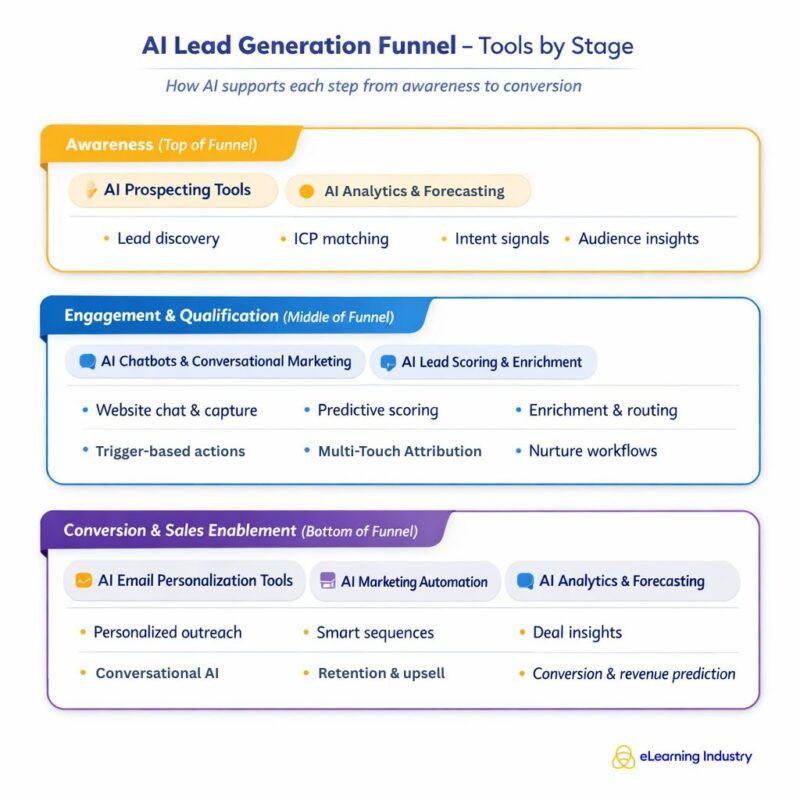
Categories Of AI Lead Generation Tools
Before jumping into specific platforms to evaluate them, it is important to understand how AI tools fit into the broader lead generation ecosystem by categories.
In fierce competitions, the most effective revenue teams tend to build a layered AI stack, where each category supports a specific stage of the buyer journey.
1. AI Prospecting And Intent Tools
The first category is about prospecting and intent. In this area, most AI platforms help you identify:
- Target accounts that match your ideal customer profile (ICP)
- Organizations actively researching relevant solutions
- Key decision-makers within buying groups
Moreover, some of their core capabilities include:
- AI-powered contact databases
- Intent signal analysis
- Account prioritization
- Predictive targeting
Especially for enterprise B2B companies, these tools drive account-based marketing (ABM) and outbound efficiency while minimizing risks.
2. AI Lead Scoring And Data Enrichment
AI lead scoring and data enrichment tools start their work once prospects enter your funnel. These tools evaluate:
- Likelihood to convert
- Sales readiness
- Long-term revenue potential
At the same time, AI enrichment tools also add:
- Firmographic data
- Technology stack insights
- Role and seniority information
This advanced process ensures sales teams work with complete, prioritized data while reducing wasted effort and improving close rates. That is why it is important to add these tools.
3. Conversational AI And Chatbots
It is a fact that modern B2B buyers expect immediate engagement.
That is why your company can use AI conversational platforms to:
- Qualify website visitors in real time
- Route high-intent prospects to sales instantly
- Answer product questions automatically
- Book meetings without human intervention
These tools are extra helpful to vendors with high website traffic by dramatically increasing conversion efficiency.
4. AI Email Personalization And Outreach
As a matter of fact, email communication may seem outdated, but it is not. Emails remain a critical channel. However, generic sequences no longer perform as they used to.
On this note, AI outreach tools enable:
- Context-aware email personalization
- Sequence optimization based on response data
- Engagement prediction
- Messaging quality scoring
The above-mentioned capabilities help sales teams maintain relevance at scale while improving reply rates.
5. AI Marketing Automation Platforms
Marketing teams are pleased to have platforms that take tasks from their manual way. Nowadays, marketing automation is evolving from workflow execution to decision-driven orchestration.
AI-powered marketing automation platforms now support:
- Dynamic audience segmentation
- Predictive campaign timing
- Personalized nurture journeys
- Revenue attribution modeling
Especially for growing SaaS companies, this category often serves as the central hub of the demand generation engine.
6. AI Analytics And Pipeline Forecasting
Lastly, we arrive at analytics. This category is about advanced AI tools that provide visibility into pipeline health by analyzing:
- Deal progression patterns
- Sales activity signals
- Conversion probabilities
- Revenue risk factors
These detailed insights allow leadership teams to forecast more accurately and intervene early when performance declines.
12 Must-Have AI Lead Generation Tools For 2026
It is common knowledge in the market that the most effective AI lead generation stacks do not rely on a single platform. That said, high-performing B2B organizations tend to combine specialized tools across prospecting, engagement, qualification, and forecasting to create a unified revenue engine.
In the following sections, we present 12 of the most impactful AI-powered platforms for HR tech vendors, LMS providers, and B2B SaaS companies looking to accelerate pipeline growth in 2026.
Prospecting And Intent Intelligence
1. ZoomInfo
What it does
ZoomInfo is one of the most comprehensive AI-powered B2B data platforms, combining company intelligence, contact data, and real-time buying intent signals.
Best for
ZoomInfo is ideal for mid-market and enterprise teams running outbound or account-based marketing programs.
Key AI capabilities
- Intent data across thousands of topics
- Predictive account prioritization
- AI-driven contact recommendations
Enterprise fit
Strong enterprise fit. It is widely used by large revenue teams for ABM and sales intelligence.
Limitations
- The premium pricing
- It requires strong CRM processes to maximize value
Integration considerations
- It has native integrations with Salesforce, HubSpot, Marketo, Outreach, and Salesloft
- It works best when aligned with a defined ICP and ABM strategy
2. Apollo.io
What it does
Apollo is a platform that combines B2B prospect data with built-in sales engagement and AI-powered outreach capabilities.
Best for
It is best known for growing SaaS teams that want an all-in-one prospecting and outbound solution.
Key AI capabilities
- AI email writing and sequence optimization
- Lead scoring based on engagement
- Contact and company enrichment
Enterprise fit
Solid enterprise fit for SMB and mid-market. It is also scalable for larger teams with structured workflows.
Limitations
- The data quality varies by region and niche
- It requires careful segmentation to avoid generic outreach
Integration considerations
- Mostly integrates with major CRMs and email platforms
- Better works when paired with personalization workflows
3. 6sense
What it does
Another alternative is 6sense. This is a predictive revenue platform that uses AI to identify accounts in-market and orchestrate account-based engagement.
Best for
6sense is ideal for enterprise organizations with complex sales cycles and ABM-focused strategies.
Key AI capabilities
- Predictive buying stage modeling
- Anonymous website visitor identification
- AI-driven account scoring and prioritization
Enterprise fit
6sense is a great fit for enterprises. It is designed for mature revenue operations teams.
Limitations
- Complex implementation
- 6sense requires sufficient data volume for accurate predictions
Integration considerations
- Deep integration with CRM, marketing automation, and advertising platforms
- Works best when sales and marketing alignment is already strong
AI Lead Scoring And CRM Intelligence
4. HubSpot
What it does
The well-known HubSpot provides AI-driven lead scoring, automation, and lifecycle management within an integrated CRM platform.
Best for
HubSpot is best for growing B2B companies that want marketing, sales, and service data unified in one system.
Key AI capabilities
- Predictive lead scoring
- AI content and campaign recommendations
- Automated segmentation and workflows
Enterprise fit
HubSpot can be used by any company of any size. It is ideal for both SMBs and enterprises.
Limitations
- Advanced features require higher-tier plans
- Customization depth is lower than enterprise CRM platforms
Integration considerations
- Large integration ecosystem
- Ideal as the central hub for AI-driven marketing orchestration
5. Salesforce (Einstein AI)
What it does
Another solid CRM is Salesforce. Specifically, Salesforce Einstein applies AI across CRM data to deliver predictive insights, opportunity scoring, and sales forecasting.
Best for
Salesforce is ideal for enterprise organizations with complex sales structures and large datasets.
Key AI capabilities
- Opportunity win probability modeling
- Lead prioritization
- Activity and pipeline intelligence
Enterprise fit
The Salesforce system is an ideal platform for large revenue teams.
Limitations
- High cost and administrative complexity
- Requires clean, structured CRM data
Integration considerations
- Extensive ecosystem and customization options
- Best suited for organizations with dedicated RevOps or CRM teams
Conversational AI And Chatbots
6. Drift
What it does
A commonly used lead generation tool with a chatbot is Drift. It enables real-time conversational marketing with AI chatbots designed to qualify visitors and route high-intent prospects to sales.
Best for
As a system, Drift is best for companies with strong website traffic and inbound-driven pipelines.
Key AI capabilities
- Intent-based conversation routing
- Automated meeting booking
- Conversational lead qualification
Enterprise fit
This platform is ideal for mid-market and enterprise.
Limitations
- Performance depends heavily on website traffic volume
- Requires ongoing optimization of conversation flows
Integration considerations
- Integrates with Salesforce, HubSpot, and marketing automation platforms
- Works best when aligned with defined qualification criteria
7. Intercom
What it does
Intercom is a platform that provides AI-powered conversational engagement across websites, apps, and customer journeys.
Best for
This one is best for SaaS companies focused on both acquisition and lifecycle engagement.
Key AI capabilities
- AI chat automation and knowledge-based responses
- Behavioral targeting
- Lead qualification and routing
Enterprise fit
Intercom scales well from growth-stage to enterprise organizations.
Limitations
- Requires structured content and a knowledge base for optimal AI performance
- Pricing increases with usage volume
Integration considerations
- Integrates with CRM, product analytics, and support tools
- Particularly effective for product-led growth (PLG) environments
AI Email And Outreach Personalization
8. Outreach
What it does
Outreach is a sales execution platform that uses AI to optimize sequences, prioritize prospects, and improve engagement.
Best for
It is best for sales teams running high-volume outbound programs.
Key AI capabilities
- Engagement-based prioritization
- Sequence performance optimization
- AI-driven send-time and messaging insights
Enterprise fit
It is ideal for mid-market and enterprise sales organizations.
Limitations
- Requires disciplined sales processes
- Content quality still depends on team input
Integration considerations
- Deep integration with Salesforce, HubSpot, and major sales tools
- Works best when paired with high-quality prospect data
9. Lavender
What it does
Lavender is an AI email coaching tool that analyzes outbound messages and suggests improvements to increase reply rates.
Best for
Lavender is best for sales development teams looking to improve personalization and effectiveness.
Key AI capabilities
- Real-time email quality scoring
- Personalization suggestions based on recipient data
- Tone and readability optimization
Enterprise fit
Lavender is the ideal platform for SMB and mid-market teams. It is highly useful as a performance layer within larger organizations.
Limitations
- Focused only on email channel
- Impact depends on adoption by individual reps
Integration considerations
- Works within Gmail and Outlook environments
- Complements broader sales engagement platforms
AI Content And Funnel Optimization
10. Jasper
What it does
Jasper is a great help to marketing teams that create AI-generated content for campaigns, landing pages, ads, and nurture sequences.
Best for
This platform is best for demand generation teams that need to scale content production without increasing headcount.
Key AI capabilities
- Campaign and landing page generation
- Brand voice consistency
- AI-assisted conversion copywriting
Enterprise fit
Jasper is solid across growth-stage and enterprise marketing teams.
Limitations
- Requires human review and strategic direction
- Content performance still depends on targeting and distribution
Integration considerations
- Works alongside CMS, ad platforms, and marketing automation systems
- Most effective when aligned with ICP messaging frameworks
11. Clearbit
What it does
This system provides real-time data enrichment and website personalization based on company intelligence.
Best for
Clearbit is best for B2B companies focused on improving conversion rates and account-based experiences.
Key AI capabilities
- Real-time firmographic enrichment
- Dynamic website personalization
- Audience segmentation based on company attributes
Enterprise fit
Clearbit is a great fit for mid-market and enterprise ABM programs.
Limitations
- Data coverage varies by region and industry
- Requires traffic volume to maximize personalization impact
Integration considerations
- Integrates with HubSpot, Salesforce, and marketing automation platforms
- Works best when paired with ABM targeting strategies
AI Forecasting And Pipeline Intelligence
12. Clari
What it does
Clari is a platform that uses AI to analyze pipeline activity, forecast revenue, and identify risk across deals and sales teams.
Best for
This system is best for revenue leaders who need accurate forecasting and pipeline visibility.
Key AI capabilities
- Deal health analysis
- Pipeline risk detection
- Predictive revenue forecasting
Enterprise fit
This platform is designed for mid-market and enterprise organizations with complex pipelines.
Limitations
- Requires consistent CRM usage and activity tracking
- Focused on pipeline optimization rather than top-of-funnel generation
Integration considerations
- Deep integration with Salesforce and major revenue tools
- Most valuable for organizations with established sales processes
How To Choose The Right AI Lead Generation Tools
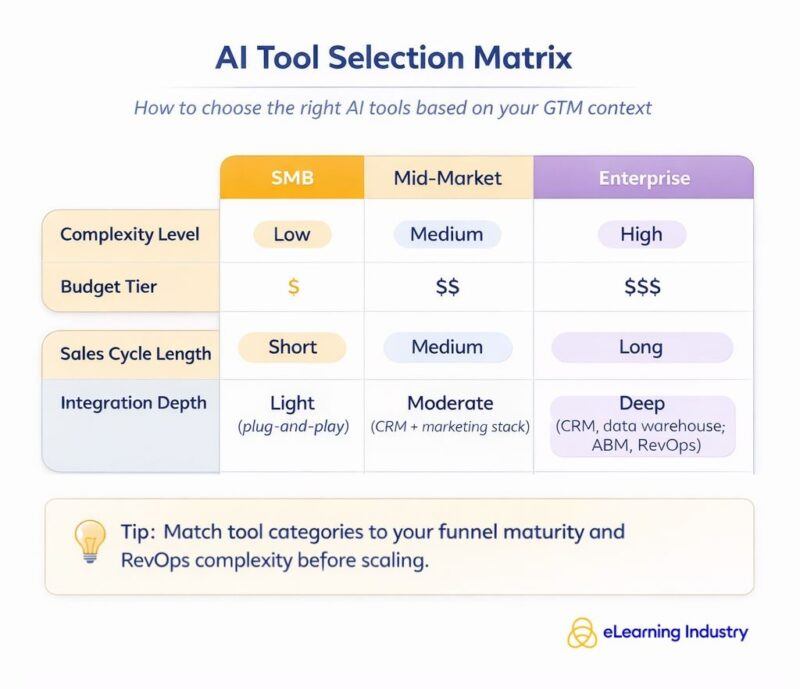
Currently, in the market, there are many platforms promising automation and intelligence. Therefore, the challenge here is not finding AI tools but selecting the right ones for your revenue model.
Especially for HR tech vendors, LMS providers, and B2B SaaS companies, the wrong tool can add complexity without improving pipeline. In contrast, the right one should strengthen your ability to identify, engage, and convert the right buyers faster.
Following in this section, we present some key factors to evaluate.
1. Match The Tool To Your Ideal Customer Profile
AI is only effective when the data inside it is precise and true. Therefore, before investing in any platform, make sure that its data coverage and targeting capabilities align with your market.
You need to consider the following:
- Industry coverage (HR, L&D, enterprise sectors)
- Geographic strength
- Company size segmentation
- Role-level targeting (HR leaders, CLOs, CHROs, IT stakeholders)
As a result, if your ICP operates in a specialized niche, broad databases may not deliver the precision you need.
2. Align With Your Sales Cycle Length
It is true that HR software and enterprise learning platforms often involve long evaluation cycles, multiple stakeholders, and formal procurement processes.
For your company, that means:
- Short-cycle tools optimized for transactional sales may underperform
- Intent intelligence and account-level tracking become more valuable
- Pipeline visibility and nurturing capabilities matter more than quick conversions
Consequently, the longer the sales cycle, the more important predictive insights and sustained engagement become.
3. Prioritize Integration Over Features
One of the most common pitfalls of AI initiatives is fragmentation. A powerful tool that does not integrate into your CRM, marketing automation, or reporting structure creates data silos.
So, you should look for:
- Native CRM integrations
- Bi-directional data syncing
- Workflow compatibility with existing processes
- API availability for customization
The goal here is not to get more tools. It is creating a connected revenue ecosystem.
4. Evaluate Data Quality and Transparency
As we mentioned above, AI success depends on clean, reliable data. The same happens for AI-driven recommendations. Therefore, before committing to a platform, assess:
- Data accuracy and refresh frequency
- Coverage depth for your target market
- Compliance with GDPR and other privacy regulations
- Visibility into how AI models prioritize or score leads
Especially for companies selling into HR and enterprise environments, data governance and compliance are not optional.
5. Consider Scalability and Governance
Scalability should always be the backbone of your plan. As your pipeline grows, your AI stack must support the following:
- Role-based access and permissions
- Reporting for leadership
- Process standardization
- Cross-team visibility
At the end of the day, tools that work for a small team may not scale effectively as revenue operations mature.
Common Mistakes When Using AI Lead Generation Tools
When you are implementing it strategically, AI can significantly improve efficiency and targeting. In general, many organizations fail to see results because of avoidable missteps.
Buying Too Many Tools
One of the common pitfalls is buying too many tools. In general, this process creates complexity, overlapping functionality, and inconsistent data. Therefore, instead of adding platforms, focus on building a streamlined system where each tool has a clear role.
Implementing AI Without A Strategy
It is important to know that AI amplifies your existing approach; it does not fix a weak one. As a result, implementing automation without a strong AI strategy can lead to inefficiency.
Poor CRM Hygiene
CRM hygiene is vital for a successful AI integration. Issues like outdate date and incomplete records can reduce AI accuracy. That is why predictive analytics only work best when the data is structured and maintained.
Ignoring Compliance Requirements
Especially for large organizations like HR and enterprise buyers, compliance matters. That is because these types of organizations are sensitive to data privacy. As a result, companies that use tools without transparency or compliance tend to risk legal issues.
Over-Automation
Yes, automation definitely improves efficiency within a company. However, over-automation can cause the opposite effects in personalization. That is because buyers today still expect relevant messaging but with human interaction at key decision points.
Why AI Tools Alone Don't Guarantee More Leads
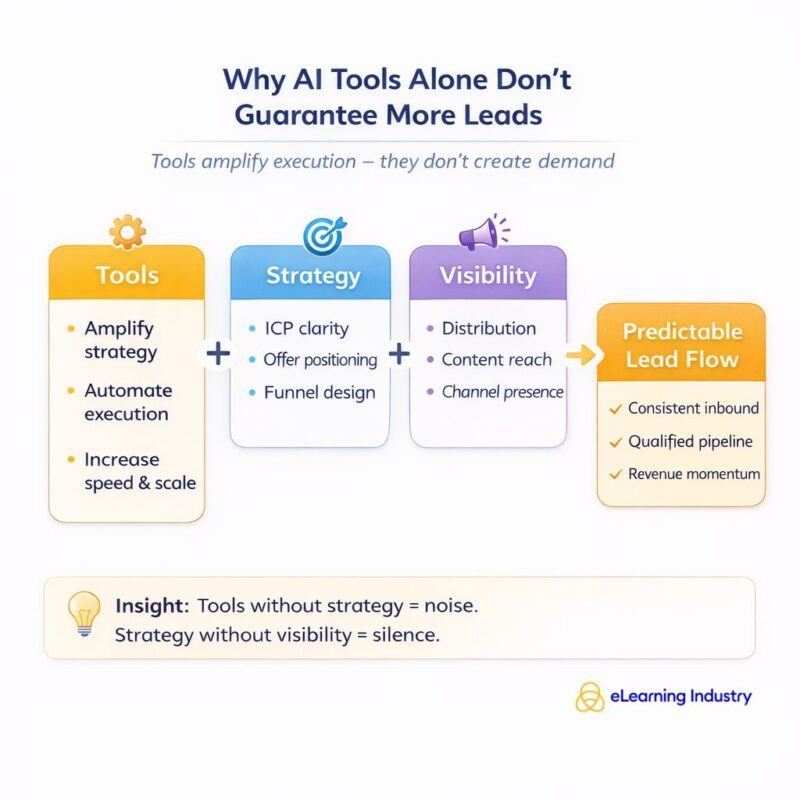
It is a fact that one of the biggest misconceptions about AI lead generation is that technology creates demand. In reality, AI tools are able to optimize capture and conversion. However, they cannot generate awareness on their own.
Here we present three factors that determine the translation of AI investments into pipeline:
1. Strategy
Who and how you engage with is all about clear market segmentation, positioning, and messaging.
2. Visibility
It is vital for prospects to discover your brand before AI identifies them.
3. Authority
Authority is key here since in B2B categories, buyers prioritize vendors they can trust.
The Role Of Industry Visibility In AI-Driven Lead Generation
In the current state of the HR and L&D market, potential buyers search extensively before deciding on a vendor. By the time a prospect fills out a form or responds to outreach, they may have already evaluated multiple providers.
Specifically, this shift has the following implications:
- AI tools are most effective when demand already exists
- Visibility influences shortlists long before sales conversations
- Third-party credibility reduces perceived risk
- Industry presence improves both inbound performance and outbound response rates
Putting it simply, demand must exist long before automation can capture it.
Especially for HR software vendors and learning technology providers, trusted industry ecosystems play a vital role in this process. Platforms like eLearning Industry attract HR and L&D audiences, and that helps in creating the awareness and credibility that AI tools later convert into pipeline.
Amplify Your AI-Powered Lead Generation Strategy
It is true that AI tools accelerate lead capture. However, qualified demand only starts with visibility.
In the market, HR tech and L&D companies that combine intelligent automation with industry exposure generate stronger pipelines and faster business growth.
In this area, eLearning Industry helps vendors turn AI-driven lead generation into measurable revenue through:
- High-intent traffic from HR and L&D decision-makers
- Sponsored listings and directory placements
- Lead generation campaigns and buyer intent programs
- Webinar and content promotion
- Strategic brand visibility across the learning and HR ecosystem
Consequently, when AI automation is paired with targeted industry exposure, the result is a more predictable, scalable demand engine.
Conclusion
In the current state of the market, the most effective lead generation strategies combine predictive intelligence, automation, and personalization across the entire funnel.
But, to be honest, technology alone is not enough. The most successful organizations seeing the strongest results share three characteristics:
- A clear understanding of their ideal buyers
- Integrated, scalable revenue systems
- Consistent visibility within their target market
Especially for HR software vendors, LMS providers, and SaaS marketing teams, the opportunity is not just to adopt AI tools, it is to build a connected ecosystem where data, automation, and market presence work together.
Consequently, the companies that combine intelligent technology with strategic demand creation will generate stronger pipelines, shorten sales cycles, and achieve more predictable business growth.
FAQAI lead generation tools use Machine Learning and predictive analytics to identify, qualify, and engage potential customers. They automate tasks such as prospecting, lead scoring, personalization, and pipeline forecasting, helping B2B companies focus on high-intent prospects and improve conversion efficiency.
AI tools analyze behavioral signals, firmographic data, and intent indicators to prioritize the most likely buyers. By automating targeting, segmentation, and outreach personalization, they reduce manual work, improve lead quality, and accelerate pipeline velocity across complex B2B sales cycles.
Most B2B organizations need a combination of AI prospecting tools, intent data platforms, lead scoring systems, conversational AI chatbots, email personalization tools, and pipeline forecasting solutions. The right mix depends on company size, sales complexity, and integration requirements.
Enterprise SaaS teams typically benefit from platforms like ZoomInfo or 6sense for intent data, Salesforce or HubSpot for AI-driven CRM insights, Drift or Intercom for conversational qualification, and Clari for forecasting. These tools support long sales cycles and multi-stakeholder buying processes.
AI lead scoring analyzes historical conversion data, engagement behavior, company attributes, and buying signals to predict which leads are most likely to convert. Unlike manual scoring models, AI continuously learns and adjusts priorities based on real performance outcomes.
No. AI tools optimize targeting and conversion, but they do not create demand on their own. Effective lead generation still requires clear positioning, defined audiences, strong messaging, and consistent market visibility to ensure there is demand for AI systems to capture.
AI chatbots engage website visitors in real time, answer questions, qualify prospects, and route high-intent buyers to sales teams. They increase conversion rates by capturing interest immediately and providing personalized interactions without requiring human availability.
Key factors include alignment with the ideal customer profile, data quality, CRM and marketing integration, scalability, compliance requirements, and support for the company’s sales cycle length. The best tools fit existing workflows rather than adding complexity.
Frequent mistakes include adopting too many tools, relying on poor CRM data, over-automating buyer interactions, ignoring compliance requirements, and implementing AI without a clear strategy or defined target audience.
Intent data identifies companies actively researching relevant topics or solutions. This allows sales and marketing teams to prioritize outreach to accounts already showing buying signals, increasing response rates and improving pipeline efficiency.
