
Online Reputation Monitoring: How B2B Brands Track Market Perception
B2B buyers rarely judge a company only by what appears on its website. Before they book a demo, approve a contract, or recommend a vendor internally, they look for outside evidence. They read customer reviews, compare providers, scan search results, check leadership profiles, follow discussions on LinkedIn and Reddit, and look at what industry publications have said.
Increasingly, buyers also ask AI platforms which providers are trustworthy, what each company is known for, and what weaknesses they should consider. As a result, a brand's reputation is no longer shaped only by direct conversations, media coverage, or search results. It is also influenced by the way AI systems interpret and summarize those signals.
Each piece of information adds to market perception. A detailed review may raise concerns about implementation. A podcast interview may strengthen an executive's credibility. A comparison article may position a company as a category leader, while an AI-generated answer may repeat an old criticism long after the business has addressed it.
Online reputation monitoring gives B2B brands a structured way to track these signals, understand what they mean, and respond before a small concern becomes a wider sales obstacle. However, it should not be treated only as a way to find negative comments. When handled well, reputation monitoring supports buyer trust, competitive intelligence, customer experience, positioning, recruitment, and revenue protection.
Online reputation monitoring is the process of tracking reviews, media coverage, social mentions, search results, customer discussions, and other digital signals to understand how a company is perceived and respond to emerging risks or opportunities.
Key Takeaways
- B2B reputation is formed across review sites, search engines, social platforms, media outlets, online communities, employee channels, and AI-generated answers.
- Reputation monitoring helps brands identify customer concerns, misinformation, changing market expectations, positive proof, and competitive weaknesses before they affect pipeline.
- Mention volume is not enough. Companies also need to consider the source, intent, seriousness, narrative, reach, and likely business impact of each signal.
- Strong monitoring programs connect reputation insights to PR, customer success, product marketing, sales, SEO, GEO, and executive decision-making.
In This Guide, We Explore…
- What Is Online Reputation Monitoring?
- Why Online Reputation Matters More In B2B
- Where B2B Reputation Is Formed
- What B2B Brands Should Monitor
- How To Evaluate Reputation Signals
- How To Build An Online Reputation Monitoring System
- How To Monitor Reviews Without Treating Every Review As A Crisis
- How To Track Media Mentions And Market Narratives
- Online Reputation Monitoring For Competitive Intelligence
- Search Reputation, GEO, And AI Visibility
- Online Reputation Monitoring Metrics
- Common Reputation Monitoring Mistakes
- Turning Reputation Insights Into Business Action
- The Future Of Online Reputation Monitoring
What Is Online Reputation Monitoring?
Online reputation monitoring is the ongoing process of finding, reviewing, and interpreting digital signals about a company. These signals may include direct references to the brand, but they can also include broader discussions that affect trust, even when the company is not mentioned by name.
In practice, a B2B reputation monitoring program may track:
- Customer and user reviews
- Media mentions and analyst commentary
- Social conversations and community discussions
- Branded search results and autocomplete suggestions
- Executive and leadership mentions
- Employee feedback
- Competitor comparisons
- AI-generated answers and recommendations
The most important part of the process is interpretation. A company can collect thousands of online mentions and still learn very little if nobody reviews what they mean. Reputation monitoring goes a step further by asking whether those signals make the business appear credible, risky, outdated, difficult to work with, or particularly strong in a certain area.
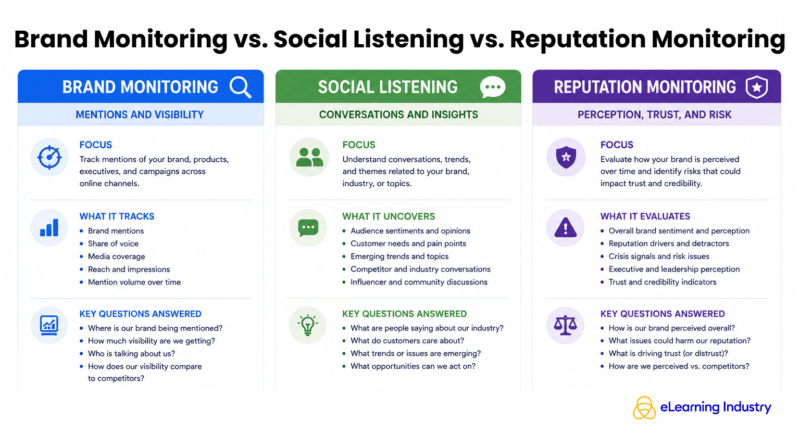
That distinction becomes clearer when reputation monitoring is compared with brand monitoring and social listening.
Brand monitoring asks, "Where is our brand mentioned?" Its main purpose is to track visibility. As a result, it helps teams find references to the company, its products, executives, campaigns, and branded terms.
Social listening, by contrast, asks, "What is our market discussing?" It looks beyond direct mentions to identify buyer concerns, industry language, emerging trends, and possible content opportunities.
Share of voice asks another question: "How visible are we compared with competitors?" It helps brands measure their relative presence across media, search, social platforms, or other channels.
Reputation monitoring, meanwhile, asks, "What do these signals say about us?" Its focus is perception, trust, and risk. More importantly, it connects individual mentions to the business consequences that may follow.
These activities often overlap, but they are not interchangeable. For example, a company can have a high share of voice and still have a weak reputation. Likewise, a specialist B2B provider may receive relatively few mentions but still have strong credibility among a small group of high-value buyers.
Why Online Reputation Matters More In B2B
Reputation matters in every market, but it has an outsized effect on complex B2B purchases. Contract values are often high, sales cycles can last for months, and several stakeholders may influence the final decision. Buyers may also need to assess implementation risk, security, compliance, integrations, service quality, and the vendor's ability to support a long-term relationship.
Because the risks are higher, negative signals can carry more weight. A single vague complaint may not influence a buying team. This is particularly important because many stakeholders are not only assessing whether the product works. They are also considering what could happen if the decision goes wrong. A technical leader may worry about integrations, while procurement focuses on contract terms. At the same time, a senior executive may be concerned about business continuity, and the person recommending the platform may worry about the effect on their own credibility.
For that reason, reputation can influence whether a company:
- Appears on an initial shortlist
- Receives demo requests
- Gives sales teams confidence during evaluation
- Passes procurement and risk reviews
- Retains customers at renewal
- Attracts partners and employees
- Builds confidence among investors and other stakeholders
In other words, B2B reputation management is not simply a brand awareness campaign. It affects perceived purchasing risk. Buyers are asking whether choosing the vendor could create technical, financial, operational, or personal consequences.
A strong reputation makes a company's claims easier to believe. By contrast, a weak or unclear reputation creates friction, even when the product itself is sound. Sales teams may then spend more time answering concerns, correcting outdated information, or proving basic credibility before they can discuss the value of the solution.
Where B2B Reputation Is Formed
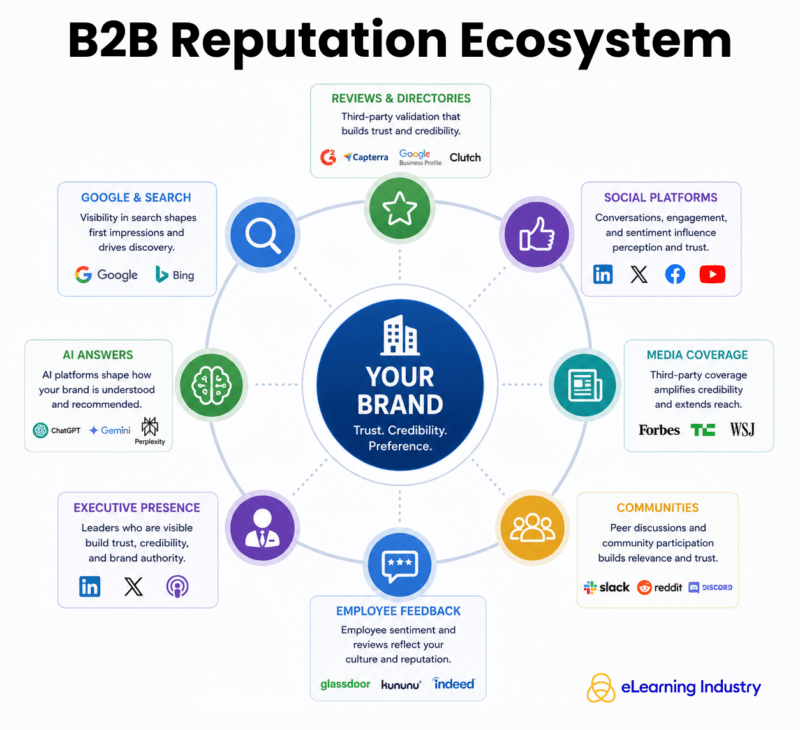
B2B reputation does not live in one channel. Instead, it develops across a wider ecosystem of reviews, search results, professional conversations, media coverage, employee experiences, leadership activity, and machine-generated summaries.
This means brands need to understand not only what appears in each channel, but also how those channels influence one another. A complaint on a review site may appear in search results. A media article may later be cited by an AI platform. An employee comment may shape a buyer's view of the company's stability. Over time, separate signals can combine into a much stronger narrative.
Review And Comparison Platforms
Software review sites, specialist directories, industry top lists, testimonials, comparison articles, and customer stories often play a direct role in vendor research. Buyers use these sources to compare features, pricing approaches, service quality, ease of use, and likely implementation effort.
Broad review platforms can provide reach. However, specialist sources may carry more relevance in certain B2B markets. For LMS, EdTech, HR tech, and similar vendors, a trusted vertical directory may influence buyers more than a large consumer review site because its audience has clearer needs and stronger purchase intent.
As a result, brands should look beyond the average rating. They should also review:
- How recent the reviews are
- Which customer roles are represented
- Which company sizes appear most often
- What themes repeat across reviews
- Whether buyers compare the brand with specific competitors
- How the company responds to criticism
- Whether the review profile reflects the current product experience
A high rating built mainly on old reviews may be less useful than a slightly lower rating supported by recent, detailed feedback. Similarly, a large number of generic comments may carry less weight than a smaller number of reviews from relevant customers.
Search Engines
Branded search results are often the first reputation check a buyer performs. A search for the company name may bring up the official website, review profiles, media coverage, employee feedback, comparison pages, social accounts, or past controversies.
However, direct brand searches are only part of the picture. Buyers may also search for:
- "[Brand] reviews"
- "[Brand] alternatives"
- "[Brand] pricing"
- "[Brand] problems"
- "[Brand] implementation"
- "[Brand] vs [Competitor]"
- "Best [category] platform for [specific need]"
These searches often reveal stronger buying intent because the user is no longer learning about the category in general. They are evaluating whether a particular vendor should remain under consideration.
Autocomplete suggestions matter as well. They show the questions and associations that frequently appear around the brand. Although they should not be treated as a complete picture of public opinion, they can reveal issues buyers may encounter before reaching the company's website.
Consequently, a business may have a strong website and polished product pages but still lose trust if third-party search results are thin, outdated, inconsistent, or dominated by criticism.
Social And Professional Platforms
LinkedIn is an important reputation channel for many B2B brands because customers, employees, executives, partners, and industry experts all contribute to the public record. A company's reputation may be shaped by official posts, leadership comments, customer replies, employee advocacy, hiring announcements, and the tone of discussions around major news.
Reddit, YouTube, specialist forums, and industry communities add a less controlled form of evidence. Buyers may trust these spaces precisely because the comments feel more candid than standard marketing content.
Media And Thought Leadership Channels
A company may be mentioned often and still be associated with the wrong message. For example, an AI-enabled learning platform may continue to be described mainly as a traditional LMS. Similarly, a company known for serving small businesses may struggle to be taken seriously in the enterprise market, even after its product and customer base have changed.
For this reason, media monitoring should track more than mention volume. Teams should examine:
- Whether the company's message is represented accurately
- Which topics are linked to the brand
- Which executives or spokespeople appear
- Whether competitors are included in the same coverage
- How authoritative the source is
- Whether the coverage leads to further discussion or traffic
The key question is not simply, "Were we mentioned?" It is, "What idea did the mention leave with the audience?"
Employee And Leadership Channels
Employer review sites, executive profiles, leadership interviews, public statements, and employee discussions all affect corporate reputation management. Buyers often want to know whether the people behind a company appear credible, stable, and capable of supporting a long-term relationship.
Executive reputation is especially important in founder-led firms, emerging technology companies, consultancies, and other businesses where trust is closely linked to a small number of visible leaders. A well-informed and consistent executive can strengthen confidence. On the other hand, careless statements, exaggerated claims, or contradictory messages can create doubt.
AI-Powered Discovery
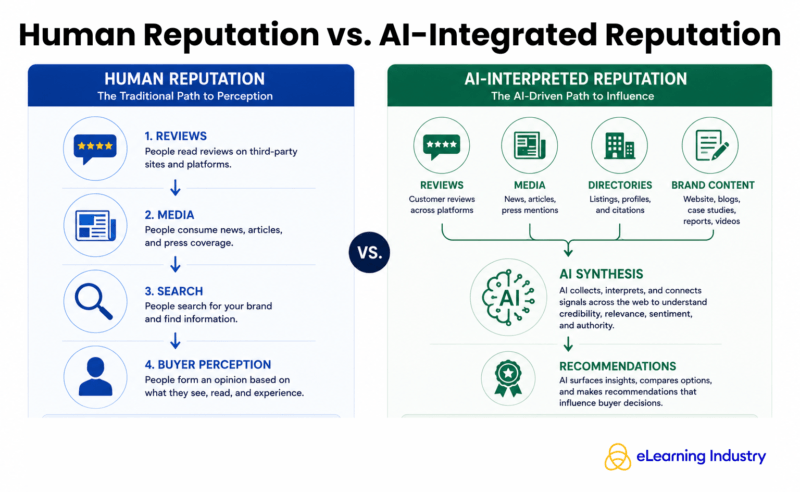
AI platforms have added another layer to the reputation ecosystem. Buyers may ask ChatGPT, Gemini, Perplexity, Google AI Overviews, or other systems to recommend vendors, summarize strengths and weaknesses, compare products, or assess whether a company is reliable.
These answers may combine information from review pages, directories, publications, company content, customer discussions, and third-party research. As a result, an AI response may present a condensed version of the brand's wider online reputation.
This creates several possible problems. A company may be missing from category recommendations, presented for the wrong use case, described using old product information, or associated with criticism that no longer reflects the current experience.
Brands, therefore, need to monitor both the underlying evidence and the conclusions AI systems draw from it. Traditional reputation monitoring looks at the source material. AI reputation monitoring also examines the summary that buyers may receive without ever visiting those original sources.
What B2B Brands Should Monitor
A useful monitoring system tracks several types of signals rather than treating every mention as part of one large stream. This makes it easier to identify patterns, assign ownership, and decide what action is needed.
Direct Brand Signals
The process usually begins with company names, product names, executive names, common misspellings, campaign names, branded hashtags, abbreviations, former company names, and customer terminology.
These queries help teams find direct online brand mentions. However, they should be treated as the foundation of the program rather than the complete program. Buyers may discuss the company without tagging it or may refer to a product using informal language that monitoring tools do not immediately recognize.
Customer Experience Signals
Next, brands should monitor discussions about support, implementation, reliability, ease of use, training, onboarding, renewals, account management, and customer service.
Positive feedback can be just as useful. Repeated praise may reveal an advantage the company has not communicated clearly enough. For example, customers may value the quality of account management more than the feature the company currently promotes most heavily.
Commercial Signals
Commercial signals include pricing objections, contract concerns, integration limitations, vendor comparisons, replacement intent, and competitor recommendations.
These signals are closely connected to active buying decisions. Someone asking about alternatives may be considering a replacement. Likewise, repeated questions about pricing may suggest that the commercial model is confusing, not simply expensive.
Trust And Risk Signals
Security concerns, compliance questions, outages, misleading claims, leadership controversies, legal issues, and ethical concerns require careful review.
However, these signals should not all be treated as crises. Context matters. An unsupported comment from an anonymous account is different from a documented concern published by a trusted industry source. Therefore, companies need clear evaluation criteria and escalation rules rather than reacting only to negative language.
Authority Signals
Reputation monitoring should also identify positive proof. Media citations, podcast appearances, awards, research mentions, expert recommendations, Top List inclusion, customer advocacy, and AI citations can all show where the company already has credibility.
These signals can support case studies, sales materials, executive visibility, PR outreach, and future campaigns. More importantly, they help the company understand which claims are already supported by outside evidence.
A monitoring program that looks only for criticism will miss some of its most valuable commercial insights.
How Τo Evaluate Reputation Signals
Mention volume can show activity, but it cannot tell a team what deserves attention. Ten low-context comments may matter less than one detailed review from a respected enterprise customer.
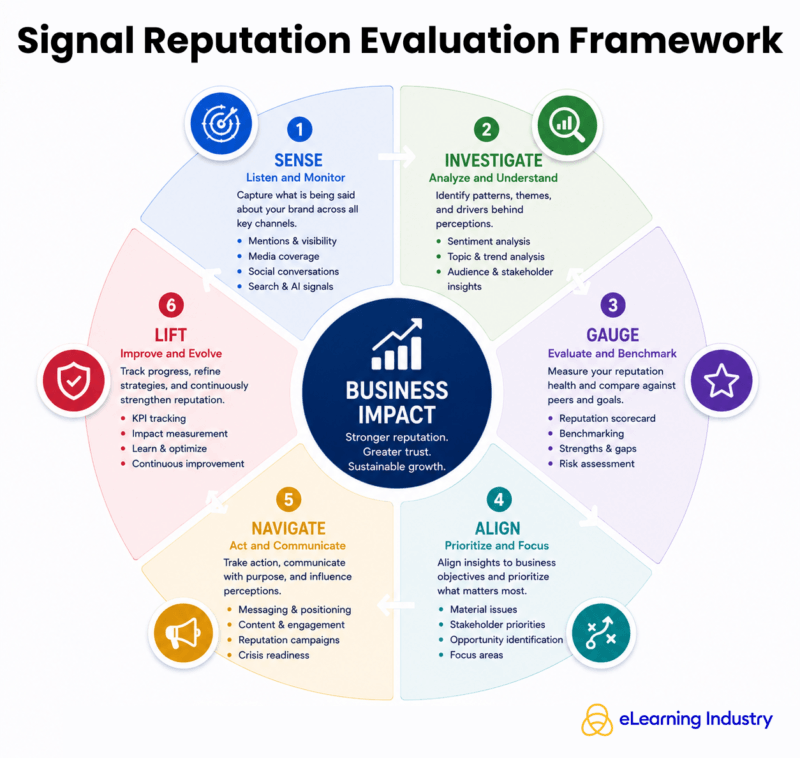
For that reason, brands need a practical way to assess the significance of each signal. One option is the SIGNAL Framework:
- S - Source authority: How credible, relevant, and influential is the source? A specialist publication or verified customer may carry more weight than an anonymous account with no clear connection to the market.
- I - Intent: Is the person researching, comparing, complaining, recommending, reporting, or asking for help? Their intent changes the meaning of the mention.
- G - Gravity: How serious is the issue or opportunity? A minor usability complaint is different from a security allegation or a major service failure.
- N - Narrative: Is this an isolated comment, or is a recurring perception beginning to form? Patterns usually matter more than single examples.
- A - Audience reach: Who can see the signal, and who is likely to be influenced by it? A small but highly relevant audience may matter more than a large general one.
- L - Likely business impact: Could the signal affect trust, pipeline, retention, recruitment, partnerships, or investor confidence?
This framework helps teams avoid two common mistakes. First, it reduces the chance of overreacting to every negative mention. Second, it makes it less likely that a serious issue will be ignored simply because its mention count is low.
The same principle applies to positive signals. One recommendation from a respected industry expert may influence buyers more than dozens of generic likes or short comments.
How Τo Build Αn Online Reputation Monitoring System
A strong system does not begin with a long list of reputation monitoring tools. Instead, it starts with clear priorities, agreed definitions, and a process for turning information into action.
Without that foundation, companies often end up with too many alerts and too little understanding. Teams may see every mention, but they still do not know which ones matter, who should respond, or what needs to change.
Step 1: Establish A Reputation Baseline
Before making changes, document the company's current position. Review ratings, review volume, review freshness, branded search results, recurring complaints, sentiment themes, media presence, executive visibility, AI visibility, and competitive share of voice.
The baseline should answer several practical questions:
- What do buyers find when they search for the company?
- Which positive and negative themes appear repeatedly?
- Where is third-party proof strong?
- Which channels are outdated or incomplete?
- Where do competitors have greater visibility?
- How accurately do AI platforms describe the business?
A clear summary supported by channel-level evidence is usually more useful than one overall reputation score. Although a single score may be convenient for executive reporting, it can hide important differences between audiences, markets, and sources.
Step 2: Map Priority Sources
Not every source deserves equal attention. The next step is to identify the channels that influence the company's actual buyers, users, employees, partners, and investors.
A B2B software vendor may prioritize specialist directories, review platforms, LinkedIn, Reddit, industry publications, Google search, and AI assistants. A professional services firm, meanwhile, may place more weight on leadership visibility, client references, media commentary, and partner networks.
The goal is not to monitor the entire internet with equal intensity. Instead, the company should focus on the places where trust is formed and buying decisions are influenced.
Step 3: Create Monitoring Queries
Once the priority sources are clear, build queries around company names, product names, executive names, common misspellings, and competitor comparisons.
Useful queries may include:
- "[Brand] reviews"
- "[Brand] alternatives"
- "[Brand] pricing"
- "[Brand] problems"
- "[Brand] implementation"
- "[Brand] support"
- "[Brand] security"
- "[Brand] vs [Competitor]"
Brands should also monitor category-level recommendation prompts. These searches help teams understand whether the company appears when buyers ask for the best platform for a certain industry, use case, company size, or technical need.
Queries should not remain static. New products, executive appointments, acquisitions, campaigns, customer concerns, and market language may all require updates over time.
Step 4: Assign Ownership
Monitoring often fails because alerts reach several people, but nobody knows who should act.
Customer success may own service complaints, while product teams review recurring usability and integration feedback. PR may handle inaccurate media coverage, and security or legal teams may assess higher-risk claims. Sales enablement may address repeated objections, while SEO and content teams work on search and AI visibility.
Whatever the structure, ownership should be clear. Teams also need backup contacts and simple handoff rules because reputation issues rarely stay within one department.
Step 5: Classify And Escalate Signals
A straightforward classification system helps teams respond in proportion to the issue. Useful categories may include:
- Informational
- Opportunity
- Customer-service issue
- Emerging reputation risk
- Critical escalation
Each category should have a clear response expectation. Informational mentions may only need to be logged. Opportunities can be routed to PR, sales, customer marketing, or content teams. Customer issues require a service owner, while emerging risks need wider review. Critical signals should follow an agreed escalation process.
Step 6: Review Trends Regularly
Real-time alerts help teams identify urgent problems, but they do not reveal the larger narrative on their own.
A practical rhythm may include daily alert review, weekly triage, monthly theme analysis, and quarterly discussion with senior leaders. Monthly and quarterly reviews should examine whether perceptions are changing, which issues are repeating, and how those patterns connect to pipeline, retention, product priorities, and positioning.
In simple terms, alerts show what happened. Regular analysis explains what is changing and what the business should do next.
How Τo Monitor Reviews Without Treating Every Review Αs Α Crisis
Review monitoring deserves its own process because reviews often appear close to the point of purchase. Buyers may read them while building a shortlist, comparing vendors, preparing for procurement, or seeking reassurance before final approval.
Brands should track more than the headline score. They should also review:
- Overall rating
- Rating trends
- Review velocity
- Recurring themes
- Reviewer role and company size
- Competitor comparison language
- Review freshness
- Management response quality
This broader view matters because a stable average rating can hide a recent decline. Likewise, a small number of new reviews may reveal a meaningful change in the customer experience.
Not every negative review requires senior escalation. Some relate to routine service issues, while others reflect a mismatch between the product and the customer's needs. A few may be inaccurate or lack important context.
The monitoring team should therefore assess credibility, identify patterns, and route each issue to the right owner. When a public response is appropriate, it should usually do five things:
- Acknowledge the reviewer and the specific concern.
- Avoid defensive or dismissive language.
- Clarify facts without turning the exchange into an argument.
- Move sensitive resolution details to a private channel.
- Explain corrective action when the company can do so honestly.
Templated replies may save time, but they often suggest that the company is not listening. A response does not need to be long. Still, it should show that someone has understood the issue and taken it seriously.
A healthier approach is to invite feedback from a broader customer group, make the process easy, and avoid pressuring users toward a positive answer. Over time, this creates a more credible view of the customer experience.
The commercial connection is important. Reviews and directory profiles can influence shortlists, Top List visibility, sales confidence, and trust during vendor comparison. Review monitoring is therefore both a customer-experience activity and a revenue-support activity.
How Τo Track Media Mentions Αnd Market Narratives
Counting press mentions is a limited way to measure reputation. A company can receive a large amount of coverage and still leave the market with the wrong impression.
Media monitoring should therefore examine:
- Tone
- Message accuracy
- Source authority
- Spokesperson visibility
- Topic association
- Competitor inclusion
- Backlinks
- Referral traffic
- Follow-on coverage
Teams should also look at which descriptions journalists, analysts, and industry experts repeat without prompting. These repeated descriptions often reveal the company's actual market narrative.
A market narrative is the simple idea people use to explain what a company is, what it is known for, and where it fits. It may not be complete or entirely accurate, but it strongly influences how buyers remember and compare the brand.
For example, a business may want to be seen as an AI-enabled learning platform, while media coverage still describes it mainly as a traditional LMS. Another company may want to compete on enterprise reliability but remain associated with low pricing or smaller customers.
In both cases, there is a gap between how the company wants to be perceived and how the market currently describes it.
That gap is not usually fixed by publishing more press releases. First, the business needs to understand why the old association remains. Product history, weak third-party proof, inconsistent executive messaging, and competitor positioning can all play a part.
Online Reputation Monitoring For Competitive Intelligence
Competitor monitoring can reveal where buyers feel satisfied, frustrated, uncertain, or underserved.
Useful signals include:
- Recurring customer praise
- Frequent complaints
- Positioning changes
- New executive narratives
- Feature launches
- Pricing concerns
- Review momentum
- Media activity
- AI recommendations
These insights can support product positioning, sales battlecards, messaging, content strategy, customer experience improvements, and market differentiation.
The purpose of competitive reputation monitoring is not to imitate other companies or exploit isolated complaints. Rather, it helps brands identify unmet expectations and trust gaps they may be able to address credibly.
Competitor data also adds context to internal performance. A decline in review ratings may look serious until the team sees that the whole category is facing the same problem. On the other hand, stable performance may hide a weakness if competitors are improving more quickly.
Search Reputation, GEO, And AI Visibility
Search reputation now extends beyond the standard results page. Buyers may encounter a company through organic listings, featured snippets, AI Overviews, comparison pages, directory profiles, ChatGPT answers, or Perplexity recommendations.
Generative engine optimization, often called GEO, focuses on improving how a brand's information appears in AI-generated discovery. It overlaps with SEO, PR, content, and reputation work because AI platforms may combine information from:
- Trusted publications
- Review pages
- Directories
- Customer discussions
- Company content
- Third-party research
- Media coverage
Brands should therefore monitor prompts such as:
- What are the best platforms for a specific need?
- Is this vendor reliable?
- What are the strengths and weaknesses of this product?
- Which alternatives should a buyer consider?
- What do customers say about this company?
- Which platform is best for a certain industry, company size, or use case?
The answers should be reviewed for inclusion, accuracy, positioning, supporting evidence, competitor references, and outdated information. It is also useful to compare several platforms because responses may vary depending on the model, prompt, timing, and sources available.
This creates an important strategic distinction. Traditional reputation monitoring asks what people say about the brand. AI reputation monitoring also asks what machines conclude from those signals.
That matters because AI systems often compress many sources into one short answer. A buyer may never open the original review, directory page, media article, or customer discussion. Instead, the summary itself may shape the shortlist.
Brands cannot control every AI-generated answer, and they should not treat one response as permanent.
Online Reputation Monitoring Metrics
Reputation metrics should reflect the purpose of the program. A long dashboard is not useful if nobody knows what decisions the numbers should support.
Visibility Metrics
Visibility metrics include mention volume, media reach, search visibility, share of voice, and branded search demand.
These figures show whether the company is present in the places where buyers look. However, visibility does not show whether that presence is positive, accurate, or persuasive. A company may receive extensive attention for the wrong reasons, so visibility metrics always need context.
Perception Metrics
Perception metrics may include sentiment by theme, the ratio of positive to negative mentions, rating trends, message association, and recurring praise or complaint topics.
Theme-level analysis is particularly useful because the same review can contain both positive and negative points. A customer may praise product reliability while criticizing onboarding. Labeling the whole review as "neutral" would hide both insights.
For that reason, automated sentiment analysis should support human review rather than replace it.
Trust Metrics
Trust metrics may include review quality, third-party validation, expert mentions, Top List placements, case study visibility, research citations, and executive credibility.
Here, quality matters more than raw quantity. One detailed enterprise case study may influence buyers more than several short testimonials. Likewise, a recommendation from a respected specialist publication may carry more weight than a larger number of low-context mentions.
Response Metrics
Response metrics include time to detect, time to respond, resolution rate, escalation frequency, and review response rate.
These figures show whether the internal process is working. Even so, speed should not be treated as the only measure of success. A fast but careless reply can cause more damage than a thoughtful response delivered slightly later.
Teams should therefore review response quality as well as response time.
Business Metrics
The strongest programs connect reputation data to business outcomes such as:
- Demo conversion from review or directory traffic
- Branded conversion rate
- Recurring sales objections
- Renewal impact
- Reputation-influenced opportunities
- Referral pipeline
Attribution will not always be precise because buyers usually consult several sources before taking action. However, sales notes, call transcripts, source data, win-loss interviews, and customer research can still show where reputation influenced the decision.
Some companies create a single reputation score for executive reporting. A composite score can help track direction, but it should not replace the underlying context. A higher overall score may hide a serious issue in one buyer segment.
Common Reputation Monitoring Mistakes
Several common habits reduce the value of reputation monitoring, such as:
- Monitoring only social media. Important B2B signals often appear on review platforms, directories, search results, industry publications, sales calls, employee channels, and AI answers. Social data is useful, but it represents only one part of the reputation ecosystem.
- Tracking mentions without interpreting them. A dashboard may show volume and sentiment while missing source authority, buyer intent, narrative, and business impact. Teams need an interpretation process, not just a stream of alerts.
- Treating all sources as equally influential. A detailed review from a relevant customer should not be weighted in the same way as an anonymous, low-context post. Reach also needs context because a small specialist audience may matter more than a large general one.
- Responding defensively. Public arguments rarely strengthen trust. A response should acknowledge the concern, correct facts carefully, and explain what the company is doing. It should not try to win a debate at the reviewer's expense.
- Ignoring positive signals. Praise, expert recommendations, research citations, strong media descriptions, and customer advocacy can support positioning and sales. Positive proof should be logged, verified, and reused where appropriate.
- Keeping reputation work inside PR. Customer success, product, sales, security, HR, legal, SEO, and leadership may all own part of the response. PR can coordinate communication, but it cannot fix a product issue, resolve a service failure, or address every sales concern alone.
Turning Reputation Insights Into Business Action
Monitoring has limited value unless it changes decisions. The clearest way to make it useful is to connect each recurring signal to an owner and a practical response.
Recurring Implementation Complaints
If customers repeatedly mention difficult implementation, the company should review onboarding, project scoping, training, support, and customer communication. Once the underlying issue is addressed, the business can publish clearer implementation guidance supported by real evidence.
Strong Customer Praise For One Feature
When customers consistently value a particular feature or service, product marketing should examine whether it matters across different buyer segments. If the pattern is strong, the company may have an advantage that deserves a clearer place in its positioning.
Competitors Dominate Comparison Content
If competitors appear frequently in buyer guides, directories, and "best platform" searches, the company should improve its directory profiles, strengthen third-party proof, and publish fair comparison or buyer-education content.
The goal is not to attack competitors. Instead, the company should make its own differences easier to understand and verify.
Executives Lack Industry Visibility
If company leaders rarely appear in trusted industry conversations, the communications team can build a focused media, podcast, conference, and thought leadership plan around their real expertise.
Executive visibility works best when leaders contribute useful ideas. It becomes less credible when every appearance feels like a product promotion.
AI Tools Overlook The Brand
If AI platforms rarely include the company in relevant recommendations, the business should review its authoritative third-party coverage, directory profiles, product information, structured content, and category positioning.
However, the answer is not to publish large amounts of repetitive content. It is to strengthen the quality, consistency, and credibility of the available evidence.
Pricing Confusion Appears Repeatedly
Repeated questions about pricing may indicate that the model is difficult to understand. In that case, marketing, sales, finance, and product teams may need to clarify packaging, contract terms, included services, and total cost.
Positive Reviews Remain Isolated
Strong reviews should not stay hidden on one platform. With permission and proper context, useful proof can support case studies, campaigns, sales materials, customer stories, and executive presentations.
Even then, the company should avoid removing nuance. A detailed and realistic customer account is often more persuasive than a polished quotation with no supporting detail.
Ultimately, reputation teams should close the loop with the people who created the signal. If customers repeatedly report a problem, the process should not end with a public reply. The insight needs to reach the team that can change the experience.
The same applies to sales. When buyers repeatedly raise a reputation concern during calls, sales teams need a clear and honest response supported by evidence. They should also report whether the concern is becoming stronger, fading, or changing.
A useful reputation review, therefore, asks three questions: What changed? Why does it matter? And what will we do about it?
The Future Of Online Reputation Monitoring
Online reputation monitoring will likely become more closely connected to operational and commercial data. AI-assisted classification can help teams sort large volumes of signals, while predictive issue detection may identify unusual patterns before they become widely visible.
At the same time, companies are likely to place more emphasis on cross-channel reputation intelligence. Rather than viewing reviews, media, search, social platforms, customer data, and AI answers separately, teams will look for patterns that appear across several sources.
Other likely developments include:
- Greater focus on executive reputation
- Closer integration with customer success data
- Routine AI answer monitoring
- Reputation analysis by buyer segment
- Stronger links between trust metrics, pipeline, and retention
- Earlier detection of recurring customer concerns
- More detailed analysis of how market narratives change over time
Still, the biggest change will not simply come from better software. It will come from a broader understanding of what reputation means.
Companies will need to examine how human audiences and AI systems interpret the same body of evidence, where those interpretations differ, and which sources influence both.
The strongest B2B brands will therefore manage reputation as a continuous source of market intelligence, not as an emergency communications task.
Conclusion
B2B reputation is built through hundreds of signals, including customer reviews, media mentions, search results, community conversations, employee experiences, executive visibility, directory profiles, and AI-generated recommendations.
Online reputation monitoring brings those signals together so teams can understand the narratives shaping buyer trust. In turn, this helps companies identify meaningful risks, find credible strengths, improve the customer experience, support sales, and act before perception becomes a revenue problem.
The objective is not to eliminate every negative comment or force the market to repeat the company's preferred message. Instead, it is to recognize patterns, correct what is wrong, and strengthen what already works.
Buyers will form an opinion with or without the company's involvement. A disciplined monitoring system helps the business understand that opinion and earn trust through accurate information, credible evidence, and a better customer experience.
FAQOnline reputation monitoring is the process of tracking and interpreting digital signals that shape how people see a company. These signals can include customer reviews, media coverage, social mentions, search results, community discussions, employee feedback, executive mentions, and AI-generated recommendations. The goal is not simply to count brand mentions. Instead, companies use reputation monitoring to understand what those mentions say about trust, credibility, customer experience, and market perception. It can also help identify emerging risks, positive proof, and opportunities to strengthen the brand.
Reputation monitoring is especially important in B2B because purchases often involve high contract values, long sales cycles, and several decision-makers. Buyers may also need to consider implementation, security, compliance, support, and the risks of choosing the wrong vendor. As a result, a small number of credible negative signals can influence an entire buying committee. Strong reputation monitoring helps companies spot concerns before they affect shortlisting, demo requests, procurement reviews, renewals, partnerships, recruitment, or investor confidence.
Brands should monitor the channels that influence their buyers and stakeholders. These usually include review platforms, specialist directories, Google search results, comparison pages, LinkedIn, Reddit, YouTube, industry communities, media publications, podcasts, webinars, and analyst commentary. Companies should also track employer review sites, executive profiles, leadership interviews, and AI platforms such as ChatGPT, Gemini, Perplexity, and Google AI Overviews. However, not every channel deserves equal attention. Brands should focus most closely on the sources their customers actually use during research and evaluation.
Social listening focuses on the wider conversations taking place in a market. It helps companies understand buyer concerns, industry trends, common language, and possible content opportunities. Reputation monitoring has a narrower focus: it looks at what reviews, mentions, search results, and other signals say about a specific company. In simple terms, social listening asks what the market is discussing, while reputation monitoring asks what those discussions suggest about the brand's credibility, trustworthiness, and level of risk.
Companies should respond calmly and address the specific issue raised. A useful reply acknowledges the reviewer, avoids defensive language, and clarifies relevant facts without starting an argument. When personal or sensitive details are involved, the conversation should move to a private channel. The company can also explain any corrective action it has taken, provided the explanation is accurate. Most importantly, responses should not feel copied and pasted. Even a brief reply should show that someone has read the review, understood the concern, and taken it seriously.
Online reputation can be measured through a combination of visibility, perception, trust, response, and business metrics. Visibility metrics include mention volume, search visibility, media reach, share of voice, and branded search demand. Perception metrics include rating trends, sentiment by theme, and recurring praise or complaint topics. Trust metrics may cover review quality, expert mentions, third-party validation, case study visibility, and executive credibility. Companies can also track response time, resolution rates, demo conversions, sales objections, renewal impact, and reputation-influenced opportunities. No single score can provide the full picture, so the underlying context still matters.
Online reviews give buyers outside evidence about the customer experience. They can reveal how well a product works, how difficult implementation may be, whether support is reliable, and how the vendor handles problems. Reviews may influence whether a company reaches a shortlist or progresses through procurement. However, buyers often look beyond the average score. They may consider how recent the reviews are, who wrote them, which themes repeat, and how the company responds to criticism. A detailed review from a relevant enterprise customer can carry more weight than many short, low-context comments.
Yes. Reviews, media coverage, directory profiles, comparison content, and other third-party signals can affect what buyers see in search results. They may also influence the information AI platforms use when summarizing a company or recommending vendors. For example, AI-generated answers may draw from trusted publications, review sites, directories, customer discussions, and company content. Therefore, a stronger online reputation can support both search visibility and AI visibility. Brands should monitor not only what people say about them, but also what AI systems conclude from those sources.
Brands should use different review periods for different needs. Daily alerts can help teams identify urgent customer issues, inaccurate information, or emerging risks. Weekly reviews are useful for sorting and assigning signals, while monthly analysis can reveal recurring themes and changes in market perception. Quarterly reviews allow senior leaders to connect reputation trends with pipeline, retention, positioning, and product priorities. The exact schedule may vary by company, but reputation data should be reviewed regularly rather than only when a crisis occurs.
Reputation monitoring should have a clear owner, but it should not sit with one department alone. PR and communications teams may coordinate the program and handle media issues. Customer success can manage service complaints, while product teams review recurring usability or integration concerns. Sales and product marketing can address buyer objections and competitor comparisons. Security, legal, HR, SEO, and executive communications may also need to take part depending on the issue. The most effective approach assigns ownership by signal type and creates clear handoff and escalation rules.
