

Best Digital Marketing Channels To Promote Online Courses In 2026
Creating a great online course is no longer enough.
The online learning industry has become one of the most competitive digital markets in the world. Every year, more creators, universities, training providers, consultants, SaaS companies, and enterprise learning brands launch new programs hoping to capture attention and generate enrollments. At the same time, learners now have endless options available across nearly every niche imaginable.
As a result, visibility has become one of the biggest challenges in online course marketing.
In 2026, the companies winning market share are not necessarily the ones with the best course material alone. They are the ones with the strongest distribution strategies, the clearest positioning, and the most effective digital marketing channels supporting their growth.
Search behavior is changing because of AI-powered search experiences and AI Overviews. Social platforms are evolving faster than ever. Audiences are fragmented across multiple channels and devices. Trust has become harder to earn. Attention spans continue to shrink.
That means marketing online courses now requires a far more strategic and multi-channel approach than it did just a few years ago.
The brands growing consistently are combining content, authority-building, SEO, webinars, podcasts, email nurturing, communities, and paid acquisition into integrated ecosystems designed to attract, engage, and convert learners at scale.
This article explores the top digital marketing channels helping online course providers grow in 2026. More importantly, it explains how these channels work together to support long-term enrollment growth, brand authority, and learner trust.
The most effective digital marketing channels for promoting online courses combine discoverability, audience targeting, trust-building, and long-term visibility.
Key Takeaways
- Successful online course marketing requires a multi-channel strategy.
- SEO and AI visibility remain essential for long-term growth, while email marketing, webinars, podcasts, and thought leadership continue to drive high-quality enrollments.
- Community-driven marketing and conversational formats are becoming increasingly important as audiences seek authenticity and trust before making purchasing decisions.
- The companies generating the strongest enrollment growth are those that combine valuable content with strategic distribution across multiple digital marketing channels.
In This Article, We Explore…
- Why Online Course Marketing Is Changing in 2026
- The Modern Course Marketing Funnel
- SEO & Organic Search (Still the Long-Term Growth Engine)
- Content Marketing & Thought Leadership
- Email Marketing & Lead Nurturing
- Webinars & Live Events
- Podcasts & Audio Content
- Social Media & Community Platforms
- Paid Advertising & Retargeting
- Directory Listings & Industry Platforms
- Why Multi-Channel Distribution Wins
- Common Online Course Marketing Mistakes
Why Online Course Marketing Is Changing In 2026
Online course marketing is evolving rapidly because the digital landscape itself is changing.
For years, many course creators relied heavily on paid advertising or basic social media promotion. That approach is becoming less reliable as customer acquisition costs increase and audiences become harder to reach organically.
One major shift is the rise of AI-powered search experiences. AI Overviews and conversational search engines are transforming how users discover information online. Instead of clicking through ten search results, learners increasingly receive summarized answers directly within search interfaces.
This creates a new challenge for online learning brands.
In short, simply ranking for keywords is no longer enough. Companies now need to build topical authority, publish trustworthy educational content, and create content ecosystems that AI systems recognize as credible and valuable.
At the same time, competition in online learning continues to intensify.
Every niche now contains:
- Independent creators
- Universities
- Corporate academies
- SaaS education platforms
- Membership communities
- Influencer-led programs
- AI-generated educational products
This saturation means differentiation has become critical.
Do not forget that audience behavior is also changing. Users consume content across multiple devices and platforms throughout the day. In this way, a learner may discover a course through TikTok, research it through Google, watch a webinar, join an email list, listen to a podcast episode, and only enroll weeks later after repeated exposure.
Overall, the customer journey is no longer linear.
Shorter attention spans also force marketers to deliver value faster. Therefore, brands must communicate expertise clearly and consistently across every touchpoint.
The key takeaway here is simple: visibility in 2026 depends on distribution, trust, and authority, not just advertising budgets.
At the end of the day, companies that focus only on promotion often struggle. On the other hand, companies that focus on authority-building across multiple channels create sustainable growth engines.
The Modern Course Marketing Funnel
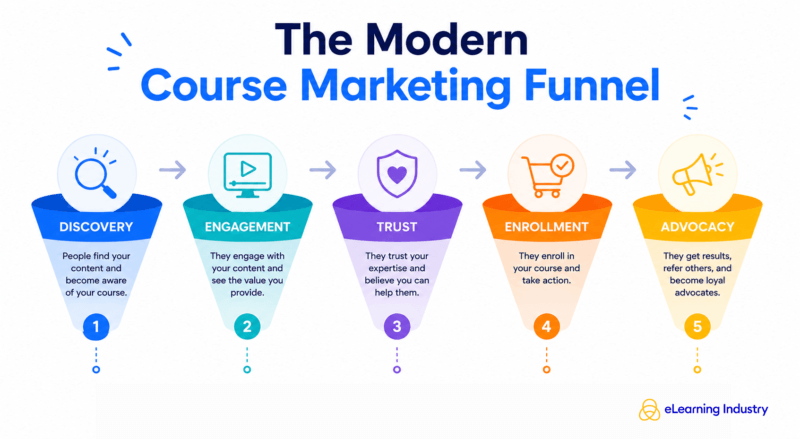
We know that modern online course marketing is built around a connected funnel designed to move learners from awareness to advocacy.
The process typically includes the following five stages:
- Discovery
- Engagement
- Trust
- Enrollment
- Retention and Advocacy
Firstly, at the discovery stage, learners first encounter your brand through channels such as SEO, social media, podcasts, YouTube, webinars, or paid ads. The goal here is visibility.
Once attention is captured, the engagement stage begins. Here, prospective students consume educational content, watch videos, read guides, subscribe to newsletters, or attend events. This stage is critical because engagement builds familiarity.
After that, trust follows engagement. In this stage, learners evaluate your credibility, expertise, reviews, thought leadership, and teaching quality before committing financially. In many ways, trust is now the true conversion mechanism in online learning marketing.
Generally, enrollment happens after sufficient confidence is established. However, the funnel does not end there.
Retention and advocacy are increasingly important growth drivers. Satisfied learners often become:
- Referral sources
- Community contributors
- Repeat customers
- Brand advocates
Overall, the strongest course marketing strategies optimize every stage of this journey rather than focusing exclusively on enrollment acquisition.
SEO & Organic Search (Still The Long-Term Growth Engine)
Despite major changes in digital marketing, SEO remains one of the most powerful channels for promoting online courses in 2026.
In general, organic search continues to deliver high-intent traffic from users actively looking for solutions, education, certifications, and professional development opportunities.
The difference today is that SEO is no longer just about keywords. Modern SEO for online courses focuses on:
- Search intent
- Topic authority
- User experience
- AI Overview optimization
- Content depth
- Expertise signals
Note that high-performing course providers create entire content ecosystems around learner pain points and educational goals.
For example, instead of publishing a single course landing page, successful brands develop:
- Educational blog articles
- Industry guides
- Learning hubs
- Case studies
- Trend reports
- FAQ content
- Video explainers
This approach improves discoverability while building authority across broader topic clusters.
AI search experiences also reward clarity and expertise. Content optimized for AI Overviews tends to:
- Answer questions directly
- Use structured formatting
- Include expert insights
- Demonstrate topical relevance
- Provide trustworthy information
Overall, evergreen content is particularly valuable for online course marketing because it compounds over time. A well-optimized guide published today can continue generating leads and enrollments for years.
Landing page optimization also remains essential. Effective course pages clearly communicate:
- Outcomes
- Credibility
- Social proof
- Curriculum benefits
- Career impact
- Student success
Strong SEO strategies support both lead generation and long-term brand visibility.
For many online learning companies, organic search becomes the foundation supporting every other digital marketing channel.
Content Marketing & Thought Leadership
In the current market, content marketing has become one of the most important growth levers for online learning brands.
Why? Because learners rarely buy educational products immediately after seeing an advertisement. Instead, they typically invest in courses after developing confidence in the expertise behind the brand.
That is exactly where thought leadership becomes powerful. In thought leadership, educational content helps organizations establish authority before sales conversations even begin.
Therefore, the most effective online course marketing strategies focus on publishing genuinely valuable insights rather than overly promotional material.
Some high-performing content formats include:
- In-depth articles
- Industry research
- Trend reports
- Educational videos
- Whitepapers
- Learning frameworks
- Strategic guides
- Expert interviews
In general, thought leadership works because it positions a brand as a trusted source of knowledge rather than simply a course provider.
This distinction is very important in competitive markets. With thought leadership, learners consistently encounter useful insights from a company, and trust naturally increases over time.
Content marketing also strengthens other digital channels:
- SEO performance improves through topical authority
- Email lists grow through downloadable assets
- Social engagement increases through shareable insights
- Webinar attendance improves through educational positioning
- Paid advertising performs better when supported by authoritative content
Another important trend in 2026 is content repurposing. Leading eLearning brands no longer create isolated pieces of content. Instead, they transform one core idea into multiple formats:
- Articles
- LinkedIn posts
- YouTube clips
- Podcast discussions
- Webinars
- Email sequences
- Infographics
This increases reach while maximizing production efficiency.
In many ways, content marketing now acts as the engine powering modern digital distribution.
Email Marketing & Lead Nurturing
Many people believe that email marketing is an outdated channel. However, facts prove them wrong. On the contrary, email marketing remains one of the highest-ROI channels in online course marketing.
While many new platforms continue to emerge, email still offers something extremely valuable: direct audience ownership.
We know that algorithms change constantly, social reach fluctuates, and paid advertising costs rise. In this environment, email lists provide stable access to interested learners without relying on third-party platforms.
However, successful email marketing in 2026 goes far beyond newsletters.
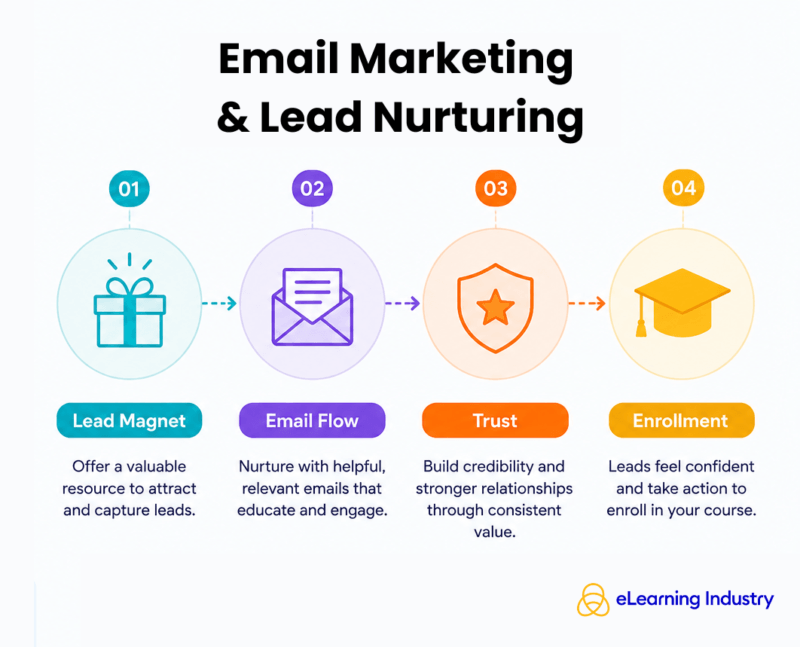
In the current state of the market, a modern course 360 inbound marketing plan uses sophisticated nurturing systems designed to guide learners through the decision-making process.
Here, lead magnets play an important role. Some common examples include:
- Free mini-courses
- Templates
- Checklists
- Industry reports
- Learning guides
- Webinar registrations
Once users enter the funnel, automated nurturing sequences help build trust over time.
Effective nurturing emails typically:
- Educate
- Solve small problems
- Demonstrate expertise
- Share student success stories
- Address objections
- Highlight outcomes
Segmentation is also one of the email marketing best practices. Always keep in mind that not every learner has the same goals or intent level. Therefore, personalized email flows based on interests, behavior, or course categories often outperform generic campaigns significantly.
Conversion-focused email flows may include:
- Welcome sequences
- Webinar follow-ups
- Abandoned enrollment reminders
- Limited-time offers
- Case study campaigns
- Certification-focused messaging
The reason email continues performing so well is simple: trust compounds through repeated value delivery. When learners consistently receive useful insights from a brand, enrollment becomes a natural next step rather than a hard sell.
Webinars & Live Events
Webinars remain one of the strongest engagement channels for promoting online courses.
In a digital environment filled with short-form content and fragmented attention, live interaction creates a deeper level of connection and credibility.
Webinars work particularly well because they allow potential learners to experience your expertise directly before purchasing. This reduces uncertainty and increases trust.
Unlike static content, webinars create opportunities for:
- Real-time interaction
- Audience participation
- Personalized explanations
- Live demonstrations
- Objection handling
- Community engagement
For many course providers, webinars function as both educational experiences and conversion events.
Popular webinar formats include:
- Workshops
- Industry trend sessions
- Product demonstrations
- Certification previews
- Live Q&A sessions
- Expert panels
- Strategic masterclasses
The strongest webinars focus heavily on value rather than aggressive selling. When audiences leave a webinar feeling informed and inspired, conversions often happen naturally.
Another major advantage of webinars is content reusability. A single webinar can be transformed into:
- YouTube videos
- Blog articles
- Podcast episodes
- Social clips
- Email campaigns
- Lead magnets
So, webinars are highly efficient from a content marketing perspective.
In 2026, hybrid events are also becoming increasingly important. Many brands now combine live virtual events with community discussions, networking experiences, and on-demand educational libraries, creating longer engagement cycles and stronger learner relationships.
For high-ticket programs especially, webinars often outperform traditional advertising because they build authority and trust simultaneously.
Podcasts & Audio Content
Podcasts have evolved into one of the most strategic channels for online learning brands.
Audio consumption continues growing globally because it fits naturally into modern lifestyles. People listen while commuting, exercising, working, or multitasking, which creates unique opportunities for long-form trust-building.
Unlike fast-moving social content, podcasts allow brands to develop deeper conversations and showcase expertise in a more human and authentic way. This matters tremendously in online education.
Learners often buy courses based on perceived credibility and connection with instructors or brands. Podcasts accelerate this relationship-building process.
Hosting an eLearning podcast can support online course marketing in several ways:
- Brand positioning
- Industry authority
- Audience loyalty
- SEO support through transcripts
- Partnership opportunities
- Long-term discoverability
Educational podcasts also help companies remain visible consistently without relying entirely on advertising. Being a guest on established podcasts is equally valuable.
Guest appearances expose course providers to highly targeted audiences already interested in specific subjects or industries. This often leads to:
- Audience expansion
- Credibility transfer
- Referral traffic
- Lead generation
- Partnership development
One important reason podcasts work so effectively is that conversations build trust faster than advertisements.
Listeners spend extended periods engaging with hosts and guests, naturally building familiarity and authority over time.
In 2026, podcast ecosystems are also becoming more interconnected with video content. Many podcasts now generate:
- YouTube clips
- LinkedIn snippets
- TikTok highlights
- Blog content
- Email assets
This multi-format distribution dramatically expands reach while maximizing content value.
For online learning brands focused on long-term authority-building, podcasts have become a highly strategic investment.
Social Media & Community Platforms
Social media continues to play a major role in online course promotion, but its function has evolved significantly.
Today, social platforms are less about direct selling and more about visibility, engagement, and relationship-building.
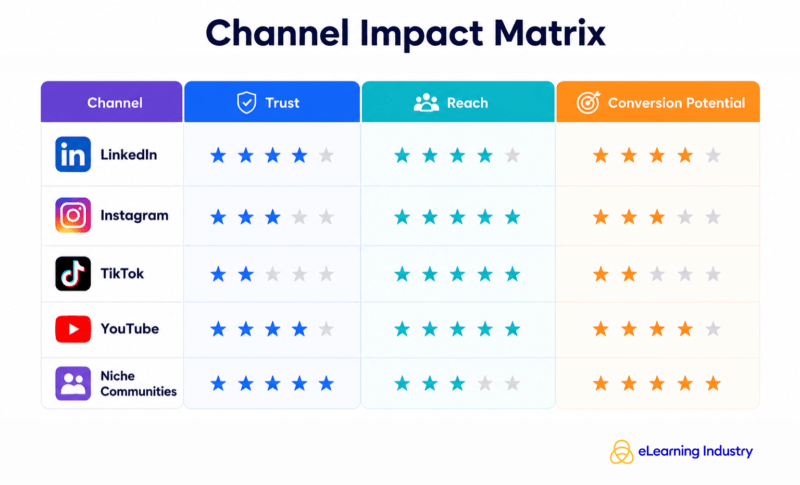
Short-form content drives awareness. Communities drive trust and conversion. Different platforms now serve different purposes within the modern course marketing funnel.
LinkedIn remains highly effective for:
- B2B learning
- Professional development
- Executive education
- Thought leadership
- Industry positioning
Instagram and TikTok excel at:
- Short-form educational content
- Awareness generation
- Brand personality
- Quick engagement
- Visual storytelling
YouTube continues to dominate long-form educational discovery.
Many successful course providers use YouTube strategically to:
- Demonstrate teaching quality
- Rank in search
- Build authority
- Generate evergreen traffic
- Support conversion funnels
Meanwhile, niche communities are becoming increasingly influential.
Private groups, Slack communities, Discord servers, Reddit communities, and membership ecosystems create environments where learners engage more deeply with brands and peers.
Communities are powerful because they create belonging.
In many cases, prospective students join communities before purchasing courses because they want validation, peer interaction, and ongoing support.
The strongest social media strategies in 2026 prioritize:
- Educational value
- Consistency
- Authenticity
- Platform-native content
- Conversation
- Community interaction
Purely promotional content tends to underperform since audiences now expect creators and brands to educate first and sell second.
Paid Advertising & Retargeting
It is true that paid advertising still plays an important role in online course marketing, but its effectiveness depends heavily on the broader marketing ecosystem supporting it. Running ads without authority, nurturing, or quality content often leads to poor results and rising acquisition costs.
On the other hand, the most successful online learning brands use paid advertising strategically rather than relying on it exclusively. On this note, Google Ads remain valuable for capturing high-intent search traffic from users actively seeking solutions, certifications, or educational programs.
LinkedIn Ads are especially effective for:
- Corporate training
- B2B education
- Leadership programs
- Executive learning
- Professional certifications
Meta Ads continue supporting:
- Awareness campaigns
- Lead generation
- Webinar promotion
- Retargeting sequences
Here, retargeting is particularly important because most users do not enroll during their first interaction with a brand.
Retargeting campaigns help re-engage users who:
- Visited landing pages
- Downloaded resources
- Watched videos
- Attended webinars
- Started checkout flows
This repeated exposure increases familiarity and trust over time.
However, paid advertising performs best when combined with:
- Valuable content
- Strong landing pages
- Email nurturing
- Social proof
- Thought leadership
Often, ads amplify existing authority; they rarely create authority on their own.
In 2026, marketers are also focusing more heavily on first-party data strategies due to privacy changes and tracking limitations. This makes lead capture and owned audience development even more critical.
Directory Listings & Industry Platforms
In the current market, many online course providers underestimate the importance of directory visibility and industry platforms. However, these ecosystems often serve as major discovery channels for learners researching educational options.
Truth is, buyers frequently explore trusted platforms before visiting individual company websites.
This is especially true in the following:
- Professional certifications
- Corporate training
- Technical education
- SaaS learning ecosystems
- Industry-specific programs
Directory listings provide several advantages:
- Category visibility
- Audience targeting
- Built-in trust
- Search discoverability
- Review ecosystems
Course marketplaces can also generate exposure to audiences that brands may struggle to reach independently.
Although marketplace competition can be intense, visibility on trusted platforms like eLearning Industry often strengthens overall brand awareness.
Let us not forget that reviews and ratings play a significant role as well. Social proof remains one of the strongest trust signals in online learning marketing. Positive reviews help reduce hesitation and increase credibility.
Strategically, directory platforms often function as middle-funnel channels where learners compare alternatives before making enrollment decisions.
The most effective brands optimize listings carefully by improving:
- Messaging
- Positioning
- Visual assets
- Outcomes
- Reviews
- Credibility indicators
Especially in competitive industries, directory visibility can meaningfully influence enrollment growth.
Why Multi-Channel Distribution Wins
The highest-performing online course brands rarely depend on a single marketing channel. Instead, they build integrated ecosystems where channels support and reinforce one another. This is especially important because modern customer journeys are fragmented and non-linear.
A learner may:
- Discover a podcast clip on LinkedIn
- Read a blog article through Google
- Join an email list
- Attend a webinar
- Watch YouTube content
- See retargeting ads
- Finally enroll weeks later
Every interaction contributes to trust-building.
Multi-channel distribution increases:
- Brand familiarity
- Visibility frequency
- Audience reach
- Conversion opportunities
- Authority signals
It also reduces risk.
Companies heavily dependent on one channel become vulnerable to:
- Algorithm changes
- Rising ad costs
- Platform instability
- Search fluctuations
Diversified marketing ecosystems create resilience.
Content repurposing is another major advantage of multi-channel strategies.
One webinar can become:
- Articles
- Social clips
- Podcast discussions
- Email campaigns
- Downloadable resources
- YouTube videos
This dramatically improves content efficiency and ROI.
Moreover, consistency also matters. High-growth learning brands maintain consistent messaging, positioning, and educational value across every channel.
The future belongs to companies that distribute strategically rather than simply publish content and hope audiences discover it organically.
Common Online Course Marketing Mistakes
Many online course providers struggle not because their products lack quality, but because their marketing strategies contain structural weaknesses.
One common mistake we witness is relying too heavily on a single channel. For instance, brands that depend entirely on paid ads, SEO, or social media often experience unstable growth when performance fluctuates.
Another issue is weak differentiation. In saturated markets, generic messaging rarely stands out. Successful course brands clearly communicate:
- Unique expertise
- Specific outcomes
- Audience relevance
- Strategic positioning
Inconsistent content is another major problem. In short, publishing sporadically makes it difficult to build authority, maintain visibility, or nurture audiences effectively.
Many companies also ignore lead nurturing entirely. They focus heavily on traffic acquisition while neglecting email flows, webinar sequences, or relationship-building systems that improve conversions over time.
Authority-building is frequently overlooked as well. Modern learners want evidence of expertise before purchasing educational products. Brands that fail to invest in thought leadership often struggle to establish trust.
Finally, some organizations focus too heavily on short-term promotion instead of long-term audience development.
The strongest growth strategies combine immediate lead generation with sustainable authority-building.
Conclusion
We know that online course marketing is becoming more competitive, more sophisticated, and more strategic.
The brands succeeding in 2026 are not relying on a single platform or tactic. They are building integrated digital ecosystems designed to attract attention, establish trust, nurture relationships, and drive long-term enrollment growth.
The most effective digital marketing channels combine visibility, credibility, and engagement.
SEO and AI visibility continue driving discoverability. Content marketing and thought leadership establish authority. Email nurturing builds relationships. Webinars and podcasts deepen trust. Social platforms expand awareness. Communities strengthen engagement. Paid advertising amplifies momentum. Together, these channels create sustainable growth engines.
As competition in online learning continues to increase, companies that distribute strategically and build audience trust consistently will outperform competitors focused only on short-term promotion.
The future of online course growth is multi-channel, content-driven, and audience-focused.
FAQThe best digital marketing channels for promoting online courses in 2026 include SEO and AI search optimization, email marketing, webinars, podcasts, YouTube, LinkedIn, paid advertising, and community-based platforms. The most successful strategies combine multiple channels to increase visibility, trust, and conversions.
To market an online course effectively, focus on building authority and trust through educational content, SEO, webinars, email nurturing, and social media engagement. A multi-channel approach helps attract learners at different stages of the buying journey.
SEO remains important because it generates long-term organic traffic from users actively searching for educational solutions. In 2026, SEO also supports AI visibility through optimized educational content, topic authority, and search intent alignment.
Email marketing helps nurture leads, build relationships, and guide prospective students toward enrollment. Automated email sequences, lead magnets, and personalized campaigns remain some of the highest-converting tactics in online course marketing.
Yes. Webinars are highly effective because they allow course providers to demonstrate expertise, answer questions in real time, and build trust before asking learners to enroll. They also work well for high-ticket or professional training programs.
Podcasts help online course providers build authority, expand audience reach, and create deeper engagement through long-form conversations. Hosting a podcast or appearing as a guest can increase credibility and generate qualified leads over time.
The best platforms depend on your audience and course niche. LinkedIn works well for professional and B2B education, while YouTube supports long-form educational discovery. Instagram and TikTok are effective for awareness and short-form educational content.
Paid advertising can still deliver strong results when combined with valuable content, email nurturing, and retargeting strategies. Ads perform best when they amplify an existing authority-driven marketing strategy rather than acting as the sole acquisition channel.
Multi-channel marketing improves visibility, strengthens trust, and increases the likelihood of reaching learners across different platforms and touchpoints. It also reduces dependence on a single traffic source or algorithm.
Common mistakes include relying on one marketing channel, inconsistent content creation, weak differentiation, ignoring lead nurturing, and failing to build authority. Successful online course marketing requires long-term consistency and strategic distribution.