
Top Growth Marketing Conferences In 2026: The 10 Best Events For B2B And SaaS Marketers
We all know that marketing rarely stands still. Often, we witness new channels emerge, search keeps changing, AI is reshaping how people discover products, and buyers expect more personalized experiences than ever before. Strategies that worked a year ago may already need an update.
That is one of the reasons growth marketing conferences continue to matter. Such conferences offer something that online articles and webinars often can't: direct conversations with people solving the same problems you face every day. In these events, you hear what's working, what isn't, and why. Also, you meet marketers, founders, vendors, and partners who can influence your next campaign or even your next career move.
Especially for B2B and SaaS marketers, these events have become more than educational conferences. In general, they are places to exchange ideas, validate strategies, discover new technology, and build relationships that continue long after the closing keynote.
Whether you are responsible for demand generation, SEO, content marketing, product marketing, customer acquisition, or overall growth strategy, choosing the right event can save months of trial and error. The best conferences bring together experienced practitioners who openly share frameworks, case studies, and lessons they've learned from both successes and failures.
However, not every conference delivers the same value. On one hand, some focus heavily on AI marketing and automation. On the other hand, others specialize in SaaS growth, account-based marketing, product marketing, SEO, or executive leadership. Some are best for hands-on learning, while others are known for networking and building partnerships.
This guide highlights the top growth marketing conferences in 2026 for B2B and SaaS marketers. You'll learn what each event focuses on, who should attend, and how to choose the conferences that match your business goals.
The best growth marketing conferences combine practical education, networking opportunities, and strategic insights that help B2B and SaaS marketers improve customer acquisition, customer retention, pipeline generation, and long-term revenue growth.
Key Takeaways
- Growth marketing conferences help marketers keep pace with rapid changes in AI, search, customer behavior, and digital marketing.
- The strongest events cover topics like demand generation, content marketing, SEO, GEO, AI marketing, product marketing, revenue growth, and customer acquisition.
- Different conferences serve different audiences. Some are ideal for SaaS marketers, while others focus on enterprise marketing, executive leadership, or technical specialists.
- The biggest return on investment often comes from networking, partnerships, and applying what you learn after the event—not just attending sessions. Choose conferences that align with your goals rather than trying to attend as many as possible.
In This Article, You Will Find…
- Why Growth Marketing Conferences Still Matter
- How We Chose These Conferences
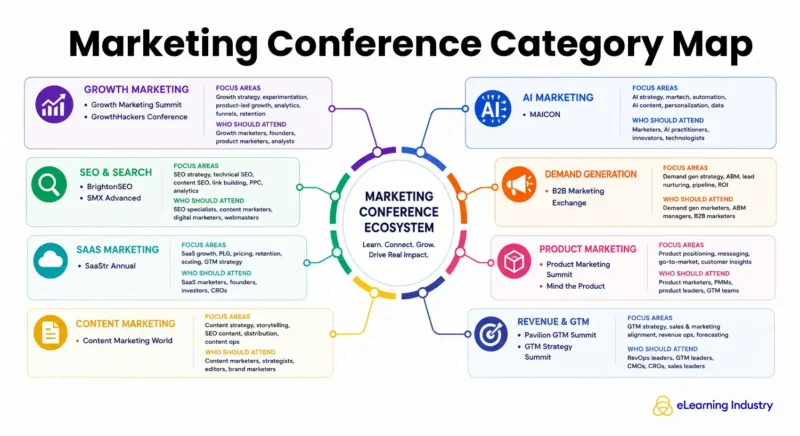
- 10 Must-Attend Growth Marketing Conferences In 2026
- Which Conferences Are Best For Learning & HR Tech Marketers?
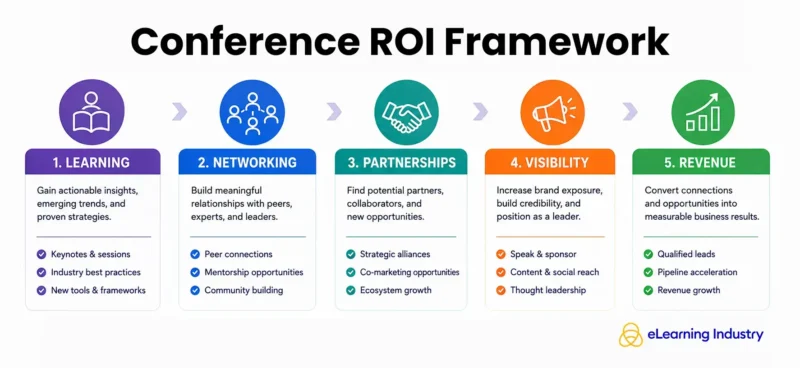
- Beyond The Sessions: How To Maximize Conference ROI
- How Conferences Strengthen Thought Leadership
- Why Podcasts And Industry Conversations Matter
- Emerging Trends You'll Hear About In 2026
- Choosing The Right Conference For Your Goals
- The Future Of Growth Marketing Events
Why Growth Marketing Conferences Still Matter
Every year, marketers have more information available than ever before. Nowadays, there is a plethora of media like podcasts, newsletters, online courses, YouTube channels, webinars, LinkedIn posts, and AI assistants that can answer almost any marketing question within seconds.
So why are marketing conferences still growing? Because information isn't the problem anymore. Context is.
Most companies aren't looking for another list of marketing tactics. They're trying to understand which ideas actually work in today's market, how other businesses are adapting, and what changes they should prioritize next.
That's where conferences make a difference.
AI Has Changed Marketing Faster Than Most Teams Can Adapt
Over the last few years, AI has become part of nearly every marketing function.
Teams now use AI for:
- Content creation
- Keyword research
- SEO
- Campaign planning
- Personalization
- Customer support
- Data analysis
- Workflow automation
At the same time, search engines continue to evolve, while AI-powered search experiences are changing how buyers discover information.
Many marketers are asking new questions:
- How does AI affect organic search?
- What is GEO, and how should we prepare for it?
- How do buyers interact with AI search assistants?
- What content performs well in both traditional search engines and AI-generated answers?
In fact, these aren't questions with one correct answer. They're topics that marketers are actively testing, measuring, and discussing.
The best growth marketing events bring together practitioners who are willing to share those findings before they become common knowledge.
Learning From Real Practitioners Saves Time
It is common knowledge that reading about a successful campaign is useful. However, listening to the person who built it is often much more valuable.
Conference speakers usually explain:
- What worked
- What failed
- What they would change
- How they measured success
- Which tools they relied on
Those details rarely make it into blog posts or case studies.
In fact, real examples help marketing leaders avoid costly mistakes while giving them ideas they can adapt to their own organizations.
Especially for B2B companies with long sales cycles, even one practical insight can improve campaign performance enough to justify the cost of attending.
Networking Creates Opportunities You Can't Predict
We have talked with many attendees, and most say the sessions are only part of the value.
It is the conversations before presentations, during coffee breaks, at networking dinners, or while waiting in line that often become the most memorable part of the conference.
Those conversations can lead to:
- Strategic partnerships
- Podcast invitations
- Customer referrals
- Vendor introductions
- Speaking opportunities
- New hires
- Career opportunities
Some relationships begin with a simple conversation and develop into years of collaboration, which is difficult to recreate through online networking alone.
Conferences Help Marketers See Beyond Their Industry
One common mistake is learning only from direct competitors. Growth marketers often find their best ideas by studying companies in completely different industries.
A SaaS company may learn customer onboarding techniques from a streaming platform. Meanwhile, an HR software vendor may borrow product marketing ideas from cybersecurity companies. Also, a Learning Management System provider might discover new demand generation strategies from fintech startups.
Therefore, cross-industry learning is one of the biggest advantages of attending broader B2B marketing conferences.
Marketing Leadership Requires Continuous Learning
It is true that marketing leaders are expected to make decisions across multiple disciplines.
Today's CMOs and Heads of Growth need to understand:
- SEO
- AI visibility
- Demand generation
- Paid acquisition
- Product marketing
- Customer retention
- Analytics
- Attribution
- Pipeline growth
- Revenue strategy
No single person can become an expert in every area.
That is why conferences help leaders stay informed without having to become specialists in everything.
Instead of starting from scratch, they learn from experts who spend every day solving specific problems.
The Value Goes Beyond Education
The strongest conferences create value long after attendees return home.
Many marketers leave with:
- New campaign ideas
- Better processes
- Stronger professional networks
- Trusted vendors
- Future business partners
- Speaking opportunities
- Content ideas for months ahead
The truth is that the conference itself may last only a few days. However, the relationships and ideas often continue generating value throughout the year.
How We Chose These Conferences
There are hundreds of marketing conferences held every year. Some attract thousands of attendees from around the world. Others focus on small executive groups or niche marketing disciplines.
Not every event belongs on the same list.
For this guide, we focused on conferences that consistently provide value for B2B marketers, SaaS companies, software vendors, and growth-focused teams.
Here are the factors we considered.
Speaker Quality
The best conferences feature practitioners rather than only professional speakers.
We looked for events where attendees can learn from:
- CMOs
- Growth leaders
- Founders
- Product marketers
- SEO specialists
- Demand generation experts
- AI practitioners
These speakers share real campaigns, measurable outcomes, and practical lessons instead of generic marketing advice.
Attendee Profile
Networking depends on who else is in the room.
Events with experienced marketing professionals often create better discussions than conferences focused mainly on product demonstrations.
Priority was given to conferences that attract:
- B2B marketers
- SaaS companies
- Technology vendors
- Marketing executives
- Founders
- Agencies
- Revenue leaders
A strong attendee community often becomes one of the biggest reasons people return each year.
Educational Value
Sessions should leave attendees with ideas they can actually use.
We prioritized conferences that emphasize:
- Actionable frameworks
- Case studies
- Workshops
- Live demonstrations
- Panel discussions
- Implementation guidance
Good conferences answer practical questions rather than simply describing trends.
Networking Opportunities
Some conferences schedule networking as an afterthought. Others build it into the entire experience.
We looked for events that include:
- Roundtable discussions
- Networking receptions
- Community meetups
- Mentor sessions
- One-on-one meetings
- Executive networking
These formats make it easier to build meaningful professional relationships.
Relevance To B2B And SaaS Marketing
Consumer marketing conferences can be valuable, but this guide focuses on companies with longer buying cycles, multiple stakeholders, and complex purchasing decisions.
Priority was given to conferences covering:
- Demand generation
- Account-based marketing
- Customer acquisition
- Product marketing
- Customer retention
- Pipeline generation
- AI marketing
- SEO
- Revenue operations
These topics closely match the challenges faced by software companies and B2B organizations.
Actionable Content
The best presentations don't stop at theory. They explain how strategies were implemented, what metrics improved, what mistakes occurred, and how results were measured.
That level of detail helps attendees adapt successful ideas to their own organizations.
Industry Reputation
Finally, we considered each conference's track record.
Many of the events in this guide have built strong reputations over several years by consistently attracting respected speakers, experienced attendees, and valuable sponsors. That consistency matters.
When marketers invest time and travel budget into attending a conference, they want confidence that the experience will be worthwhile.
In the next section, we'll explore the growth marketing conferences in 2026 that stand out across SaaS, demand generation, AI, SEO, product marketing, and executive leadership.
10 Must-Attend Growth Marketing Conferences In 2026
Every conference has its own personality. Some focus on strategy. Others emphasize practical workshops, executive networking, or specific disciplines like SEO, product marketing, or demand generation.
Instead of trying to attend every event, it's usually better to choose the ones that match your role and your company's goals.
The conferences below consistently attract experienced marketers, founders, growth leaders, and technology companies. While agendas and speakers change each year, these events have built strong reputations for delivering useful insights and valuable networking opportunities.
Growth Marketing Summit
Category: Growth Marketing
Typical location: Frankfurt, Germany
Best for: Growth marketers, startup founders, Heads of Growth, product teams, digital marketers
What the conference focuses on
Growth Marketing Summit has become one of Europe's best-known growth marketing events. Rather than covering every marketing discipline, it stays focused on sustainable business growth through experimentation, customer insights, product optimization, and data.
Sessions typically explore topics such as:
- Growth strategy
- Customer acquisition
- Retention
- Product-led growth
- Conversion rate optimization
- Experimentation
- Analytics
- AI in marketing
Many presentations are built around real case studies instead of theoretical frameworks, making it easier for attendees to apply ideas within their own organizations.
Who should attend?
This conference is a good fit for professionals responsible for growing products or businesses through measurable marketing efforts, including:
- Heads of Growth
- Growth Marketing Managers
- Product Marketers
- Startup founders
- Digital marketing leaders
- Marketing analysts
B2B SaaS companies looking to improve customer acquisition and retention will find plenty of relevant sessions.
Why it's worth attending
One of the strengths of Growth Marketing Summit is its practical approach. Speakers often explain how they tested ideas, what failed, what succeeded, and how they measured results.
Rather than presenting polished success stories, many sessions focus on continuous improvement and learning from experimentation.
The event also attracts a healthy mix of startups, scale-ups, and enterprise companies, creating opportunities to hear different perspectives on growth challenges.
Key takeaway
If your role revolves around experimentation, optimization, and sustainable growth, this conference should be high on your shortlist.
GrowthHackers Conference
Category: Growth Marketing
Typical location: United States (varies by year)
Best for: Growth teams, SaaS companies, founders, marketing leaders
What the conference focuses on
GrowthHackers helped popularize experimentation as a structured approach to business growth. Its conference continues that focus by exploring how organizations can build repeatable growth systems across marketing, product, customer success, and sales.
Popular themes include:
- Growth experimentation
- Customer lifecycle
- Product adoption
- Retention strategies
- AI-powered marketing
- Growth teams
- Data-driven decision making
Unlike broader digital marketing conferences, GrowthHackers places significant attention on cross-functional collaboration between marketing and product teams.
Who should attend?
The conference works particularly well for:
- SaaS marketers
- Product managers
- Growth leaders
- Customer success professionals
- Startup founders
- Revenue teams
Organizations adopting product-led growth often find the sessions especially relevant.
Why it's worth attending
Growth doesn't happen in isolation. One recurring message at GrowthHackers is that marketing, product, customer success, and sales all contribute to customer growth. Attendees leave with frameworks that can improve collaboration across departments instead of optimizing individual channels independently.
Networking is another strength. Since attendees often face similar business challenges, conversations tend to be practical rather than purely promotional.
Key takeaway
Growth marketing becomes more effective when every customer-facing team works toward the same objectives.
SaaStr Annual
Category: SaaS Marketing
Typical location: California, USA
Best for: SaaS founders, CMOs, revenue leaders, demand generation teams, investors
What the conference focuses on
Few conferences are as closely associated with SaaS as SaaStr Annual. Although marketing is only one part of the agenda, it plays a central role because customer acquisition remains one of the biggest challenges for software companies.
Sessions commonly explore:
- Demand generation
- Customer acquisition
- Product marketing
- Customer success
- Revenue operations
- Sales alignment
- Pricing
- AI adoption
- Scaling SaaS businesses
The conference also brings together investors, founders, executives, and technology vendors, creating opportunities that extend beyond marketing.
Who should attend?
SaaStr Annual is particularly valuable for:
- SaaS CMOs
- Founders
- Heads of Marketing
- Demand Generation Managers
- Revenue Operations leaders
- Customer Success leaders
Growing software companies can benefit from the mix of strategic leadership sessions and tactical marketing discussions.
Why it's worth attending
Unlike many marketing conferences, SaaStr views growth through the entire customer journey. Marketing, sales, onboarding, expansion, and retention are treated as connected parts of one growth system. For B2B SaaS organizations, this broader perspective often leads to better collaboration across departments.
The networking opportunities are equally valuable. Decision-makers from software companies of every size attend, making it easier to build relationships with peers, partners, and potential customers.
Key takeaway
If your company sells software, SaaStr Annual remains one of the strongest conferences for understanding how marketing supports long-term revenue growth.
B2B Marketing Exchange
Category: Demand Generation
Typical location: Scottsdale, Arizona, USA
Best for: Demand generation professionals, ABM teams, revenue marketers, marketing leaders
What the conference focuses on
B2B Marketing Exchange is one of the leading demand generation conferences for marketers working in complex B2B sales environments.
Rather than focusing on consumer marketing, the event concentrates on longer buying journeys, multiple decision-makers, and revenue-focused marketing.
Core topics usually include:
- Demand generation
- Account-based marketing (ABM)
- Pipeline generation
- Sales and marketing alignment
- Marketing automation
- Content strategy
- Revenue attribution
- Customer experience
Sessions often include practical examples from technology companies, making the advice highly relevant for SaaS organizations.
Who should attend?
Ideal attendees include:
- Demand Generation Managers
- Revenue Marketing teams
- Marketing Operations professionals
- ABM specialists
- CMOs
- Heads of Growth
Organizations with enterprise sales cycles will likely gain the most value.
Why it's worth attending
Many conferences discuss lead generation.
B2B Marketing Exchange goes further by examining how marketing contributes to pipeline, revenue, and long-term customer relationships.
Speakers typically present measurable business outcomes instead of vanity metrics.
For leaders under pressure to demonstrate marketing's contribution to revenue, this practical focus is particularly useful.
Key takeaway
Demand generation isn't just about generating more leads. It's about creating better opportunities that convert into revenue.
Content Marketing World
Category: Content Marketing
Typical location: Washington, D.C., USA
Best for: Content marketers, SEO professionals, brand marketers, communications teams
What the conference focuses on
Content Marketing World remains one of the most respected content marketing events for B2B organizations.
As AI changes how content is created and discovered, the conference has expanded its agenda to include topics such as:
- Content strategy
- SEO
- GEO
- AI-assisted content creation
- Editorial planning
- Brand storytelling
- Video marketing
- Content measurement
- Audience development
Instead of treating content as a publishing exercise, many sessions examine how content supports customer acquisition, customer education, and long-term business growth.
Who should attend?
This event is well-suited for:
- Content Marketing Managers
- SEO specialists
- Editorial teams
- Communications professionals
- Brand marketers
- Demand generation teams
Marketing leaders responsible for thought leadership initiatives will also find valuable insights.
Why it's worth attending
Content remains one of the strongest long-term growth channels for B2B companies, but expectations have changed. Organizations now need content that performs well in traditional search engines, AI-powered search experiences, newsletters, podcasts, webinars, and social platforms.
Content Marketing World addresses this broader landscape while maintaining a practical focus on planning, production, distribution, and measurement.
Attendees also gain access to a large community of experienced content professionals who openly share workflows, editorial processes, and lessons learned.
Key takeaway
Great content isn't about publishing more. It's about creating information that helps buyers make better decisions across every stage of the customer journey.
BrightonSEO
Category: SEO & Search Marketing
Typical location: Brighton, UK (with additional international editions)
Best for: SEO professionals, content marketers, digital marketers, technical SEO specialists
What the conference focuses on
BrightonSEO has grown into one of the world's best-known SEO conferences. While search engine optimization remains the core topic, the agenda has expanded significantly in recent years.
You'll often find sessions covering:
- Technical SEO
- Content strategy
- AI search
- GEO (Generative Engine Optimization)
- Digital PR
- Analytics
- Site architecture
- Local SEO
- International SEO
- Search automation
The event attracts both in-house marketers and agency professionals, creating a diverse mix of perspectives.
Who should attend?
BrightonSEO is an excellent fit for:
- SEO Managers
- Content Strategists
- Technical SEO Specialists
- Digital Marketing Managers
- Website owners
- Marketing consultants
For SaaS companies that rely on organic growth, the conference offers practical advice that can directly influence traffic and lead generation.
Why it's worth attending
Search continues to evolve quickly. AI-generated search experiences, changes in user behavior, and ongoing search engine updates mean marketers need to rethink how they create and structure content.
BrightonSEO consistently addresses these topics with technical depth while keeping sessions accessible for non-engineers.
Key takeaway
If organic search is an important acquisition channel, BrightonSEO remains one of the strongest conferences available.
SMX Advanced
Category: SEO & Search Marketing
Typical location: United States
Best for: Experienced SEO professionals, enterprise marketers, technical specialists
What the conference focuses on
SMX Advanced is designed for marketers who already have a solid understanding of SEO and paid search.
Rather than covering introductory topics, it explores more advanced areas such as:
- Enterprise SEO
- Technical optimization
- AI search experiences
- Search automation
- Search analytics
- Large website management
- Performance measurement
Many sessions focus on solving complex search challenges faced by enterprise organizations and fast-growing technology companies.
Who should attend?
This conference is best suited for:
- Senior SEO Managers
- Enterprise marketing teams
- Technical SEO professionals
- Digital strategy leaders
- Marketing directors
Organizations managing large websites or multiple digital properties will benefit most.
Why it's worth attending
SMX Advanced goes beyond basic optimization tips. Presentations often include detailed case studies, technical implementation advice, and discussions about where search is heading over the next few years.
That makes it particularly valuable for marketing leaders responsible for long-term search strategy.
Key takeaway
Advanced SEO requires continuous learning, especially as AI continues to reshape search behavior.
MAICON
Category: AI Marketing
Typical location: Cleveland, Ohio, USA
Best for: Marketing leaders, AI practitioners, operations teams, executives
What the conference focuses on
Artificial Intelligence is no longer a niche topic.
It's influencing nearly every aspect of modern marketing, from content creation and campaign optimization to analytics, personalization, and customer service.
MAICON focuses specifically on helping marketing professionals understand how to adopt AI responsibly and effectively.
Common topics include:
- AI strategy
- Marketing automation
- Predictive analytics
- AI governance
- Content creation
- Customer experience
- Workflow optimization
- AI ethics
Unlike broader technology conferences, MAICON concentrates on practical business applications rather than technical development.
Who should attend?
Ideal attendees include:
- CMOs
- Marketing Operations teams
- Digital Marketing leaders
- AI strategy teams
- Content leaders
- Marketing analysts
Organizations building AI into their marketing workflows will gain valuable insights.
Why it's worth attending
Many companies have started experimenting with AI.
Far fewer have developed clear processes, governance, or measurement frameworks.
MAICON helps bridge that gap by focusing on implementation instead of speculation.
Key takeaway
The future isn't about replacing marketers with AI. It's about helping marketers make better decisions with AI.
Product Marketing Summit
Category: Product Marketing
Typical location: Multiple global cities
Best for: Product marketers, product managers, GTM teams, SaaS companies
What the conference focuses on
Product Marketing Summit brings together professionals responsible for connecting products with markets.
Its agenda usually includes:
- Product positioning
- Messaging
- Go-to-market planning
- Competitive intelligence
- Product launches
- Customer research
- Sales enablement
- Pricing strategy
Unlike broader marketing conferences, sessions focus specifically on helping products succeed throughout their lifecycle.
Who should attend?
This conference is recommended for:
- Product Marketing Managers
- Product Directors
- SaaS marketing teams
- Founders
- Customer marketing teams
Companies launching new software products often find immediate value in the practical sessions.
Why it's worth attending
Strong products don't automatically become successful products. Clear positioning, effective messaging, and strong collaboration between product, sales, and marketing remain essential.
This conference helps marketing teams improve those areas.
Key takeaway
Product marketing connects customer needs with business growth.
Pavilion GTM Summit
Category: Revenue & Go-to-Market
Typical location: United States
Best for: Executives, GTM leaders, revenue teams, founders
What the conference focuses on
Go-to-market strategy has become increasingly cross-functional. Marketing, sales, customer success, product, and operations all contribute to revenue growth.
The Pavilion GTM Summit reflects that reality by bringing together leaders from across the business. Topics often include:
- Revenue strategy
- Pipeline growth
- Customer expansion
- Leadership
- Team alignment
- Forecasting
- AI adoption
- Executive decision-making
- Who should attend?
This event is especially valuable for:
- CMOs
- CROs
- Founders
- Heads of Growth
- Revenue leaders
- Executive teams
- Why it's worth attending
Rather than looking at marketing in isolation, Pavilion encourages attendees to think about the entire customer journey. That broader perspective often leads to better organizational alignment.
Key takeaway
Growth accelerates when every customer-facing team shares the same goals.
Which Conferences Are Best For Learning And HR Tech Marketers?
If you work in Learning Management Systems (LMS), talent development, HR technology, workplace learning, or AI-powered learning platforms, attending only marketing conferences may limit your perspective.
The strongest marketing strategies often come from understanding your customers first. That means spending time where learning leaders, HR professionals, and talent executives gather.
Combining marketing conferences with industry-specific events helps marketers better understand customer challenges, product trends, and buying priorities.
Here are some of the most valuable conferences to consider.
ATD International Conference & Exposition
For companies serving corporate learning teams, this is one of the most important events of the year.
The audience typically includes:
- Learning leaders
- Instructional designers
- L&D professionals
- Training managers
- HR executives
- Enterprise learning teams
For marketers, it's an opportunity to hear customer conversations firsthand rather than relying only on market research.
Why it complements marketing conferences
After learning growth strategies at marketing events, marketers can validate messaging directly with the audience they're trying to reach.
Learning Technologies Conference
Learning Technologies attracts professionals working across workplace learning, digital learning, AI learning platforms, and educational technology.
Marketing teams often attend to:
- Understand customer priorities
- Explore emerging learning technologies
- Meet technology partners
- Monitor industry trends
For LMS vendors, this conference provides valuable market intelligence alongside networking opportunities.
HR Tech Conference
HR Tech focuses on the future of human resources and workplace technology.
Sessions commonly explore:
- HR software
- AI in HR
- Workforce planning
- Employee experience
- Skills development
- Talent management
- Analytics
Although the primary audience isn't marketers, the event provides valuable insight into how HR buyers evaluate technology investments.
That understanding can improve positioning, messaging, and campaign strategy.
Why This Combination Works
Many software marketers spend most of their time speaking with other marketers. Even though that is quite useful, it does not always improve customer understanding.
The strongest Learning Tech and HR Tech marketing teams often combine two perspectives:
Marketing conferences help answer:
- How should we generate demand?
- How should we improve SEO?
- Which AI tools should we adopt?
- How can we measure growth?
Industry conferences help answer:
- What problems are buyers trying to solve?
- Which technologies are gaining attention?
- How are customer priorities changing?
- What language resonates with decision-makers?
When these insights come together, marketing becomes much more customer-focused.
For LMS vendors, HR technology companies, and AI learning platforms, this combination often produces stronger positioning, more relevant content, and better-performing campaigns.
Beyond The Sessions: How To Maximize Conference ROI
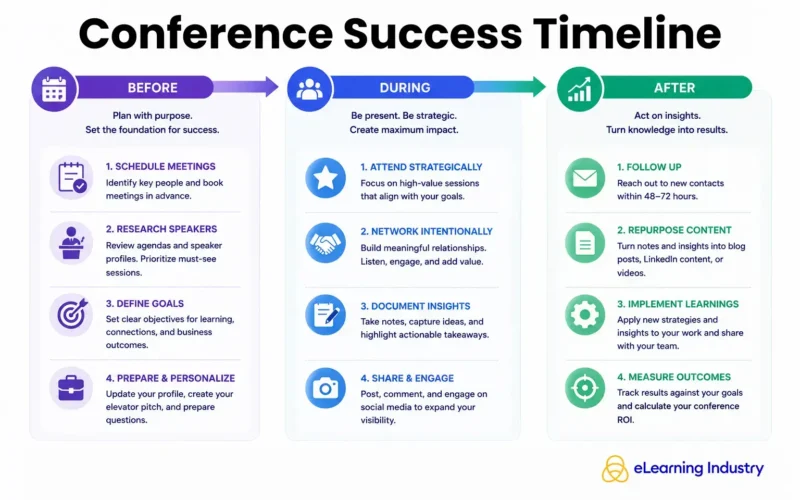
Attending a conference is an investment. Registration fees, travel, accommodation, and time away from work all add up. To get the most from that investment, it's worth planning before you arrive and continuing the work after you return home.
The marketers who gain the most value usually treat a conference as a business project rather than a few days out of the office.
Before The Conference
Start with clear objectives. For istance, ask yourself what success looks like. Are you hoping to improve your SEO strategy? Learn more about AI marketing? Meet potential partners? Explore new technology vendors? Find speaking opportunities?
Once your goals are clear, review the agenda and identify the sessions that support those priorities.
It's also worth researching the speakers and attendees. Many conferences publish attendee lists or offer networking apps before the event. Reach out to people you'd like to meet and schedule short conversations in advance. Waiting until you're there often means calendars are already full.
Finally, decide how you'll capture ideas. Whether you prefer a notebook, a document, or a note-taking app, having one place for insights makes it easier to review everything later.
During The Conference
It's tempting to attend sessions from morning until evening, but that isn't always the best use of your time.
Leave space for conversations.
Some of the most valuable insights happen over coffee, at networking events, or between presentations. Don't be afraid to introduce yourself. Most people attend conferences because they want to meet others in the industry.
Take notes with action in mind. Instead of writing down every slide, focus on ideas you can test within your own organization.
You should also visit exhibitors selectively. Rather than collecting brochures from every booth, spend time with vendors solving problems your business actually has.
After The Conference
This is where many attendees lose momentum.
Within a few days of returning, review your notes and identify the ideas worth acting on.
Follow up with the people you met. A short LinkedIn message or email is often enough to continue the conversation.
Then prioritize implementation.
Choose two or three ideas you can test over the next quarter instead of trying to apply everything at once.
Finally, share what you learned with your team. Internal presentations, documentation, or workshops help spread knowledge and increase the return on your company's investment.
How Conferences Strengthen Thought Leadership
Conferences aren't just places to learn. They're also places to build your professional reputation.
For marketers looking to become recognized voices in their industry, conferences create opportunities that are difficult to find elsewhere.
Speaking at an event immediately increases visibility. It demonstrates expertise and puts your ideas in front of an audience that's already interested in your field. But you don't have to be on stage to benefit.
Many conferences offer opportunities to:
- Join panel discussions
- Record podcast interviews
- Participate in roundtable conversations
- Meet journalists and analysts
- Connect with event organizers
- Collaborate with other speakers
These interactions often lead to future invitations, partnerships, and content opportunities.
Another advantage is original content. Instead of writing about industry trends from your desk, you can share observations, interview experts, and publish insights while the conversations are still fresh.
That type of content tends to feel more authentic because it's based on real discussions rather than second-hand research.
The Difference Between Attending And Speaking
Attending helps you learn. On the other hand, speaking helps people remember you.
A well-prepared presentation can introduce your company to future customers, potential partners, talented employees, and industry media.
For marketers looking to build long-term authority, speaking is often one of the highest-value activities available.
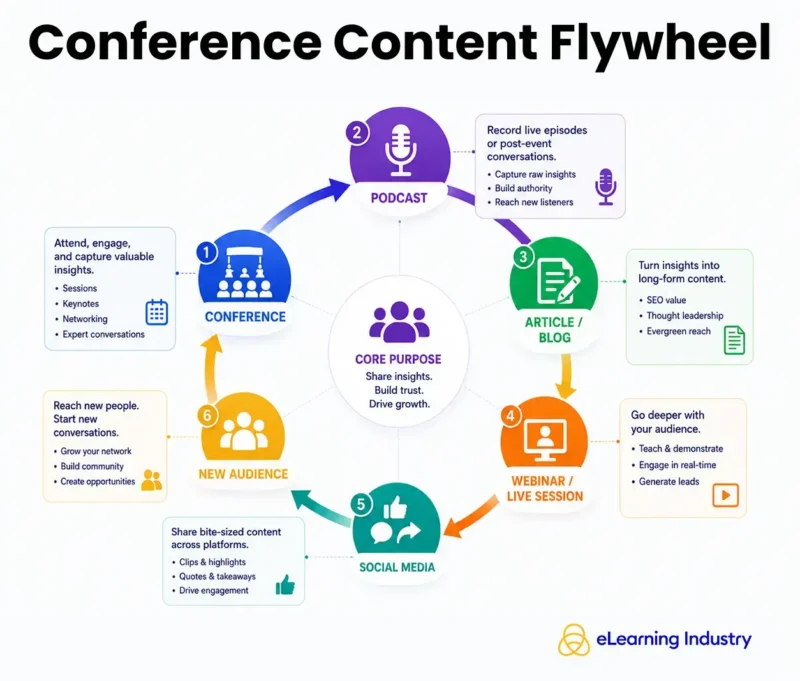
Why Podcasts And Industry Conversations Matter
Conferences don't end when the final session finishes. In many cases, that's when the best conversations begin.
Podcasts have become one of the easiest ways to extend those conversations and reach people who couldn't attend the event.
Many companies now record podcast episodes during conferences because guests, customers, and industry experts are already in one place.
A single event can provide enough interviews for months of content.
Conference podcasts also feel more natural, as podcast guests often discuss what they've learned, emerging trends, and practical challenges instead of repeating prepared marketing messages.
For companies investing in thought leadership, conferences create opportunities to:
- Record live podcast episodes
- Interview keynote speakers
- Feature customers
- Discuss industry trends
- Capture expert opinions
- Build relationships for future collaborations
These conversations don't have to stay as podcasts.
One interview can become:
- A blog article
- A webinar
- Short social media videos
- Newsletter marketing content
- Sales enablement material
- Internal training resources
That approach helps marketing teams create more value from a single event.
Emerging Trends You'll Hear About In 2026
While every conference has its own focus, several themes are likely to appear across most marketing events in 2026.
AI Agents
Marketing teams are moving beyond simple AI assistants.
The conversation is shifting toward AI agents that can complete multi-step workflows, analyze data, and support decision-making with less manual input.
The focus is becoming orchestration rather than automation alone.
AI Visibility And GEO
As more buyers use AI-powered search experiences, marketers are paying closer attention to Generative Engine Optimization (GEO) and AI visibility.
Questions such as "How do AI systems choose which brands to mention?" are becoming increasingly important.
Expect more sessions exploring structured content, topical authority, entity optimization, and brand credibility.
Revenue Marketing
Marketing leaders continue moving away from lead volume as the primary success metric.
Instead, they're focusing on pipeline contribution, customer lifetime value, expansion revenue, and business outcomes.
This shift is bringing marketing, sales, and customer success closer together.
First-Party Data
Privacy regulations and changing browser technologies continue reducing reliance on third-party tracking.
Organizations are investing more heavily in customer communities, owned media, CRM systems, and first-party data strategies.
Buyer Communities
Customers increasingly trust peers more than advertising.
As a result, many companies are building communities where customers can share experiences, ask questions, and learn from one another.
Community-led growth continues gaining momentum.
Personalization
Generic messaging is becoming less effective.
Advances in AI and customer data are allowing companies to create more relevant experiences across websites, email campaigns, and product interactions.
Product-Led Growth
Many software companies continue exploring ways to let products demonstrate value before a customer speaks with sales.
Free trials, product education, onboarding experiences, and customer success are becoming larger parts of overall growth strategies.
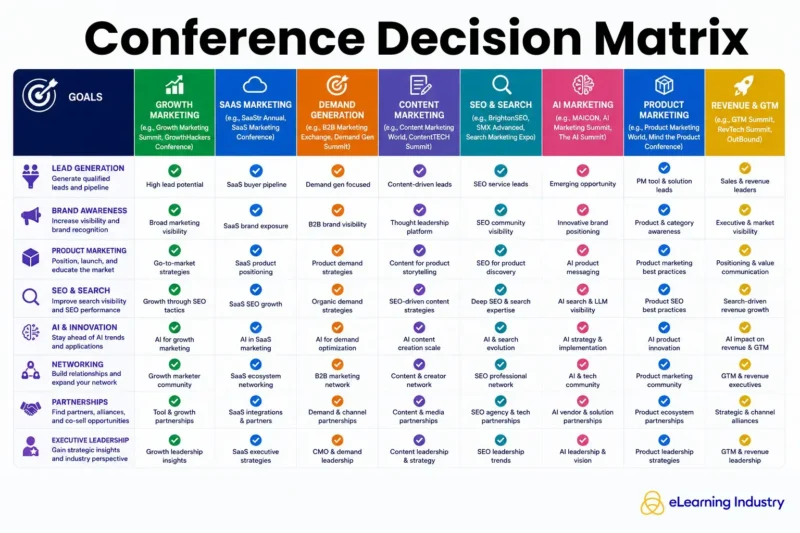
Choosing The Right Conference For Your Goals
With so many marketing conferences available, it's easy to assume that attending the biggest event will deliver the greatest value. But that's not always the case. The right conference depends on what you're trying to achieve and the challenges your business is facing.
If your priority is improving your organic visibility, conferences like BrightonSEO and SMX Advanced provide in-depth sessions on SEO, technical optimization, AI search, and the future of search marketing. Marketers looking to understand how AI is changing the industry may find more value in MAICON, where the focus is on practical AI adoption, automation, and emerging marketing technologies.
For SaaS companies aiming to scale customer acquisition and revenue, SaaStr Annual offers a broad view of growth, covering marketing, sales, customer success, and product strategy. If demand generation is your main objective, B2B Marketing Exchange is a strong choice thanks to its emphasis on pipeline growth, account-based marketing, and revenue-focused campaigns.
Product Marketing Summit is well suited to teams preparing for product launches, refining their messaging, or improving go-to-market strategies. Meanwhile, executives looking to strengthen cross-functional leadership and build relationships with other senior decision-makers may benefit most from attending Pavilion GTM Summit or similar revenue-focused events.
Finally, marketers working in Learning Technology, HR Tech, or SaaS should also consider industry-specific events alongside traditional marketing conferences. Conferences such as ATD International Conference & Exposition, Learning Technologies Conference, and HR Tech Conference offer direct access to the audiences you market to every day. Understanding how buyers think, the challenges they face, and the trends shaping their industries can be just as valuable as learning the latest marketing tactics.
The Future Of Growth Marketing Events
Conferences continue to evolve alongside the marketing industry. Meanwhile, hybrid experiences remain common, allowing attendees to combine in-person networking with digital access to selected sessions.
AI is also improving how people connect at events. On this note, many organizers now use AI-powered recommendations to match attendees with similar interests, making networking more intentional than traditional business card exchanges.
In the meantime, executive communities are becoming smaller and more focused. Instead of attracting thousands of general attendees, some events now prioritize curated discussions among senior leaders facing similar challenges.
On the other side, hands-on workshops are also replacing passive presentations. Rather than watching another slide deck, attendees increasingly want opportunities to solve problems, review real examples, and collaborate with peers.
At the same time, creator-led events continue growing. Newsletter authors, podcast hosts, consultants, and industry experts are building communities around their audiences, creating smaller conferences with highly engaged participants.
The common thread across all of these changes is community.
At the end of the day, people still attend conferences to learn. But they're increasingly attending to build relationships, exchange ideas, and become part of professional networks that continue throughout the year.
Conclusion
The best growth marketing conferences don't simply introduce new ideas. They help marketers understand which ideas are worth acting on.
For B2B and SaaS organizations, the greatest value often comes from combining education with relationships. A conversation over coffee can lead to a strategic partnership. A workshop can improve your next campaign. A podcast interview can introduce your brand to an entirely new audience.
The strongest marketing teams don't rely on conferences for inspiration alone. They use them to validate ideas, strengthen customer relationships, discover emerging technologies, and bring practical knowledge back to their organizations.
As AI, search, customer expectations, and go-to-market strategies continue to evolve, continuous learning will remain one of the most valuable competitive advantages a marketer can have.
Choose your conferences carefully, arrive with clear goals, and leave with a plan for putting what you've learned into practice.
FAQGrowth marketing conferences help marketers stay current with rapidly changing trends in AI, SEO, demand generation, product marketing, and customer acquisition. They also provide opportunities to learn from real-world case studies, network with industry professionals, and discover practical strategies that can improve business growth.
SaaStr Annual is one of the top conferences for SaaS businesses because it covers customer acquisition, revenue operations, product marketing, customer success, and scaling software companies. GrowthHackers Conference and Growth Marketing Summit are also excellent choices for SaaS marketers focused on experimentation and sustainable growth.
For many B2B organizations, the return on investment extends beyond educational sessions. Conferences often lead to valuable networking opportunities, strategic partnerships, new vendors, speaking opportunities, and practical ideas that can improve marketing performance long after the event ends.
Start by identifying your primary goal. If you want to improve SEO, consider BrightonSEO or SMX Advanced. For AI marketing, MAICON is a strong choice. If your focus is demand generation, B2B Marketing Exchange may be the best fit, while SaaStr Annual is ideal for SaaS growth.
Many conferences are expected to focus on AI agents, Generative Engine Optimization (GEO), AI-powered search, first-party data, revenue marketing, product-led growth, customer communities, and personalization powered by Artificial Intelligence.
Set clear objectives before attending, schedule meetings in advance, prioritize sessions that align with your goals, actively network with attendees, and follow up afterward. Implementing just a few actionable ideas often delivers more value than trying to apply everything you learned.
Yes. While dedicated SEO conferences like BrightonSEO and SMX Advanced offer the deepest search-focused content, broader growth marketing conferences increasingly include sessions on AI search, GEO, content strategy, and organic growth.
Absolutely. Marketing conferences help improve marketing skills, while industry events such as ATD International Conference, Learning Technologies Conference, and HR Tech Conference provide valuable insight into customer needs, buying behavior, and emerging market trends.
Beyond formal sessions, conferences create opportunities to meet founders, marketers, partners, customers, vendors, and industry leaders. These relationships can lead to collaborations, referrals, podcast appearances, speaking engagements, and long-term business partnerships.
Yes. Many conferences offer practical strategies that startups and small businesses can implement immediately. Learning from experienced marketers, discovering new tools, and building relationships with potential partners or investors can help accelerate growth without relying solely on trial and error.