
Brand Sentiment: Reasons Why Customer Perception Matters More Than Ever
Companies spend a lot of time measuring whether people can see their brand. They track impressions, rankings, website traffic, media mentions, share of voice, and social reach. These metrics matter because buyers cannot consider a company they do not know exists.
But visibility answers only part of the question. It tells you whether people are talking about your business, not what those conversations mean.
Brand sentiment looks at the other side of the picture: What are people saying about your brand, and how do they feel about it?
A company can have a large share of voice while customer trust is falling. A pricing change, product problem, or controversial decision might generate thousands of mentions without improving the company's reputation. On the other hand, a smaller company may receive fewer mentions but have customers who regularly recommend it and speak positively about their experience.
This distinction is especially important in B2B markets. Buying decisions often involve several stakeholders, longer research periods, and higher financial risk. Prospects may spend weeks comparing vendors, reading reviews, speaking with peers, checking industry publications, and researching products before they ever contact sales.
Brand sentiment can help companies understand what those buyers are finding along the way.
In general, brand sentiment describes the attitudes, emotions, and opinions people express toward a brand, typically categorized as positive, negative, or neutral and analyzed across customer feedback, reviews, social media, media coverage, communities, and other sources.
The important point is that sentiment analysis should go further than counting positive and negative social media posts. Useful brand sentiment tracking looks across the places where customers, prospects, employees, journalists, analysts, and other industry participants actually discuss the company.
Key Takeaways
- Brand sentiment measures how people feel about a company, while share of voice measures how visible that company is.
- Social media is only one source of sentiment. Reviews, customer conversations, surveys, media coverage, communities, search results, and other sources can provide just as much insight.
- Positive, neutral, and negative classifications are useful starting points, but they rarely explain the full story.
- Understanding the topics and causes behind sentiment is usually more useful than focusing on one overall sentiment score.
- B2B companies can use sentiment data across marketing, sales, product, customer success, PR, and leadership.
- Search engines and AI assistants make the consistency of brand perception across third-party sources increasingly relevant.
In This Article, We Cover…
- What Is Brand Sentiment?
- Brand Sentiment Vs. Brand Perception, Reputation, And Share Of Voice
- Why Brand Sentiment Matters For B2B Brands
- Where Brand Sentiment Data Comes From
- How To Measure And Analyze Brand Sentiment
- How To Improve Brand Sentiment
- How Reviews And Third-Party Validation Shape Brand Sentiment
- Brand Sentiment In Search And AI Results
- Turn Brand Sentiment Into Business Intelligence
- Common Brand Sentiment Mistakes
What Is Brand Sentiment?
Brand sentiment measures the feelings and opinions people express when they talk about a company, product, service, or experience. Most sentiment analysis starts by classifying these conversations as positive, neutral, or negative.
Positive brand sentiment appears when people express satisfaction, trust, enthusiasm, or support. A customer might recommend a product to a colleague, praise a company's support team, share a successful implementation story, or speak positively about a particular feature.
These conversations can provide evidence of customer advocacy and help companies understand what people value most about their offering.
Neutral sentiment includes mentions where there is no clear positive or negative judgment. This might include factual references, product questions, news reports, feature comparisons, or people asking for recommendations.
Neutral does not mean unimportant. In B2B markets, questions and comparisons can be strong signs of active buying interest. Someone asking whether one LMS supports a particular integration, for example, may be much closer to making a purchase than someone who simply likes a company's LinkedIn post.
Negative brand sentiment appears when customers or other audiences express dissatisfaction, frustration, distrust, or disappointment. Common examples include complaints about customer support, implementation problems, pricing concerns, product reliability issues, poor experiences, or criticism of company policies.
Brand Sentiment Vs. Brand Perception, Reputation, And Share Of Voice
We all know that brand sentiment is closely connected with brand perception and reputation, but the terms describe different things.
In detail, brand sentiment focuses on how people currently feel about the company. On the other hand, brand perception is broader and includes the qualities and associations people connect with the brand. Buyers might perceive one provider as innovative, another as affordable, and another as reliable.
Brand reputation develops over a longer period. It reflects the wider judgment people have formed about the organization based on its history, behavior, customer experiences, media coverage, leadership, and other signals.
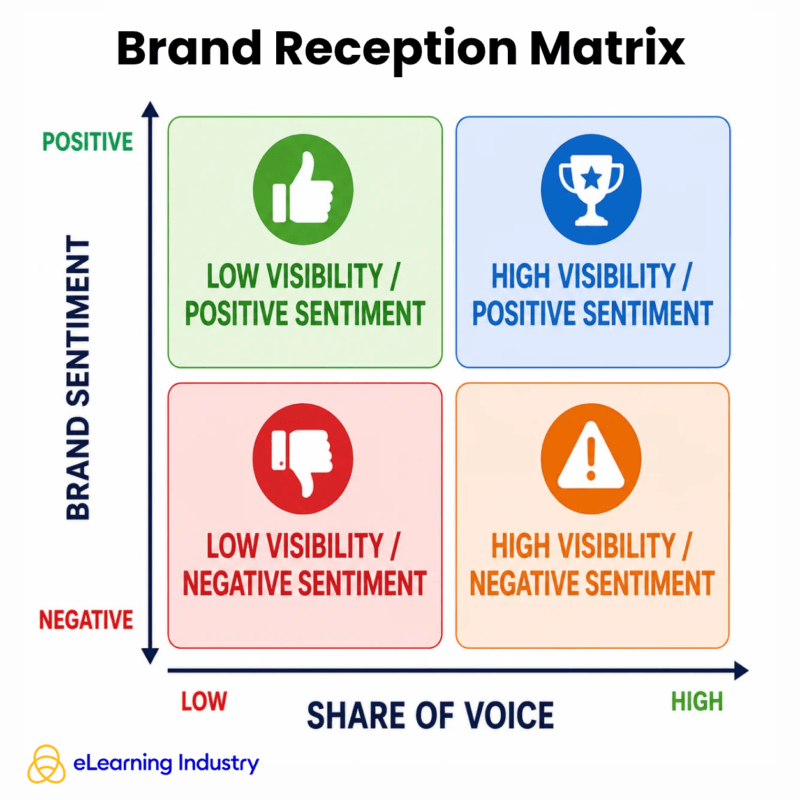
Then there is share of voice, which measures visibility relative to competitors. It can tell you how much of the conversation a company owns, but it does not tell you whether that conversation is favorable.
For example, a company could have high share of voice and negative sentiment after announcing an unpopular pricing change. The company is highly visible, but much of that visibility is working against it.
Another business could have low share of voice and positive sentiment because it serves a smaller market but has customers who consistently recommend it.
Neither position is ideal on its own. A stronger position combines:
Strong visibility + positive sentiment + relevant brand associations
Companies need people to know they exist, but they also need those people to associate the brand with qualities that support consideration and trust.
Why Brand Sentiment Matters For B2B Brands
Brand awareness can put a company on a buyer's radar. Sentiment can influence whether it stays there.
B2B buyers rarely base a significant purchase on a single advertisement, website visit, or sales presentation. They gather information from several sources and compare what the vendor says with what other people say about the vendor.
That research might include customer reviews, LinkedIn discussions, industry communities, comparison pages, analyst or industry publications, search results, software directories, and increasingly, AI assistants.
As a result, brand sentiment can influence several parts of the buying process. It can affect trust, shortlist inclusion, product consideration, recommendations, customer retention, advocacy, partnerships, employer reputation, and even the way sales conversations begin.
Imagine that a company runs a strong awareness campaign and starts generating more branded searches. The campaign appears successful according to reach and traffic metrics. But prospects searching for the business repeatedly find complaints about implementation difficulties and slow support.
Awareness has increased, yet conversion may still suffer because the wider market perception has not improved with it.
The reverse can happen too. Strong customer sentiment can make marketing and sales more effective because buyers encounter consistent evidence that supports what the company says about itself.
The relationship can be summarized simply:
Brand awareness gets you noticed. Brand sentiment influences what buyers think once they notice you.
Where Brand Sentiment Data Comes From
Social media receives a lot of attention in sentiment analysis, mainly because conversations are public and relatively easy to monitor. But for many B2B companies, some of the most valuable signals appear elsewhere.
Customer reviews provide direct opinions about products, service quality, support, implementation, usability, and value. They are particularly useful because customers often explain both what worked and what did not.
Social media can capture real-time reactions, recommendations, complaints, and wider industry conversations. Platforms such as LinkedIn may be especially relevant for B2B brands.
Communities and forums can reveal more detailed and candid discussions. Buyers often use them to ask peers about products without involving the vendor.
Companies should also look at customer surveys, support tickets, customer success conversations, media coverage, and sales calls. Support teams hear recurring frustrations. Salespeople hear objections. Customer success teams know which problems repeatedly affect retention or satisfaction.
Meanwhile, search results, directories, comparison pages, and AI-generated answers provide another perspective: what prospective buyers are likely to encounter when they research the company.
Bringing these sources together creates a more useful picture than brand monitoring any single channel.
How To Measure And Analyze Brand Sentiment
The simplest way to begin measuring brand sentiment is to track the percentage of mentions classified as positive, neutral, and negative.
For example, a company might find that during a particular month:
- 55% of relevant mentions were positive
- 30% were neutral
- 15% were negative
Some companies also calculate net sentiment by subtracting the percentage of negative mentions from the percentage of positive mentions. That calculation can make trends easier to track, but it should not become the entire analysis.
A single sentiment score should never be interpreted without context.
Consider two companies that both have a net sentiment score of +40. One may have thousands of customer conversations across reviews, communities, and media. The other may have only 20 mentions. The number looks the same, but the evidence behind it is very different.
Volume, therefore, matters. So does the source of the conversation.
Companies can strengthen their analysis by tracking sentiment volume, changes over time, sentiment by channel, sentiment by topic, differences between customer segments, and sentiment compared with competitors. More importantly, they should look beyond whether something is positive or negative and ask why.
A practical brand sentiment analysis process could look like this:
- Define what you want to understand.
- Identify the sources most relevant to that question.
- Collect brand mentions and customer feedback.
- Classify the sentiment.
- Manually review important or representative examples.
- Look for recurring themes.
- Segment the findings by audience, channel, product, or topic where useful.
- Compare changes over time.
- Turn the findings into specific business actions.
How To Improve Brand Sentiment
The most effective way to improve negative brand sentiment is usually to address whatever is causing it.
Marketing can improve communication around a problem, but it cannot permanently cover up a poor customer experience. If customers repeatedly complain about support, pricing, implementation, reliability, or usability, the company needs to investigate those issues directly.
Start with the feedback itself. Look for recurring complaints rather than reacting to every negative comment as an isolated problem.
Then use a simple process:
Listen - Diagnose - Respond - Fix - Communicate - Measure
Listening shows you what people are experiencing. Diagnosis helps identify the underlying cause. A response lets customers know the company has heard the criticism. Fixing the problem addresses the source of the sentiment, while communication explains what has changed. Finally, continued measurement shows whether perception improves.
Companies should also avoid trying to manufacture a better sentiment score. Defensive replies, arguments with customers, fake reviews, deleting legitimate criticism, generic corporate responses, or attempting to overwhelm negative comments with promotional content can create more distrust.
Thought leadership and industry participation can help as well. Useful research, media commentary, webinars, podcasts, interviews, and contributor articles give companies opportunities to demonstrate expertise without turning every conversation into a product pitch.
Over time, these activities can influence the wider set of associations people have with the brand.
How Reviews And Third-Party Validation Shape Brand Sentiment
What a company says about itself matters. But buyers naturally evaluate those claims differently from information that comes from customers and independent sources.
Customer reviews, industry directories, case studies, Top Lists, media mentions, expert recommendations, interviews, and comparison content all help buyers understand how a company performs outside its own marketing materials.
This is particularly relevant for learning tech, HR tech, EdTech, SaaS, and AI vendors, where buyers often compare several products before speaking with sales.
For example, eLearning Industry vendors can add or update their directory listing and gather customer reviews that give buyers a clearer view of their product. Vendors can also apply for relevant eLearning Industry Top Lists.
Case studies and thought leadership serve a slightly different purpose. They give buyers more context about customer results or a company's expertise. Media coverage and expert commentary can provide additional third-party signals.
The aim should not be to create an artificially positive picture. It should be to make credible evidence easier to discover.
You cannot manufacture positive sentiment, but you can make authentic positive customer experiences easier for prospective buyers to discover.
Brand Sentiment In Search And AI Results
Brand perception now extends into another important area: what buyers encounter when they search for a company or ask an AI assistant about it.
A prospective customer might search or ask:
- Is this brand trustworthy?
- What do customers think about this company?
- What are its main weaknesses?
- Is this product better than a competitor?
- What are the best LMS platforms for enterprises?
The resulting information may draw attention to sources that the company does not own.
Search engines can surface reviews, news coverage, directories, forums, comparison content, customer conversations, videos, and brand-owned pages. AI assistants may also synthesize information found across multiple sources when answering questions about brands and products.
This is why brand sentiment increasingly overlaps with online reputation management, SEO, GEO, PR, customer reviews, and third-party authority.
The objective is not to try to control every answer that appears online. That is unrealistic. A company cannot directly control how an AI system characterizes its brand. It can improve the accuracy, consistency, and credibility of the evidence available across the web.
That means maintaining accurate company information, responding to genuine customer concerns, earning credible coverage, keeping third-party profiles current, publishing useful expert content, and encouraging authentic customers to share their experiences.
Over time, a stronger and more consistent body of evidence can help both people and automated systems understand the company more accurately.
Turn Brand Sentiment Into Business Intelligence
Sentiment data becomes much more valuable when it leaves the marketing dashboard and reaches the teams that can act on it.
Marketing teams can use sentiment insights to refine messaging, identify content gaps, and understand how campaigns affect perception. If buyers consistently misunderstand a product's positioning, for example, the answer may be clearer communication rather than more promotion.
Product teams can use recurring themes to identify pain points and understand which features customers value or struggle with.
Customer success teams can detect repeated friction in onboarding or support while also identifying customers who may be strong advocates.
Sales teams can use sentiment insights to prepare for common objections, address trust concerns, and understand how prospects already view the company before a sales conversation begins.
For PR teams, sentiment provides context around reputation. A sudden rise in negative discussion may signal an emerging issue, while growing interest around a topic may create an opportunity for media commentary or thought leadership.
Leadership can use the same information to understand shifts in market perception, evaluate positioning, and identify reputational risks before they become larger business problems.
The most useful sentiment programs, therefore, combine quantitative tracking with qualitative analysis. Numbers can reveal that perception is changing. Conversations explain why.
Brand sentiment is not merely a marketing metric. At its best, it is market intelligence.
Common Brand Sentiment Mistakes
One of the biggest mistakes companies make is treating social media sentiment as the complete picture. Depending on the market, customer reviews, sales calls, support tickets, communities, and industry platforms may contain far more useful information.
Other common mistakes include:
- Treating every mention as equally important
- Looking only at positive and negative classifications
- Ignoring neutral conversations
- Trusting automated sentiment tools without manual review
- Tracking sentiment without considering mention volume
- Ignoring differences between customer segments
- Looking at a single snapshot instead of long-term trends
- Trying to improve the sentiment score instead of improving the customer experience
- Ignoring reviews and third-party platforms
- Failing to compare sentiment with competitors
- Keeping useful findings inside the marketing department
- Assuming companies can directly control AI-generated perceptions
The common issue behind many of these mistakes is focusing too much on the metric itself.
Sentiment measurement should help a company understand its market. The score is useful only when it leads to better questions, clearer insights, and practical decisions.
Conclusion
Brand sentiment tells companies something that traffic, rankings, impressions, and share of voice cannot fully explain: how the market feels about what it sees.
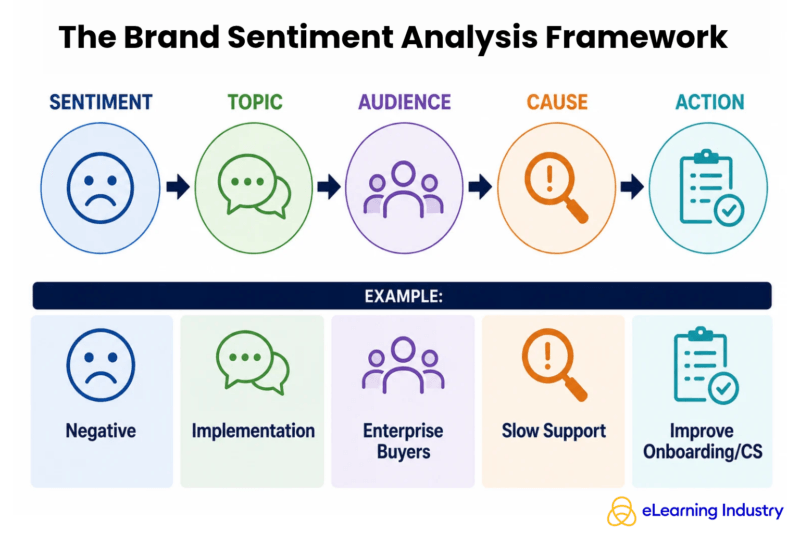
But counting positive and negative mentions is only the beginning. A useful brand sentiment program looks deeper into the conversations behind those numbers. It asks what customers and prospects feel, what topics are shaping those opinions, which audiences hold particular views, and why those perceptions exist.
That context can reveal problems that traditional marketing metrics miss. It can show that customers like the product but dislike implementation. It can reveal that awareness is growing while trust is falling. Or it might uncover a group of satisfied customers whose experiences could become stronger proof for future buyers.
For B2B companies, these insights can support customer experience, product development, positioning, sales, PR, reputation management, and leadership decisions.
And as buyers increasingly rely on reviews, industry platforms, search engines, communities, and AI assistants during their research, companies need a broader understanding of how they are represented outside their own channels.
The goal is not to control every conversation. It is to listen carefully, understand what is shaping perception, and act on the parts of the experience the business can improve.
When companies do that consistently, brand sentiment becomes more than another metric to report. It becomes a practical source of information about what customers value, where trust is being gained or lost, and what the market may need next.
FAQBrand sentiment is the overall attitude, emotion, or opinion people express toward a brand. It is usually classified as positive, neutral, or negative and can be measured across customer reviews, social media, surveys, media coverage, online communities, support conversations, and other sources.
For B2B companies, brand sentiment can help show how customers and prospects actually feel about the company, not just whether they are aware of it.
Brand sentiment focuses on how people currently feel about a brand, while brand perception is broader. Brand perception includes the qualities, ideas, and associations people connect with a company.
For example, buyers might perceive a brand as innovative, expensive, reliable, or difficult to use. Sentiment reflects whether those perceptions lead to positive, negative, or neutral feelings.
The two are closely connected, but they are not the same. Brand perception describes what people associate with the company, while brand sentiment helps show how they feel about those associations.
Companies can measure brand sentiment by collecting relevant mentions and customer feedback, then classifying them as positive, neutral, or negative.
Common sources include customer reviews, social media, surveys, support tickets, sales conversations, industry communities, media coverage, directories, and comparison content.
Beyond basic sentiment distribution, companies should also track changes over time, sentiment volume, sentiment by channel, sentiment by topic, and differences between customer segments. Manual review is also important because automated sentiment analysis can misinterpret sarcasm, context, technical language, and mixed opinions.
There is no universal brand sentiment score that every company should aim for. What counts as good depends on the industry, audience, source of the data, number of mentions, and how sentiment changes over time.
A positive net sentiment score can be encouraging, but the number should never be viewed on its own. A company with a high score based on 20 mentions may have less meaningful data than a company with a slightly lower score based on thousands of customer conversations.
Instead of focusing on one benchmark, companies should look at trends, recurring themes, competitor sentiment, and the issues driving positive or negative opinions.
The most effective way to improve negative brand sentiment is to address the reasons behind it. If customers repeatedly complain about implementation, support, pricing, usability, or product reliability, the company should focus on fixing those problems rather than simply trying to improve the sentiment score.
A useful process is to listen to feedback, identify recurring causes, respond where appropriate, make changes, communicate those changes, and continue measuring sentiment.
Companies should also avoid defensive responses, fake reviews, deleting legitimate criticism, or trying to drown out negative comments with promotional content. These tactics can damage trust further.
Reviews can have a strong influence on brand sentiment because they show prospective buyers how real customers describe their experiences. Positive reviews can strengthen trust, while repeated complaints can reinforce negative perceptions.
AI-generated results can also affect how people understand a brand. When users ask AI assistants about a company, product, or competitor, the answer may reflect information from reviews, directories, media coverage, comparison pages, forums, brand-owned content, and other online sources.
Companies cannot directly control how an AI system describes their brand. However, they can improve the quality, accuracy, and consistency of the information available online by maintaining current profiles, earning credible coverage, responding to customer concerns, publishing useful content, and encouraging authentic customer feedback.
