

Must-Attend Events For University Marketers
In the current scene, higher education marketing has become much more complex than it was just a few years ago. Universities are no longer competing only with neighboring institutions. Instead, they are competing for attention across search engines, social media, online learning platforms, and increasingly crowded digital channels. At the same time, prospective students expect personalized experiences, fast communication, and clear information throughout the enrollment process.
Artificial Intelligence is also changing how institutions recruit students, create content, analyze data, and automate marketing campaigns. Now, enrollment teams are under pressure to do more with limited budgets, while communications teams must protect their institution's reputation in a fast-moving media environment.
Specifically, in a landscape that changes this quickly, staying informed matters. Therefore, reading industry reports and following marketing blogs can help, but conferences offer something those resources cannot. They bring together university leaders, enrollment professionals, marketers, technology providers, and education innovators in one place. The conversations that happen between sessions often become just as valuable as the presentations themselves.
In this guide, we highlight the higher education marketing conferences that are most likely to deliver practical value in 2026. Rather than listing every event available, it focuses on conferences that help institutions improve enrollment, strengthen marketing performance, explore AI, and build meaningful professional relationships.
Higher education marketing conferences help enrollment teams, university marketers, communications professionals, and EdTech companies stay current with student recruitment strategies, digital marketing, AI adoption, CRM platforms, and higher education innovation. The best events combine practical learning, networking, technology demonstrations, and opportunities to collaborate with peers across the education sector.
Key Takeaways
If you're deciding which higher education conferences to attend in 2026, keep these points in mind:
- The best conferences combine enrollment, marketing, technology, leadership, and student experience.
- Different events serve different goals. Some focus on communications, while others emphasize digital transformation or educational technology.
- Universities benefit from attending both education-specific conferences and broader marketing events.
- EdTech companies, CRM providers, AI vendors, and marketing agencies often gain valuable partnerships by exhibiting or sponsoring education conferences.
- Your Return On Investment depends as much on preparation and follow-up as it does on the event itself.
In This Article…
- Why Higher Education Marketing Conferences Still Matter
- How We Selected These Conferences
- 15 Essential Higher Education Marketing Conferences To Attend In 2026
- Which Conferences Are Best For EdTech And LMS Vendors?
- How To Maximize Conference ROI
- Conferences As A Thought Leadership Opportunity
- Beyond The Stage: Podcasts, Webinars And Community
- Emerging Themes In Higher Education Marketing
- Choosing The Right Conference
- The Future Of Higher Education Marketing Events
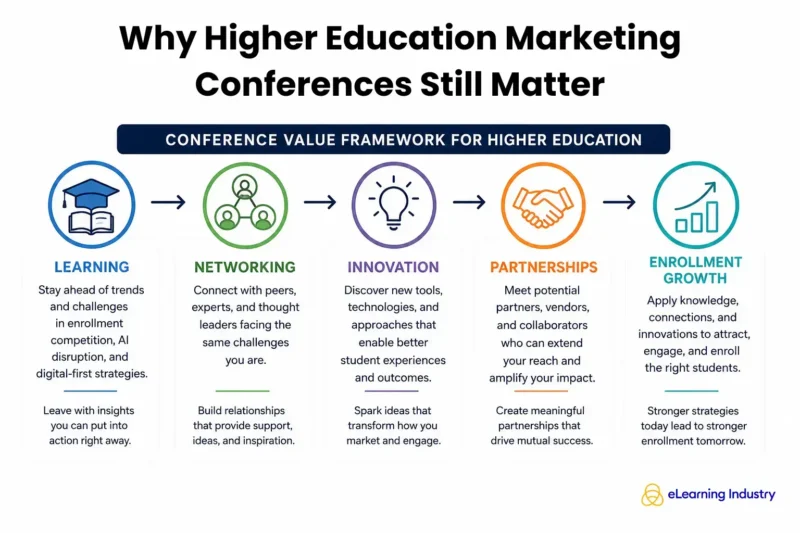
Why Higher Education Marketing Conferences Still Matter
It's easy to question whether conferences are worth the investment. Registration fees, travel costs, and time away from work can add up quickly. But for many institutions, the value extends well beyond the sessions listed on the agenda.
Specifically, higher education is changing rapidly, and marketers need opportunities to learn directly from peers solving similar problems.
Enrollment Competition Continues To Increase
Many institutions are seeing greater competition for prospective students. Demographic shifts, changing learner expectations, and the growth of online education mean that attracting applicants requires more sophisticated marketing than ever before.
Now, students compare institutions long before they submit an application. So, they evaluate websites, social media content, virtual tours, student reviews, rankings, and digital experiences.
Often, conferences allow enrollment marketers to see which recruitment strategies are producing measurable results across different institutions.
AI Is Reshaping University Marketing
We have all witnessed Artificial Intelligence moving from experimentation to everyday practice.
Nowadays, marketing teams are exploring AI for content creation, personalization, predictive analytics, chatbot development, campaign optimization, and student engagement. Universities are also trying to understand where AI should support human decision-making rather than replace it.
Moreover, many conferences now dedicate entire tracks to AI in higher education, offering practical examples instead of theoretical discussions.
The Student Journey Is Increasingly Digital
Today's prospective students expect seamless online experiences from their first interaction through enrollment.
This includes:
- Personalized email campaigns
- Mobile-friendly websites
- CRM-driven communications
- Virtual events
- Chatbots
- Self-service portals
- Automated follow-up
- Digital application experiences
Marketing conferences often showcase how institutions are improving each stage of this journey using new technologies and better data.
Networking Remains One Of The Biggest Benefits
It is true that the formal presentations are valuable, but many attendees say the real learning happens during informal conversations. Talking with professionals from other universities often leads to new ideas, practical advice, and long-term professional relationships. It's also an opportunity to compare challenges, discuss successful campaigns, and learn what hasn't worked.
Conferences Create Partnership Opportunities
Many higher education conferences attract more than universities. You'll often meet:
- CRM providers
- Student engagement platforms
- Learning management system vendors
- Marketing agencies
- AI startups
- Analytics companies
- Enrollment technology vendors
- Digital accessibility specialists
These conversations can help institutions evaluate technology before making major purchasing decisions.
Continuous Learning Matters More Than Ever
Marketing best practices change quickly while search engines evolve. In the meantime, social platforms introduce new features, student behavior shifts, and privacy regulations continue to develop. Therefore, attending conferences helps professionals stay informed without having to piece together information from dozens of different sources.
How We Selected These Conferences
We all know that there are hundreds of education conferences held every year all over the world. Some focus on academic leadership, while others specialize in technology, teaching, fundraising, communications, or policy.
Rather than creating another long list of events, this guide focuses on conferences that offer meaningful value for higher education marketers and enrollment professionals. Several factors influenced our selection.
Speaker Quality
Strong conferences consistently attract experienced practitioners rather than relying solely on motivational speakers.
The best sessions feature university leaders, marketing executives, enrollment specialists, researchers, and technology experts who share real case studies and measurable results. Practical experience matters more than theory.
Attendee Profile
Networking is one of the biggest reasons to attend a conference.
Events that attract senior decision-makers, enrollment leaders, communications teams, and digital marketing professionals create stronger opportunities for collaboration. The audience often determines the value of the event as much as the agenda.
Marketing Relevance
Not every education conference focuses on marketing. We prioritized events that regularly cover topics such as:
- Student recruitment
- Enrollment strategy
- Digital marketing
- Branding
- Content strategy
- Social media
- CRM implementation
- Analytics
- AI
- Marketing automation
These subjects have become central to institutional growth.
Higher Education Focus
Some broader marketing conferences are included later in this guide, but education-specific events remain the primary focus.
They address challenges unique to colleges and universities, including enrollment cycles, institutional branding, alumni engagement, accreditation, student communications, and campus technology.
Networking Opportunities
Some conferences are designed around community building rather than presentations alone. Roundtables, workshops, networking receptions, vendor showcases, and collaborative sessions often provide the most valuable experiences.
We looked for conferences that encourage interaction instead of simply delivering keynote speeches.
Innovation
Higher education is experiencing rapid technological change.
Conferences that highlight AI, data analytics, digital transformation, student experience, automation, and emerging educational technology earned higher consideration. These topics are likely to shape institutional strategy throughout 2026 and beyond.
Practical Value
Perhaps the most important factor is whether attendees leave with ideas they can actually implement. A conference should provide actionable insights, not just inspiration.
The strongest events help participants return to campus with new strategies, useful contacts, and practical solutions.
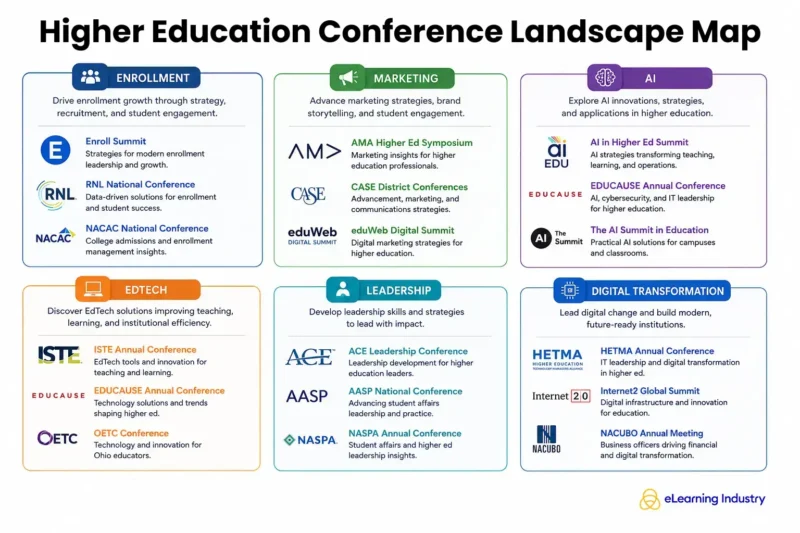
15 Essential Higher Education Marketing Conferences To Attend In 2026
1. AMA Symposium for the Marketing of Higher Education
The American Marketing Association's Symposium for the Marketing of Higher Education has long been one of the most respected events dedicated specifically to university marketing.
Unlike broader education conferences, this symposium focuses almost entirely on marketing strategy, enrollment growth, branding, communications, and student engagement. That narrow focus makes it especially valuable for professionals whose primary responsibility is attracting and retaining students.
Sessions often feature real examples from colleges and universities that have tested new marketing approaches, improved digital performance, or strengthened institutional branding.
Best for:
University marketing leaders, communications teams, enrollment marketers, digital strategists, and brand managers.
- Typical attendees
- Chief Marketing Officers
- Marketing Directors
- Enrollment professionals
- Communications leaders
- University presidents
- Creative teams
- Higher education consultants
- Key topics
- Enrollment marketing
- Brand strategy
- Content marketing
- Student recruitment
- Digital advertising
- AI applications
- CRM strategy
- Analytics
- Website optimization
Why attend:
If your role centers on marketing rather than general institutional leadership, few conferences offer the same level of relevance. Nearly every session connects directly to challenges universities face today.
2. CASE Annual Conference
The Council for Advancement and Support of Education (CASE) Annual Conference brings together professionals responsible for advancement, communications, alumni relations, fundraising, and institutional reputation.
Although CASE is widely known for advancement work, its sessions increasingly explore integrated communications and marketing strategies.
Many institutions are now aligning marketing, communications, advancement, and alumni engagement under shared leadership. CASE reflects that shift by encouraging collaboration across departments.
Best for:
Communications professionals, advancement teams, fundraising leaders, alumni relations, and institutional marketers.
- Typical attendees
- Communications Directors
- Advancement Officers
- Alumni Relations teams
- Marketing professionals
- University leadership
- Development offices
- Key topics
- Institutional storytelling
- Reputation management
- Fundraising communications
- Alumni engagement
- Brand strategy
- Crisis communications
- Content creation
- Community engagement
Why attend:
CASE is particularly valuable for universities seeking a more coordinated approach to communications, fundraising, and institutional branding.
3. EduWeb Summit
EduWeb Summit has built a strong reputation among digital marketers working in higher education.
The conference emphasizes practical digital marketing strategies rather than broad institutional policy discussions. Sessions frequently cover search engine optimization, paid advertising, social media, web accessibility, analytics, user experience, content strategy, and emerging digital tools.
Its relatively focused audience also creates excellent networking opportunities among professionals working on similar challenges.
Best for:
Digital marketing teams, web managers, enrollment marketers, communications specialists, and content strategists.
- Typical attendees
- Digital Marketing Managers
- Website teams
- SEO specialists
- Social media managers
- Enrollment marketers
- Communications professionals
- Web developers
- Key topics
- SEO
- Content strategy
- Accessibility
- Analytics
- Paid media
- Social media
- AI tools
- User experience
- Digital recruitment
Why attend:
For professionals responsible for improving a university's digital presence, EduWeb remains one of the most practical conferences available.
4. HighEdWeb Annual Conference
HighEdWeb focuses on the people responsible for building and managing universities' digital experiences. The conference blends marketing, technology, communications, accessibility, content management, analytics, and user experience into one program.
Unlike events that emphasize executive leadership, HighEdWeb provides practical sessions designed for professionals working directly on university websites, digital campaigns, and online communications.
Best for:
Web teams, digital communications, UX professionals, content creators, and technical marketers.
- Typical attendees
- Web Managers
- UX Designers
- Content Strategists
- Developers
- Accessibility specialists
- Digital marketers
- Communications professionals
- Key topics
- Website strategy
- Accessibility
- Content management
- User experience
- Analytics
- AI
- Search
- Digital communications
Why attend:
HighEdWeb offers practical advice that teams can implement immediately, making it especially useful for professionals responsible for managing institutional websites and digital services.
5. NAFSA Annual Conference & Expo
While NAFSA is primarily known for international education, its annual conference has become increasingly relevant for enrollment marketing teams focused on global recruitment.
International student mobility continues to evolve, and institutions need effective strategies for reaching students across different markets and digital channels.
NAFSA brings together universities, government agencies, recruitment organizations, technology providers, and international education experts from around the world.
Best for:
International recruitment teams, enrollment marketers, admissions professionals, and university leadership.
- Typical attendees
- International Admissions Directors
- Enrollment leaders
- Recruitment specialists
- University administrators
- Study abroad professionals
- EdTech vendors
- Key topics
- International recruitment
- Student mobility
- Global partnerships
- Admissions
- Digital engagement
- International communications
- Cross-border education
Why attend:
For institutions looking to expand their international recruitment efforts, NAFSA provides valuable market insights and networking opportunities that are difficult to find elsewhere.
6. ASU+GSV Summit
The ASU+GSV Summit has become one of the most influential gatherings at the intersection of education, technology, investment, and innovation. While it is not exclusively a marketing conference, it offers valuable insight into where higher education is heading and how institutions can adapt.
The audience is broader than many university-focused events. Alongside higher education leaders, you'll find entrepreneurs, investors, startup founders, policymakers, technology companies, and EdTech providers. That mix creates conversations that rarely happen at traditional academic conferences.
Marketing teams that want to understand future student expectations, new business models, and emerging technologies will find plenty to explore.
Best for:
University executives, innovation teams, digital transformation leaders, EdTech companies, marketing leaders, and strategic planners.
- Typical attendees
- University presidents
- Chief Innovation Officers
- CMOs
- EdTech founders
- Investors
- Technology vendors
- Government representatives
- Learning platform providers
- Key topics
- AI in education
- Digital transformation
- Student success
- Online learning
- Workforce development
- Education technology
- Innovation strategy
- Skills-based learning
Why attend:
If your institution is planning for the next five to ten years rather than the next enrollment cycle, ASU+GSV offers a valuable perspective. It helps marketing leaders understand where higher education is moving and which technologies are likely to influence recruitment, learning, and student engagement.
7. EDUCAUSE Annual Conference
EDUCAUSE is widely recognized as one of the leading conferences for higher education technology professionals. At first glance, it may seem geared toward CIOs and IT departments, but marketing and enrollment teams increasingly benefit from attending as well.
Marketing now relies on technology more than ever. CRM platforms, analytics, marketing automation, personalization, cybersecurity, accessibility, and AI all require close collaboration between marketing and IT. EDUCAUSE helps bridge that gap.
Best for:
Digital transformation leaders, marketing technology teams, IT professionals, enrollment operations, and university leadership.
- Typical attendees
- CIOs
- Digital transformation leaders
- CRM administrators
- Marketing operations teams
- Data analysts
- Technology vendors
- University executives
- Key topics
- Artificial Intelligence
- Data governance
- CRM
- Analytics
- Cybersecurity
- Student experience
- Cloud technology
- Digital strategy
Why attend:
If your marketing strategy depends on technology—and most do—EDUCAUSE helps you understand the infrastructure behind successful digital engagement.
8. UPCEA Annual Conference
UPCEA serves professionals working in online education, continuing education, professional learning, and workforce development.
As lifelong learning becomes a larger part of institutional strategy, many marketing teams now promote certificate programs, executive education, online degrees, and professional development alongside traditional undergraduate offerings. UPCEA focuses on these growing markets.
Best for:
Marketing teams promoting online programs, continuing education, graduate recruitment, and workforce partnerships.
- Typical attendees
- Continuing education leaders
- Online learning professionals
- Marketing Directors
- Enrollment teams
- Academic leaders
- Corporate partnership managers
- Key topics
- Adult learners
- Online education
- Workforce education
- Marketing strategy
- Enrollment growth
- Program development
- Lifelong learning
Why attend:
Institutions looking to diversify enrollment beyond traditional undergraduate students will find practical ideas and valuable networking opportunities.
9. SXSW EDU
SXSW EDU brings together educators, researchers, entrepreneurs, nonprofits, technology companies, and higher education leaders.
The conference has a different atmosphere from traditional academic events. Sessions often explore emerging ideas before they become mainstream.
For marketing teams, it offers exposure to changing learner expectations, new communication channels, and innovative approaches to education.
Best for:
Innovation leaders, university marketers, communications teams, student experience professionals, and EdTech companies.
- Typical attendees
- Educators
- Entrepreneurs
- University leaders
- Marketing professionals
- Startup founders
- Researchers
- Technology providers
- Key topics
- Innovation
- Student engagement
- AI
- Digital learning
- Community building
- Inclusion
- Emerging technology
Why attend:
SXSW EDU encourages creative thinking and cross-industry collaboration. It is particularly useful for institutions looking beyond traditional marketing approaches.
10. Learning Technologies Conference
As digital learning expands, universities increasingly rely on learning technology platforms to support teaching and student success.
The Learning Technologies Conference explores innovations in online learning, learning management systems, digital training, AI-assisted education, and educational software.
While much of the audience comes from corporate learning environments, higher education professionals can gain valuable insight into technologies that improve learning experiences.
Best for:
Learning technology teams, LMS administrators, instructional designers, EdTech vendors, and online education leaders.
- Typical attendees
- Learning designers
- LMS providers
- Educational technologists
- Product managers
- Digital learning specialists
- University technology teams
- Key topics
- Learning platforms
- AI-assisted learning
- LMS innovation
- Digital education
- Analytics
- Skills development
Why attend:
Marketing increasingly depends on the student experience after enrollment. Understanding how technology supports learning can strengthen recruitment messaging and retention strategies.
11. INBOUND
Although INBOUND is not a higher education conference, it has become one of the most valuable marketing events for professionals across many industries.
University marketers attend to learn about content marketing, SEO, customer journeys, AI, automation, sales alignment, and digital strategy. Many of these practices translate directly into student recruitment.
Best for:
Digital marketers, content teams, CRM specialists, enrollment marketers, and communications professionals.
- Typical attendees
- Marketing Directors
- Content strategists
- SEO specialists
- CRM professionals
- Agency leaders
- Technology companies
- Key topics
- Content marketing
- AI
- CRM
- Marketing automation
- SEO
- Social media
- Analytics
- Customer experience
Why attend:
INBOUND provides marketing ideas that extend well beyond higher education. Many institutions adapt these strategies for student recruitment and engagement.
12. Content Marketing World
Universities publish more content than almost any other type of organization. From research stories and alumni profiles to student testimonials and admissions resources, content plays a central role in recruitment and brand building.
Content Marketing World helps teams create stronger editorial strategies and improve content performance.
Best for:
Content strategists, communications teams, brand managers, and university storytellers.
- Key topics
- Editorial strategy
- SEO
- Storytelling
- Video
- AI-assisted content
- Analytics
- Audience engagement
Why attend:
Institutions looking to improve content quality and consistency will find practical sessions they can apply immediately.
13. Digital Summit
Digital Summit offers broad marketing education across SEO, analytics, advertising, social media, AI, UX, and digital strategy.
Unlike education-specific conferences, it exposes university marketers to ideas being used across healthcare, retail, finance, technology, and nonprofit organizations.
Best for:
Digital marketing professionals seeking broader industry knowledge.
- Key topics
- SEO
- Paid advertising
- AI
- Analytics
- User experience
- Email marketing
- Digital strategy
Why attend:
Looking outside higher education often sparks new ideas that can be adapted for university recruitment and communications.
14. Gartner Marketing Symposium/Xpo
Marketing leaders responsible for long-term planning often benefit from Gartner's research-driven approach.
Sessions explore technology trends, customer experience, AI, measurement, organizational strategy, and leadership.
Best for:
CMOs, marketing executives, and strategic planning teams.
- Key topics
- AI strategy
- Marketing leadership
- Customer experience
- Analytics
- Organizational change
- Technology adoption
Why attend:
This conference focuses less on day-to-day tactics and more on long-term marketing strategy.
15. Adobe Summit
Many universities already rely on Adobe Experience Cloud, Creative Cloud, or Adobe Analytics. Adobe Summit explores personalization, customer journeys, AI, data, and digital experiences.
While much of the audience comes from business sectors, the lessons apply equally to student recruitment and engagement.
Best for:
Digital experience teams, marketing operations, analytics professionals, and CRM leaders.
- Key topics
- Customer journeys
- Personalization
- Analytics
- AI
- Content management
- Digital experience platforms
Why attend:
Marketing teams interested in personalization and data-driven experiences will find practical examples from organizations across multiple industries.
Which Conferences Are Best For EdTech And LMS Vendors?
We know that most conference roundups focus only on universities. But education conferences also provide valuable opportunities for companies that serve higher education.
That includes:
- EdTech startups
- CRM providers
- Learning management system vendors
- AI companies
- Student engagement platforms
- Marketing automation providers
- Accessibility solution providers
- Analytics companies
- Digital agencies
For these organizations, conferences are about much more than exhibiting a product.
Meet Decision-Makers In One Place
In general, education conferences attract the people who influence purchasing decisions. Instead of scheduling dozens of individual meetings throughout the year, vendors can meet marketing leaders, enrollment directors, IT teams, communications professionals, and senior administrators during a single event. Eventually, that creates opportunities for more meaningful conversations.
Understand Real Institutional Challenges
The best product ideas often come from listening rather than presenting. Conference sessions, hallway discussions, and workshops reveal what universities are struggling with today. Vendors gain firsthand insight into issues such as declining enrollment, fragmented technology stacks, AI governance, accessibility requirements, and data integration. These conversations help shape better products and services.
Demonstrate Products In Context
Education buyers rarely purchase software after watching a generic sales demonstration. They want to see how a solution addresses higher education challenges specifically. Conferences provide opportunities to demonstrate real use cases, answer technical questions, and receive immediate feedback from prospective customers.
Build Strategic Partnerships
Not every valuable connection becomes a customer. Many become integration partners, implementation consultants, research collaborators, or referral sources. Partnerships often grow over time through repeated interactions at industry events.
Generate Qualified Leads
Compared with general technology conferences, education-focused events attract a more concentrated audience. Attendees often arrive with active projects, upcoming technology evaluations, or long-term digital transformation initiatives. That makes conversations more focused and relevant.
Education Conferences Are Different From General SaaS Events
General software conferences usually emphasize rapid growth, product launches, and sales acceleration. Higher education conferences tend to move at a different pace. Buying decisions often involve multiple stakeholders, committee reviews, procurement processes, and long planning cycles.
Success depends less on delivering the perfect pitch and more on building trust, demonstrating expertise, and understanding institutional priorities. Organizations that recognize this difference are more likely to develop lasting relationships with colleges and universities.
How To Maximize Conference ROI
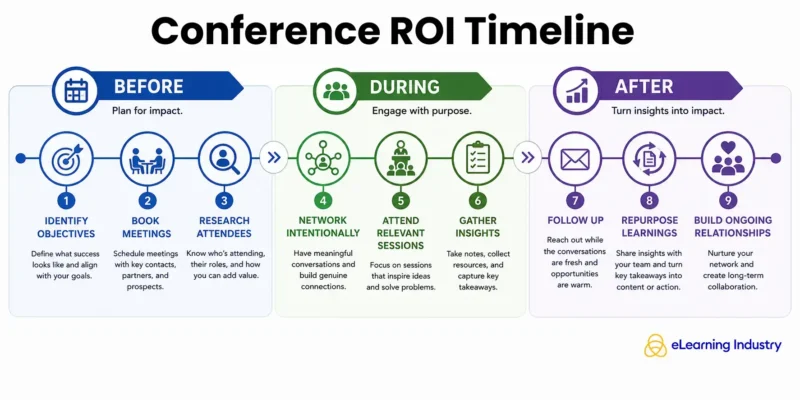
Simply attending a conference does not guarantee results. The value often comes from how well you prepare beforehand and how effectively you follow up afterward.
Before The Conference
Set clear objectives before you arrive. Ask yourself:
- Which challenges do we want to solve?
- Who do we want to meet?
- Which sessions are most relevant?
- Which vendors should we evaluate?
- Which institutions would we like to learn from?
Scheduling meetings in advance also helps make better use of your time.
During The Conference
Balance structured learning with networking.
Attend sessions that relate directly to your goals, but leave time for conversations between presentations. Some of the most valuable insights come from informal discussions with peers who have faced similar challenges.
Take notes with future action in mind. Instead of recording everything you hear, focus on ideas your institution could realistically apply.
After The Conference
The event should be the beginning of the conversation, not the end. Within a week:
- Follow up with new contacts.
- Share key takeaways with your team.
- Review vendor information.
- Identify ideas worth testing.
- Plan next steps while the experience is still fresh.
- Even one practical improvement can justify the investment.
Conferences As A Thought Leadership Opportunity
Yes, attending a conference is valuable, but speaking at one can have an even greater impact.
Presenting a session, joining a panel discussion, or leading a workshop gives you an opportunity to share your experience with peers while raising your institution's profile. It also helps build credibility with prospective students, partners, vendors, and other universities.
Therefore, thought leadership is no longer limited to publishing research papers or keynote speeches. Many conferences actively look for practical presentations that show how institutions solved real problems. A case study on improving enrollment, redesigning a university website, or implementing a CRM platform can be just as valuable as a session on emerging trends.
Especially for marketing professionals, speaking creates visibility that often lasts well beyond the event itself.
Share Practical Experience
Conference attendees usually appreciate presentations that focus on lessons learned rather than polished success stories.
A session that explains how your team increased inquiry conversions, improved email engagement, or streamlined content production often generates more discussion than one filled with high-level strategy.
Being transparent about challenges also makes your presentation more useful.
Participate In Panel Discussions
Not every speaking opportunity requires preparing a full presentation. Panel discussions allow participants to exchange ideas, answer audience questions, and offer different perspectives on common challenges.
These sessions are especially valuable for topics such as AI adoption, student recruitment, accessibility, and digital transformation, where there is rarely a single right answer.
Lead Workshops
Workshops provide a more interactive learning experience than traditional presentations. Instead of listening to a speaker for an hour, attendees work through practical exercises, discuss ideas with peers, and leave with something they can apply immediately.
For university marketers, workshops on content strategy, analytics, CRM optimization, or campaign planning often attract strong participation.
Publish Research And Case Studies
Many conferences encourage presenters to submit papers, reports, or supporting resources. Publishing research alongside your presentation helps extend its reach and gives attendees something they can revisit later.
Institutions can also repurpose this material for their own websites, newsletters, or knowledge centers.
Build Executive Visibility
Speaking regularly at respected conferences strengthens both personal and institutional reputation. Prospective partners begin to recognize your institution as a contributor to industry discussions rather than simply a participant. This visibility can support partnership opportunities, media requests, recruitment efforts, and future speaking invitations.
Speaking Creates Long-Term Value
One presentation rarely ends when attendees leave the room. It often leads to podcast invitations, webinar opportunities, LinkedIn discussions, collaborative research projects, and introductions to institutions facing similar challenges.
In many cases, these ongoing conversations become more valuable than the conference itself.
Beyond The Stage: Podcasts, Webinars, And Community
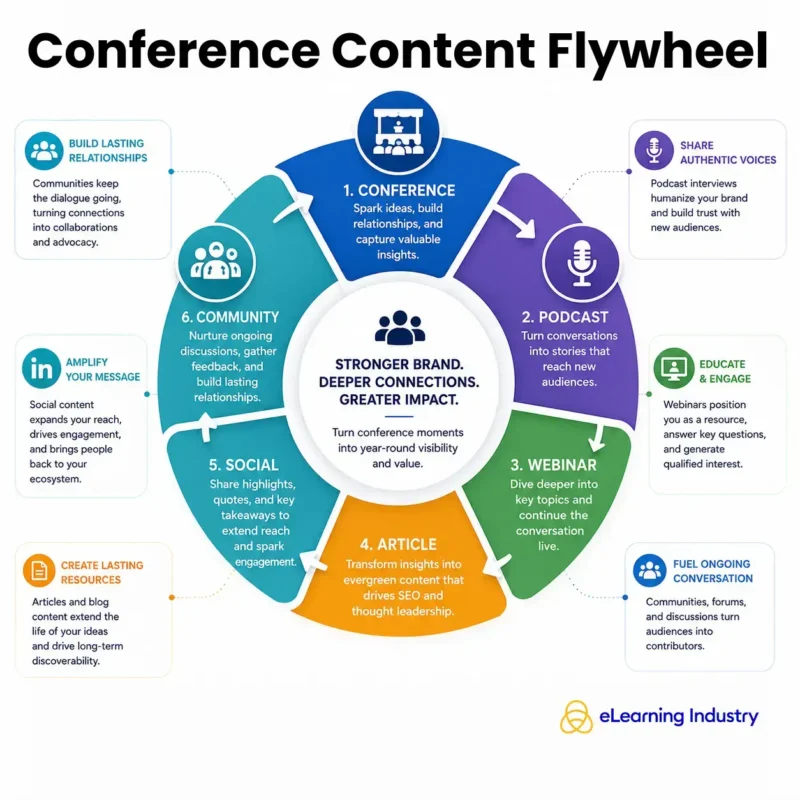
A conference lasts only a few days, but the ideas shared there can continue to generate value throughout the year.
Many institutions now treat conferences as the starting point for a broader content strategy. Rather than allowing presentations to disappear after the event, they repurpose insights into formats that reach wider audiences. This approach helps extend the return on investment while reinforcing institutional expertise.
Turn Presentations Into Podcast Conversations
Podcast guest interviews allow speakers to expand on ideas they introduced during conference sessions.
Instead of condensing a topic into a forty-minute presentation, podcasts create space for deeper conversations, practical examples, and follow-up questions.
They also reach professionals who could not attend the conference.
Host Webinars After The Event
A webinar can build on a conference presentation by exploring implementation in greater detail.
For example, a university that presented a successful enrollment campaign might later host a webinar explaining how the campaign was planned, measured, and improved over time. This provides additional value while keeping the conversation going.
Publish Articles And Guides
Conference presentations often contain enough material for several written resources.
Organizations can transform session content into:
- Blog articles
- Research summaries
- White papers
- Practical guides
- Case studies
- Industry reports
These resources help reinforce expertise while improving search visibility.
Share Insights On LinkedIn
Conference takeaways often generate meaningful discussion on LinkedIn.
Rather than posting generic photos from the event, professionals can summarize key lessons, highlight emerging trends, or comment on presentations that challenged their thinking. These posts frequently encourage conversations with colleagues who attended the same sessions.
Build Community Throughout The Year
Many conferences now support online communities where attendees continue exchanging ideas long after the event ends. Maintaining these relationships creates opportunities to ask questions, share resources, collaborate on research, and identify future speaking opportunities.
The strongest professional networks develop gradually through ongoing interaction rather than a single conference meeting.
Emerging Themes In Higher Education Marketing
The topics dominating conference agendas in education marketing have changed significantly over the past few years. Traditional discussions around branding and communications remain important, but institutions are now exploring a much broader range of challenges.
These themes are likely to appear across many higher education conferences in 2026.
AI In Student Recruitment
Artificial Intelligence is becoming part of everyday marketing operations.
Institutions are experimenting with AI to support:
- Content creation
- Chatbots
- Campaign optimization
- Predictive enrollment models
- Audience segmentation
- Data analysis
Most universities are still determining where AI delivers meaningful value and where human oversight remains essential.
Conference sessions increasingly focus on practical implementation rather than speculation.
Personalization At Scale
Prospective students expect communications that reflect their interests, academic goals, and stage in the enrollment journey. Personalization now extends beyond inserting a student's name into an email.
Institutions are building more tailored experiences across websites, advertising, email campaigns, events, and application support.
CRM Optimization
Many universities already have customer relationship management platforms in place. The challenge is no longer choosing a CRM. It is learning how to use it effectively.
Conference sessions often explore workflow automation, data quality, reporting, campaign management, and cross-department collaboration.
Marketing Automation
Automation continues to expand beyond email marketing. Institutions are automating inquiry management, event reminders, application follow-up, content distribution, and reporting.
The goal is not simply to reduce manual work but to provide more consistent communication throughout the student journey.
Student Experience
Marketing no longer ends when a student submits an application. Student experience influences retention, institutional reputation, alumni engagement, and future recruitment.
As a result, marketing teams increasingly collaborate with student services, academic departments, and technology teams to improve the entire student lifecycle.
Lifelong Learning
Universities are serving more diverse audiences than ever before. Graduate education, executive programs, professional certificates, online learning, and workforce development continue to grow.
Marketing strategies must adapt to learners with different motivations, schedules, and career goals.
Skills-Based Education
Employers increasingly value practical skills alongside traditional degrees. Institutions are responding with microcredentials, certificates, flexible learning pathways, and industry partnerships.
Marketing teams play an important role in communicating these opportunities to prospective learners.
Online And Hybrid Learning
Digital education continues to evolve. Rather than treating online learning as a separate offering, many universities now integrate flexible learning options across multiple programs.
Marketing messages increasingly focus on accessibility, flexibility, and student support alongside academic quality.
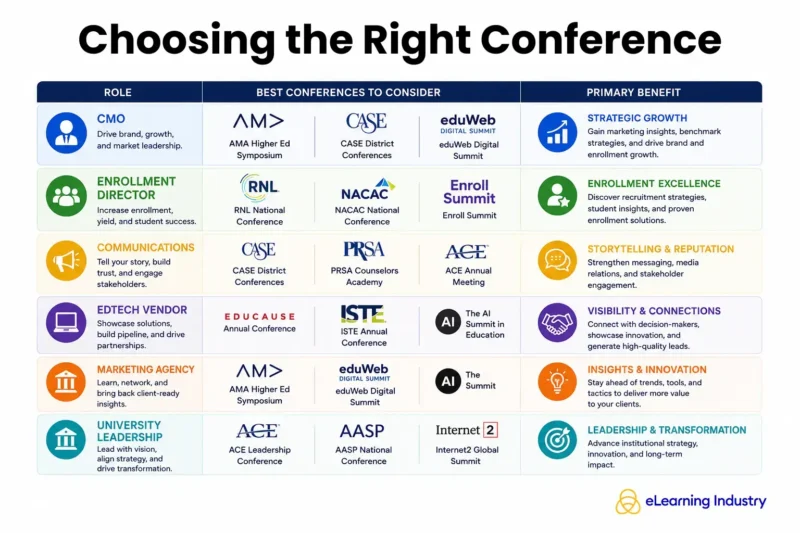
Choosing The Right Conference
The best conference depends on your role, your goals, and the challenges your institution is trying to solve. A communications director may benefit from different events than an enrollment manager or an EdTech founder.
The recommendations below can help narrow your options.
Chief Marketing Officer
Recommended conferences
- AMA Symposium for the Marketing of Higher Education
- CASE Annual Conference
- Gartner Marketing Symposium/Xpo
- INBOUND
Primary benefit: Strategic marketing leadership, branding, organizational planning, and long-term growth.
Enrollment Director
Recommended conferences:
- AMA Symposium
- EduWeb Summit
- NAFSA Annual Conference
- UPCEA Annual Conference
Primary benefit: Student recruitment, enrollment strategy, CRM optimization, and admissions marketing.
University Communications Leader
Recommended conferences
- CASE Annual Conference
- HighEdWeb
- Content Marketing World
Primary benefit: Institutional storytelling, reputation management, digital communications, and content strategy.
EdTech Or LMS Vendor
Recommended conferences
- ASU+GSV Summit
- EDUCAUSE
- NAFSA
- HighEdWeb
- SXSW EDU
Primary benefit: Partnership development, product demonstrations, buyer insights, and lead generation.
Marketing Agency Serving Universities
Recommended conferences
- AMA Symposium
- EduWeb Summit
- INBOUND
- Digital Summit
Primary benefit: Industry knowledge, networking, client acquisition, and marketing innovation.
University Leadership
Recommended conferences
- ASU+GSV Summit
- EDUCAUSE
- CASE Annual Conference
- SXSW EDU
Primary benefit: Strategic planning, institutional innovation, technology adoption, and executive networking.
The Future Of Higher Education Marketing Events
Conferences continue to evolve alongside higher education itself.
While in-person events remain valuable, organizers are introducing new formats that make learning and networking more flexible.
Several trends are likely to shape higher education marketing conferences in the coming years.
- Hybrid participation. Many events now combine in-person sessions with virtual access. This allows institutions with limited travel budgets to participate while expanding the conference's global reach.
- AI-powered networking. Artificial Intelligence is beginning to improve networking experiences by recommending relevant sessions, exhibitors, and attendees based on individual interests and professional goals. These tools cannot replace face-to-face conversations, but they can make introductions more targeted.
- Executive roundtables. Smaller discussion groups are becoming more common. Rather than listening to presentations all day, senior leaders increasingly value opportunities to exchange ideas with peers in closed, facilitated discussions.
- Smaller, focused events. Alongside large annual conferences, many organizations are hosting regional meetings, workshops, and specialized events focused on subjects such as AI, enrollment analytics, digital accessibility, or CRM strategy. These smaller gatherings often provide more opportunities for meaningful discussion.
- Creator-led learning. Industry experts, consultants, researchers, and practitioners are producing independent workshops, masterclasses, podcasts, and live events throughout the year. These complement traditional conferences by providing ongoing education between annual gatherings.
- Stronger collaboration between universities and technology companies. The relationship between institutions and technology vendors continues to mature. Rather than viewing vendors solely as software providers, many universities now involve them in strategic planning, research initiatives, pilot programs, and innovation projects. Future conferences are likely to create more opportunities for collaborative problem-solving rather than traditional sales interactions.
Conclusion
Higher education marketing conferences offer far more than keynote presentations and networking receptions. They provide opportunities to learn from institutions facing similar challenges, explore new technologies, evaluate potential partners, and discover practical strategies that can improve marketing performance.
The most valuable conferences are those that align with your goals. An enrollment team looking to strengthen student recruitment may prioritize events such as the AMA Symposium or EduWeb Summit, while a university exploring digital transformation may benefit more from EDUCAUSE or ASU+GSV. Communications professionals, EdTech companies, and marketing agencies each have different priorities, and the right conference should reflect those needs.
It's also worth remembering that the conference itself is only part of the experience. Preparing before you attend, building genuine relationships during the event, and following up afterward often determine whether the investment delivers lasting value. The conversations you have, the partnerships you develop, and the ideas you put into practice are what make these events worthwhile.
As higher education continues to adapt to changing student expectations, Artificial Intelligence, evolving technology, and new models of learning, conferences remain one of the best ways to stay informed and connected. Whether you're responsible for enrollment, communications, digital marketing, institutional leadership, or educational technology, choosing the right events in 2026 can help your organization make better decisions, build stronger partnerships, and prepare for the opportunities ahead.
FAQSome of the best higher education marketing conferences in 2026 include the AMA Symposium for the Marketing of Higher Education, CASE Annual Conference, EduWeb Summit, HighEdWeb Annual Conference, EDUCAUSE Annual Conference, ASU+GSV Summit, SXSW EDU, UPCEA Annual Conference, and NAFSA Annual Conference & Expo. Broader marketing events such as INBOUND, Content Marketing World, Adobe Summit, and Digital Summit are also valuable for university marketers looking to learn new digital marketing strategies and emerging technologies.
University marketing teams should prioritize conferences that focus on enrollment marketing, branding, digital communications, and student engagement. The AMA Symposium, EduWeb Summit, HighEdWeb, and CASE Annual Conference are among the strongest choices because they cover topics such as content strategy, SEO, CRM, analytics, social media, AI, and higher education communications. Teams responsible for digital transformation may also benefit from attending EDUCAUSE or ASU+GSV.
Yes, higher education conferences can provide significant value when they align with your institution's goals. They offer opportunities to learn from peer institutions, discover new marketing strategies, evaluate technology solutions, and build relationships with industry professionals. The greatest return often comes from applying the ideas you learn and maintaining the connections you make after the event.
EdTech companies, LMS vendors, CRM providers, and AI solution providers should consider events such as ASU+GSV Summit, EDUCAUSE Annual Conference, NAFSA Annual Conference, HighEdWeb, and SXSW EDU. These conferences attract university leaders, enrollment professionals, IT teams, and decision-makers who are actively exploring new technologies and strategic partnerships.
Conferences expose enrollment and marketing teams to proven recruitment strategies, successful case studies, and emerging technologies that support student engagement. Attendees can learn about personalization, AI, marketing automation, CRM optimization, content marketing, and digital advertising while gaining insights from institutions facing similar enrollment challenges. These ideas can often be adapted to improve recruitment campaigns and the overall student journey.
Universities can maximize conference ROI by preparing before the event, engaging actively during the conference, and following up afterward. Setting clear objectives, scheduling meetings in advance, attending relevant sessions, and networking with peers and vendors all contribute to a more productive experience. After returning to campus, teams should share key takeaways, evaluate potential partnerships, implement practical ideas, and maintain relationships with new contacts to extend the value of their investment.
