
How To Develop A 360 Inbound Marketing Plan To Scale Your Business
In the past, outbound marketing dominated B2B growth strategies. This means companies relied heavily on cold outreach, paid ads, trade shows, and aggressive sales tactics to generate a pipeline. While those channels still have value, they are becoming more expensive, more crowded, and less effective. Plus, buyers have changed.
Today's decision-makers research solutions long before they talk to sales. Whether you sell SaaS, LMS platforms, HR technology, or enterprise services, your prospects are already comparing vendors, reading reviews, consuming content, listening to podcasts, attending webinars, and searching for answers online.
If your company is invisible during that research phase, you lose opportunities before conversations even begin.
That's why inbound marketing matters more than ever.
A modern inbound strategy is not just about publishing blog posts and hoping for traffic. The companies generating a consistent pipeline today are building integrated, full-funnel systems that attract the right audience, nurture trust, convert interest into demand, and expand customer value over time.
In other words, they are building a 360 inbound marketing plan.
Here, you will learn how to build a full-funnel inbound marketing strategy, increase visibility across search engines and AI-driven discovery, create content that drives engagement and leads, develop nurturing systems that generate pipeline, align inbound marketing with revenue growth, and scale inbound into a long-term growth engine.
A 360 inbound marketing plan combines content, SEO, lead generation, and nurturing strategies to attract, engage, and convert high-intent buyers across the full funnel.
Key Takeaways
- Inbound marketing attracts buyers before sales conversations begin.
- A 360 strategy integrates SEO, content, webinars, email, podcasts, and thought leadership.
- Full-funnel alignment is critical for generating pipeline and revenue.
- Distribution matters as much as content creation.
- Companies that combine inbound strategy with high-intent visibility platforms accelerate growth faster.
In This Article…
- What 360 Inbound Marketing Really Means
- The 360 Inbound Marketing Framework
- Stage 1: Attract The Right Audience
- Stage 2: Engage With High-Value Content
- Stage 3: Convert Visitors Into Leads
- Stage 4: Nurture Leads Into Pipeline
- Stage 5: Expand And Scale
- The Role Of Distribution In Inbound Marketing
- Why High-Intent Platforms Amplify Inbound Results
- Common Inbound Marketing Mistakes
- How To Measure Inbound Marketing Success
What 360 Inbound Marketing Really Means
Many companies misunderstand inbound marketing. Some think inbound means blogging. Others think it means SEO. Some reduce it to lead magnets or email automation. These are aspects of inbound marketing, but they are not the entire system.
A true 360 inbound marketing plan is a connected growth framework designed to move buyers from awareness to revenue.
It includes: attraction via visibility and discovery, engagement through valuable content and experiences, conversion via lead capture systems, nurturing through personalized communication, and expansion through retention, upselling, and advocacy.
That distinction matters.
Too many marketing teams operate in silos. SEO works separately from content. Webinars are disconnected from sales follow-up. Email nurturing lacks personalization. Social media becomes reactive instead of strategic.
The result is fragmented buyer experiences and inconsistent pipeline generation.
A 360 inbound marketing strategy addresses this problem by harmonizing all channels and assets with the customer journey.
Inbound replaces disjointed tactics with a scalable revenue engine.
This approach is particularly critical in B2B SaaS, LMS, and HR tech industries, where the buying cycle is extended, and trust is a significant factor in decision-making.
Always remember that your prospects are not quick buyers. On the contrary, they are exploring features, integrations, pricing, customer success stories, vendor reputation, industry expertise, and ROI potential before they make decisions.
Inbound marketing ensures your brand is present during each stage of that evaluation process.
Do not forget that the companies winning today are not necessarily the loudest. They are the most discoverable, trusted, and consistently visible. That only happens when inbound is treated as a system, not a tactic.
The 360 Inbound Marketing Framework
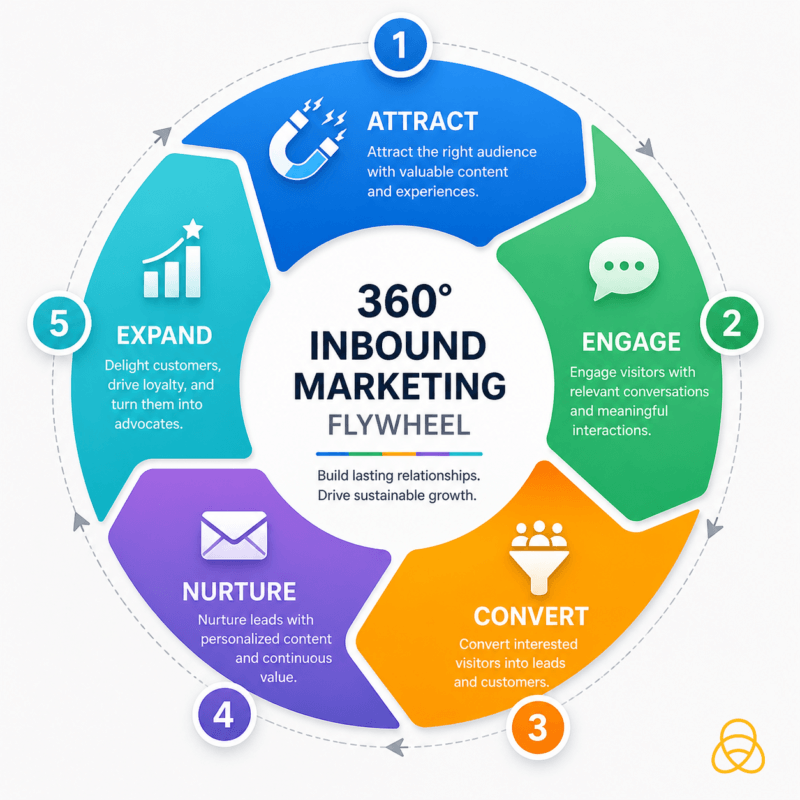
At its core, a 360 inbound marketing plan follows five interconnected stages:
- Attract
- Engage
- Convert
- Nurture
- Expand
Each stage supports the next one. The key here is to remember the following:
- Traffic alone is not enough.
- Engagement without conversion is incomplete.
- Lead capture without nurturing creates leakage.
- Customer acquisition without expansion limits revenue growth.
The strongest inbound strategies create momentum across the entire customer lifecycle.
The Five Core Stages
- Attract: The stage where you generate awareness and visibility among your target audience.
- Engage: Here, you build trust through educational and high-value content.
- Convert: After the trust engage stage, you turn visitors into leads through strategic offers and experiences.
- Nurture: Now, you guide prospects through the buying journey until they are sales-ready.
- Expand: At the end, you increase customer lifetime value through retention, advocacy, and upselling.
Stage 1: Attract The Right Audience
The first stage of inbound marketing is about visibility. If buyers cannot find you, they cannot engage with you.
The challenge today is that digital competition is intense. Nearly every company publishes content. Thousands of articles are produced daily across SaaS, HR Tech, and LMS industries.
That means visibility requires strategy.
SEO And Organic Search
Search remains one of the most powerful inbound acquisition channels because it captures existing intent. People search because they already have questions, problems, or buying interest.
A strong inbound full-funnel marketing strategy begins with keyword targeting aligned to the customer journey. For example:
- Top-of-funnel keywords
- What is employee onboarding software?
- Best LMS for remote training
- How to improve employee engagement
- Mid-funnel keywords
- LMS comparison guide
- HR automation platform reviews
- Best onboarding tools for enterprises
- Bottom-funnel keywords
- LMS pricing comparison
- SaaS onboarding software demo
- HR platform implementation services
The goal is not simply ranking for traffic. The goal is to attract qualified traffic with business intent. Many companies chase vanity metrics and publish broad content that generates visits but no pipeline. A 360 inbound marketing plan prioritizes relevance over volume.
Optimizing For AI Overviews And AI Search
In the fast-paced environment of SEO, search behavior is evolving rapidly as well. AI-generated search summaries, conversational search experiences, and recommendation engines are changing how buyers discover information.
For your business, that means inbound marketers need to optimize content not just for traditional search rankings, but also for AI discoverability.
If you want to improve visibility in AI-driven environments, you should answer questions clearly and directly, structure content with strong headings, use concise definitions and summaries, build topical authority through clusters, include data and expert insights, and publish genuinely useful content instead of generic SEO filler.
In general, companies that adapt early to AI search visibility will gain a significant competitive advantage.
Content Marketing
Content is the fuel behind inbound marketing. However, not all content performs equally.
High-performing B2B inbound content typically includes educational articles, research reports, industry trend analysis, buyer guides, templates, comparison pages, and strategic insights.
The best content solves problems. It also helps buyers make decisions and reduces uncertainty. But most importantly, it builds trust before sales conversations begin.
Thought Leadership
As a rule, trust is increasingly tied to expertise.
Buyers want to learn from credible voices, not faceless brands. That is why thought leadership has become essential in modern inbound marketing.
Executives, founders, marketers, and product leaders should actively share:
- Industry perspectives
- Lessons learned
- Market trends
- Predictions
- Contrarian insights
- Operational expertise
Thought leadership strengthens brand positioning while increasing visibility across multiple channels.
The goal at this stage is simple: be visible before buyers begin evaluating vendors.
If your brand enters the conversation early, you shape perception long before competitors appear.
Stage 2: Engage With High-Value Content
It is a fact that visibility gets attention. In the meantime, engagement builds trust.
This stage is where inbound marketing becomes more than content production.
Do not forget that your audience needs reasons to spend time with your brand. That means creating experiences that educate, inform, and demonstrate expertise.
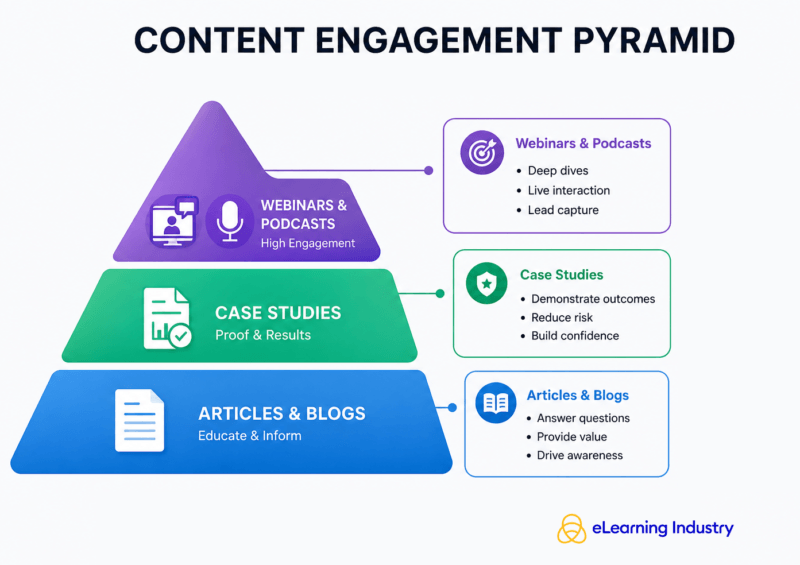
Webinars: High-Engagement Inbound Assets
Webinars remain one of the strongest engagement tools in B2B marketing. Why? Because they combine education, live interaction, authority, and lead capture in a single format.
Strong webinar topics often cover industry trends, product walkthroughs, tactical frameworks, customer success stories, research findings, and expert panels.
Webinars are also good at creating reusable content. That means one webinar can easily be repurposed into blog articles, LinkedIn clips, email campaigns, podcast episodes, sales enablement assets, and social content.
Eventually, this extends the value of every event while improving content efficiency.
Podcasts: Authority And Reach
In the current state of the market, podcasts are on the rise. Their advantage is that they create familiarity and credibility.
Today, modern buyers often spend significant time listening to industry discussions during commutes, workouts, or work sessions.
For B2B brands, podcasts offer multiple benefits. They:
- Build authority
- Reach niche audiences
- Expand executive visibility
- Create partnerships
- Generate distribution opportunities
You do not necessarily need a massive audience to succeed. Even niche podcasts can influence high-value buyers if the content is relevant and insightful.
Companies can either:
- Launch their own podcast
- Appear as guests on existing shows
- Sponsor industry podcasts
The key here is consistency and relevance.
Case Studies: Turning Proof Into Influence
Buyers tend to trust other buyers more than you. This is where case studies come in to help by reducing perceived risk. They show real outcomes, measurable results, and implementation success.
Strong case studies focus on:
- The customer problem
- The solution implemented
- Measurable outcomes
- Time-to-value
- Lessons learned
In this scenario, specificity matters. While "improved efficiency" sounds vague, "reduced onboarding time by 42% in six months" creates credibility.
Overall, buyers want proof that your solution works in real-world environments. That proof becomes a major driver of conversions.
Stage 3: Convert Visitors Into Leads
Now that you have attracted the right audience and increased their engagement, you need to jump into conversion.
Remember that this is where many inbound strategies fail. Most companies generate traffic but do little to capture demand. Without conversion systems, inbound becomes expensive brand awareness instead of measurable growth.
Lead Magnets
Lead magnets provide value in exchange for contact information. Common lead magnets include templates, guides, benchmark reports, toolkits, research studies, checklists, and ROI calculators.
However, the best lead magnets solve immediate problems. In short, they should feel practical and actionable.
For example, a generic marketing eBook may underperform. But a resource titled "15 SaaS Webinar Campaign Templates That Increased Demo Bookings" is much more compelling.
Specificity improves conversions.
Landing Pages
Every inbound campaign should direct users toward focused landing pages.
A strong landing page typically includes a clear headline, simple messaging, benefit-focused copy, social proof, a strong CTA, and minimal distractions.
Many landing pages fail because they overload visitors with too much information, when clarity usually outperforms complexity.
Visitors should immediately understand:
- What is being offered
- Why it matters
- What action to take next
- Forms and pop-ups
Forms are critical conversion points. However, long forms create friction.
Modern inbound strategies balance data collection with user experience. Some best practices include:
- Asking only for essential information
- Using progressive profiling over time
- Testing form length
- Optimizing mobile experiences
- Timing pop-ups strategically
The objective is simple: reduce barriers while maintaining lead quality.
Conversion Is Where ROI Begins
Yes, traffic is valuable. But traffic alone does not generate revenue.
Conversions create opportunities. That is why high-performing inbound marketers obsess over:
- Conversion rates
- CTA performance
- User experience
- Offer relevance
- Funnel friction
Even small improvements in conversion rates can significantly impact pipeline growth.
A 2% increase in conversion across high-volume traffic sources can translate into substantial revenue gains over time. In short, traffic without conversion is wasted effort.
Stage 4: Nurture Leads Into Pipeline
This is where most inbound marketing strategies break down.
While many companies successfully generate leads, they fail to nurture them effectively.
The reality is that most B2B buyers are not ready to purchase immediately. Especially in SaaS, LMS, and HR technology sectors, buying cycles can take weeks or months.
That means nurturing is essential.
Email Marketing And Automation
Email remains one of the highest-performing nurturing channels because it allows direct, personalized communication. Strong nurturing sequences guide prospects through the buying journey gradually.
Examples include:
- Educational sequences
- Product education campaigns
- Customer success examples
- Industry insights
- Webinar follow-ups
- Trial onboarding sequences
Here, segmentation matters a lot.
A CTO evaluating integrations has different concerns than an HR Director evaluating usability. That is why personalized communication improves engagement and accelerates decision-making.
Content Nurturing
Nurturing should not feel like constant selling. Instead, it should feel helpful. That means aligning content to buyer intent.
Here are some examples:
- Early-stage leads
- Educational articles
- Industry trends
- Introductory webinars
- Mid-stage leads
- Comparison guides
- Case studies
- Product walkthroughs
- Bottom-funnel leads
- ROI analysis
- Customer references
- Implementation details
- Pricing conversations
The more relevant your nurturing becomes, the stronger your conversion rates will be.
Retargeting Campaigns
Not every visitor converts immediately. Some need retargeting to keep your brand visible after prospects leave your website.
Effective retargeting campaigns often promote:
- Webinars
- Case studies
- Product demos
- Research reports
- Customer stories
The goal here is re-engagement.
Many buyers need multiple interactions before taking action. That is why retargeting increases the likelihood of returning visitors and continued engagement.
Why Nurturing Drives Revenue
Nurturing is where marketing and sales alignment becomes critical. Marketing creates momentum while sales closes opportunities. Without nurturing, prospects lose interest, forget priorities, or choose competitors. Therefore, nurturing keeps conversations active. It transforms interest into intent and intent into pipeline.
That is why mature inbound marketing programs focus heavily on lifecycle marketing, automation, and personalized buyer journeys.
Stage 5: Expand And Scale
Inbound marketing should not stop at customer acquisition.
The most successful companies use inbound principles to increase customer lifetime value and turn customers into growth drivers.
Upselling And Cross-Selling
Existing customers are often your highest-converting audience because they already trust your company. That makes expansion significantly more efficient than acquiring entirely new customers.
Examples of expansion opportunities include premium feature adoption, additional licenses, advanced training programs, enterprise upgrades, and new product modules.
Expansion campaigns should focus on customer outcomes. In the meantime, customers buy more when they see additional value.
Customer Retention
Retention is a growth strategy. Reducing churn improves profitability, forecasting stability, and long-term revenue performance. Here, inbound content can support retention through:
- Customer education
- Product training
- Success webinars
- Community resources
- Help centers
- Strategic updates
The more successful customers become, the longer they stay.
Community And Advocacy
One of the most overlooked growth channels in B2B marketing is customer advocacy.
Happy customers create:
- Referrals
- Testimonials
- Reviews
- Case studies
- Word-of-mouth visibility
Community-driven growth compounds over time.
This is particularly important in LMS and HR Tech markets where peer recommendations strongly influence purchasing decisions.
Strong inbound marketing creates customers. Exceptional inbound marketing creates advocates and advocates accelerate growth faster than advertising alone.
The Role Of Distribution In Inbound Marketing
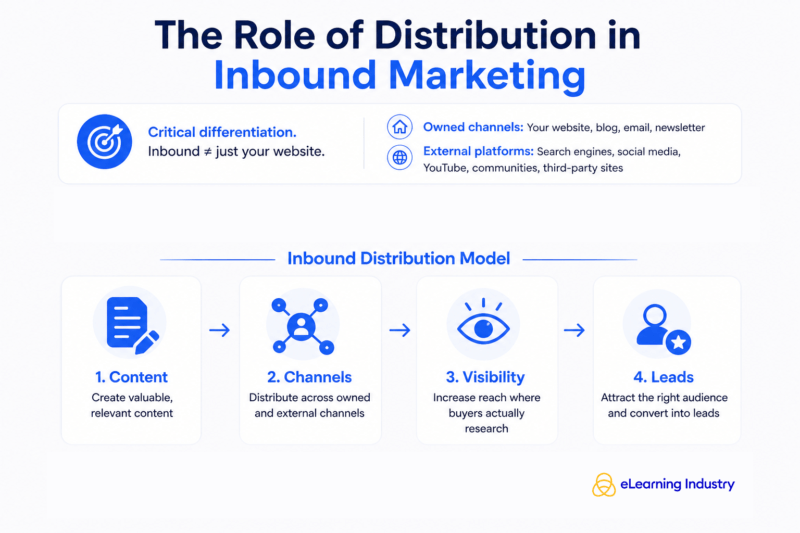
Here is one of the biggest misconceptions in modern marketing. Inbound does not mean waiting for people to find your website. It is distribution that determines whether your inbound strategy succeeds or fails.
Even outstanding content underperforms without visibility.
Owned Channels Vs. External Platforms
Owned channels include:
- Your website
- Your email list
- Your webinar platform
- Your social channels
These are highly important. However, buyers do not spend all their time on your properties. They research across LinkedIn, industry newsletters, podcasts, search engines, review platforms, online communities, and industry publications. That means inbound marketers need external distribution strategies.
Multi-Channel Distribution
Every major content asset should be distributed across multiple formats and channels. For example, a single research report can become:
- Blog articles
- LinkedIn posts
- Webinar discussions
- Podcast topics
- Email campaigns
- Sales collateral
- Short-form videos
This multiplies reach while increasing efficiency.
The companies winning with inbound today are not necessarily producing more content but distributing content more effectively.
Why High-Intent Platforms Amplify Inbound Results
Inbound marketing works best when your brand appears where buyers are already researching.
Intent matters. A random social media impression is not the same as visibility in a high-intent research environment.
That is why high-performing inbound strategies increasingly combine:
- Organic content
- Search visibility
- Review ecosystems
- Industry platforms
- Educational hubs
- Demand-generation channels
These environments accelerate trust because buyers are already in evaluation mode.
Why High-Intent Visibility Improves Conversion
When buyers actively research solutions, they are more likely to:
- Engage with educational content
- Attend webinars
- Download reports
- Request demos
- Compare vendors
This shortens the path from awareness to pipeline.
Instead of forcing demand creation, you align your inbound strategy with existing buying intent, which improves:
- Lead quality
- Conversion rates
- Sales efficiency
- Customer acquisition costs
The Future Of Inbound Is Integrated
Modern inbound marketing is no longer isolated from broader demand generation.
The strongest growth strategies combine:
- SEO
- Content marketing
- Thought leadership
- Paid amplification
- Community engagement
- High-intent discovery channels
- Marketing automation
- Revenue operations alignment
Inbound marketing works faster and more effectively when every channel reinforces the same buyer journey.
Common Inbound Marketing Mistakes
Even experienced marketing teams make mistakes that limit inbound performance.
Here are some of the most common issues:
- Focusing only on traffic
- Traffic is not revenue.
Large visitor numbers mean little if:
- Leads are low quality
- Conversion rates are weak
- Pipeline contribution is minimal
The goal is qualified demand, not vanity metrics.
Ignoring Lead Nurturing
Generating leads without a lead nurturing strategy wastes acquisition investment.
Most buyers require multiple touchpoints before converting. Without nurturing systems, leads go cold.
Inconsistent Content Production
Inbound marketing compounds over time, but inconsistency destroys momentum.
Companies often publish aggressively for a few months and then stop.
Sustainable publishing schedules outperform short bursts of activity.
Weak Distribution
Publishing content is not enough. Distribution of it is what drives visibility.
Without amplification, even strong content struggles to perform.
Poor Measurement
Many teams track surface-level metrics but fail to measure revenue impact.
Inbound marketing should connect directly to:
- Pipeline generation
- Opportunity creation
- Customer acquisition
- Revenue contribution
Without attribution and reporting, optimization becomes difficult.
How To Measure Inbound Marketing Success
Inbound marketing should be measured as a revenue function, not just a traffic channel.
That means tracking metrics across the entire funnel.
Traffic Metrics
These metrics evaluate visibility and audience growth. Examples include:
- Organic traffic
- Keyword rankings
- Branded search growth
- Referral traffic
- Returning visitors
Traffic matters because it reflects discoverability. However, traffic alone is not enough.
Conversion Metrics
Conversion metrics show whether your audience is taking action. Examples include:
- Landing page conversion rates
- Lead magnet downloads
- Webinar registrations
- Demo requests
- Email signups
Strong inbound programs continuously optimize conversion performance.
Lead Quality Metrics
Not all leads are equal. Measure:
- Marketing-qualified leads (MQLs)
- Sales-qualified leads (SQLs)
- Lead-to-opportunity conversion
- Opportunity velocity
Lead quality often matters more than lead volume.
Pipeline Contribution
This is where inbound marketing proves business value.
You should track:
- Pipeline generated from inbound
- Revenue influenced by inbound
- Opportunity creation rates
- Deal sizes
- Sales cycle impact
Inbound should contribute directly to revenue growth.
Customer Acquisition Cost (CAC)
CAC helps evaluate efficiency. As inbound marketing matures, CAC often decreases because:
- Organic traffic compounds
- Brand authority grows
- Referral traffic increases
- Customer trust improves
Over time, strong inbound programs become more efficient and scalable. That is one reason inbound remains such a powerful long-term growth strategy.
Conclusion
Inbound marketing has evolved. It is no longer just a content strategy or an SEO initiative. Today, inbound is a full-funnel growth engine that connects visibility, engagement, lead generation, nurturing, and customer expansion.
The companies generating the strongest pipelines are not relying on isolated tactics. Instead, they are building integrated systems.
A 360 inbound marketing plan helps businesses:
- Attract high-intent buyers
- Build authority and trust
- Convert traffic into leads
- Nurture opportunities into revenue
- Expand long-term customer value
For B2B SaaS, LMS, and HR Tech vendors, this approach is especially powerful because buyers research extensively before making decisions.
If your company is visible, credible, and consistently helpful during that journey, you create a competitive advantage long before sales conversations begin.
The future of inbound marketing belongs to companies that combine:
- Strategic SEO
- High-value content
- Thought leadership
- Strong distribution
- Personalized nurturing
- Revenue-focused measurement
Inbound is no longer about simply generating traffic; it is about building sustainable pipeline growth. And the companies that master that system will outperform competitors for years to come.
FAQA 360 inbound marketing plan is a full-funnel strategy designed to attract, engage, convert, nurture, and retain customers across multiple channels. It combines SEO, content marketing, webinars, email campaigns, thought leadership, and lead nurturing into one connected system focused on generating pipeline and revenue.
Inbound marketing focuses on attracting buyers through valuable content and educational experiences, while outbound marketing relies on direct outreach such as cold emails, paid ads, and sales calls. Inbound helps buyers discover your brand organically before speaking with sales, making it especially effective for longer B2B buying cycles.
B2B SaaS buyers typically research solutions extensively before making decisions. Inbound marketing helps SaaS companies build visibility, establish authority, educate prospects, and nurture leads throughout the decision-making process. This increases trust and improves pipeline quality over time.
A strong inbound marketing strategy should include SEO, blog content, webinars, email marketing, podcasts, social media distribution, case studies, landing pages, and lead nurturing workflows. The goal is to create a connected customer journey across every stage of the funnel.
Inbound marketing is a long-term growth strategy. Some channels, such as webinars and email campaigns, can produce results relatively quickly, while SEO and organic content often take several months to build momentum. Most companies begin seeing stronger pipeline impact within six to twelve months of consistent execution.
One of the biggest mistakes is focusing only on traffic instead of conversions and pipeline generation. Many businesses create content but fail to build lead capture systems, nurturing workflows, or distribution strategies that turn visibility into revenue opportunities.
Inbound marketing performance should be measured using metrics such as organic traffic, conversion rates, lead quality, pipeline contribution, customer acquisition cost (CAC), and revenue influenced by marketing. The most important metric is how inbound contributes to business growth.
Educational articles, buyer guides, webinars, case studies, research reports, comparison pages, podcasts, and thought leadership content tend to perform well. The best content helps buyers solve problems, answer questions, and make informed purchasing decisions.
AI is changing how buyers discover information through AI Overviews, conversational search, and recommendation engines. Modern inbound strategies need to optimize for AI discoverability by creating structured, high-quality, authoritative content that answers questions clearly and demonstrates expertise.
Yes. The strongest growth strategies often combine inbound and outbound marketing. Inbound builds awareness, trust, and long-term demand generation, while outbound can accelerate pipeline creation and targeted outreach. Together, they create a more balanced and scalable revenue strategy.