

How To Offer AI Strategy Consulting Services Successfully
We all witness Artificial Intelligence becoming a boardroom priority across almost every industry. Organizations are investing in AI to improve productivity, streamline operations, reduce costs, and uncover new opportunities for growth. Yet despite growing interest, many leadership teams are still unsure where to begin. They know AI matters, but they don't have a clear plan for evaluating opportunities, prioritizing investments, or managing the risks that come with adoption.
Overall, this uncertainty has created a growing market for AI strategy consulting services. Businesses are looking for advisors who can help them make informed decisions before they invest in new technology. In general, they need practical guidance on where AI fits into their business, which initiatives deserve attention first, and how to build an approach that supports long-term objectives rather than short-term experimentation.
But winning this work requires more than technical expertise. Therefore, many firms offer similar services, and buyers often struggle to distinguish one consultant from another. Firms that consistently win AI strategy engagements tend to have three things in common: they position their services around business outcomes instead of technology, they follow a repeatable consulting methodology, and they establish credibility long before a sales conversation begins.
This guide explains how to build, package, position, and market AI strategy consulting services that organizations are willing to invest in. Whether you're launching a new AI consulting business or expanding an existing advisory practice, the principles remain the same. Clients want confidence that you understand their business, not just the technology behind Artificial Intelligence.
Overall, AI strategy consulting helps organizations identify high-value AI opportunities, assess their readiness for adoption, develop implementation roadmaps, establish governance practices, and align AI investments with broader business objectives. Rather than building AI solutions, strategy consultants help leadership teams decide where AI can create the greatest business value and how to implement it responsibly.
Key Takeaways
- AI strategy consulting focuses on business outcomes, not AI tools.
- Organizations invest in AI to improve productivity, reduce costs, strengthen decision-making, and create a competitive advantage.
- The most successful consultants package repeatable frameworks instead of selling open-ended advisory services.
- Thought leadership, executive education, and case studies build trust before the first sales conversation.
- Credibility and a clear methodology often matter more than technical complexity.
In This Article, We Cover…
- What Is AI Strategy Consulting?
- What Businesses Actually Buy
- Packaging Your AI Strategy Consulting Services
- How Τo Build Α Repeatable Consulting Framework
- How Τo Demonstrate Expertise Before Τhe First Sales Call
- Winning AI Strategy Consulting Clients
- Case Studies: What Buyers Want Τo See
- Pricing AI Strategy Consulting Services
- Common Mistakes AI Consultants Make
- Building Long-Term Client Relationships
- The Future Οf AI Strategy Consulting
What Is AI Strategy Consulting?
At its core, AI strategy consulting helps organizations answer one fundamental question: How can Artificial Intelligence create measurable value for our business?
Essentially, this is why AI strategy consulting begins with the business rather than the technology. Instead of recommending tools immediately, consultants work with leadership teams to understand strategic objectives, operational challenges, available data, organizational readiness, and the broader business environment. Only after that assessment does it make sense to recommend where AI should and shouldn't be applied.
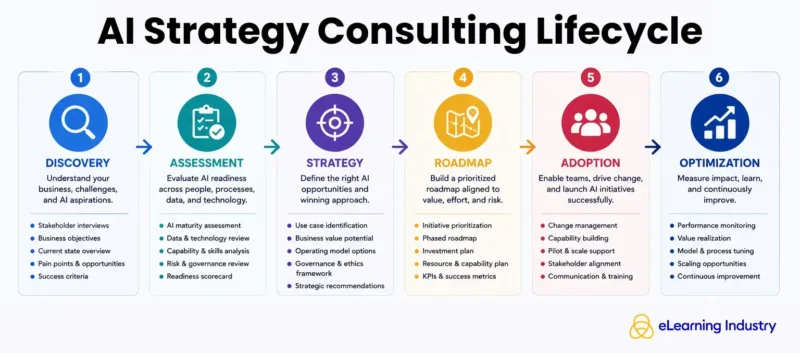
In practice, an AI strategy engagement usually covers several interconnected areas. Together, these activities help organizations make informed decisions while avoiding expensive technology investments that lack a clear business case.
Assessing AI Readiness
We all know that every successful AI initiative starts with understanding where the organization stands today.
An AI maturity assessment typically examines several areas, including leadership commitment, data quality, technology infrastructure, existing digital capabilities, governance practices, and the organization's willingness to adopt new ways of working. These assessments often reveal that technical infrastructure is only one part of the equation. In many cases, organizational alignment, change readiness, or unclear ownership present larger barriers than technology itself.
Identifying High-Value Use Cases
One of the most valuable contributions an AI strategy consultant can make is helping organizations separate promising opportunities from interesting ideas.
Most companies already have a growing list of AI suggestions generated by different departments. In essence, marketing wants personalized content while finance wants better forecasting. Meanwhile, customer service wants AI-powered support, HR wants recruiting automation, and operations wants workflow optimization.
The challenge here isn't generating ideas. Instead, it is deciding which opportunities deserve investment.
Building An AI Roadmap
Once priorities have been established, they need to be organized into a practical implementation plan.
Here, an AI roadmap translates strategic recommendations into a sequence of initiatives that the organization can realistically execute over time. Rather than encouraging companies to launch multiple enterprise-wide projects simultaneously, a roadmap introduces AI through manageable phases that balance ambition with organizational capacity.
Also, a roadmap helps executives understand how individual AI projects contribute to larger business objectives, making it easier to allocate budgets, measure progress, and maintain stakeholder alignment throughout the transformation process.
Aligning Stakeholders
AI initiatives rarely succeed when they are driven by a single department in isolation.
In general, successful adoption requires input from leadership, operations, IT, legal, finance, HR, compliance, and business unit leaders. Here, each group brings different priorities, concerns, and expectations. Without alignment, organizations often experience delays, conflicting objectives, duplicated efforts, or resistance during implementation.
Establishing Governance And Managing Risk
As organizations expand their use of AI, governance becomes increasingly important. Executives are no longer asking whether they should adopt AI; they're asking how to do it responsibly.
In general, an effective AI strategy includes policies that address issues such as data privacy, regulatory compliance, model oversight, security, vendor selection, acceptable use, and ethical decision-making. Governance provides consistency without preventing innovation, giving employees clear guidance on how AI should be used across the organization.
Supporting Adoption And Organizational Change
Even the strongest AI strategy has little value if employees don't adopt it.
This is exactly why many AI consulting services extend beyond strategic planning. In essence, consultants often facilitate executive workshops, develop communication plans, deliver AI literacy programs, and advise leadership teams on change management throughout implementation. In short, these activities help organizations build confidence in AI while reducing uncertainty among employees who may be concerned about how the technology will affect their work.
AI Strategy Consulting Versus AI Implementation Consulting
The distinction between strategy consulting and implementation consulting is important because clients often confuse the two.
Overall, AI strategy consulting focuses on helping organizations determine what they should do and why. It addresses questions about business priorities, investment decisions, governance, organizational readiness, and long-term direction. Here, the outcome is typically a roadmap, a governance framework, prioritized use cases, and executive alignment around future initiatives.
On the other hand, AI implementation consulting focuses on executing that strategy. Implementation consultants configure platforms, integrate systems, build AI applications, deploy models, automate workflows, and provide technical support throughout delivery.
Both services are valuable, but they solve different problems.
What Businesses Actually Buy
One of the biggest mindset shifts for anyone building an AI consulting business is recognizing that clients are rarely buying Artificial Intelligence itself. They are investing in business outcomes, and AI happens to be one of the ways they hope to achieve them.
Here, this distinction influences every aspect of how AI strategy consulting services should be positioned. Firms that lead with technical terminology often struggle to connect with executive buyers because technology is rarely the problem they are trying to solve.
Consider the questions executives typically ask during an initial conversation. They are rarely asking which large language model performs best or which automation platform supports the most integrations. Instead, they ask questions such as:
- How can AI improve productivity across our teams?
- Where can we reduce operational costs without sacrificing quality?
- Which business processes should we prioritize first?
- How do we manage the risks associated with AI adoption?
- What kind of return on investment should we expect?
These are business questions, and they require business-focused answers.
It is true that this approach also creates clearer differentiation. Many consulting firms claim to provide AI consulting services, but relatively few explain how those services contribute to measurable business performance. Also, organizations invest because they expect better results, not because they want access to the latest technology. The consultants who consistently win new business understand that difference and make it the foundation of every client conversation.
Packaging Your AI Strategy Consulting Services
One of the quickest ways to make your consulting business easier to sell is to stop selling "AI consulting" as a broad service. While the phrase describes what you do, it doesn't tell potential clients what they'll receive, how long the engagement will take, or what outcomes they can expect. For many buyers, especially executives who are evaluating several firms at once, vague service descriptions create uncertainty rather than confidence.
Well-defined service offerings solve this problem. Instead of presenting an open-ended consulting engagement, you package your expertise into services with a clear scope, defined deliverables, and a specific business objective. Clients understand what they're buying, and your sales process becomes more structured because every engagement follows a repeatable approach.
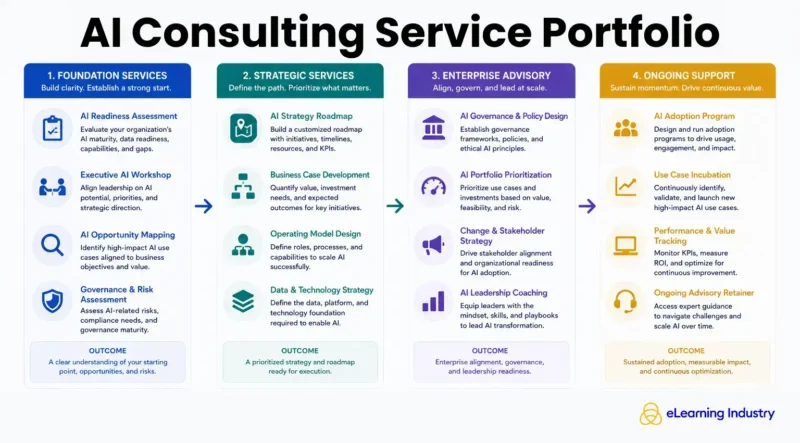
While every consultancy will develop its own portfolio, several service offerings have become common across the market.
AI Readiness Assessment
An AI Readiness Assessment is often the ideal entry point for a new client relationship. Many organizations recognize that AI is becoming strategically important, but they don't have a clear understanding of where they currently stand or what capabilities they need to develop.
The final deliverable typically includes an AI maturity assessment, key strengths and gaps, prioritized opportunities, potential risks, and recommendations for next steps. Rather than overwhelming clients with technical detail, the report should help executives understand where investment will have the greatest impact.
Because the assessment naturally identifies future opportunities, it often leads to follow-on strategy engagements without requiring a hard sales pitch.
Executive AI Workshop
Many leadership teams need education before they need strategy.
An Executive AI Workshop provides senior leaders with a practical understanding of Artificial Intelligence, current business applications, emerging risks, and the strategic decisions they will need to make over the coming years. Unlike technical training sessions, executive workshops focus on business implications rather than implementation details.
A workshop may include industry trends, competitor examples, AI governance considerations, interactive discussions, and facilitated exercises that help leadership identify potential opportunities within their own organization.
AI Opportunity Mapping
Once leadership understands the broader landscape, the next step is identifying where AI can create measurable business value.
AI Opportunity Mapping brings together stakeholders from across the organization to evaluate existing processes, identify pain points, and prioritize use cases based on business impact and implementation feasibility.
The outcome is a prioritized portfolio of AI initiatives that supports strategic decision-making and future investment planning.
AI Strategy Roadmap
For many consulting firms, the AI Strategy Roadmap becomes the core service offering.
Building on earlier assessments and workshops, the roadmap provides a structured plan for implementing AI over the next twelve to thirty-six months. It outlines strategic priorities, sequencing, governance requirements, technology considerations, investment recommendations, and organizational milestones.
The roadmap also gives leaders a common reference point for future decision-making. Rather than evaluating every AI initiative independently, leadership can compare new ideas against the organization's agreed strategic direction.
Governance And Risk Assessment
As regulatory scrutiny increases and organizations deploy AI across more business functions, governance has become a standalone advisory service rather than a supporting activity.
A governance assessment reviews existing policies, compliance requirements, data management practices, security controls, vendor oversight, and organizational responsibilities. Consultants then recommend governance frameworks that support responsible AI adoption while remaining practical for day-to-day operations.
AI Adoption Program
Strategy alone rarely changes how people work.
Organizations frequently need support as AI moves from planning into day-to-day operations. An AI Adoption Program focuses on organizational change by helping leaders communicate the strategy, prepare employees, provide AI literacy training, and measure adoption across the business.
Executive Coaching And Advisory
Many CEOs and senior executives want a trusted advisor they can call as new AI questions emerge.
Executive coaching may include reviewing investment decisions, discussing new AI developments, facilitating board presentations, evaluating vendor proposals, or advising leadership during major transformation initiatives.
These engagements typically require fewer deliverables than project work but provide significant long-term value because they position the consultant as an ongoing strategic partner.
Fixed-Scope Engagements Versus Advisory Retainers
As firms mature, many shift from project-based consulting toward recurring advisory relationships.
Fixed-scope engagements remain valuable because they give clients a clear starting point. Services such as AI readiness assessments, executive workshops, and strategy roadmaps are relatively easy to understand and purchase. They also provide measurable outcomes that justify the initial investment.
The strongest consulting firms often combine both approaches. Initial projects build trust and demonstrate expertise. Ongoing advisory relationships extend that trust over time and create opportunities to support implementation, governance, executive education, and future strategy updates.
How To Build A Repeatable Consulting Framework
One of the defining characteristics of successful consulting firms is that they don't approach every engagement from scratch. While every client has unique challenges, the process used to solve those challenges follows a consistent methodology.
When firms describe their work using a branded methodology instead of generic consulting language, they appear more established. Buyers often remember a clear framework long after they've forgotten a list of services.
The framework itself doesn't need to be revolutionary. In fact, the best consulting methodologies are often straightforward. Their value comes from providing a clear path that clients can understand and trust.
For illustration, consider the following example.
The ALIGN Framework
The ALIGN Framework organizes an AI strategy engagement into five practical stages.
A - Assess Business Maturity
Every engagement begins with understanding the organization's current capabilities.
This stage includes stakeholder interviews, AI maturity assessments, business process reviews, technology evaluations, and leadership discussions. The objective is to identify both opportunities and constraints before strategic recommendations are made.
Rather than assuming every client is ready for advanced AI adoption, consultants establish a realistic baseline.
L - Locate High-Value Use Cases
Once the current state is understood, attention shifts toward opportunity identification.
Workshops and discovery sessions help uncover areas where AI can improve productivity, reduce costs, support decision-making, or enhance customer experience.
Each opportunity is evaluated according to business impact, implementation complexity, organizational readiness, and expected return on investment. This process prevents organizations from pursuing projects simply because the technology is interesting.
I - Identify Risks And Governance Needs
Every AI initiative introduces new considerations around privacy, security, compliance, ethics, and operational oversight.
Rather than treating governance as a separate conversation, successful consultants integrate it into strategy development from the beginning.
This stage defines governance principles, identifies regulatory requirements, recommends accountability structures, and highlights potential risks that leadership should address before implementation.
G - Generate A Prioritized Roadmap
Once opportunities and risks have been evaluated, consultants organize initiatives into a phased implementation roadmap.
Projects are prioritized according to business value, dependencies, available resources, and organizational capacity. The roadmap provides executives with a practical sequence of initiatives rather than an overwhelming list of recommendations.
It also establishes milestones that allow leadership to measure progress over time.
N - Navigate Implementation And Adoption
Strategy should not end when the roadmap is delivered.
Many organizations need continued support as projects move into implementation. Consultants help leadership monitor progress, facilitate stakeholder alignment, update governance practices, measure outcomes, and adjust priorities as business needs evolve.
This final stage transforms the consultant from a project advisor into a long-term strategic partner.
It is important to say that the ALIGN Framework is only one example. The most important lesson is not the acronym itself but the principle behind it. Every consulting firm should develop a methodology that reflects its strengths, target market, and consulting philosophy.
Your framework might emphasize innovation, operational excellence, governance, digital transformation, or industry specialization. What matters is that it provides a repeatable structure clients can understand and your team can consistently deliver.
How To Demonstrate Expertise Before The First Sales Call
One of the most common misconceptions in consulting is that expertise alone attracts clients. In reality, potential buyers rarely see your expertise until you've found a way to make it visible.
Most executives begin evaluating advisors long before they schedule a meeting. They read articles, watch presentations, listen to podcasts, browse LinkedIn profiles, and ask peers for recommendations. By the time they reach out, they've often formed an opinion about which consultants appear credible.
That means marketing is no longer separate from consulting. It's one of the primary ways firms demonstrate expertise.
Thought leadership is particularly effective because it answers questions before a sales conversation begins. When a consultant consistently publishes useful insights, buyers gain confidence that the same level of thinking will carry into client engagements.
This doesn't mean publishing content for the sake of staying active. The goal is to help executives make better decisions.
Original research, industry analysis, practical implementation guides, and commentary on emerging trends generally create more authority than promotional content. Buyers are looking for advisors who understand their business challenges, not firms that constantly advertise their services.
Webinars and executive roundtables create another opportunity to build credibility. Rather than presenting product demonstrations, successful events focus on business challenges, lessons learned, and practical advice. Attendees should leave with useful insights, whether they become clients or not.
Across all these activities, the objective remains the same: reduce the amount of trust that needs to be built during the sales process. When prospects already recognize your expertise, sales conversations become less about proving credibility and more about discussing how you can help solve their specific challenges.
Winning AI Strategy Consulting Clients
Many consulting firms assume that winning more clients means generating more leads. In reality, the quality of those leads often matters more than the quantity. Organizations looking for AI strategy consulting services are making significant business decisions, and those decisions usually involve multiple stakeholders, budget approvals, and long evaluation cycles. Very few executives hire an AI strategy consultant after seeing a single advertisement or sales message.
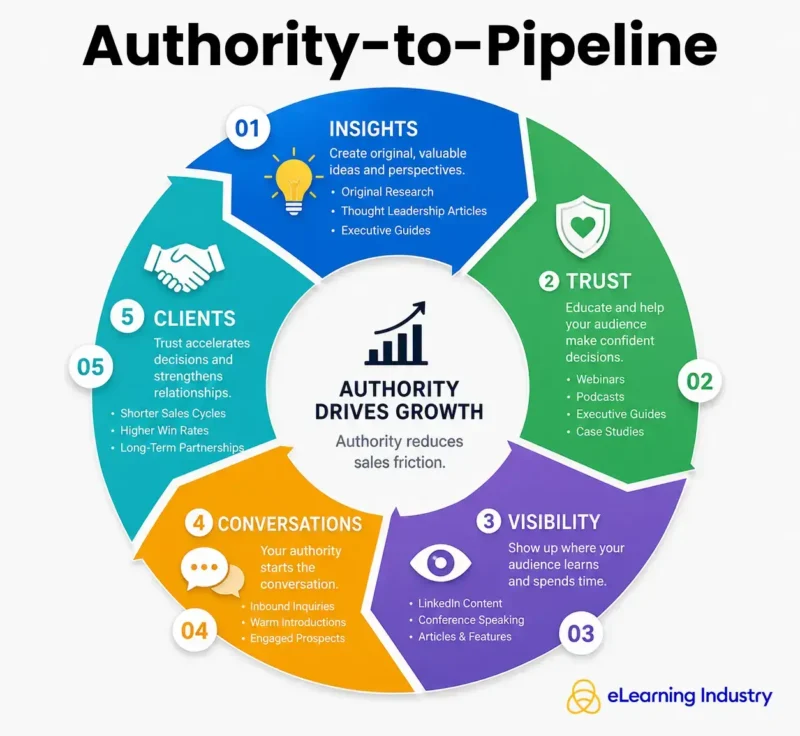
The firms that consistently attract high-value clients tend to follow a different approach. Instead of relying on direct selling, they invest in educating their market. By the time a prospective client reaches out, they already understand the firm's expertise, methodology, and point of view.
Education creates trust, and trust shortens the sales cycle.
Referrals Remain One Of The Strongest Acquisition Channels
Despite the growth of digital marketing, referrals continue to generate some of the highest-quality consulting opportunities. Organizations place significant weight on recommendations from peers, existing advisors, and industry contacts because they reduce the perceived risk of hiring a consultant.
Satisfied clients naturally become advocates when they've experienced measurable business outcomes. This is another reason to focus on delivering clear results rather than simply completing project deliverables. Executives are much more likely to recommend a consultant who helped them achieve a strategic objective than one who simply delivered a report.
Strategic Partnerships Expand Your Reach
Many consulting firms overlook partnerships because they're focused on building direct client relationships. Yet strategic partnerships can become one of the fastest ways to access enterprise opportunities.
Technology providers, digital transformation consultancies, cloud implementation partners, cybersecurity firms, accounting firms, and legal advisors frequently encounter organizations that need an AI strategy before implementation begins. Rather than competing with these firms, look for opportunities to complement their services.
By establishing referral relationships with complementary service providers, you create opportunities that neither organization could generate alone.
Executive Education Creates Qualified Conversations
Executives rarely attend webinars because they want to be sold to. They participate because they're trying to understand an emerging topic, evaluate industry trends, or make better business decisions.
This makes educational events particularly effective for AI consulting services. Webinars, executive breakfasts, leadership roundtables, and private workshops allow consultants to demonstrate expertise while providing immediate value to attendees.
A useful session naturally creates follow-up conversations without requiring a hard sales approach.
LinkedIn Supports Long Sales Cycles
For many AI strategy consultants, LinkedIn has become one of the most valuable platforms for building credibility. Not because it generates immediate leads, but because it allows potential clients to observe your thinking over time.
The most effective LinkedIn content usually falls into a few categories:
- Observations from consulting engagements (while protecting client confidentiality)
- Commentary on industry developments
- Practical frameworks and decision-making tools
- Executive insights about AI governance, change management, or digital transformation
- Lessons learned from successful implementations
Content that helps leaders make better decisions generally performs better than promotional posts announcing services.
Industry Publications And Podcasts
Publishing articles in respected industry publications or appearing as a guest on business podcasts expands your credibility beyond your own marketing channels.
These opportunities position you as an industry contributor rather than simply a service provider. They also expose your expertise to audiences who may never have discovered your firm through traditional marketing.
The objective isn't media exposure for its own sake. It's creating multiple touchpoints where prospective clients can become familiar with your perspective before entering the buying process.
Email Nurturing Keeps Conversations Moving
Not every prospect is ready to begin an engagement immediately.
Instead of sending promotional newsletters, share useful resources, industry updates, executive guides, and practical advice. Every communication should reinforce your expertise while helping readers make better decisions.
When organizations eventually decide to seek outside guidance, they're more likely to remember the consultant who consistently provided value without asking for anything in return.
Case Studies: What Buyers Want To See
Case studies remain one of the strongest forms of proof in consulting because they show how ideas translate into business outcomes.
Many firms make the mistake of turning case studies into project summaries. They describe activities, list deliverables, and mention technologies, but they never explain why the work mattered. Executives evaluating AI advisory services are looking for something different. They want evidence that a consultant can solve business problems similar to their own.
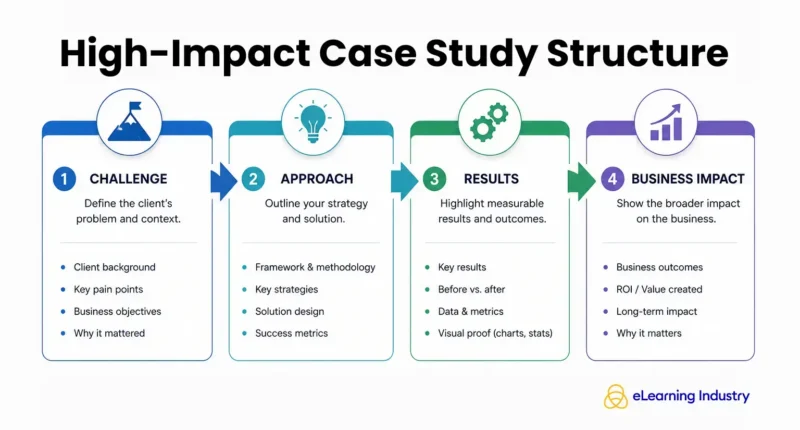
A strong case study follows a simple structure.
Start With The Challenge
Begin by describing the client's business situation rather than the technology involved.
- What problem were they trying to solve?
- Why was change necessary?
- What constraints existed?
This context helps prospective clients recognize similarities between the featured organization and their own business.
Explain The Strategy
Next, describe how your consulting team approached the problem.
Focus on the decision-making process rather than every project detail. Explain how you assessed the current state, identified opportunities, prioritized initiatives, or developed an AI roadmap.
This section demonstrates your methodology and shows prospective clients how you think.
Highlight Implementation
Even if your engagement focused primarily on strategy, explain how recommendations moved toward execution.
- Did leadership adopt the roadmap?
- Were governance policies introduced?
- Did departments begin implementing prioritized use cases?
Showing progress reinforces that your work extended beyond theoretical advice.
Measure Business Outcomes
This is often the most important section.
Whenever possible, quantify results using business metrics rather than technical achievements.
Examples include:
- reduced operating costs
- improved productivity
- shorter processing times
- increased customer satisfaction
- faster decision-making
- revenue growth
- improved compliance
- stronger executive alignment
If exact numbers cannot be shared, describe the business impact qualitatively while respecting client confidentiality.
Share Lessons Learned
Concluding with key lessons adds credibility because it demonstrates reflection rather than self-promotion.
Discuss what surprised the team, what changed during the project, or what advice you would offer organizations facing similar challenges.
This perspective reinforces your role as a strategic advisor rather than simply a project delivery partner.
What If You're A New Consultancy?
Many new firms hesitate to publish case studies because they don't yet have an extensive client portfolio.
Fortunately, case studies don't always need to describe large enterprise projects.
You can document pilot engagements, internal AI initiatives, workshop outcomes, framework demonstrations, or anonymized consulting experiences that illustrate your methodology. The objective is to show how you approach problems and create value.
Pricing AI Strategy Consulting Services
Pricing is one of the most challenging aspects of building an AI consulting business. Charge too little and prospects may question the value of your expertise. Charge too much without demonstrating business impact and buyers may struggle to justify the investment.
The goal isn't to find a universal price point. It's to align pricing with the value your engagement creates.
Workshops
Executive workshops are often priced as fixed-fee engagements because the scope is well defined. Clients know what they'll receive, consultants can estimate preparation time accurately, and the service provides a clear entry point into broader advisory work.
Project-Based Pricing
Services such as AI readiness assessments, AI opportunity mapping, governance reviews, and AI strategy roadmaps are usually delivered as fixed-price projects.
This model benefits both parties. Clients gain cost certainty, while consultants are rewarded for expertise and efficiency rather than the number of hours worked.
Advisory Retainers
Long-term advisory relationships are commonly structured as monthly or quarterly retainers.
Rather than purchasing individual projects, clients receive ongoing access to strategic guidance, executive coaching, governance support, roadmap reviews, and leadership advisory services.
Retainers also provide predictable recurring revenue for consulting firms while strengthening long-term client relationships.
Executive Advisory
Some organizations prefer direct access to experienced advisors without commissioning larger consulting engagements.
Executive advisory services may include board presentations, investment reviews, vendor evaluations, AI governance discussions, and strategic planning sessions. Pricing typically reflects the seniority of the advisor and the strategic importance of the work.
Value-Based Pricing
As your reputation grows, value-based pricing often becomes the most effective model.
Instead of calculating fees based on hours worked, pricing reflects the business value your expertise creates.
While value-based pricing requires greater confidence and stronger positioning, it also shifts conversations away from hourly rates and toward business outcomes.
Clients rarely ask how many hours a recommendation requires if they believe it helped them make a significantly better decision.
Common Mistakes AI Consultants Make
As demand for AI transformation consulting continues to grow, more firms are entering the market. Increased competition makes clear positioning more important than ever.
Several mistakes appear repeatedly across consulting websites, proposals, and sales conversations.
Selling Technology Instead Of Outcomes
Executives care far more about solving business problems than learning about technical capabilities.
Lead with outcomes. Explain how AI supports productivity, operational efficiency, better decision-making, or growth before discussing specific technologies.
Using Overly Technical Language
Technical expertise is important, but excessive jargon often creates distance between consultants and executive buyers.
Use language that business leaders understand. Technical discussions can always follow once strategic priorities are established.
Offering Generic Consulting Services
Broad statements such as "We provide AI consulting services" make it difficult for prospects to understand what they're buying.
Clearly packaged offerings with defined outcomes create stronger positioning and simplify the buying process.
Trying To Serve Everyone
Generalist positioning makes differentiation difficult.
Specialization—whether by industry, business function, company size, or consulting approach—helps firms become known for solving specific types of problems.
Lacking Proof
Prospective clients want evidence.
Thought leadership, case studies, research, speaking engagements, executive workshops, and published frameworks all contribute to credibility. Without proof, even experienced consultants may struggle to stand out in a crowded market.
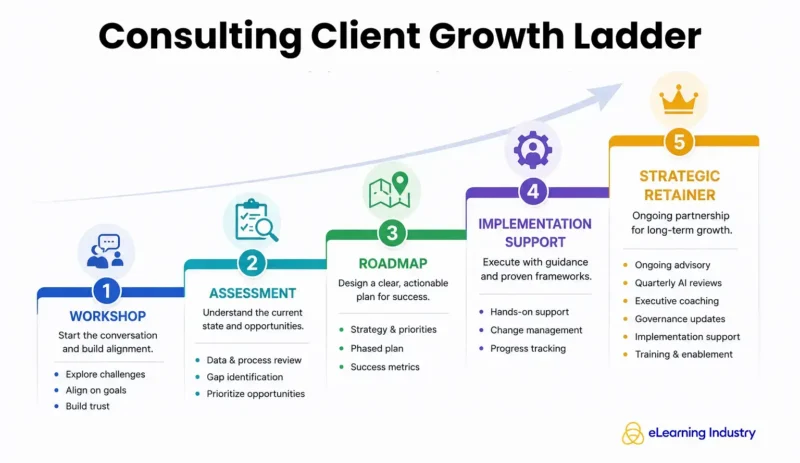
Building Long-Term Client Relationships
The end of a strategy project should mark the beginning of a longer relationship, not the conclusion of one.
Consultants who continue supporting clients through these changes often generate significantly more value than those who focus only on one-off engagements.
Quarterly AI strategy reviews provide an opportunity to revisit priorities, evaluate progress, and identify new opportunities as the organization's capabilities mature.
Executive coaching helps leadership navigate ongoing investment decisions and communicate AI strategy across the business.
Governance updates ensure policies remain aligned with changing regulations and emerging risks.
Implementation advisory helps project teams maintain alignment with the original strategic objectives while adapting to practical realities.
AI literacy programs and leadership training continue building internal capability long after the initial engagement concludes.
These services strengthen client relationships because they recognize that AI transformation is an ongoing process rather than a single project.
The Future Of AI Strategy Consulting
The market for enterprise AI consulting continues to evolve. While early engagements focused primarily on identifying AI opportunities, organizations are now asking broader strategic questions about governance, organizational design, regulatory compliance, workforce readiness, and long-term operating models.
Several areas are likely to see increasing demand over the coming years.
AI governance will continue expanding as regulations become more detailed and organizations seek consistent policies across departments.
AI literacy programs will become a standard component of enterprise transformation initiatives as executives recognize that technology adoption depends on employee understanding.
Perhaps the biggest shift, however, is that clients increasingly expect integrated support. Rather than hiring separate firms for strategy, governance, education, implementation, and change management, many organizations prefer advisors who can coordinate these activities as part of a broader AI transformation consulting practice.
The firms that succeed over the next decade are unlikely to be those with the most technical certifications or the longest list of software partners. Instead, they will be the firms that consistently help executives make better decisions, reduce uncertainty, and guide organizations through the practical realities of AI adoption.
Conclusion
AI strategy consulting services are no longer a niche offering. As Artificial Intelligence becomes part of mainstream business strategy, organizations need trusted advisors who can help them move from curiosity to execution with confidence.
For consulting firms, this represents a significant opportunity, but success depends on much more than technical expertise. Clients are looking for partners who understand business priorities, communicate clearly, and provide structured guidance that leads to measurable outcomes. A well-defined consulting methodology, thoughtfully packaged services, and a consistent body of thought leadership do more than support marketing efforts—they build the trust required to win executive buy-in.
The strongest AI consulting firms also recognize that strategy is only the beginning of the client relationship.
FAQAI strategy consulting helps organizations identify where Artificial Intelligence can create business value and how to implement it effectively. Rather than building AI applications, consultants focus on assessing AI readiness, identifying high-impact use cases, developing AI roadmaps, establishing governance, and aligning AI initiatives with business objectives. The goal is to help leadership teams make informed decisions before investing in technology.
An AI strategy consultant should provide services that support the full planning and decision-making process, not just technology recommendations. Common offerings include AI readiness assessments, executive AI workshops, AI opportunity mapping, AI strategy roadmaps, governance and risk assessments, AI adoption programs, executive coaching, and ongoing AI advisory services. Packaging these services into clear, repeatable offerings makes it easier for clients to understand the value they will receive.
The most successful AI consultants win clients by building trust before the first sales conversation. They publish thought leadership, share original research, speak at industry events, host webinars, and showcase case studies that demonstrate measurable business outcomes. Referrals, strategic partnerships, LinkedIn, executive roundtables, and email nurturing are also effective client acquisition channels. In most cases, educating potential buyers produces better results than direct selling.
There is no standard pricing model for AI strategy consulting because fees depend on the scope of the engagement, the consultant's experience, and the business value delivered. Executive workshops and AI readiness assessments are often priced as fixed-fee projects, while ongoing advisory services typically use monthly retainers. As firms gain experience and establish a strong reputation, many move toward value-based pricing, where fees reflect the impact of the engagement rather than the number of consulting hours.
AI strategy consultants need a combination of business, technical, and communication skills. They should understand AI technologies well enough to evaluate opportunities, but they also need expertise in business strategy, digital transformation, change management, AI governance, data management, stakeholder facilitation, and executive communication. Strong problem-solving abilities and the ability to translate technical concepts into clear business recommendations are equally important.
Credibility is built by consistently demonstrating expertise rather than simply claiming it. AI consulting firms can strengthen their reputation by publishing practical thought leadership, producing original research, creating executive guides, sharing case studies, hosting educational webinars, speaking at conferences, and maintaining an active professional presence on platforms like LinkedIn. Developing a proprietary consulting framework and showcasing measurable client outcomes also helps establish trust with prospective clients.