

Many Companies Use AI, But Few Have An Implementation Strategy
Many companies are increasing their AI investments, but they still struggle when they move from planning to execution. Recent McKinsey research shows that around 70% of AI projects fail to reach full production because organizations underestimate change management and internal alignment. You don't face a technology problem alone. You face a people and process challenge that often slows adoption and reduces impact. That's why you should define clear AI implementation steps for business that guide how teams test, adopt, and scale use cases across departments.
When you plan your AI rollout strategy, you need to focus on how people actually work day to day. You cannot treat AI as a standalone tool. You need to embed it into workflows your teams already use. This is where most companies fail, because they focus on tools first instead of behavior change. Additionally, you need to set ownership early, so every team knows who drives adoption, who tracks results, and who fixes issues when they appear.
If you want results, you need to keep alignment at the center of every decision. You should bring leaders and teams into the process early and keep communication simple and consistent. You also need to manage change actively, not react to it after problems appear. Successful AI implementation depends on aligning teams, managing change, and embedding AI into workflows without disrupting trust or productivity. When you do this well, you reduce resistance and help people use AI with confidence. Start with clarity before scale to avoid costly adoption delays across teams early on today.
Key Takeaways
- AI implementation is primarily an organizational challenge, not a technical one.
- Successful rollout requires clear communication, gradual adoption, and team alignment.
- Poor implementation can lead to resistance and reduced trust.
- Companies that manage change effectively scale AI faster and more successfully.
In This Guide, You Will Find...
- Why AI Implementation Fails (And It's Not About Technology)
- The Real Risks Of AI Implementation
- The AI Implementation Strategy: A 5-Step Model
- How To Introduce AI Without Breaking Team Trust
- Managing Change: The Human Side Of AI Implementation
- Common Mistakes Companies Make When Implementing AI
- How AI Implementation Impacts Business Performance
- The Role Of Learning And HR Tech In AI Adoption
- From Implementation To Competitive Advantage
Why AI Implementation Fails (And It's Not About Technology)
Most AI implementation efforts fail for reasons that have little to do with technology. You see strong tools, solid models, and well-funded projects, yet results still fall short. The real problem starts inside the organization, not inside the system. In many cases, teams do not share the same direction. Leaders set goals, but they do not translate them into clear actions for the people who use the tools every day. As a result, confusion builds quickly. People try to guess what success looks like instead of working toward a defined outcome.
Communication also breaks down during AI transformation execution. Teams often receive updates too late or too vaguely, which creates uncertainty. At the same time, employees start to feel left out of decisions that directly affect their work. This gap slows adoption and weakens momentum. Resistance to change adds another layer of difficulty. People naturally protect familiar workflows, especially when they do not fully understand how AI will affect their roles. Without clear guidance, they push back or disengage.
However, the technology itself rarely causes failure. The issue comes from how leaders introduce and manage change. Successful AI implementation depends on clarity, alignment, and consistent communication across every level of the business. When you look at companies that use AI today, the difference is not in the tools they choose. It is in how well they prepare their teams, set expectations, and support adoption from the start.
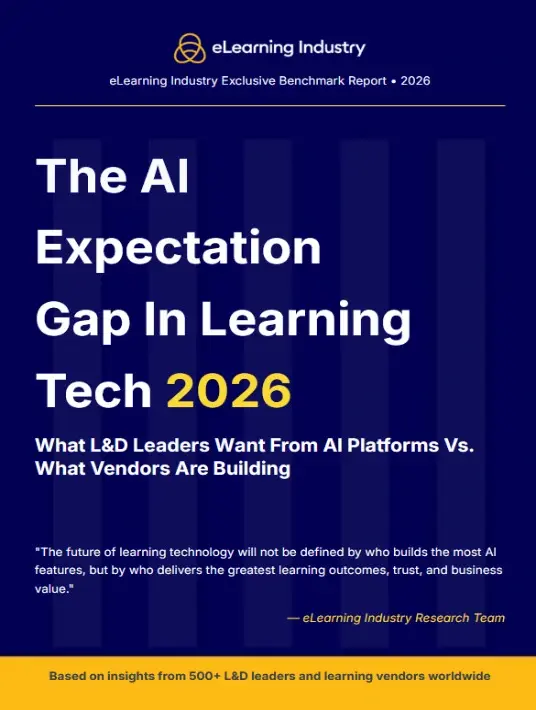
AI implementation is being held back by execution and integration challenges. An eLearning Industry report finds that 48% of learning technology vendors struggle to keep pace with AI innovation, 45% cite integration complexity, and 41% face resource constraints involving budget, staffing, or development time.
The Real Risks Of AI Implementation
-
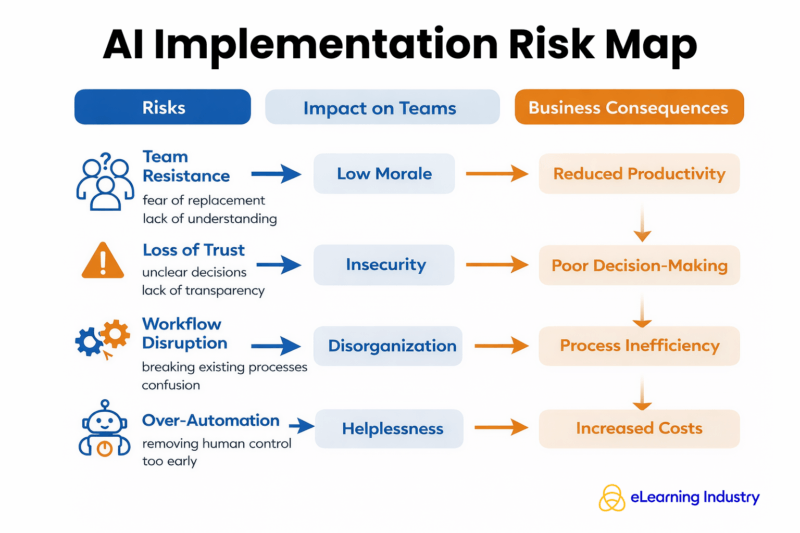
Team Resistance
One of the first challenges you face in AI implementation is resistance from your teams. People often worry about replacement, especially when they do not fully understand how AI will support their work. At the same time, unclear communication creates confusion about roles and expectations. When you don't address these concerns early, adoption slows down and frustration grows across departments.
-
Loss Of Trust
Trust breaks down when leaders fail to explain how decisions get made. If teams feel left out of the process, they start to question the intent behind the change. In many cases, this comes from a lack of transparency around data use and decision-making logic. As a result, people disengage instead of supporting the shift.
-
Workflow Disruption
You also risk breaking systems that already work. Many companies rush into implementing AI in business without mapping existing workflows first. This leads to confusion, duplicated effort, and broken handoffs between teams. When AI workflows break, productivity drops before any real gains appear.
-
Over-Automation
Some organizations move too fast and remove human oversight too early. While automation improves speed, it can also remove context that humans still need to make better decisions. Without balance, you create errors that AI alone cannot fix.
-
Skills Gap
Another major risk comes from the lack of internal capability. Many teams do not yet have the AI skills needed to use new systems effectively. This slows down adoption and increases dependence on external support, which limits long-term success.
-
Common AI Implementation Mistakes
Finally, many issues come from common AI implementation mistakes like skipping training, ignoring feedback loops, or rolling out tools without proper testing. These errors build up over time and weaken performance instead of improving it.
The AI Implementation Strategy: A 5-Step Model
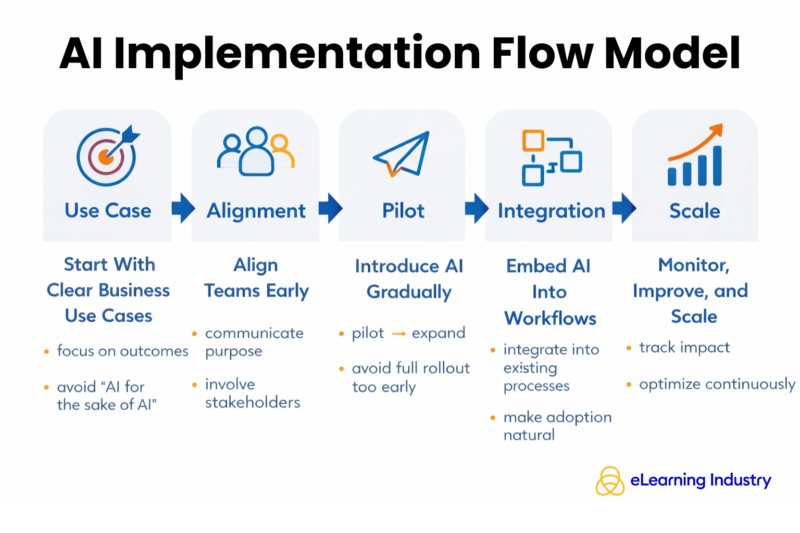
Step 1: Start With Clear Business Use Cases
You need to define exactly what you want AI to solve before you introduce any tools. Focus on outcomes like faster decisions, better customer support, or reduced manual work. Avoid using AI for the sake of AI, because that creates confusion and weak results. When you anchor decisions in real business value, you give teams a clear direction from the start.
Also, you need to align leadership on priorities before anything goes live. If each department defines success differently, you end up with scattered results and weak impact. Instead, narrow your focus to a few high-value use cases first. This helps you prove value early and builds momentum for wider adoption across the business.
Step 2: Align Teams Early
You improve adoption when you involve people early in the process. Communicate the purpose behind the change and explain how it affects daily work. At the same time, set clear expectations so teams know what will change and what will stay the same. If you want to understand how to roll out AI without resistance, alignment becomes your strongest lever.
You should also open feedback channels before full deployment. When people feel heard, they engage more and resist less. In addition, assign clear owners for communication in each department. This keeps messages consistent and avoids confusion across teams.
Step 3: Introduce AI Gradually
You should never launch everything at once. Start with a pilot, test results, and then expand step by step. This approach helps you fix issues early and build confidence across teams. Gradual rollout also gives you time to adjust based on real user feedback instead of assumptions.
At this stage, track how people actually use AI, not just system performance. Usage data often reveals friction points that reports miss. As a result, you can refine the rollout before scaling further.
Step 4: Embed AI Into Workflows
AI adoption works best when it fits into existing processes. You should integrate tools directly into daily tasks instead of forcing people to change how they work. This approach strengthens your AI integration strategy and makes adoption feel natural instead of disruptive.
When AI sits inside tools people already use, you remove friction and speed up adoption. This step matters most in AI in operations because it connects automation directly to real work without breaking flow.
Step 5: Monitor, Improve, And Scale
Once you introduce AI in operations, you need to track performance closely. Measure impact, collect feedback, and improve continuously. Over time, you scale what works and remove what doesn't. This keeps your system aligned with business goals.
You should treat monitoring as ongoing work, not a final step. AI systems evolve, and user behavior changes with them. When you stay active in optimization, you support a stronger enterprise AI strategy and keep results consistent as you scale.
How To Introduce AI Without Breaking Team Trust
Control, support, and privacy are major ingredients of AI trust. According to our report, nearly 6 in 10 L&D buyers say control over AI settings is the strongest mechanism for building trust, while 55% point to training and support, and 54% to data privacy protections. The report interprets this as demand for transparency, customization, and human oversight.
1. Be Transparent
- Explain what the AI system does in simple terms
- Show how it supports daily work instead of replacing it
- Clarify what data it uses and why it matters
You build trust in any AI implementation when people understand what they are dealing with. If you leave gaps in communication, people fill them with assumptions. That often leads to fear and resistance. Instead, you should explain the purpose early and keep the message consistent across teams. When you connect AI to real tasks, people stop seeing it as a threat and start seeing it as support. A strong AI business strategy depends on this level of clarity from the start.
2. Keep Humans In Control
- Avoid full automation in early stages
- Keep human review in key decisions
- Define clear escalation points for edge cases
You strengthen your AI implementation steps for business when you keep humans involved in decision-making. AI should support choices, not replace judgment too early. When teams know they still have control, they engage more confidently. Over time, you can increase automation, but you should always introduce it gradually. This approach reduces risk and keeps performance stable during change.
3. Communicate Benefits Clearly
- Highlight efficiency gains in daily work
- Show how AI reduces repetitive tasks
- Explain how it improves accuracy and outcomes
You improve your AI adoption strategy when you focus on real benefits instead of abstract promises. People respond better when they see how their workload becomes easier, not when they hear technical explanations. When you link AI to practical improvements, adoption increases naturally across teams.
Do you want to stay updated regarding the latest eLearning news? Subscribe to our newsletter and never miss a beat!
Managing Change: The Human Side Of AI Implementation
-
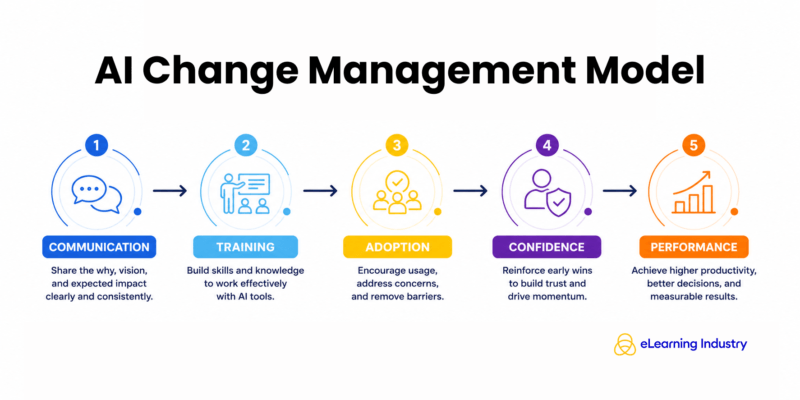
Training As An Ongoing Process
AI implementation often fails when companies treat training as a one-time event. You need to give people time to learn, practice, and connect new tools to real work. Different teams learn at different speeds, so you should reinforce learning continuously instead of rushing deployment. When you skip this step, confusion grows and adoption slows down quickly.
-
Enablement Over Instruction
You don't just train people, you enable them. That means showing how tools improve daily work, not just explaining how they function. When employees see practical value, they engage more and resist less. This becomes even more important during AI transformation execution, where multiple teams must adjust workflows at the same time and align around new ways of working.
-
Cultural Adaptation And Buy-In
People resist uncertainty more than they resist technology. You reduce friction when leaders communicate openly and invite feedback early. When teams feel included, they adapt faster and take ownership of change. Over time, this creates a culture that supports learning instead of blocking it.
-
Connecting Change To Business Outcomes
Your AI strategy for business should always link tools to real outcomes. When employees understand why change happens and how it improves their work, they commit more fully. You strengthen adoption when you connect technology with behavior and make both work together instead of separately.
Common Mistakes Companies Make When Implementing AI
-
Rushing Deployment
Many companies move too fast and push AI into production before teams are ready. This creates confusion, broken workflows, and weak adoption. When you rush, you skip the testing phase that helps you catch real issues early. As a result, performance drops and trust decreases across the organization.
-
Poor Communication
Teams struggle when leaders don't explain what changes, why it matters, and how it affects daily work. Without clear communication, people fill the gaps with assumptions. That leads to resistance and slows down AI implementation across departments.
-
Lack Of Training
Companies often underestimate how much support employees need. Without proper training, people don't feel confident using new tools. This slows adoption and limits results, especially during enterprise AI implementation where multiple teams must adjust at once.
-
Ignoring Feedback
When companies ignore user input, they miss critical issues in real workflows. Employees often spot problems first, but their feedback rarely reaches decision-makers. Over time, this disconnect weakens trust and reduces system effectiveness.
-
Focusing Only On Tools
Many leaders focus on software instead of behavior. They invest in platforms but forget about adoption, culture, and process change. This creates strong systems that no one fully uses, which reduces return on investment.
-
Underestimating The AI Skills Gap
Organizations often assume teams already have the right capabilities. However, AI skills gap trends show that most companies still lack practical experience with AI tools. Without upskilling, even the best systems underperform.
-
Weak Long-Term AI Strategy
Some companies treat AI as a one-time project instead of a long-term shift. A strong AI strategy connects tools, people, and processes over time. Without it, efforts stay fragmented and fail to scale effectively.
How AI Implementation Impacts Business Performance
-
Efficiency Gains Across Teams
AI implementation helps teams remove repetitive manual work and focus on higher-value tasks. You streamline workflows and reduce delays caused by routine processes. As a result, employees spend more time on work that actually drives business outcomes instead of administrative effort.
-
Faster Execution And Delivery
AI speeds up how quickly teams process information and make decisions. You reduce bottlenecks in reporting, analysis, and coordination across departments. When data moves faster, teams respond in real time instead of waiting on slow manual cycles. This directly improves execution speed across the business.
-
Cost Reduction Through Automation
A strong AI implementation strategy helps you lower operational costs by automating repetitive tasks. You scale output without increasing resources at the same pace. However, cost savings only appear when you connect AI tools to real workflows instead of isolated systems.
-
Better Decision-Making Quality
AI improves decision-making by giving leaders faster access to accurate insights. You move away from guesswork and rely more on real data. This reduces errors and improves consistency across teams, which leads to better overall business performance.
-
Stronger Strategic Alignment
An effective AI strategy framework connects operational improvements to broader business goals. You don't just optimize individual tasks; you improve how the organization performs as a whole. This alignment helps teams stay focused and measure impact more clearly over time.
The Role Of Learning And HR Tech In AI Adoption
Workforce training plays a central role in driving AI adoption in L&D. You cannot expect teams to use new systems effectively without giving them the right knowledge and support. HR tech helps structure this learning process by delivering training at scale, tracking progress, and identifying where people struggle. When you build learning into the rollout, you reduce confusion and improve confidence across the organization. This makes adoption more stable and less dependent on individual effort.
Adoption support becomes even more important during AI transformation execution because teams face constant change across tools and workflows. HR systems help managers guide employees through this shift by providing clear learning paths and ongoing reinforcement. Instead of overwhelming people with new processes, you create a structured environment where they can adapt step by step. This approach improves consistency and keeps teams aligned during complex transitions.
Skill development ensures long-term success. You need to build capabilities that go beyond basic tool usage and focus on practical application in daily work. HR tech supports this by identifying gaps and recommending targeted learning. When you understand how to roll out AI without resistance, you realize that people need time, clarity, and continuous development. Over time, this builds stronger teams that adapt faster and use AI more effectively across different business functions.
From Implementation To Competitive Advantage
Companies gain real value from AI only when they move beyond experimentation and focus on execution. Speed matters, but not in isolation. When teams adopt AI quickly and use it in daily workflows, they shorten the gap between investment and impact. Faster adoption leads to faster results because employees start applying insights sooner, not months later. However, speed without structure creates confusion, so leaders need a clear foundation before scaling.
A strong AI implementation strategy helps you connect tools to real business outcomes. You improve performance when you align use cases with operational priorities instead of testing AI in isolated pockets. Companies that do this well don't just automate tasks; they improve how decisions flow across the organization. This shift raises both efficiency and consistency at scale.
When you understand how to implement AI in a company effectively, you realize the advantage comes from execution discipline. A well-defined corporate AI strategy ensures these gains compound. It connects leadership vision with day-to-day execution, turning AI from a set of tools into a long-term performance advantage.
Key Takeaway
Successful AI adoption depends on execution, not experimentation. Across every stage, you see the same pattern: companies struggle less with technology and more with alignment, communication, and behavior change. When leaders ignore these factors, they slow down value creation and increase resistance across teams. A clear AI implementation strategy helps you avoid that gap by connecting tools directly to business outcomes and guiding teams through structured change.
At the same time, long-term success depends on discipline and consistency. An effective AI strategy roadmap ensures you don't treat AI as a one-time initiative but as an evolving capability inside the business. When you connect planning with execution, you improve adoption speed and reduce friction across departments. However, many organizations still fall into common AI implementation mistakes like rushing deployment, skipping training, or focusing only on tools instead of people. These errors weaken trust and limit performance, even when the technology itself works well.
eLearning Industry helps AI solution providers, learning platforms, and HR tech vendors connect with businesses that are actively implementing AI, through targeted visibility, thought leadership, and high-intent lead generation campaigns. If your solution helps organizations automate workflows, improve decision-making, or scale AI adoption, this is your opportunity to reach the buyers who need it most.
FAQMost AI projects fail due to poor change management, lack of employee buy-in, unclear communication, and weak alignment with business processes rather than technical issues.
The biggest challenge is human adoption, which involves getting teams to trust, understand, and consistently use AI in their daily workflows.
By starting small, communicating clearly, involving teams early, providing training, and gradually integrating AI into existing processes.
Risks include employee resistance, reduced productivity, wasted investment, lack of trust in AI systems, and stalled digital transformation efforts.
It is critical, as effective change management ensures alignment, builds confidence, and helps employees adapt smoothly to new AI-driven workflows.
When done well, it improves efficiency, decision-making, and scalability; when done poorly, it can slow operations and reduce overall performance.
