



Are You Measuring Your Share Of Voice?
Your brand generated more mentions, impressions, and website traffic than last quarter. That sounds like progress, right? But what if your competitors grew twice as fast? Your visibility could be rising while your position in the market conversation weakens. This is where the Share of Voice (SOV) formula helps.
If you're asking what is share of voice, you should know that it measures the portion of a visibility pool your brand captures compared with competitors. That pool might include brand mentions, organic search results, paid ads, media coverage, or AI responses. Each channel needs its own method and denominator, while market visibility across channels should not be combined.
A Google/NRG study found that 60% of B2B buyers used AI tools during their purchasing journey. Because competitors may appear in places you are not measuring. Also, impression share is a related paid-search metric, but it does not capture every form of visibility.
So, how do you use share of voice marketing, and what is a good share of voice percentage for your market? In this guide, we cover the calculation, channel-specific examples, and ways to interpret results.
Key Takeaways:
- The standard Share of Voice formula divides your brand's measured visibility by the total visibility of the defined competitive set and multiplies the result by 100.
- Share of Voice can be calculated using mentions, impressions, search visibility, or other comparable metrics.
- Different channels require different measurement approaches; there is no single universally comparable SOV percentage.
- A higher Share of Voice indicates a larger proportion of the measured visibility pool, not necessarily greater revenue or market share.
- The choice of competitors, keywords, channels, geography, and timeframe directly affects the result.
- Tracking SOV over time can help identify changes in competitive visibility.
- For B2B brands, relevance and quality of exposure matter alongside volume.
In This Guide, You Will Find...
- What Is the Share Of Voice Formula?
- How To Calculate Share Of Voice In 5 Steps
- Share Of Voice Formulas By Marketing Channel
- How To Interpret Your SoV Results
- What Is A Good SoV Percentage?
- Share Of Voice vs. Market Share vs. Share Of Search
- How To Use Share Of Voice To Improve Your Marketing Strategy
- Common Share Of Voice Calculation Mistakes
What Is the Share Of Voice Formula?
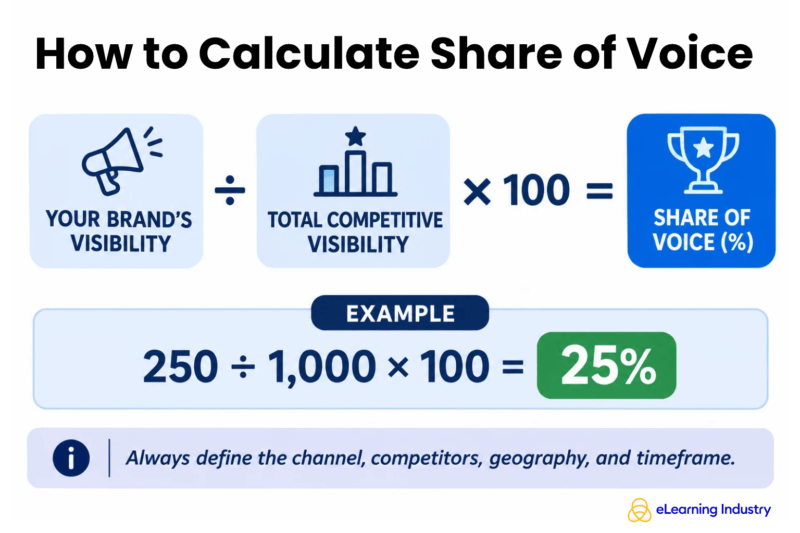
The share of voice formula compares your brand’s visibility with the combined visibility of the competitors in your analysis.
- Your Brand's Visibility: The mentions, impressions, or other relevant metric attributed to your brand.
- Total Measured Market Visibility: The combined visibility of your brand and the competitors included in the analysis.
- 100: Converts the result into a percentage.
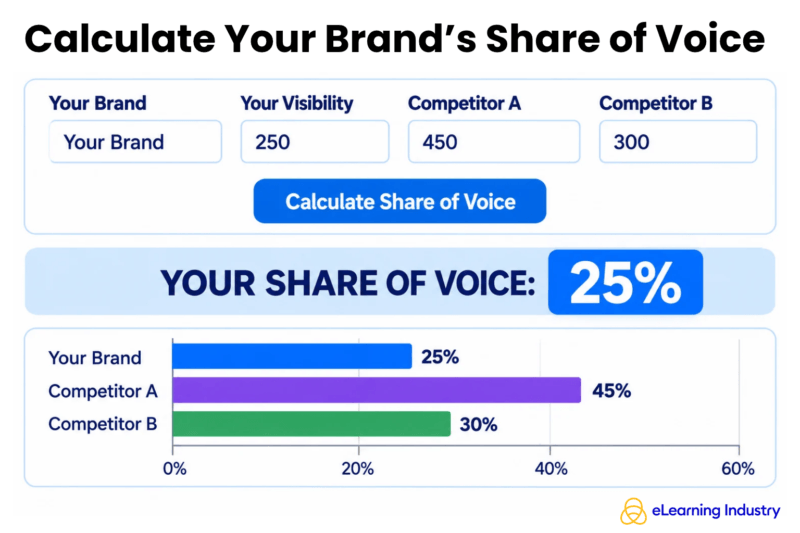
Let's see how this translates using an example. Imagine three LMS vendors receive the following mentions in relevant industry publications during one month:
| LMS Vendor | Brand Mentions |
| Your LMS | 250 |
| Competitor A | 450 |
| Competitor B | 300 |
| Total | 1000 |
Your share of voice calculation:
(250 ÷ 1,000) × 100 = 25%
So, what does this means in simple terms? Your LMS accounts for 25% of the measured mentions across these three vendors during the selected period.
This example shows how to calculate share of voice percentage using a clearly defined metric and competitor set. The result does not mean your LMS owns 25% of the market, generates 25% of industry revenue, or is preferred by 25% of buyers. It only describes its share of the mentions measured.
You can use media monitoring to track visibility over time, then assess brand sentiment and brand discovery separately. These additional measures help explain the quality and impact of your visibility without changing the SOV calculation.
How To Calculate Share Of Voice In 5 Steps
To get useful results from SOV analysis, you need more than a list of brand mentions. You need a clearly defined market, consistent metrics, and comparable data. If you're learning how to calculate share of voice in marketing, follow these five steps to build a reliable measurement and understand what your results reveal about your brand's position.
Step 1: Define Your Market And Competitors
Start by identifying the brands competing for the same audience. For example, an LMS vendor targeting mid-market employee training teams might compare its visibility with five vendors serving similar buyers.
Avoid including every company in the global LMS market if they target different segments or solve different problems. A focused competitor list gives you a more meaningful view of competitive visibility. You can also examine specific categories, such as customer education or healthcare compliance training.
Step 2: Choose The Channel Or Visibility Metric
Decide which channel you want to measure. Options include:
- Brand mentions
- Social media mentions
- Organic search visibility
- Paid search impressions
- Earned media coverage
- AI-generated answers and citations
Keep the metric consistent across all brands. For example, when assessing AI visibility for LMS vendors, compare their appearances across the same prompts and AI platforms. Don't combine unrelated channel metrics in one share of voice measurement.
Step 3: Set The Timeframe And Geography
Define the period and location for your analysis. You might measure:
- Monthly or quarterly visibility
- United States, European Union, or global coverage
Use equivalent dates and geographic boundaries for every competitor. This makes it easier to identify changes and connect them with campaign activity.
Step 4: Collect Comparable Data
Use consistent tools, sources, and collection rules. Depending on your channel, you might use SEO platforms, social listening tools, media monitoring, or online reputation monitoring. Remove irrelevant mentions, duplicates, and false brand matches where possible. Don't forget to apply the same filtering rules to every competitor.
Step 5: Apply The Formula And Interpret The Result
Add your brand's visibility to the competitors' figures to calculate total visibility. Then apply the share of voice formula:
SOV (%) = (Your Brand's Visibility ÷ Total Measured Market Visibility) × 100
Compare the result with previous periods, individual competitors, strategic categories, campaign activity, and relevant business outcomes. This supports more useful competitive benchmarking than looking at a single percentage in isolation.
Share Of Voice Formulas By Marketing Channel
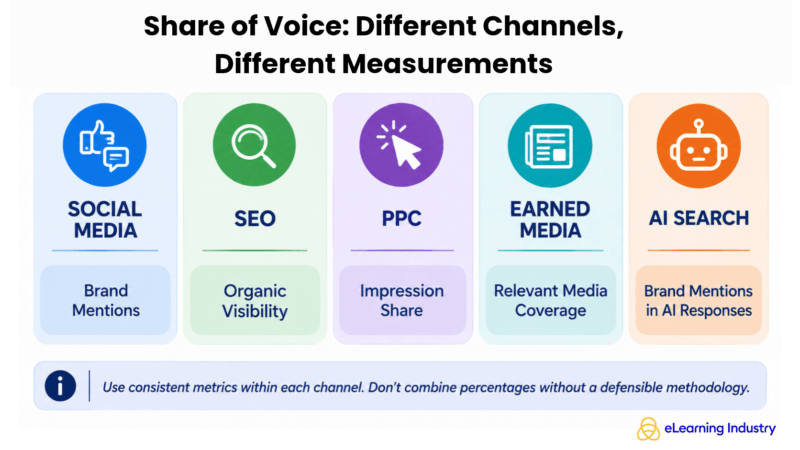
Share of Voice is a family of related competitive metrics. The underlying idea stays the same: measure your brand's visibility against a defined competitive set. However, each channel has different data sources, denominators, and measurement methods. The right share of voice formula depends on what you want to understand and which visibility signals you can measure consistently.
1. Social Media Share of Voice Formula
With social media SOV, you measure how much of the conversation around a defined topic, product, or category belongs to your brand.
Social SOV (%) = (Your Brand's Social Mentions ÷ Total Competitor-Set Brand Mentions) X 100
Example:
Your brand receives 600 relevant social mentions during a month. Your selected competitors receive 2,400, bringing the total to 3,000.
(600 ÷ 3,000) X 100 = 20%
Your social SOV is 20%.
Depending on the platform and tool, social listening may track mentions, impressions, reach, or engagement. These metrics reveal different aspects of visibility. For social listening for B2B marketers, mentions can help measure conversation volume, while impressions estimate how often content appears on users' screens. Choose one metric and apply it consistently. Don't combine mentions from your brand with impressions from competitors.
2. SEO Share of Voice Formula
Organic search SOV estimates how much search visibility your brand captures across a defined set of relevant keywords. You can use estimated organic traffic or a platform-specific visibility score.
A simple traffic-based model is:
SEO SOV (%) = (Your Estimated Organic Visits ÷ Total Estimated Organic Visits) X 100
Example:
Your LMS receives 8,000 estimated organic visits across a selected keyword set. Your competitors collectively receive 32,000. Total estimated visits are 40,000.
(8,000 ÷ 40,000) X 100 = 20%
Your estimated SEO SOV is 20%.
SEO Share of Voice should be calculated using the same keyword set, geographic market, timeframe, and visibility estimation method across all brands.
This explains how to calculate SEO share of voice using estimated traffic. The result depends on the selected keywords, ranking data, click-through-rate assumptions, and competitor set. SEO platforms also use different visibility models, so results may vary. Track the same keyword group and methodology over time to understand changes in organic visibility and search visibility.
3. Google Ads Impression Share Formula
Paid search requires a distinction between competitive SOV and Google Ads Impression Share.
Google Ads calculates Impression Share as:
Impression Share (%) = (Impressions Received ÷ Estimated Eligible Impressions) X 100
Example:
Your ad receives 12,000 impressions out of an estimated 20,000 eligible impressions.
(12,000 ÷ 20,000) X 100 = 60%
Your Impression Share is 60%.
This metric helps you understand how often your ads appeared compared with the opportunities available to them. However, it is not identical to competitive SOV. Its denominator is estimated eligible impressions, not the total impressions received by a mutually exclusive group of competitors. Multiple advertisers can appear in different auctions, so their Impression Share percentages do not need to add up to 100%. This is the key distinction when considering how to calculate PPC share of voice.
4. Earned Media Share of Voice Formula
With earned media SOV, you measure your brand's portion of relevant coverage across selected publications, websites, or industry outlets.
Earned Media SOV (%) = (Your Brand's Relevant Media Mentions ÷ Total Relevant Media Mentions) X 100
Example:
Your brand receives 40 relevant media mentions, while the selected competitors receive 160. The total is 200.
(40 ÷ 200) X 100 = 20%
Your earned media SOV is 20%.
Mention volume is useful, but it doesn't tell the whole story. Consider publication authority, audience relevance, article prominence, sentiment, and original coverage versus syndicated content. These factors help you assess the quality of your earned media strategy. Reviewing examples of earned media, such as expert interviews, independent product reviews, and editorial coverage, can also help you identify opportunities.
5. AI Search Share of Voice
Measure mentions across a predefined set of AI prompts, platforms, and time periods. The competitive set must include your own brand. AI search adds another way to examine competitive visibility. You can measure how often your brand appears in answers generated by tools such as ChatGPT, Google AI Overviews, or other AI search experiences.
One possible operational formula is:
AI Mentions Share (%) = (Your Brand Mentions in AI Responses ÷ Total Competitive-Set Brand Mentions in AI Responses) X 100
Example:
Across a defined set of prompts, your LMS receives 30 mentions. Competitors receive 120, bringing the total to 150.
(30 ÷ 150) X 100 = 20%
Your AI mention share is 20%.
This is a proposed measurement approach, not a universally standardized industry formula. AI answers can mention several brands at once, and repeated prompts may produce different results.
Also distinguish three outcomes:
- AI mention share: How often your brand appears in generated answers.
- AI recommendation rate: How often an AI system recommends your brand when users ask for solutions.
- AI citation rate: How often your website or content is cited as a source.
How To Interpret Your SoV Results
Your SOV gives you a snapshot of brand visibility, but its value becomes clearer when you compare it with competitors, previous periods, and business results. Here’s how to interpret share of voice and use it to guide your marketing decisions.
1. Compare Against Your Competitive Set
A 20% SOV means different things depending on your market. Capturing 20% of mentions among three vendors is different from holding the same share among fifteen. Always consider the size and relevance of your competitor set when reviewing the results of your share of voice formula.
2. Track Changes Over Time
Imagine:
| Quarter | Your Mentions | Total Mentions | Your SOV |
| Q1 | 200 | 1,000 | 20% |
| Q2 | 300 | 1,200 | 25% |
| Q3 | 350 | 1,750 | 20% |
Your mentions increased every quarter, yet your SOV dropped from 25% to 20% in Q3. Competitors simply grew their visibility faster. This is why you should examine absolute numbers alongside relative performance.
3. Evaluate Visibility Quality
Not all mentions carry equal value. Coverage in a respected industry publication read by LMS buyers may be more relevant than numerous unrelated social media mentions. Consider audience fit, publication authority, and context.
4. Consider Sentiment And Context
A high SOV driven by negative reviews or unfavorable coverage may indicate a reputation problem rather than stronger brand positioning.
5. Connect SOV With Business Outcomes
Use share of voice analysis alongside branded searches, relevant website traffic, qualified leads, pipeline, and customer awareness. Consider where visibility appears in the B2B buyer journey, and compare those trends with broader marketing performance. Avoid assuming that a rise or fall in SOV directly caused a change in revenue.
What Is A Good SOV Percentage?
There is no universally good Share of Voice percentage. A meaningful benchmark depends on your competitors, market, channel, and business objectives. A 10% result could be strong in a fragmented category but weak in a concentrated market. It may also be valuable in a specialized niche if the mentions reach relevant buyers.
For example, an LMS vendor might have 5% SOV across the broad LMS category but 35% in discussions about LMS platforms for manufacturing training. If manufacturing companies are its ideal customers, the niche result could be more valuable.
For B2B companies, owning a meaningful share of the right conversation can matter more than dominating a broad, poorly targeted category. This is particularly relevant to mid-market LMS vendors competing with larger enterprise brands. Use the share of voice formula consistently, but judge the result against your brand strategy for growth and its ability to build brand awareness among potential customers.
Share Of Voice vs. Market Share vs. Share Of Search
| Metric | What It Measures | Main Question |
| Share of Voice | Relative visibility within a defined competitive dataset | How visible are we compared with competitors? |
| Market Share | Proportion of a defined market's sales, revenue, customers, or units | How much of the market do we control? |
| Share of Search | Proportion of relevant branded search demand within a defined brand set | How much search interest does our brand capture? |
You can analyze these metrics together, but they aren't interchangeable. A company may have high SOV and low market share because visibility hasn't translated into sales. Another may hold strong market share despite weaker current visibility. Use the SOV formula to track competitive presence, while monitoring sales and search demand separately. Activities such as media outreach can improve visibility, but they don't guarantee market growth.
How To Use Share Of Voice To Improve Your Marketing Strategy
A consistent share of voice formula helps you spot gaps and prioritize actions that support your commercial objectives.
Identify Competitive Visibility Gaps
Find topics, channels, and industry conversations where competitors receive attention but your brand is absent. Review category visibility to uncover opportunities.
Prioritize Relevant Topics And Markets
Focus on industries, buyer needs, and product categories that align with your target audience rather than pursuing broad exposure.
Strengthen Brand Authority
Invest in useful research, expert commentary, customer stories, and thought leadership marketing to demonstrate your expertise.
Improve Third-Party Visibility
Explore relevant industry publications, directories, editorial opportunities, and customer reviews. Include online reputation management in your efforts to monitor how audiences discuss your brand.
Evaluate Campaign Impact
Track whether campaigns increase visibility within your chosen competitive set. Compare results before and after each initiative.
Monitor Changes Consistently
Keep your measurement methodology stable and review results regularly. In share of voice marketing, consistency helps distinguish meaningful progress from temporary fluctuations.
Example: A mid-market LMS vendor identifies low SOV in healthcare training. Instead of launching a generic awareness campaign, it develops healthcare-specific customer evidence, useful content, and relevant industry visibility initiatives. It then tracks whether its presence improves among the competitors and topics that matter. This is an illustrative strategy, not a guaranteed outcome.
Common Share Of Voice Calculation Mistakes
1. Comparing inconsistent data sources: Use comparable tools and collection methods across all brands. Different sources may count mentions differently.
2. Choosing irrelevant competitors: Include brands targeting similar customers and competing in the same category.
3. Mixing channel metrics: Don't combine social mentions, SEO traffic, and media coverage in one calculation.
4. Confusing impression share with competitive SOV: Paid search impression share uses eligible impressions as its denominator, not total competitor visibility.
5. Ignoring duplicates or irrelevant mentions: Clean your dataset to avoid inflated results from repeated coverage, false matches, or unrelated discussions.
6. Comparing different periods or geographies: Keep dates and locations consistent across brands.
7. Prioritizing volume over relevance: A smaller number of mentions from potential buyers may matter more than broad exposure.
8. Assuming high SOV means positive sentiment: Negative coverage can increase visibility without strengthening reputation.
9. Confusing SOV with market share: Visibility does not automatically translate into sales, revenue, or customers.
10. Overreacting to short-term changes: One month's results rarely establish a lasting trend. Review consistent periods before changing your strategy. Apply the same share of voice measurement principles when assessing B2B thought leadership and use them to understand how to calculate share of voice percentage accurately.
Conclusion
Share of Voice gives you a clearer picture of where your brand stands in a competitive market. By applying the share of voice formula consistently, you can see how much visibility your brand captures, which competitors attract more attention, and where opportunities exist. However, the percentage alone does not tell the whole story. The value of each result depends on your chosen channels, competitors, audience, timeframe, and the relevance of the exposure.
A reliable share of voice measurement helps you track progress, identify visibility gaps, and understand whether your marketing efforts are reaching the right audiences. Use competitive benchmarking to put your results into context, and look beyond mention volume to evaluate sentiment, audience fit, and business outcomes. For LMS and Learning Tech companies, this could mean prioritizing relevant industry conversations, supporting social media training initiatives, and building brand authority among the buyers who matter most.
Measuring your brand's visibility is the first step. Improving it is the next. eLearning Industry helps LMS, Learning Tech, and HR Tech companies strengthen their presence among relevant industry audiences through content marketing, thought leadership, SEO and AI visibility initiatives, industry directories, and targeted marketing campaigns.
FAQsThe standard Share of Voice (SOV) formula is:
SOV = (Your Brand's Visibility ÷ Total Market Visibility) X 100
Suppose your brand receives 2,000 advertising impressions in a market where all competitors collectively generate 10,000 impressions.
SOV = (2,000÷10,000) X 100 = 20%
Your brand therefore has a 20% Share of Voice, meaning it accounts for one-fifth of the measured advertising visibility in that market.
There is no universal benchmark for a good Share of Voice percentage. The right target depends on your industry, competition, marketing budget, audience size, and business objectives. A 15% share might be strong in a highly competitive market but less impressive in a smaller niche. Track your SOV over time and compare it with relevant competitors to understand whether your visibility is improving.
Social media Share of Voice is commonly calculated using brand mentions:
Social SOV = (Your Brand Mentions ÷ Total Brand Mentions in the Market) X 100
For example, if your brand receives 500 mentions out of 2,500 total mentions across you and your competitors, your social SOV is 20%.
Share of Voice measures how visible or prominent a brand is compared with competitors. Market share measures its actual portion of total sales or revenue within a defined market.
For example, a software company might generate 30% of industry-related online mentions but account for only 10% of market revenue. This suggests strong visibility without an equivalent level of commercial performance.
Yes. Brands can estimate their AI Share of Voice by measuring how frequently they appear in AI-generated responses compared with competitors across a defined set of prompts.
A consistent methodology should include:
-
Prompt selection: Create questions relevant to your industry, products, and target audience.
-
Competitor tracking: Monitor which brands appear in responses.
-
Mention measurement: Record how often your brand is mentioned.
-
Citation tracking: Identify whether AI tools link to your website or other sources.
-
Regular monitoring: Repeat tests using the same prompts, platforms, and conditions.
