

Charging For AI Services Has Become The Norm
AI features are becoming standard across SaaS products. Nowadays, most platforms no longer treat them as optional add-ons. They sit at the core of the product experience. Yet one question still creates friction for founders and product teams: how should AI pricing strategies be structured so they support growth without slowing adoption? Some companies experiment with charging separately for AI subscription pricing models, while others bundle capabilities into core plans and rethink pricing AI features as part of overall value delivery. The challenge is not just technical, as it directly shapes how customers perceive value and decide to upgrade.
According to recent SaaS benchmarks, over 70% of SaaS companies now include some form of AI capability in their product offering, but fewer than half monetize it directly. This gap creates pressure on pricing teams to rethink how they package and position AI. Instead of treating it as a premium upsell, leading companies connect pricing to usage, outcomes, or tiered access that reflects real customer value.
The strongest AI pricing strategies align pricing with customer value, usage patterns, and business outcomes rather than simply charging for AI features themselves. This article breaks down the most effective AI business strategies SaaS companies use today and shows how pricing decisions directly influence adoption, retention, and long-term profitability. It also helps teams avoid underpricing or overcomplicating their monetization models as markets mature over time.
Key Takeaways
- AI pricing strategies vary between subscriptions, usage-based pricing, and premium add-ons.
- The best pricing models focus on customer value and adoption.
- Usage-based pricing is becoming increasingly common for AI features.
- Smart SaaS companies balance monetization with accessibility and trust.
In This Guide, You Will Find...
- Why AI Pricing Is Different From Traditional SaaS Pricing
- The Most Common AI Pricing Models
- How Smart SaaS Companies Decide What To Charge For
- The Rise Of Usage-Based Pricing In AI
- When AI Features Should Be Free vs. Premium
- The Biggest AI Pricing Mistakes SaaS Companies Make
- How AI Pricing Impacts Adoption And Trust
- Enterprise AI Pricing vs. SMB AI Pricing
- How AI Vendors Communicate Pricing Successfully
- The Future Of AI Pricing Strategies
- How AI Visibility Influences Pricing Power
Why AI Pricing Is Different From Traditional SaaS Pricing
AI pricing behaves differently from traditional SaaS pricing because the cost structure and user behavior don’t stay fixed. When you build standard SaaS products, you usually deal with predictable infrastructure costs and stable usage patterns. But AI changes that foundation. Compute-heavy features like text generation, image creation, or real-time predictions consume variable infrastructure resources every time a user interacts with them. As a result, your cost per customer can fluctuate significantly depending on usage intensity.
This is where AI pricing strategies become more complex. You don’t just decide what a feature is worth. You also need to account for what it costs you every time it runs. A customer who uses an AI assistant occasionally may cost very little, while a power user running thousands of prompts can quickly shift your margins if pricing is not aligned with usage.
At the same time, customers often struggle to understand the true value of AI features upfront. That uncertainty makes it harder to position pricing in a simple tiered model. Instead, companies need to think carefully about how to monetize AI features in a way that feels fair, transparent, and scalable. This is also why conversations around how AI companies make money often center on usage-based billing, credits, or hybrid subscription models rather than flat pricing alone.
Ultimately, AI introduces dynamic costs and changing user behavior that traditional SaaS pricing models were not built for, forcing companies to rethink both value delivery and revenue design from the ground up.
The Most Common AI Pricing Models
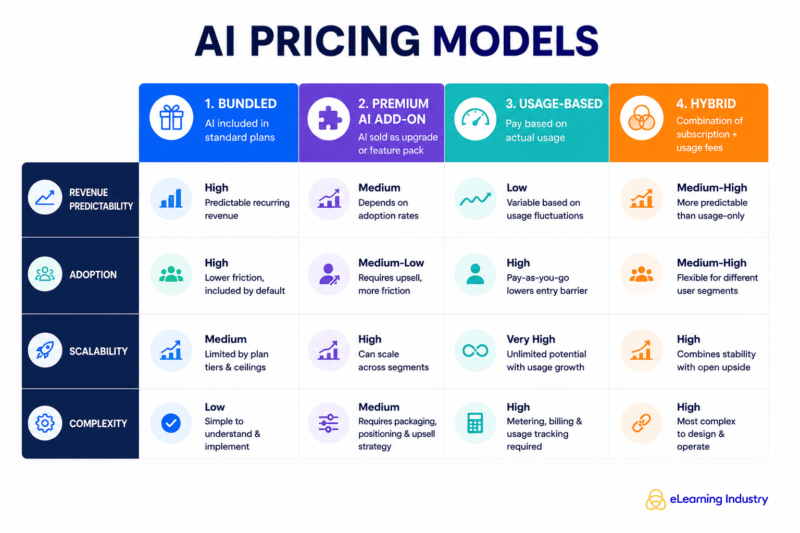
AI monetization has evolved quickly, and most companies now rely on a small set of structured approaches that directly influence growth and retention. When you think about AI pricing strategies, you need to look at how each model impacts adoption, cost control, and long-term revenue potential.
1. Bundled AI Pricing
In this model, companies include AI features inside existing subscription tiers without charging extra. Customers get access as part of their plan, which makes adoption feel seamless and low-friction.
Benefits:
- Faster adoption because users don’t face extra pricing barriers
- Simpler messaging for sales and marketing teams
- Easier onboarding since AI feels like a native product feature
Risks:
- Hidden infrastructure costs can grow quickly
- Heavy users may consume disproportionate compute resources
- Harder to separate AI value from core product value
2. Premium AI Add-On
Here, companies package AI as an upgrade or separate feature set that sits above standard plans. This creates a clear line between base functionality and advanced AI capabilities.
Benefits:
- Stronger monetization control
- Better protection of margins on compute-heavy features
- Clear value positioning for enterprise buyers
Risks:
- Lower adoption rates among price-sensitive users
- Can slow down product-led growth motion
- Requires strong messaging to justify the upgrade
This model is common in mature SaaS AI pricing models where AI delivers distinct, high-value outcomes. It also reflects how AI subscription pricing evolves as products mature and customers become more willing to pay for advanced capabilities.
3. Usage-Based Pricing
This model charges customers based on consumption, such as per prompt, per token, or per generation. It directly connects cost to usage intensity.
Benefits:
- Scalable revenue aligned with product usage
- Fair pricing structure for both light and heavy users
- Easier to tie revenue to actual system load
Risks:
- Revenue becomes less predictable month to month
- Customers may hesitate to experiment due to cost concerns
- Requires strong metering and billing infrastructure
This approach, often referred to as usage-based pricing for AI tools, has become a foundation for many modern AI-first platforms. It also helps improve pipeline velocity by allowing sales teams to close deals faster while still maintaining flexibility in expansion revenue.
4. Hybrid Pricing Models
Hybrid models combine subscription tiers with usage-based fees. Customers pay a base fee and then scale costs based on activity.
Structure:
- Base subscription for access
- Additional usage fees for AI consumption
This approach is increasingly common in SaaS AI pricing as companies try to balance predictability with scalability. It allows teams to capture value from high-usage customers while still offering stable entry pricing. It also plays a key role in shaping an effective AI strategy roadmap, helping companies design pricing systems that evolve as product usage, customer segments, and compute costs change over time.
How Smart SaaS Companies Decide What To Charge For
1. Customer Value
- Identify the core outcome the AI delivers to users in real workflows
- Measure impact through time saved, productivity gains, or revenue lift
- Anchor pricing decisions to the value customers clearly recognize and rely on
AI may be increasingly expected, but buyers aren't evaluating it in isolation. According to eLearning Industry research, 63% of L&D buyers cite pricing as a key consideration when selecting a learning platform, compared with just 30% who cite AI features. User Experience (70%) and integration capabilities (59%) also rank higher. This suggests that AI pricing strategies need to account for the product's overall value rather than assuming that AI functionality alone creates pricing power.
2. Infrastructure Costs
- Track compute usage per request, feature, or session
- Include model, API, storage, and latency-related expenses in cost planning
- Continuously adjust pricing to maintain healthy margins at scale
3. Feature Differentiation
- Separate basic automation tools from advanced AI capabilities with clear boundaries
- Position high-impact or complex features in higher-value tiers
- Use product differentiation to justify pricing gaps between plans
4. Willingness To Pay
- Test pricing sensitivity across different customer segments and company sizes
- Benchmark against competitor offerings and market expectations
- Monitor how generative AI pricing trends influence buyer behavior and acceptance levels
5. Strategic Pricing Lens
- Align decisions with broader AI pricing strategies used across SaaS portfolios
- Study how leading AI companies structure pricing around outcomes instead of features
- Continuously refine pricing based on adoption patterns, usage intensity, and product maturity signals

The Rise Of Usage-Based Pricing In AI
Why Usage-Based Pricing Is Becoming The Default
Usage-based models are growing fast because AI doesn’t behave like traditional software. Every request carries a real cost, and that cost changes depending on how people use the product. When you design AI pricing strategies, you can’t rely on fixed assumptions anymore. You need pricing that adapts to real consumption patterns.
AI workloads vary widely across users and use cases. One customer may send a few prompts a day, while another runs thousands of heavy computations in the same period. This variation makes flat pricing risky for companies and unfair for customers who use the product lightly. At the same time, infrastructure costs scale directly with usage, especially when models rely on third-party APIs or large compute clusters.
Key reasons for growth:
- AI workloads fluctuate heavily across users and time
- Infrastructure costs increase with every additional request
- Pricing needs to reflect actual consumption rather than access
Where Usage-Based Pricing Is Already Winning
The model is already standard in several fast-growing AI categories. It fits naturally into products where output generation or processing varies per request and cannot be easily capped.
AI pricing examples include:
- AI writing assistants charging per word or generation
- Copilots that bill based on task completion or prompt volume
- Image and video generation tools priced per render or second of compute
At the same time, companies use an AI strategy framework to balance predictability and flexibility, often combining usage tiers with base subscriptions to stabilize revenue while still capturing upside from power users.
When AI Features Should Be Free vs. Premium
Free AI Features
- Include AI features that drive early AI pricing strategies and help users understand core product value.
- Use free access to improve onboarding and reduce friction during first-time product adoption.
- Offer lightweight AI tools that support retention without creating high infrastructure costs.
- Keep free capabilities simple so users experience value quickly and return regularly.
Premium AI Features
- Reserve advanced capabilities for paid tiers in how SaaS companies price AI features across different customer segments.
- Monetize features that support complex workflows, automation, and multi-step decision-making at scale.
- Target enterprise use cases where AI directly improves revenue, efficiency, or operational performance.
- Package high-compute features into premium plans to ensure sustainable margins and predictable growth.
eLearning Industry research reinforces the importance of value-based AI pricing. Only 3% of L&D buyers say they are willing to pay significantly more for AI capabilities, while 42% tie their willingness to pay to proven use cases and outcomes. For SaaS providers, this suggests that simply labeling a feature "AI-powered" may not be enough to justify a premium. Vendors need to connect higher prices to clear, measurable value.
Do you want to stay updated regarding the latest eLearning news? Subscribe to our newsletter and never miss a beat!
The Biggest AI Pricing Mistakes SaaS Companies Make
- Charging too early: Teams monetize AI before users understand its value, which slows adoption and reduces long-term engagement. This is one of the most common AI pricing strategies mistakes in early-stage SaaS products.
- Underpricing infrastructure-heavy features: High-compute AI features often cost more to deliver than expected, which slowly damages margins and creates long-term pricing pressure.
- Unclear value communication: Customers struggle to connect price with outcomes when benefits are not clearly explained in simple, user-focused language.
- Overcomplicated pricing: Too many tiers, credits, and rules make it harder for users to choose and reduce conversion rates, especially when teams overthink should AI features cost extra decisions.
How AI Pricing Impacts Adoption And Trust
Transparent Pricing Builds Confidence
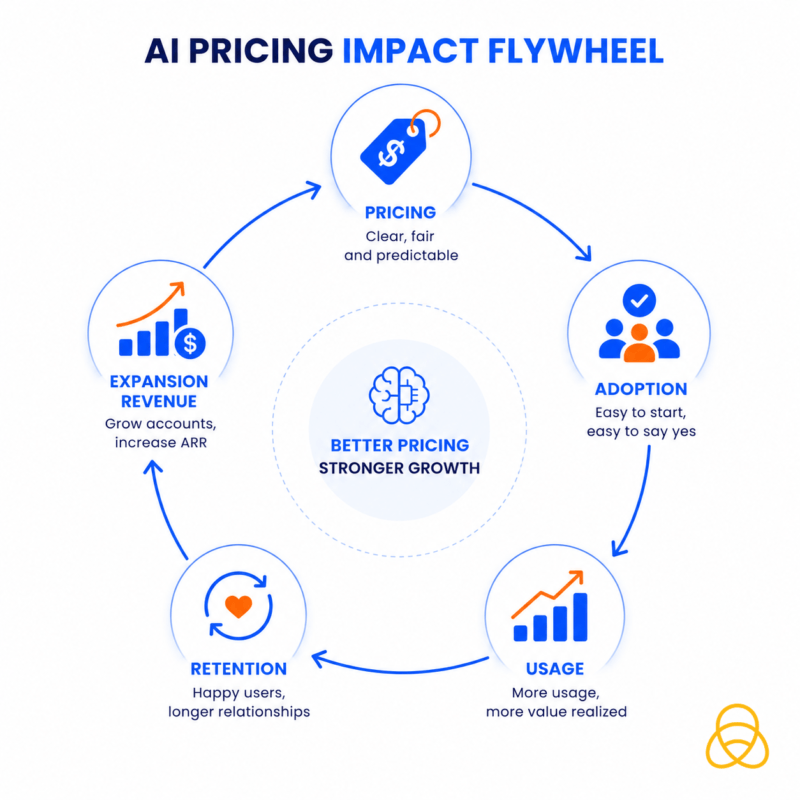
Clear and predictable pricing plays a major role in how users perceive AI products. When customers understand exactly what they are paying for, they feel more in control and more willing to commit. This is especially important in AI products where value can feel abstract at first. Transparent models help users connect cost with outcomes, which reduces hesitation during onboarding and trial stages.
When you design AI pricing strategies, clarity should always come before complexity. If users can quickly understand how pricing works, they are more likely to trust the product and integrate it into daily workflows. In practice, transparency also reduces support load and improves conversion rates because customers don’t need to decode pricing rules before making a decision.
Unpredictable Pricing Creates Friction
When pricing feels unclear or inconsistent, users hesitate to scale their usage. This often happens with hidden usage fees, unclear credit systems, or unexpected charges. As a result, customers may limit their interaction with AI features, even when those features deliver strong value.
In SaaS AI pricing, unpredictability becomes a direct barrier to growth. Instead of encouraging adoption, it creates anxiety around cost control. Over time, this slows down expansion and reduces product stickiness.
Pricing Influences Experimentation
Pricing also shapes how freely users explore AI features. When pricing feels fair and easy to understand, customers are more likely to test different use cases and integrate AI deeper into their workflows. However, when pricing feels restrictive or unclear, users become cautious and limit experimentation. This directly impacts product learning cycles and slows feature discovery.
Strong pricing design becomes part of a broader brand strategy for growth, because it influences not just revenue, but also how confidently users engage with the product over time.
Pricing Shapes Brand Perception
Pricing sends a strong signal about how a company thinks and operates. When pricing feels straightforward, users often associate the product with clarity, reliability, and ease of use. It sets expectations before a customer even fully experiences the product. On the other hand, complex pricing structures can create doubt. Even if the product delivers strong performance, confusion around plans or billing can weaken overall trust. Users may start questioning hidden costs or long-term commitments, which affects how confidently they engage.
Enterprise AI Pricing Vs. SMB AI Pricing
SMB Buyers
SMB customers prioritize clarity and speed when evaluating tools. They want pricing that is easy to understand and quick to approve without long procurement cycles.
- Prefer simple pricing tiers with clear limits
- Expect predictable monthly or annual costs
- Avoid complex usage rules or hidden fees
- Make fast decisions based on immediate value
For SMB-focused AI pricing model design, simplicity directly drives adoption and reduces churn risk.
Enterprise Buyers
Enterprise customers evaluate AI products through a different lens. They focus less on simplicity and more on scale, control, and long-term operational fit.
- Require scalable systems that support high usage volumes
- Expect strong security, compliance, and data governance
- Demand customization to fit internal workflows and systems
- Often involve multiple stakeholders in purchase decisions
Enterprise deals also extend beyond software access. They frequently include onboarding, dedicated support, implementation services, and governance frameworks to ensure safe deployment at scale.
This difference shapes how companies build an AI product pricing strategy across segments. SMB pricing focuses on accessibility and speed, while enterprise pricing emphasizes flexibility and operational depth. Together, these approaches define how companies structure growth, expansion, and long-term positioning within an AI strategy for business.
How AI Vendors Communicate Pricing Successfully
-
Positioning
Successful AI vendors start by clearly defining where their product sits in the market. They don’t just describe features. Τhey explain the problem they solve and the type of customer they serve. Strong positioning helps buyers immediately understand relevance without needing deep technical knowledge. When companies build AI pricing strategies, positioning becomes the foundation for everything else, because it shapes how value is perceived before pricing is even discussed.
-
Messaging
Clear messaging translates product capabilities into simple, outcome-driven language. Instead of focusing on technical details, successful vendors highlight what users can achieve with the product. This approach reduces confusion and makes pricing feel more justified. In SaaS AI pricing, messaging often separates high-performing products from those that struggle to convert interest into paying customers.
-
Demonstrating ROI
Vendors that communicate pricing well always connect cost to measurable business outcomes. They show how AI reduces time, increases efficiency, or drives revenue improvements. This makes pricing feel less like an expense and more like an investment decision.
-
Thought Leadership
Strong vendors build B2B thought leadership by publishing insights, case studies, and benchmarks that educate the market. This builds trust before buyers even reach the pricing page.
-
Education And Buyer Enablement
Top-performing companies invest in educating buyers about how AI works and how value is created. They simplify complex concepts so decision-makers can confidently evaluate pricing without uncertainty. This approach strengthens the overall AI monetization strategy, because it reduces friction in the buying process and shortens sales cycles.
The Future Of AI Pricing Strategies
The next wave of AI monetization will focus on flexibility and closer alignment between value and cost. Companies will move away from rigid plans and adopt more adaptive structures that reflect real product usage and outcomes. As competition increases, pricing will become a key lever for differentiation rather than just a revenue function.
One major shift will be the rise of more hybrid pricing models. Companies will combine subscriptions with usage credits to give customers both predictability and scalability. This approach also supports AI SaaS pricing models that need to balance enterprise requirements with product-led growth.
At the same time, usage credits will become more common as a way to simplify billing. Instead of tracking complex metrics, customers will buy credits and apply them across different features. This evolution will strengthen usage-based pricing for AI tools by making consumption easier to understand and control.
Outcome-based pricing will also gain traction, where companies tie costs directly to business results rather than inputs. Finally, embedded AI will become standard across platforms, making AI workflows more seamless and deeply integrated into everyday tools without users even noticing separate AI layers.
How AI Visibility Influences Pricing Power
Companies that consistently show up in industry conversations gain more control over how they price their products. Visibility builds familiarity, and familiarity reduces resistance during purchase decisions. Over time, this directly increases pricing power because customers feel more confident choosing a known brand over a lesser-known alternative.
Thought leadership plays a major role here. When companies publish insights, case studies, and clear perspectives on AI trends, they position themselves as experts rather than just vendors. This strengthens credibility and supports stronger AI pricing strategies because buyers trust the value behind the price.
Additionally, trust shapes how customers interpret pricing. If a company is seen as reliable and consistent, users are more willing to accept premium tiers without hesitation. Category positioning adds another layer, since brands that define or lead a category often set pricing expectations for the entire market. This is where thought leadership marketing becomes a long-term advantage, reinforcing authority and improving how the market perceives value.
Key Takeaway
AI pricing has moved from a simple packaging decision to a core growth lever that directly shapes adoption, retention, and profitability across SaaS companies. As AI becomes embedded in nearly every product category, companies can no longer rely on static pricing logic. Instead, they must design systems that reflect real usage, customer value, and infrastructure realities. This is where strong AI pricing strategies become essential, because they help companies connect what they charge with what customers actually gain.
At the same time, pricing is now tightly linked to product design and a go-to-market strategy. Companies treat it as part of a broader AI implementation strategy, where monetization, infrastructure costs, and customer experience all influence each other. Whether businesses choose bundled models, usage-based systems, or hybrid structures, the goal remains consistent: create pricing that scales with value, not just features.
Meanwhile, AI subscription pricing continues to evolve as vendors experiment with credits, tiered access, and outcome-aligned billing models that better match diverse usage patterns.
eLearning Industry helps AI solution providers, SaaS companies, and HR tech vendors showcase their products through targeted visibility, thought leadership, webinars, and lead generation campaigns, connecting them with businesses actively exploring AI-powered solutions. If your company offers AI features designed to improve productivity, automation, or decision-making, this is your opportunity to reach buyers actively evaluating AI investments.
FAQThere is no single best model, but most successful AI products use a mix of subscription (SaaS) and usage-based pricing to balance predictable revenue with scalability.
Often yes. Advanced AI features are bundled into premium tiers or add-ons to reflect higher compute costs and encourage upselling.
It’s a model where customers pay based on how much they use the product, such as API calls, tokens processed, or tasks completed.
They make money mainly through subscriptions, tiered plans, enterprise contracts, API access fees, and sometimes usage-based billing.