

Roles, Responsibilities, And Business Impact Of A PR Team Explained
For years, many people associated PR with press releases, media interviews, and responding when something went wrong. Those responsibilities still matter, but they no longer define the role of a modern PR team.
Today, PR sits much closer to the center of business strategy. That is because it helps companies build credibility, strengthen their reputation, increase executive visibility, and stay visible wherever buyers look for information. Essentially, that includes news publications, podcasts, industry websites, conferences, LinkedIn, search engines, and AI-powered search experiences.
Overall, this shift reflects the way people make buying decisions. Whether someone is choosing a software platform, evaluating a technology partner, or considering a new employer, they rarely act after seeing a single advertisement. Instead, they spend time researching. They read articles, compare vendors, listen to podcasts, follow industry experts, and search for independent opinions. Therefore, by the time they speak with a sales team, they've often formed a clear impression of the company.
That is exactly why visibility alone is not enough anymore. Companies also need credibility. Credibility comes from being present in trusted conversations, earning recognition from respected publications, and consistently sharing useful ideas. Those outcomes don't happen by accident. Instead, they are the result of a thoughtful public relations strategy.
A strong PR team helps create those opportunities by:
- Building relationships with journalists and industry influencers
- Supporting executives as visible industry experts
- Creating thought leadership content
- Strengthening brand reputation across multiple channels
- Helping the company earn trust before buyers speak with sales
A PR team manages an organization's reputation by building relationships with the media, creating thought leadership, supporting executive visibility, and increasing brand awareness across traditional, digital, and AI-driven channels.
Key Takeaways
- PR teams manage reputation, visibility, and strategic communications.
- Modern PR extends beyond media relations into thought leadership, executive branding, podcasts, SEO, and AI visibility.
- Effective PR supports brand awareness, demand generation, and long-term business growth.
- PR works best when integrated with marketing, content, and sales.
In This Article, We Explore…
- What Is A PR Team?
- Why PR Matters More Than Ever
- Core Roles Within A Modern PR Team
- The Business Impact Of PR
- How PR Supports Marketing And Demand Generation
- PR, SEO, GEO, And AI Visibility
- Executive Thought Leadership: The New PR Advantage
- Common PR Mistakes Companies Make
- Measuring PR Success
- The Future Of PR
What Is A PR Team?
We all know that a PR team is responsible for shaping how an organization is perceived by the outside world.
In general, that responsibility extends far beyond speaking with journalists. Every company has a reputation, whether it actively manages it or not. Customers, investors, employees, partners, analysts, and the media all form opinions based on what they read, hear, and experience.
Having said that, the role of a public relations team is to influence those perceptions through clear communication, valuable insights, and consistent visibility. Therefore, it works to ensure the organization is represented accurately while creating opportunities to build trust with the audiences that matter most.
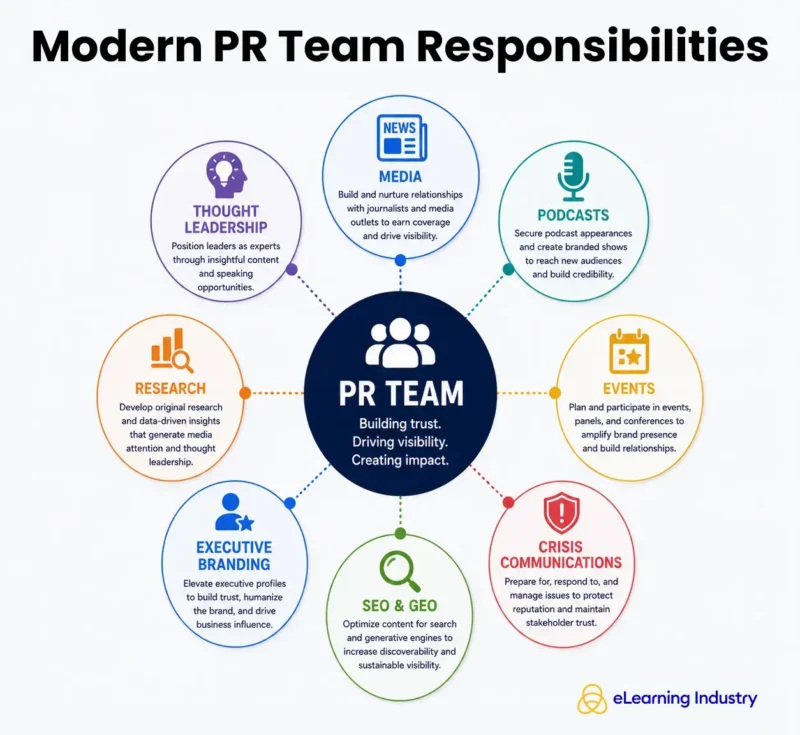
However, today's communication landscape looks very different. Modern public relations often includes responsibilities such as:
- Media relations and press outreach
- Executive thought leadership
- Podcast guesting
- Speaking opportunities
- Analyst relations
- Original research
- Industry awards
- Reputation management
- Crisis communications
- SEO, GEO, and AI visibility
In general, this shift represents more than an expansion of responsibilities. It reflects a different way of thinking about PR.
Rather than chasing publicity for its own sake, modern PR focuses on building authority. That authority develops gradually as a company contributes valuable ideas, appears in respected publications, publishes original research, participates in industry discussions, and consistently provides useful commentary.
Modern PR teams help create those opportunities by supporting leaders with interviews, keynote presentations, guest articles, podcast appearances, LinkedIn content, and media training. As executives become recognized experts, the company's reputation grows alongside them.
Over time, these efforts create a cycle of credibility. Journalists become more likely to seek expert commentary, conference organizers extend speaking invitations, analysts become familiar with the business, and potential customers gain confidence before ever speaking with the sales team.
That accumulated trust often becomes one of a company's strongest competitive advantages.
Why PR Matters More Than Ever
The way people evaluate businesses has changed.
Whether someone is purchasing enterprise software, hiring a consultant, or selecting a technology partner, they usually complete a significant amount of research before contacting the company. They compare competitors, read customer stories, watch webinars, search Google, ask AI assistants questions, and look for expert opinions from sources they already trust.
As a result, companies have fewer opportunities to shape first impressions directly.
Those first impressions are increasingly formed through independent sources. A buyer might discover a company because its CEO appeared on an industry podcast, later read an article quoting one of its executives, come across original research published by the business, and finally visit the company's website after already believing it is credible.
This is where PR creates value. Unlike advertising, which pays for attention, PR focuses on earning attention through trusted channels. It helps organizations become part of conversations that buyers are already having instead of interrupting them with promotional messages.
Several factors have made this approach more valuable than ever:
- Buyers trust independent sources more than company messaging.
- Research now happens long before the first sales conversation.
- Executive expertise often influences purchasing decisions.
- Reputation spreads quickly through digital and AI-powered channels.
- Trust has become a key competitive advantage in crowded markets.
Strong public relations also creates consistency across every public touchpoint. Whether someone reads a news article, attends a webinar, listens to a podcast, or visits the company website, they should encounter the same clear story about who the organization is, what it stands for, and why it matters.
Like any strong reputation, trust isn't built overnight. It grows through consistent actions, credible communication, and meaningful contributions over time.
Core Roles Within A Modern PR Team
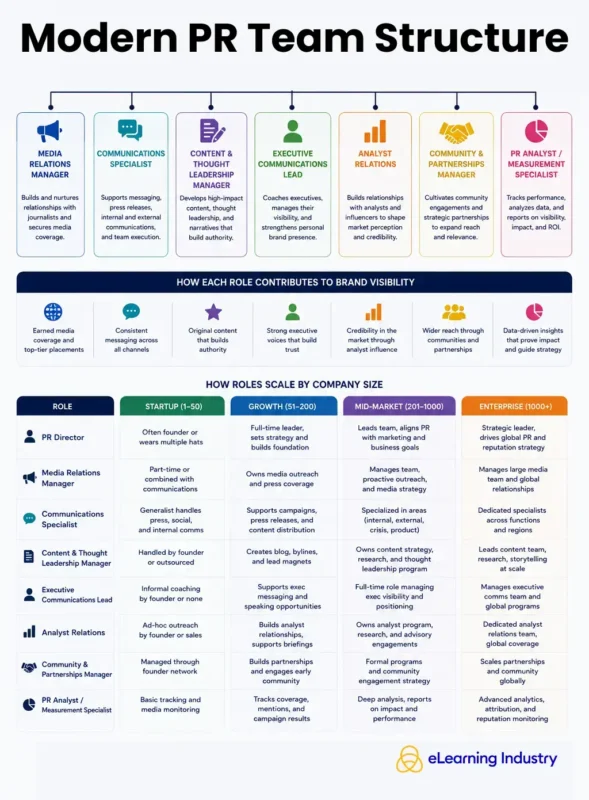
Not every organization builds its PR team in the same way.
For instance, a startup may have one communications manager responsible for everything from media outreach to executive LinkedIn content. On the other hand, a global enterprise may have separate teams for corporate communications, product PR, analyst relations, internal communications, investor relations, and executive messaging. The size may change, but the core objective does not.
Every PR team exists to strengthen reputation, increase visibility, and support business goals through strategic communication.
Overall, the following roles are common within modern public relations teams, although responsibilities often overlap depending on company size.
PR Director
The PR Director is responsible for setting the overall communications strategy.
Rather than focusing only on daily media activity, this role connects PR with broader business objectives. The PR Director works closely with executive leadership to decide which stories the company should tell, which audiences matter most, and how public relations can support growth.
This role often oversees crisis planning, messaging, measurement, agency relationships, executive communications, and cross-functional collaboration with marketing, sales, and leadership.
A good PR Director spends as much time thinking about business priorities as communication tactics.
They ask questions like:
- How do we increase trust in a new market?
- How do we position our CEO as an industry expert?
- How do we support a product launch beyond advertising?
- How do we strengthen our reputation before entering a competitive category?
Those strategic questions shape everything the team does.
Media Relations Manager
Media relations remains one of the foundations of public relations, but the role has become much more strategic than simply sending press releases to journalists.
A Media Relations Manager is responsible for building long-term relationships with reporters, editors, producers, and industry publications. The objective isn't to secure coverage for every announcement. Instead, it's to become a reliable source of useful information that journalists can trust when covering the industry.
That requires a deep understanding of both the company's business and the media landscape. Journalists receive hundreds of pitches every week, so successful PR professionals focus on stories that provide genuine value rather than promotional messages.
Their responsibilities often include:
- Developing media lists based on relevant publications and journalists
- Pitching stories that align with current industry trends
- Coordinating interviews between journalists and company spokespeople
- Responding to media inquiries
- Preparing briefing documents before interviews
- Monitoring media coverage and identifying new opportunities
Over time, strong media relationships make it easier to secure meaningful coverage because journalists already know the company can provide knowledgeable commentary and credible sources.
Communications Specialist
Communications Specialists are responsible for much of the content that supports a PR strategy.
While many people associate this role with writing press releases, the reality is far broader. Communications professionals develop a wide range of materials that ensure the company's messaging remains clear and consistent across every public channel.
Depending on the organization, they may create:
- Press releases
- Company announcements
- Award submissions
- Customer success stories
- Executive biographies
- Media kits
- Fact sheets
- Internal communications
- Q&A documents for interviews
- Messaging frameworks
Strong writing remains one of the most valuable skills in public relations. Every document should explain complex ideas in a way that's easy to understand while maintaining consistency across the organization's communications.
Content And Thought Leadership Manager
One of the biggest changes in modern PR has been the rise of thought leadership.
Today's buyers don't just want to hear about products. They want to hear from experts who understand their challenges, explain industry trends, and provide practical insights.
The Content and Thought Leadership Manager helps position executives and Subject Matter Experts as trusted voices within their market.
Their work often includes developing:
- Guest articles for industry publications
- Opinion pieces
- Research reports
- Executive blogs
- LinkedIn articles
- Commentary on industry developments
- Podcast talking points
- Conference presentations
The purpose isn't to promote the company directly. Instead, the focus is on sharing useful knowledge that helps the audience understand important issues affecting their industry.
When this approach is consistent, the company gradually becomes associated with expertise rather than advertising.
Executive Communications Lead
Executives have become one of the strongest assets in modern public relations.
Customers increasingly want to know who leads the companies they buy from. Investors want confidence in leadership. Employees want leaders who communicate clearly. Journalists and conference organizers also prefer speaking with executives who can offer informed opinions rather than scripted product messaging.
The Executive Communications Lead helps leaders communicate effectively across every public setting.
Their responsibilities often include:
- Preparing keynote presentations
- Writing speeches
- Developing executive messaging
- Coaching leaders before media interviews
- Supporting LinkedIn content
- Preparing executives for podcasts and panel discussions
- Drafting opinion articles and contributed content
The role isn't about putting words into someone's mouth. It's about helping executives express their expertise clearly while ensuring every public appearance supports the company's broader communication strategy.
Analyst Relations
For many B2B organizations, analysts have significant influence over purchasing decisions.
Enterprise buyers frequently consult research firms before selecting vendors, especially when making large technology investments.
Analyst Relations professionals build relationships with these firms by providing product updates, sharing market insights, arranging briefings, and answering questions throughout the year.
Their work helps ensure analysts understand the company's vision, strengths, and position within the market.
Positive analyst relationships don't guarantee favorable reports, but they do ensure the company is accurately represented when analysts evaluate the competitive landscape.
Community And Partnerships
Modern PR extends beyond traditional media and industry analysts.
Many organizations now invest heavily in communities, strategic partnerships, and industry networks because these relationships contribute to long-term reputation.
Depending on the business, this role may involve:
- Managing industry association memberships
- Supporting partnership announcements
- Building relationships with creators and influencers
- Coordinating community initiatives
- Managing customer advocacy programs
- Promoting sponsorships and events
These activities strengthen credibility by showing that the organization actively contributes to its industry rather than simply promoting itself.
How PR Team Structures Change As Companies Grow
Every organization needs public relations, but the structure of the team usually reflects the size and maturity of the business.
Early-stage startups often rely on a single communications professional or an external PR agency. In these environments, one person may handle everything from media outreach and executive content to event planning and social media support.
As companies grow, responsibilities become more specialized. Mid-sized businesses often introduce dedicated roles for media relations, thought leadership, executive communications, and content development. This allows each function to receive greater focus while maintaining a consistent communication strategy.
Large enterprises typically build entire communications departments that include specialists across several areas, including:
- Corporate communications
- Product PR
- Executive communications
- Analyst relations
- Investor relations
- Internal communications
- Regional communications
- Crisis management
Although the structure becomes more complex, the objective remains the same. Every role contributes to building trust, protecting reputation, and increasing visibility among the audiences that matter most.
Modern PR Team Structure
The Business Impact Of PR
For many years, PR was viewed as a support function. It was often measured by the number of press releases published or the amount of media coverage generated each month. While those metrics still provide useful information, they only tell part of the story.
Today, public relations has a much broader impact on business performance.
Therefore, rather than focusing solely on communications, modern PR creates the conditions that make marketing, sales, recruitment, partnerships, and even investor relations more effective.
Building Brand Awareness
We all know that no company can grow if potential customers have never heard of it.
PR increases visibility by placing the business where its audience already spends time. That could include industry publications, podcasts, conferences, research reports, newsletters, webinars, or interviews with company leaders.
Unlike paid advertising, these appearances are often viewed as independent endorsements because they come from trusted third parties. Over time, repeated exposure helps build familiarity.
When buyers eventually enter the market, they're more likely to recognize companies they've encountered through credible sources.
Strengthening Trust
Awareness creates recognition while trust creates preference. Overall, this is one of PR's greatest strengths.
Independent media coverage, analyst reports, conference speaking opportunities, podcast interviews, and expert commentary all provide external validation that advertising cannot replicate.
When buyers repeatedly encounter the same company across respected sources, confidence begins to grow naturally.
Instead of wondering whether the company is credible, buyers begin assuming that it is.
That shift can significantly influence purchasing decisions, especially in competitive B2B markets where products often appear similar on paper.
Increasing Share Of Voice
Share of voice measures how visible a company is compared with its competitors.
Although the metric originated in advertising, it has become increasingly important in PR because it reflects how often an organization appears in industry conversations.
Companies with a strong share of voice are frequently quoted in articles, invited onto podcasts, featured at conferences, and included in market discussions.
That consistent visibility creates the impression of market leadership.
Even when competitors offer similar products, organizations with a stronger public presence are often viewed as more established and more influential.
Supporting Executive Credibility
Modern buyers don't only evaluate products; they evaluate leadership.
A CEO who regularly contributes thoughtful commentary, speaks at respected conferences, appears on industry podcasts, and publishes insightful articles becomes a trusted representative of the company.
This credibility benefits the entire organization.
Customers feel more confident buying from recognized experts. Journalists are more likely to request interviews. Conference organizers extend speaking invitations. Analysts become familiar with the executive team's perspective.
As executive visibility grows, so does the company's reputation.
Improving Investor Confidence
For private companies seeking funding and public companies communicating with shareholders, reputation matters.
Investors look beyond financial performance.
They also evaluate leadership, market positioning, competitive differentiation, and public perception.
A company that communicates consistently, appears in respected publications, publishes original research, and demonstrates industry leadership often inspires greater confidence than one that rarely appears outside its own website.
PR supports that confidence by ensuring the market has a clear understanding of the company's direction and expertise.
Supporting Recruitment And Employer Brand
The hiring process has changed just as much as the buying process.
Before accepting a job offer, candidates research employers through search engines, news articles, employee reviews, executive interviews, and social media.
Public relations contributes to employer branding by highlighting company culture, leadership, innovation, community involvement, and industry recognition.
This visibility makes it easier to attract talented people who want to work for organizations with strong reputations.
Creating Better Conditions For Demand Generation
One of the biggest misconceptions about PR is that it should generate leads directly.
While PR can contribute to pipeline growth, its primary role is different. PR creates awareness before marketing campaigns begin. It builds credibility before sales conversations start. It establishes trust before prospects compare vendors.
Think of PR as reducing friction throughout the buying journey.
When prospects already recognize the company's name, have seen its executives interviewed, or have read its research, marketing campaigns become more effective because they don't need to introduce an unfamiliar brand.
Sales teams also benefit because prospects arrive with greater confidence and a better understanding of the business. In that sense, PR rarely works in isolation. Its value comes from making every other growth function perform more effectively.
How PR Supports Marketing And Demand Generation
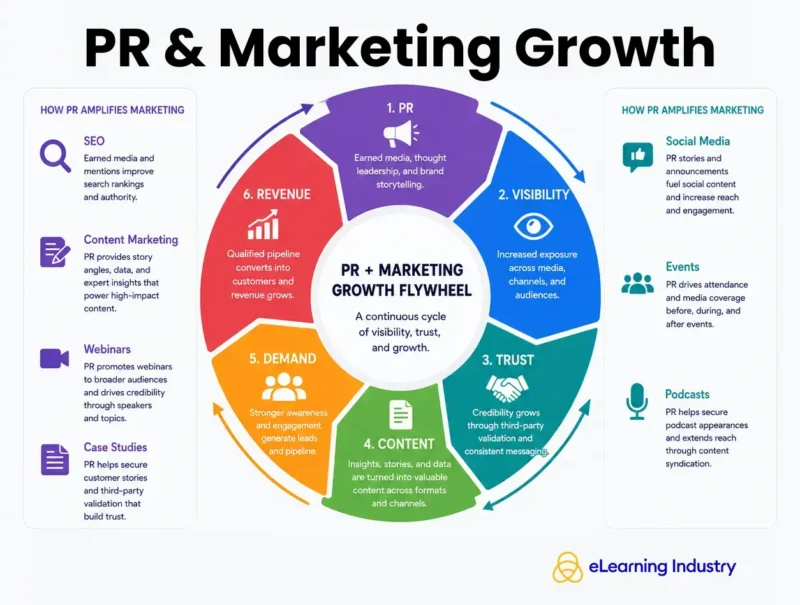
Public relations and marketing are often discussed as separate disciplines. In reality, the strongest organizations treat them as complementary functions with shared business goals.
Marketing focuses on creating demand through campaigns, advertising, email, content, and digital channels. PR focuses on creating trust through independent validation, executive visibility, and industry credibility. When these efforts are aligned, the results become much stronger.
For example, a media interview secured by the PR team doesn't end when the article is published. Marketing can repurpose that content into social media posts, newsletters, blog articles, sales materials, webinar discussions, and paid campaigns.
Likewise, original research developed for a marketing campaign can generate media coverage, speaking invitations, podcast opportunities, and analyst interest through PR.
Instead of operating in separate silos, successful teams build a shared content ecosystem where every activity supports multiple business objectives.
This collaboration strengthens:
- SEO through earned backlinks and authoritative mentions
- Content marketing by adding third-party credibility
- Webinar attendance through media exposure
- Event promotion through speaker visibility
- Case studies through customer storytelling
- Social media through earned content
- Sales enablement through trusted external validation
When PR and marketing work together, every successful campaign creates additional opportunities for visibility, and every PR win generates new marketing assets.
That continuous cycle allows organizations to build awareness, trust, and demand more efficiently than either function could achieve on its own.
PR, SEO, GEO, And AI Visibility
For many years, the connection between PR and SEO was fairly straightforward.
When a company earned coverage in reputable publications, it often received backlinks to its website. Those backlinks helped improve domain authority, increased referral traffic, and signaled credibility to search engines. As a result, public relations became an indirect but valuable contributor to organic search performance.
Today, people don't rely solely on Google when researching a company or evaluating a product. Many also use AI-powered search experiences and conversational assistants to compare vendors, understand industry trends, and discover expert recommendations.
This is where concepts like Generative Engine Optimization (GEO) are becoming increasingly relevant.
While the discipline is still evolving, the underlying principle is familiar: organizations that publish credible information and earn recognition from trusted third parties are more likely to be discovered.
Many of the activities that support GEO are already part of a modern PR strategy.
These include:
- Earning coverage in respected publications
- Publishing original research
- Contributing expert commentary
- Appearing on industry podcasts
- Securing speaking opportunities
- Building executive thought leadership
- Creating high-quality content that other publications reference
Unlike traditional advertising, these assets continue generating value long after they're published. A podcast interview may be discovered months later. An industry report can be cited for years.
Every interview adds another trusted source. Every research report provides another reference point for journalists, analysts, search engines, and AI platforms.
That does not mean PR replaces SEO. Instead, it means that the two functions work best together. SEO helps people discover content through search queries. Meanwhile, PR helps create the authority that makes both search engines and readers trust that content.
Companies that consistently contribute useful ideas to their industry won't simply rank well. They'll become part of the trusted information that people, and increasingly AI systems, use to understand their market.
Executive Thought Leadership: The New PR Advantage
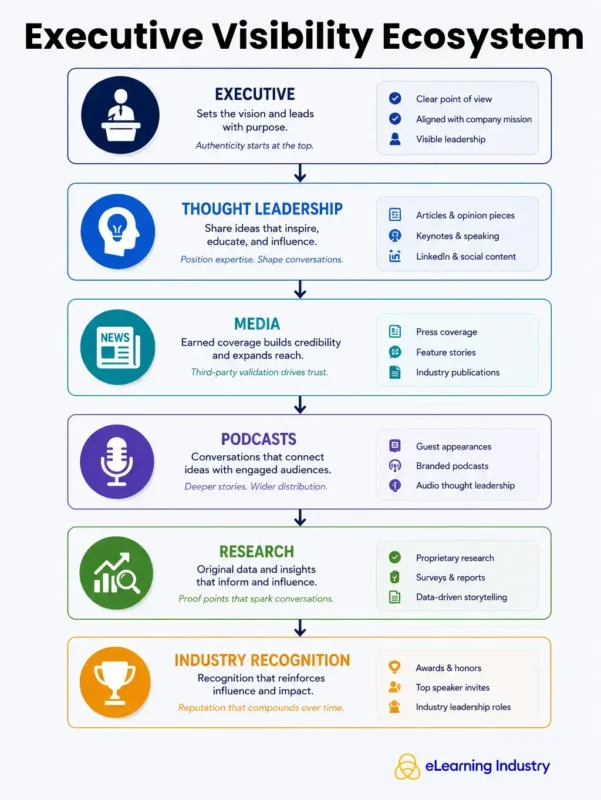
Modern PR is no longer focused only on promoting companies. Increasingly, it's about helping the people behind those companies become trusted voices in their industries. This shift reflects how buyers make decisions.
People often connect with individuals before they connect with brands. A founder who regularly shares practical insights on LinkedIn, speaks at industry events, appears on podcasts, or contributes articles to respected publications gradually becomes a familiar face. That familiarity builds trust, and that trust naturally extends to the company they represent.
Executive thought leadership isn't about personal branding for its own sake. Its purpose is to demonstrate expertise, contribute to industry conversations, and provide genuine value to the audience. When executives consistently explain complex topics, share lessons from experience, or comment on important developments, they position both themselves and their organizations as credible sources of information.
Modern PR teams play a central role in making this happen.
Rather than waiting for media opportunities to appear, they proactively help executives build a public profile through activities such as:
- Writing guest articles for industry publications
- Securing podcast interviews
- Preparing keynote presentations
- Developing LinkedIn content
- Providing commentary on breaking industry news
- Participating in webinars and panel discussions
- Supporting award nominations and recognition programs
The goal isn't to keep executives constantly in the spotlight. Instead, it's to ensure they appear in the right places, discussing topics that genuinely matter to their audience.
Journalists begin reaching out for expert opinions instead of waiting for pitches. Conference organizers invite executives to speak because they already recognize their expertise. Podcast hosts seek informed guests who can educate listeners rather than promote products.
For many organizations, executive thought leadership has become one of the most valuable outcomes of a strong PR strategy.
Common PR Mistakes Companies Make
Most organizations understand that reputation matters. The challenge is that many still approach public relations using outdated assumptions.
One of the most common mistakes is treating PR as something that only happens during major announcements. Companies become highly active during product launches, funding rounds, or acquisitions, then disappear from public conversations for months.
Effective PR doesn't work that way. Building credibility requires consistency. Journalists, analysts, customers, and industry audiences are more likely to engage with organizations that contribute valuable insights throughout the year rather than only when they have news to promote.
Another common mistake is relying too heavily on press releases. Press releases remain useful for communicating important announcements, but they represent only one part of a modern public relations strategy. On their own, they rarely generate sustained visibility or meaningful thought leadership.
Organizations that see stronger results typically invest across multiple channels, including media relations, executive communications, podcasts, original research, conference speaking, and contributed content.
A third mistake is failing to align PR with marketing. When communications teams and marketing teams work independently, opportunities are often missed. A media interview can become a webinar topic. A research report can support both PR outreach and demand generation campaigns. A conference presentation can provide weeks of social media and content marketing material. Without collaboration, much of that value is lost.
Many companies also underestimate the importance of executive visibility. Corporate brands matter, but buyers increasingly want to hear directly from founders, CEOs, and subject matter experts. Organizations that invest only in company messaging while ignoring executive communications often miss valuable opportunities to build trust.
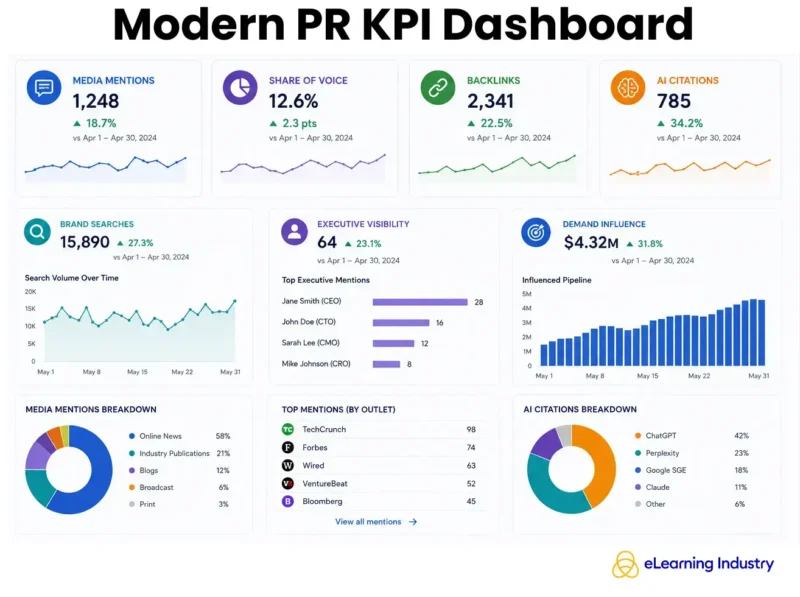
Finally, many businesses measure PR using only media mentions. Coverage is important, but it doesn't tell the whole story. A successful PR strategy should also consider how communication influences awareness, trust, website traffic, branded search, executive credibility, recruitment, partnerships, and demand generation.
Looking beyond simple media counts provides a much clearer picture of PR's contribution to business growth.
Measuring PR Success
Public relations has become much easier to measure than it was a decade ago.
While no single metric captures the full impact of PR, organizations now have access to a much broader range of data that connects communications with business outcomes.
Media coverage remains an important indicator because it shows how frequently a company appears in relevant publications. The quality of that coverage often matters more than the quantity. A feature article in a respected industry publication may provide more value than multiple mentions in websites with limited credibility or audience relevance.
Many organizations also monitor share of voice, which compares how often the company appears in industry conversations relative to its competitors. Consistent visibility often indicates growing market authority and stronger brand recognition.
Digital metrics provide another layer of insight. PR teams increasingly track:
- Backlinks earned through media coverage
- Referral traffic from articles and interviews
- Branded search volume
- Website engagement following major announcements
- Social sharing of earned media
- Growth in executive LinkedIn audiences
Executive visibility has become another important measurement area. Rather than focusing solely on media interviews, organizations often evaluate:
- Podcast appearances
- Speaking invitations
- Guest articles
- Webinar participation
- Analyst briefings
- Awards and industry recognition
These activities demonstrate how frequently executives contribute to conversations within their market.
Newer measurement frameworks are also beginning to consider AI visibility.
Although standards continue to evolve, companies are increasingly interested in understanding how often they appear within AI-generated responses, knowledge summaries, and trusted recommendation engines. As AI becomes another way people discover businesses, these indicators are likely to become more significant.
Ultimately, the most meaningful PR metrics connect communication with broader business objectives. Strong public relations should contribute to outcomes such as:
- Greater brand awareness
- Increased trust
- Higher-quality website traffic
- Stronger executive credibility
- Improved recruitment
- Better partnership opportunities
- Increased marketing efficiency
- Greater influence on pipeline and revenue
Looking at PR through this wider lens allows leadership teams to evaluate communications as a strategic investment rather than simply a cost center.
The Future Of PR
Public relations has changed significantly over the past decade, and that pace of change is unlikely to slow.
New technologies, changing buyer behavior, and evolving media habits continue to reshape how organizations build trust and communicate with their markets.
One of the biggest shifts is the growing use of AI. Communications teams are already using AI to monitor media coverage, identify trends, summarize news, and support content development. While these tools improve efficiency, they don't replace the strategic thinking that sits at the heart of effective public relations. Building relationships, understanding audiences, and exercising good judgment remain fundamentally human responsibilities.
Another trend is the continued growth of executive-led communication. Rather than relying exclusively on corporate announcements, organizations are increasingly investing in leaders who can explain industry developments, share informed opinions, and contribute meaningful perspectives through podcasts, conferences, newsletters, and social platforms.
Podcast outreach is also becoming a larger part of PR strategies. Many professionals now consume industry information through audio and video rather than traditional news websites. Appearing as a guest on respected podcasts allows executives to have longer, more thoughtful conversations than would typically be possible in a news interview.
Original research is likely to become even more valuable. Companies that publish unique data, benchmark reports, or market analysis create resources that journalists, analysts, customers, and other businesses naturally reference. This generates ongoing media opportunities while strengthening the organization's authority.
Community participation will also play a greater role. Industry communities, professional networks, creator partnerships, and customer advocacy programs increasingly shape how brands are perceived. Public relations teams are expanding their focus beyond media to include these wider ecosystems.
At the same time, visibility across search engines and AI-powered discovery platforms will continue growing in importance. Organizations that consistently publish useful information, earn high-quality media coverage, and contribute to industry discussions will be better positioned wherever future buyers search for answers.
Taken together, these trends point toward a broader evolution of the PR function.
The most successful teams won't simply manage communications. They will help organizations understand their markets, strengthen executive authority, identify emerging opportunities, protect reputation, and build lasting trust across every channel that influences business decisions.
Conclusion
The role of the PR team has expanded far beyond traditional media relations. Today's public relations professionals help organizations build credibility, strengthen executive voices, shape industry conversations, and increase visibility across news publications, podcasts, conferences, search engines, and AI-powered discovery platforms.
Their work supports much more than communications. It influences how customers evaluate vendors, how investors assess companies, how potential employees view employers, and how the market perceives a brand over time.
Perhaps most importantly, modern PR creates the trust that allows other business functions to perform more effectively. Marketing campaigns benefit from stronger brand recognition. Sales teams engage prospects who are already familiar with the company. Recruitment becomes easier because candidates recognize the organization's reputation. Partnerships develop more naturally because credibility already exists.
As buying journeys continue to evolve, organizations will need more than advertising to stand out. They'll need consistent visibility, recognized expertise, and meaningful contributions to the conversations shaping their industries.
That's why public relations has become a strategic business function rather than simply a communications discipline.
Companies that invest in modern PR aren't just increasing media coverage. They're building authority, strengthening relationships, and creating a reputation that supports sustainable growth for years to come.
FAQA PR team manages an organization's reputation and public image. It builds relationships with the media, supports executive visibility, develops thought leadership, manages corporate communications, and helps the company earn trust through credible, third-party channels. Modern PR also contributes to SEO, AI visibility, and long-term business growth.
A modern PR team does much more than write press releases. Its responsibilities often include media relations, crisis communication, executive communications, podcast outreach, thought leadership, analyst relations, event support, reputation management, and content that increases brand visibility across search engines and AI-powered platforms.
The structure of a PR team varies by company size, but common roles include a PR Director, Media Relations Manager, Communications Specialist, Content and Thought Leadership Manager, Executive Communications Lead, Analyst Relations Manager, and Community or Partnerships Manager. In smaller companies, one person may handle several of these responsibilities.
Companies need a PR team to build trust, strengthen their reputation, and increase visibility with customers, investors, employees, partners, and the media. Effective PR helps organizations earn credibility through independent sources, making marketing and sales efforts more effective over time.
PR supports business growth by increasing brand awareness, improving executive credibility, strengthening customer trust, and generating earned media coverage. These activities help create demand, shorten sales cycles, attract talent, and position the company as a leader in its market.
Marketing focuses on promoting products and generating demand through paid and owned channels. PR focuses on earning trust through media coverage, thought leadership, executive visibility, and strategic communications. The strongest organizations align PR and marketing because each function supports the other's goals.
Media coverage, backlinks, expert commentary, and thought leadership all strengthen a company's online authority. These signals can improve search engine performance while also increasing the likelihood that the company is referenced across AI-powered search experiences and generative search platforms.
PR success is measured using a combination of business and communications metrics. Common KPIs include media coverage, share of voice, backlinks, branded search volume, referral traffic, executive speaking opportunities, podcast appearances, AI citations, and PR's influence on marketing and sales performance.
A company should consider investing in PR when it wants to increase market awareness, establish industry credibility, support executive thought leadership, launch new products, enter new markets, or strengthen its reputation with customers and investors. Many startups begin with a PR agency before building an in-house team as they grow.
Yes. PR isn't only for large enterprises. Small businesses and startups can use public relations to build credibility, secure media coverage, establish executive thought leadership, attract partnerships, and compete with larger brands. A focused PR strategy often delivers more long-term value than relying solely on paid advertising.
