





eLearning App Development Guide For 2026
In the past decade, the global education sector has undergone a permanent shift, from traditional classrooms to digital ones. Today, remote learning is no longer a temporary arrangement but has become a global standard for many. Current projections indicate that the global market is set to reach nearly $456 billion this year, with custom, game-based eLearning mobile applications having the largest share (up to 33%). This explosive growth underscores why organizations are racing to build mobile eLearning apps.
For any business or institution looking to thrive in today's market, launching a high-quality eLearning mobile application is the key to capturing a share of this multi-billion-dollar industry. But most are stuck with an important question: how do you build one? This article will provide a comprehensive roadmap for building a mobile learning app, covering everything from essential features to development costs and monetization strategies.
What else is in this guide...
- Understanding eLearning Apps: Types, Key Features, And Applications
- Why Build A Mobile Learning App In 2026?
- A Step-By-Step Tutorial To Building An eLearning Mobile App
- How Much Does It Cost To Develop An eLearning Mobile App?
Understanding eLearning Apps: Types, Key Features, And Applications
What Is An eLearning App?
Fundamentally, an eLearning mobile app is a digital platform that delivers educational content, training materials, and resources directly to a user's smartphone or tablet. Today, these not only deliver content digitally but also provide immersive environments that leverage AI, AR/VR, and other emerging technologies to make learning more active.
Types Of eLearning Apps
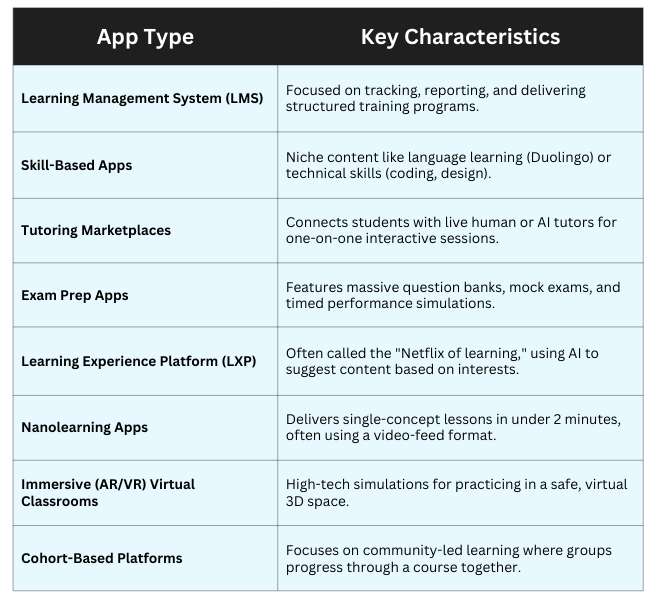
Key Features Of An eLearning Mobile Application
Modern users expect high engagement, personalized recommendations, and data-driven insights. To achieve this, your eLearning mobile application must include the following features:
- Gamification
Features such as rewards, badges, 3D avatars, etc., that motivate learners and encourage return visits. - AI personalization
Adaptive learning paths that change in real time based on the learner's speed, accuracy, and historical performance. - Offline access
A critical eLearning mobile app requirement to ensure minimal downtime and enable learners to download modules and study even without a constant 5G connection. - Microlearning
Short, 3–5 minute lessons designed for learners with busy schedules. - Collaborative tools
Discussion forums, peer-to-peer messaging, and cohort-based chats that allow users to learn together. - Analytics and dashboards
Real-time data for both learners (to track progress) and admins (to identify at-risk learners or popular content). - Smart push notifications
AI-generated alerts that remind learners to study or continue their session during the most productive times of the day. - Live streaming and webinars
Integrated, low-latency video conferencing for real-time Q&A.
Real-World Applications Of eLearning Mobile Apps
The utility of an eLearning mobile app extends beyond classrooms. Organizations across nearly every sector are building a mobile eLearning app to solve specific real-world challenges, ranging from life-saving medical training to high-stakes global logistics.
- Healthcare eLearning applications
Clinical simulations, remote patient education, compliance training, and just-in-time medical reference apps. - Corporate eLearning applications
Onboarding, leadership coaching, sales enablement, and upskilling apps. - K-12 and higher education applications
Digital classrooms, exam simulations and mock-ups, peer-to-peer study, and accessibility support apps. - Retail eLearning applications
Merchandising guides, product tutorials, customer servicing simulations, mobile training, and POS apps. - Manufacturing eLearning applications
Digital twin training, safety drills, maintenance logs, and quality control assessment apps. - Finance eLearning applications
Regulatory compliance training, advisory coaching, cybersecurity awareness, and FinTech integration apps.
Why Build A Mobile Learning App In 2026?
There are several benefits of investing in eLearning application design and development:
1. Higher Engagement And Retention
Mobile apps are more engaging than desktop sites because they align with how and where people access information today. Research shows that mobile learners complete lessons 45% faster than desktop learners. This is because of microlearning: mobile eLearning apps break content into short sessions, often lasting 3 to 5 minutes.
2. "Just-In-Time" Knowledge Application And Referencing
Another reason to invest in eLearning mobile app development is to capitalize on providing information at the exact moment of need. This just-in-time delivery ensures knowledge is applied immediately, which is the most effective way to cement a new skill.
3. To Meet The Demographics Of 2026
With 96% of the global population now using mobile phones to access the internet, building an eLearning mobile app is the only way to achieve true scale. Moreover, audiences (working professionals, Gen Z, and students) that eLearning businesses target are also the primary users of mobile apps.
4. Accessibility And Inclusivity
Mobile eLearning apps are also a major touchpoint for neurodivergent people (accounting for almost 40% of the young-age workforce) and people with disabilities. They allow users to toggle between visual, auditory, and kinesthetic modes (like haptic feedback), something that static desktop sites struggle to provide.
A Step-By-Step Tutorial To Building An eLearning Mobile App
Before you begin developing an eLearning mobile app, identify who you are doing it for and why. Here is a step-by-step eLearning mobile app development tutorial.
Step 1: Research And Discover
Start by clarifying what the app must achieve and who it serves.
- Primary audience: K-12, higher ed., corporate L&D, test prep, coaching, or hobby learning.
- Primary goal: Course sales, learner outcomes, certifications, employee compliance, or retention.
- Success metrics: Course completion rate, weekly active users, time-to-competency, assessment scores, renewals.
Step 2: Choose The Learning Model And Core Use Cases
Lock the learning experience before you decide on key features.
- Self-paced courses (videos, modules, quizzes)
- Cohort-based learning (live sessions, batches, instructor-led)
- Microlearning (short lessons, daily practice)
- Blended learning (online content plus offline classroom)
- Social learning (peer groups, discussions, mentorship)
Step 3: Plan Your MVP/Prototype
Build the smallest version that can launch and prove adoption. You can consider some critical features from the following:
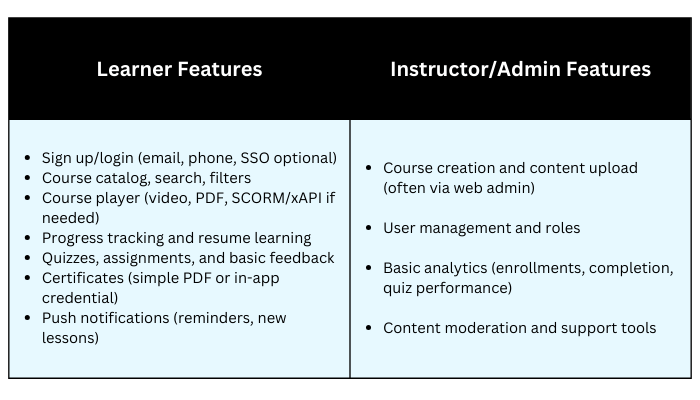
Step 4: Determine Your Content Management Strategy
An eLearning app is only as good as its content experience.
- Standardize module structure: Lesson length, quiz frequency, objectives.
- Define formats: Video, slides, reading, interactive exercises.
- Create metadata rules: Category, level, language, duration, skills.
- Decide offline access rules: What can be downloaded, expiration, and DRM needs.
Step 5: Pick The Right Tech Stack
Choose based on speed, budget, and long-term maintenance.
- Choose native (iOS, Android) for specific device features and peak performance.
- Build cross-platform eLearning mobile apps with React Native or Flutter for faster market entry and wider reach.
- Integrate secure APIs for authentication, analytics, and payments.
- Use CDNs for global media delivery and high-quality streaming.
Step 6: Build The UI/UX For Learning Flow, Not Just Screens
Besides focusing on devices and screens, design your eLearning mobile app around learning behaviors. Prioritize:
- Fast onboarding to the first lesson.
- Clear progress indicators and next-lesson prompts.
- Distraction-free player and readable typography.
- Search-first navigation for large catalogs.
- Accessibility support (captions, font scaling, contrast, screen readers).
Step 7: Build The eLearning App
Build the backend systems, covering secure access, content management, learner progress, assessments, notifications, and analytics. In parallel, work on the frontend mobile app experience in phases, starting with core access and course flows, and gradually adding lesson playback, progress visibility, assessments, certifications, and notifications.
Step 8: Integrate Payments And Monetization
Choose your ideal revenue model: subscription, one-time, freemium, corporate licensing, or in-app purchases. Make sure to account for tax, invoice, and refund rules, promo codes, and entitlement management.
Step 9: Test The eLearning App
Test your app thoroughly, also thinking from a user perspective. Look for functional gaps during enrollment, playback, quizzes, or progress sync. Check how the app performs on low-end phones, across different OS versions, and on different form factors. Offline testing is equally important; your app must work optimally even within sync conflicts or network drops.
Step 10: Launch, Monitor, And Iterate
Treat the launch as the starting point, not the finish line. Roll out the app with a controlled release plan, monitor stability and performance through analytics and event tracking, and use real user behavior to guide continuous product and content improvements.
How Much Does It Cost To Develop An eLearning Mobile App?
eLearning mobile app development costs can range from $15,000 to over $150,000, or even more if the app requires AI features. This cost is primarily driven by the technical complexity.
A basic MVP app with only a few features, like standard course catalogs, costs roughly $15,000 to $30,000. Mod-level eLearning apps, with robust back-end and performance requirements, can cost up to $80,000. Advanced eLearning platforms with intelligent features such as AI tutors, AR/VR-based classrooms, etc., cost significantly more ($100,000+).
Moreover, the cost also varies depending on your development approach. Building an app internally, if you already have a team, can be cost-effective but requires consideration of opportunity costs. Using existing staff means pulling them away from other revenue-generating projects.
Partnering with a mobile app development company offers a balanced middle ground. You get a ready-to-use team and faster delivery without the burden of hiring. The most cost-efficient approach, however, is to hire dedicated mobile app developers for a focused partnership. Developers integrate into your workflows and dedicatedly work on your project, while the service provider handles the administrative burden.
Ending Note
Building an eLearning mobile app in 2026 is no longer about simply digitizing content. It is about delivering a personalized, intelligent learning experience that fits in the pocket, evolves with the learner, and provides immediate utility.
While the investment seems considerable, so is the potential for a huge return on productivity, engagement, and growth. Don't let the technical complexity stall your progress. Start small with an MVP to focus on a single proven learning outcome, and then scale based on the feedback. The future of education is mobile; it's time to build yours.
Image Credits:
- The images within the body of the article were created/supplied by the author.