


 ChatGPT
 Perplexity
 Claude
 Grok
Grok
AI: The Catalyst Making Learning Easier And Critical
The rapid ascent of powerful Artificial Intelligence (AI) has created a fundamental paradox in the world of professional development. On one hand, AI has emerged as a revolutionary tool, capable of delivering personalized, on-demand education that makes the process of acquiring new knowledge simpler and more efficient than ever before. On the other hand, it is a profoundly disruptive economic force, reshaping industries and automating tasks at a pace that makes continuous skill acquisition a matter of professional survival. The debate is no longer if we should engage in lifelong learning, but whether AI is primarily a tool that eases this journey or the very catalyst that makes the journey nonnegotiable.
This article will explore both facets of AI's dual impact on professional growth. We will first examine the compelling case for how AI makes learning "easier" by acting as an infinitely patient and personalized tutor for every individual. We will then pivot to the argument that AI makes learning "more essential" by accelerating skill obsolescence and fundamentally altering the landscape of work. By synthesizing these perspectives, we can develop a forward-looking strategy that empowers professionals to navigate this new era, not as passive observers, but as active participants in their own evolution. The central question is, how exactly is this technology making the mechanics of learning more accessible and effective? We will look at the "Centaur" model to answer this question.
In this article, you'll find
- The Case For "Easier": AI As A Personalized, On-Demand Tutor
- The Case For "More Essential": AI As A Catalyst For A Skills Revolution
- The "Centaur" Model: Learning In The Flow Of A Transformed Workplace
- Navigating The AI Learning Landscape
The Case For "Easier": AI As A Personalized, On-Demand Tutor
AI's role as a powerful enabler in education is strategically transformative. For decades, educators have understood the profound impact of one-on-one instruction, a concept crystallized in Benjamin Bloom's 1984 "2 sigma problem." Bloom demonstrated that students receiving personal tutoring performed two standard deviations better than their peers in a traditional classroom—a massive improvement. The challenge, however, has always been the economic and logistical impossibility of scaling this model. AI-driven tools are now poised to solve this problem, democratizing access to personalized instruction and making the learning process fundamentally easier and more effective.
AI-Powered Personalization And Efficiency
By analyzing a learner's performance, behavior, and preferences in real time, AI can create customized learning pathways that adapt to individual needs. This moves beyond the one-size-fits-all model of traditional education, offering a tailored experience that maximizes both understanding and efficiency. The quantitative benefits of this approach are striking:
- Enhanced performance
A quasi-experimental study found that an AI-based learning system led to a 25% improvement in student performance compared to a control group using traditional methods. - Accelerated learning
The same study revealed that students using the AI system completed their tasks 25% faster. Furthermore, research shows that intelligent tutoring systems can reduce the time required for learning by up to one-third to one-half. - Increased engagement
By providing content that is appropriately challenging and relevant, AI has been shown to produce a 15% increase in student engagement.
Revolutionizing The Learning Experience
Beyond quantitative metrics, AI is transforming the qualitative nature of learning. Tools like Khan Academy's Khanmigo are not designed to simply provide answers; they function as Socratic tutors that guide learners toward discovery. For instance, if a student makes a mistake in using the distributive property in an algebra problem, the AI won't correct them outright. Instead, it notices the error and prompts the student to explain their reasoning, helping them identify the misconception on their own.
This makes learning a more interactive and dynamic process. Students can now "talk" to historical figures or literary characters like Jay Gatsby to better understand their motivations, or co-author a creative story with an AI partner that helps build their narrative skills. These experiences, which were once the stuff of science fiction, bring subjects to life and foster a deeper, more intuitive grasp of complex topics. While AI is clearly making the mechanics of learning more accessible and engaging, its broader impact on the professional landscape presents a different, more urgent challenge.
The Case For "More Essential": AI As A Catalyst For A Skills Revolution
Beyond its function as an educational tool, AI is a powerful economic force that is actively reshaping the global labor market. This disruption is the primary reason why lifelong learning is rapidly shifting from a professional virtue to an economic necessity. The same technology that can teach us algebra can also automate analytical tasks, rendering certain skills obsolete while creating intense demand for new ones. This ongoing transformation makes continuous learning essential for career relevance and resilience.
The Shifting Landscape Of Work
The scale of AI's impact on the workforce is unprecedented. Major economic analyses paint a clear picture of a labor market in flux, where the value of existing skills is diminishing and the risk of automation is widespread. Roughly two-thirds of current jobs are exposed to some degree of AI automation, reports Goldman Sachs. A vast majority of professionals will see their roles change, requiring them to adapt to working alongside AI or transition to new functions entirely, with generative AI possibly substituting up to one-fourth of current work.
A significant portion of tasks, particularly those involving information processing and content generation, are vulnerable to being automated: OECD reports that 27% of jobs are in occupations at high-risk of automation. Over a quarter of the workforce is in roles where the core functions are highly susceptible to being replaced by automation technologies. The skills that are valuable today have a rapidly shrinking shelf life, mandating a constant cycle of upskilling and reskilling to remain competitive.
The data paints a clear picture: as AI subsumes routine analytical and generative tasks, the market is placing a new premium on skills AI cannot easily replicate. The decline in demand for rote knowledge work directly fuels the rise in demand for creative thinking, leadership, and resilience—competencies that guide strategy and manage complexity rather than simply process information.
The New Skills Imperative
As AI automates routine cognitive tasks, the demand is shifting toward capabilities that are either uniquely human or complementary to AI. The focus is no longer on simply possessing information, but on applying it with creativity, critical thinking, and social intelligence. The pressure to acquire these new competencies is immense, creating a high-stakes environment where professionals feel perpetually behind. This dynamic has normalized a state of professional anxiety, where one might question whether their feelings of inadequacy are a symptom of this rapid technological displacement or a personal bout with imposter syndrome.
Top Growing Skills By 2030
The skills projected to be in highest demand are a blend of technological prowess and advanced human-centric abilities:
- AI and Big Data
- Networks and cybersecurity
- Technological literacy
- Creative thinking
- Resilience, flexibility and agility
- Curiosity and lifelong learning
- Leadership and social influence
- Talent management
- Analytical thinking
- Environmental stewardship
The dual nature of AI as both a simplifier of the learning process and a disruptor of the job market is not a contradiction. Rather, it points toward a new, integrated model for professional development where learning and working are inextricably linked.
The "Centaur" Model: Learning In The Flow Of A Transformed Workplace
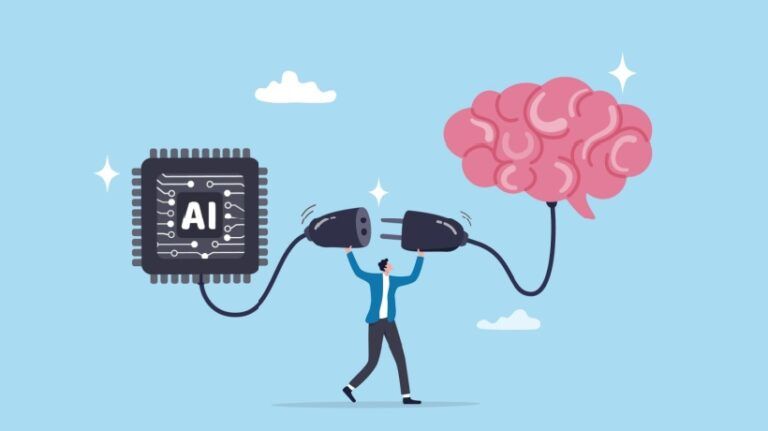
The debate over whether AI makes learning "easier" or "more essential" presents a false dichotomy. The reality is a powerful synergy: AI makes the process of learning easier and more accessible precisely because its impact on the economy has made continuous learning more essential than ever. The guiding principle for the modern workforce is the "Centaur" model, a concept born from the world of chess. After AI defeated grandmaster Garry Kasparov, a new form of the game emerged where human-AI teams, or "Centaurs," consistently outperformed both AI alone and humans alone. This paradigm—Human + AI > AI alone—is the key to unlocking future professional growth.
From Formal Training To Integrated Learning
The urgency of this new skills imperative demands a move away from traditional, event-based training toward a more fluid and integrated approach. Coined by analyst Josh Bersin, "learning in the flow of work" describes a model where knowledge and training are delivered directly within an employee's existing workflow, at the precise moment of need. This approach addresses a major source of corporate inefficiency.
Data shows that employees spend an average of 9.3 hours per week just searching for information. Furthermore, 57% of workers report that their current software actually makes them less productive, highlighting the friction created by disconnected systems. Learning in the flow of work eliminates this friction by embedding knowledge where it is most relevant.
AI As A Co-pilot For Growth, Using The "Centaur" Model
In this model, AI functions as a "co-pilot," not a replacement. It enhances human capabilities by automating mundane tasks and providing data-driven insights, freeing up professionals to focus on higher-level strategy, creativity, and collaboration. The "Centaur" chess analogy perfectly illustrates this dynamic: the human provides strategic intuition and experience, while the AI supplies flawless tactical calculation and deep data analysis.
The practical benefits of this integrated approach are significant. By embedding training videos and guidance directly into its driver platform, Uber saw a 13% reduction in onboarding time and an 8% rise in productivity. This demonstrates that when learning is contextual, seamless, and immediately applicable, it drives tangible business outcomes. The goal is not to pull employees out of their work to learn, but to make learning an intrinsic part of how they work. Successfully adopting this new model, however, requires navigating significant challenges and maintaining a critical perspective.
Navigating The AI Learning Landscape
While AI holds immense potential for education, realizing its benefits requires a balanced approach that avoids overreliance. A successful strategy leverages AI as a tool without stifling genuine intellectual growth.
Strategies For Effective Learning Using The "Centaur" Model
- Active engagement
The main risk of AI is intellectual passivity. Since genuine learning requires cognitive effort, AI should function as an intellectual "sparring partner," not a shortcut that circumvents the learning process. - Human-centric skills
As AI manages analytical and repetitive tasks, professional value shifts to "soft skills" where humans excel, such as leadership, emotional intelligence, and strategic thinking. - Social connection
Learning is a social process. Research indicates that Social and Emotional Learning (SEL) programs significantly boost achievement and mental health. AI cannot replace the empathy, motivation, and connection provided by human teachers.
Key Challenges
Integrating AI in the "Centaur" model requires addressing data privacy and algorithmic bias to prevent amplifying societal inequalities. Additionally, the digital divide threatens to widen the gap between those with access to advanced AI tools and those without. Human oversight remains essential to ensure ethical use and provide the nuanced judgment algorithms lack.
Conclusion
AI presents a powerful duality: it makes learning easier through personalization while making continuous learning essential for professional survival. The future belongs not to those replaced by AI, but those who adopt the "Centaur" model—professionals who treat AI as a cognitive co-pilot, using it to amplify their own intelligence and adaptability in a changing world.