

The Various Ways AI Companies Become Profitable
AI investment is exploding, and many decision-makers still ask the same question: how do AI companies make money in real terms? You see rapid product launches, rising valuations, and constant funding rounds, but the revenue logic often stays unclear. AI companies today build income through subscriptions, enterprise deals, APIs, usage-based billing, services, and data products. This shift reflects how buyers adopt AI inside core workflows rather than as standalone tools.
According to McKinsey, generative AI could add $2.6–$4.4 trillion in annual economic value across industries. That scale pushes companies to move beyond single-pricing strategies and build layered monetization systems. Instead of relying on one revenue stream, leading AI companies now stack multiple models across product lines and customer segments. You see enterprise buyers pushed toward long-term contracts, while developers and startups get usage-based or API-driven pricing that scales with consumption.
The real shift sits in how companies tie pricing directly to value creation. AI providers no longer just sell software access. They monetize outcomes, compute usage, workflow integration, and even downstream productivity gains. This creates more complexity in how revenue grows, but it also unlocks faster scaling when products embed deeply into enterprise systems. For founders, investors, and operators, understanding these structures matters more than tracking surface-level adoption metrics.
In this article, we will discuss the most important AI business models shaping the market and break down how each one drives sustainable revenue across different segments of the AI economy.
Key Takeaways
- Most AI companies monetize through SaaS subscriptions, APIs, and enterprise services.
- Usage-based pricing is becoming increasingly common in AI.
- The most successful AI companies combine technology with scalable distribution and recurring revenue.
- AI monetization depends on solving real business problems, not just offering AI features.
In This Guide, You Will Find...
- Why The AI Market Is Growing So Fast
- The Core Business Models Explaining How AI Companies Make Money
- How Do Generative AI Companies Make Money?
- Why Distribution Matters As Much As Technology For AI Companies To Make Money
- How AI Companies Make Money And Scale Revenue
- The Rise Of AI-as-a-Service (AIaaS)
- Common Monetization Challenges For AI Companies
- What Investors And Buyers Look For In AI Companies
- Lessons From Leading AI Companies
- The Future Of AI Business Models
Why The AI Market Is Growing So Fast
The AI market is growing fast because companies now treat it as part of their core operations. Enterprises no longer experiment with AI on the sidelines. Instead, they embed it directly into daily decision-making, customer support, marketing, and product development. As a result, adoption moves from pilot projects to full-scale deployment across departments. This shift creates consistent demand and pushes AI deeper into enterprise infrastructure.
At the same time, productivity gains drive this acceleration. Companies use AI to reduce manual work, speed up analysis, and automate repetitive tasks. Therefore, teams spend less time on execution and more time on higher-value work. This efficiency gain becomes easy to measure, which makes AI investments easier to justify at the executive level. In addition, organizations redesign internal processes around AI-driven systems, which further increases reliance on these tools.
Investor interest also plays a major role. Capital flows toward companies that show strong usage growth and clear monetization paths. Consequently, startups and established vendors compete to capture enterprise contracts and expand recurring revenue. This competition pushes faster innovation and broader adoption across industries.
Ultimately, AI shifts from a standalone tool to a business infrastructure layer. Companies no longer view it as optional software. Instead, they integrate it into AI workflows that support everything from operations to strategy. This evolution shapes the best AI business models in 2026, as vendors build entire ecosystems around long-term value delivery. As part of this shift, firms refine their AI platform business strategy to lock in enterprise customers and scale usage across departments.
The Core Business Models Explaining How AI Companies Make Money
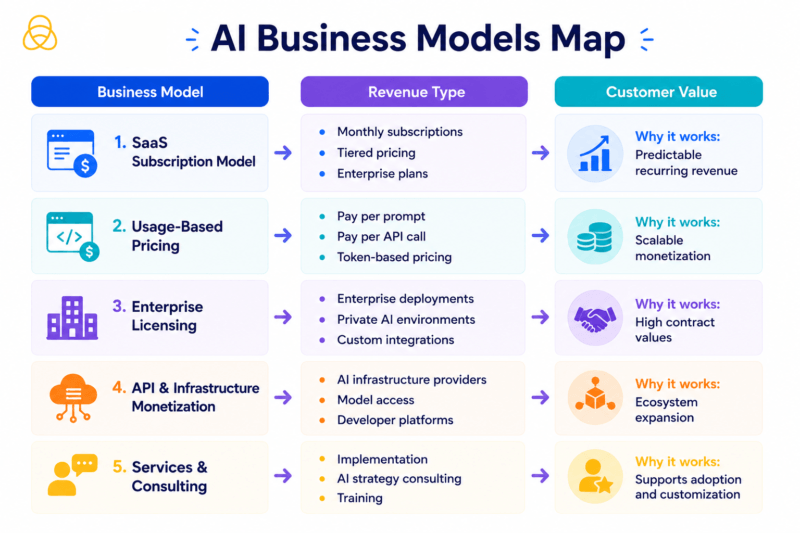
AI companies don't rely on a single way to earn revenue. Instead, they combine multiple monetization models to match different customers, use cases, and levels of adoption. If you want to understand how AI companies make money in practice, you need to look at how each model connects pricing to value, scale, and deployment depth.
SaaS Subscription Model
AI companies often start with subscriptions because it gives them predictable revenue and clear customer retention metrics.
Examples:
- Monthly or annual subscriptions
- Tiered pricing based on usage or features
- Enterprise SaaS plans with added support
Why it works:
- It creates stable recurring revenue
- It simplifies budgeting for customers
- It supports long-term product iteration
This model also plays a key role in AI company profitability because it stabilizes cash flow while companies scale product features and customer bases.
Usage-Based Pricing
Many AI products now charge based on actual consumption instead of fixed plans.
Examples:
- Pay per prompt
- Pay per API call
- Token-based pricing for model usage
Why it works:
- It scales directly with customer usage
- It lowers entry barriers for new users
- It aligns cost with value delivered
This approach shows clearly how AI startups generate revenue when adoption varies widely across customer segments.
Enterprise Licensing
Large organizations often prefer direct licensing agreements for control, security, and compliance.
Examples:
- Enterprise-wide deployments
- Private AI environments
- Custom integrations with internal systems
Why it works:
- It generates high-value contracts
- It locks in long-term relationships
- It supports complex deployment needs
This model often sits at the center of AI strategy for business because enterprises prioritize reliability and governance over flexibility.
API & Infrastructure Monetization
Some of the biggest players focus on providing the backbone of AI systems rather than end-user applications.
Examples:
- AI infrastructure providers
- Model access through APIs
- Developer platforms and toolkits
Why it works:
- It expands ecosystem adoption
- It enables third-party innovation
- It scales with developer demand
This layer often defines the growth of the biggest AI companies, especially those powering multiple products built on top of their infrastructure.
Services & Consulting
Many AI companies also offer services to accelerate adoption and implementation.
Examples:
- Implementation support
- AI strategy consulting
- Training and onboarding programs
Why it works:
- It reduces adoption friction
- It customizes solutions for enterprises
- It strengthens long-term partnerships
This model often bridges gaps in early adoption and helps enterprises integrate AI into real operations while improving overall deployment success.
How Do Generative AI Companies Make Money?
Generative AI companies don't just sell access to models. Instead, they package value around workflows, speed, and usability. If you look at how AI companies make money, you'll notice a clear shift toward embedding AI directly into everyday tools rather than selling raw model access.
Subscriptions And Tiered Access
Most generative AI platforms rely on subscription pricing to create predictable revenue.
- Monthly plans for individuals and teams
- Tiered pricing based on features or usage limits
- Premium plans with faster models or higher capacity
This structure supports steady growth and anchors the AI SaaS business model across both consumer and enterprise markets.
Enterprise Copilots
Companies now build copilots that sit inside enterprise workflows.
- Integrated assistants in CRM, HR, or finance tools
- Company-specific knowledge layers
- Secure, private deployment options
These copilots drive higher contract values and sit at the center of modern AI monetization strategies for large organizations.
Productivity Tools
Generative AI companies also monetize standalone productivity apps.
- Writing, design, coding, and analysis tools
- Time-saving automation features
- Collaboration enhancements for teams
These tools succeed because they reduce friction in daily work and deliver immediate value.
Embedded AI
Finally, many providers embed AI directly into third-party platforms.
- API integrations inside SaaS products
- White-label AI features
- Developer ecosystem distribution
This approach scales widely and strengthens retention. It also shows how AI companies make money has shifted toward invisible, embedded functionality rather than standalone products.
Do you want to stay updated regarding the latest eLearning news? Subscribe to our newsletter and never miss a beat!
Why Distribution Matters As Much As Technology For AI Companies To Make Money
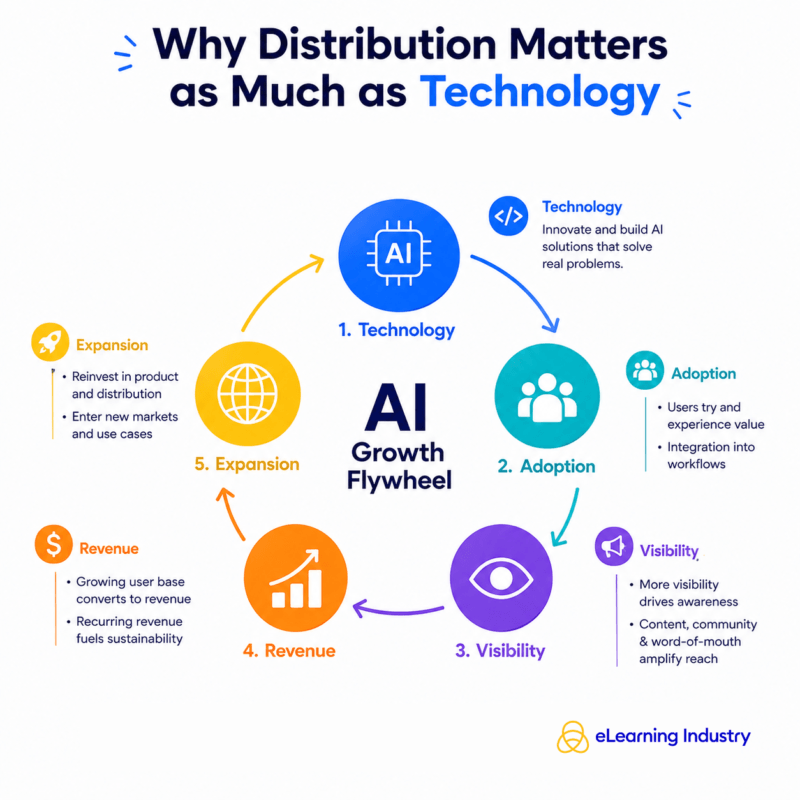
Visibility In Crowded Markets
Visibility decides whether an AI product gets adopted or ignored. Even strong models lose momentum when users don't see them early in their buying journey. Companies push visibility through search presence, product reviews, integrations, and developer communities. As a result, awareness directly impacts adoption speed and long-term retention. This is why distribution teams now sit alongside product teams in shaping AI business models that scale beyond early traction.
Strategic Partnerships
AI companies grow faster when they plug into existing platforms instead of competing with them. They form partnerships with SaaS providers, cloud vendors, and enterprise software ecosystems. These deals reduce friction for customers and shorten sales cycles. In many cases, partnerships also unlock bundled offerings that improve perceived value. Therefore, distribution becomes a shared channel rather than a standalone effort, which strengthens market positioning.
Ecosystem Positioning
Winning companies position themselves inside ecosystems where customers already spend time and money. They integrate into workflows, marketplaces, and developer platforms instead of forcing users into new environments. This approach increases stickiness and expands use cases across departments. It also creates natural upsell paths that improve revenue consistency. In this context, pipeline velocity improves because leads convert faster when the product already sits inside their workflow stack.
Audience Trust
Trust plays a major role in adoption, especially in enterprise environments. Buyers evaluate security, reliability, and long-term vendor stability before committing. AI companies build trust through transparent performance metrics, case studies, and consistent product updates. Over time, trust reduces sales friction and strengthens retention. This is particularly important for understanding how generative AI companies make money, since revenue depends on long-term usage rather than one-time purchases.
How AI Companies Make Money And Scale Revenue
-
Upselling Enterprise Plans
AI companies increase revenue by moving customers from basic plans to enterprise agreements. They do this by adding advanced security, higher usage limits, dedicated support, and compliance features. Once a team adopts the product, expansion becomes easier because switching costs rise over time. This is where AI companies' profitability becomes a practical question, since profitability often depends on how well companies convert usage into higher-value contracts.
-
Expanding Use Cases
Revenue also grows when companies expand how customers use the product. Instead of focusing on one workflow, AI vendors push adoption across departments like marketing, operations, HR, and finance. As usage spreads, organizations rely more heavily on the platform. This naturally increases spend without requiring aggressive sales pressure. Over time, the generative AI business model benefits from deeper integration into daily decision-making rather than isolated tasks.
-
Ecosystem Integrations
Integration with third-party tools helps AI companies scale faster. They connect their systems with CRM platforms, cloud infrastructure, productivity tools, and data warehouses. These integrations make the product harder to remove and easier to adopt across teams. As a result, companies embed AI into broader workflows instead of treating it as a standalone tool. This strengthens long-term retention and supports expansion inside large organizations.
-
Recurring Contracts
Enterprise customers prefer predictable pricing through multi-year contracts. These agreements provide stability for both sides and reduce churn risk. Vendors often bundle services, support, and custom features into these deals. In many cases, corporate AI strategy decisions depend on long-term vendor alignment rather than short-term cost. Additionally, AI consulting services often support these contracts by helping enterprises design and implement full-scale AI adoption plans that extend usage across the organization.
The Rise Of AI-as-a-Service (AIaaS)
-
Accessibility
AI-as-a-Service makes advanced capabilities available to companies that don't have deep technical teams. Instead of building models from scratch, businesses plug into ready-made APIs and platforms. This reduces complexity and speeds up adoption across industries. As a result, even smaller companies can access tools that once required major R&D investment. In practice, this shift answers how AI companies make money by widening the customer base beyond large enterprises.
-
Subscription Economy
Most AIaaS platforms run on subscription pricing that scales with usage or features. Companies pay monthly or annually for continuous access, updates, and improvements. This structure aligns with the AI SaaS business model, where revenue depends on retention rather than one-time sales. Therefore, providers focus heavily on product stickiness, integrations, and ongoing value delivery to keep customers engaged over time.
-
Lower Adoption Barriers
AIaaS reduces the friction that usually blocks new technology adoption. Businesses don't need large infrastructure investments or specialized AI teams to get started. Instead, they deploy tools quickly through cloud-based systems and start generating value almost immediately. This speed changes buying behavior and shortens decision cycles. At the same time, companies use this accessibility as part of a branded strategy for growth, positioning themselves as easy-to-adopt solutions that fit into existing workflows without disruption.
Common Monetization Challenges For AI Companies
-
Infrastructure Costs
AI companies face heavy infrastructure expenses from day one. They pay for compute, cloud storage, and model training at scale, and those costs rise quickly as usage grows. Unlike traditional SaaS, margins don't automatically expand with revenue. Instead, companies need strong cost control and efficient model deployment to stay sustainable. This pressure shapes long-term AI platform business strategy, where infrastructure decisions directly impact profitability and pricing flexibility.
-
Customer Acquisition
Getting customers in AI is expensive and competitive. Many buyers already use established tools, so new entrants must spend heavily on marketing, sales, and partnerships to win attention. At the same time, enterprise sales cycles take longer and involve multiple stakeholders. As a result, companies must align messaging, distribution, and product education to convert leads effectively. This is a key factor in understanding how AI companies make money at scale, since revenue depends on both acquisition speed and retention quality.
-
Differentiation
AI products often look similar on the surface, especially when they rely on similar models or APIs. This creates a challenge around standing out in a crowded market. Companies need to differentiate through workflow integration, UX, data advantage, or industry specialization. Without a clear edge, pricing pressure increases and margins shrink.
-
Trust And Adoption
Enterprises move slowly when adopting AI because they worry about security, accuracy, and compliance. Companies must prove reliability through case studies, certifications, and transparent performance metrics. Trust becomes a core driver of adoption and long-term contracts.
-
Commoditization
As models become widely available, core capabilities turn into commodities. This pushes companies to compete on packaging, distribution, and ecosystem value rather than raw technology. Therefore, teams invest in a full-funnel marketing strategy to guide users from awareness to enterprise conversion and reduce dependency on model-level differentiation.
The ability to monetize AI features may depend heavily on proving their value. eLearning Industry research found that only 3% of L&D buyers are willing to pay significantly more for AI capabilities, while 42% tie their willingness to pay to proven use cases and outcomes. This suggests that simply adding AI may not justify premium pricing; providers need to connect those capabilities to measurable business impact.

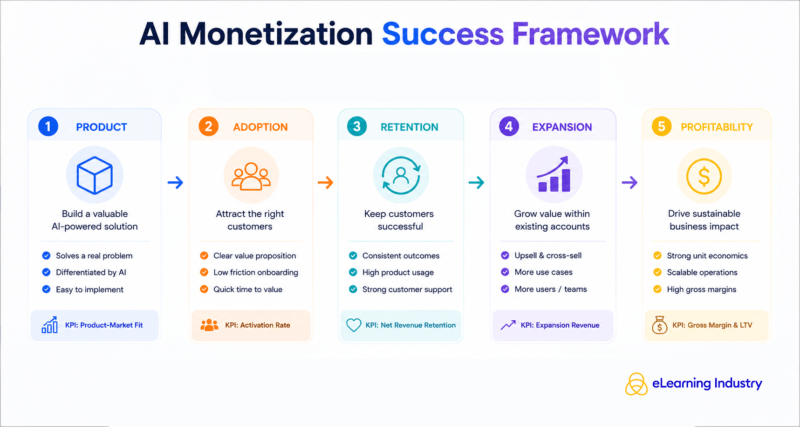
What Investors And Buyers Look For In AI Companies
-
Recurring Revenue
Investors and buyers first look at whether an AI company can generate stable, recurring income. They prefer subscription contracts, long-term enterprise deals, and predictable usage patterns. This reduces risk and signals that the product has moved beyond experimentation. It also connects directly to the question of "How do AI companies make money?" in a way that proves consistency over time, not just early traction.
-
Retention
Retention shows whether customers stay after the initial purchase. High retention signals that the product delivers ongoing value and fits into daily workflows. Buyers pay close attention to churn rates, especially in competitive categories where switching tools is easy. Strong retention also improves valuation because it indicates product-market fit and long-term demand.
-
Scalability
Investors focus heavily on scalability because AI products must grow without proportional cost increases. They evaluate whether the company can expand across markets, industries, and customer sizes without rebuilding the core system. This is where AI software monetization becomes important, since pricing models must support expansion without hurting margins.
-
Adoption
Adoption shows how quickly users integrate AI into real workflows. Buyers look for usage depth, not just signups. Companies that embed into daily operations outperform those used occasionally. Strong adoption also strengthens AI companies' revenue models, since higher engagement leads to expansion revenue and upsells.
-
Real Business Impact
Finally, investors want proof of measurable outcomes. They evaluate time savings, cost reduction, and productivity gains inside enterprise environments. Without clear impact, even strong technology struggles to scale. This is why AI implementation strategy matters, since successful deployment often determines whether AI becomes a core business asset or just an experimental tool.
AI capabilities alone may not be enough to differentiate a product. According to eLearning Industry research, L&D buyers continue to prioritize User Experience, pricing, and integration over AI features when evaluating learning technology. As AI becomes more commonplace, it may increasingly function as a baseline expectation, with competitive advantage shifting toward usability, integration, and demonstrated value.
Lessons From Leading AI Companies That Make Money
OpenAI
- Platform strategy: OpenAI builds general-purpose models and wraps them in products like ChatGPT, which turns raw capability into usable tools at scale.
- Partnerships: It works closely with Microsoft to distribute models through Azure and enterprise products, which expands reach into large organizations.
- Ecosystem positioning: It positions itself as a foundational layer for applications, which strengthens long-term demand and supports multiple AI monetization strategies across products.
Anthropic
- Platform strategy: Anthropic focuses on safety-first large language models designed for enterprise reliability and controlled deployment.
- Partnerships: It integrates with cloud providers like AWS and enterprise tooling ecosystems to speed up adoption.
- Ecosystem positioning: It targets regulated industries and enterprise workflows, reinforcing a trust-driven AI SaaS business model.
Microsoft
- Platform strategy: Microsoft embeds AI across its ecosystem, including Office, Azure, and developer tools, making AI a default feature rather than an add-on.
- Partnerships: It leverages its relationship with OpenAI to strengthen product differentiation and accelerate rollout across enterprise customers.
- Ecosystem positioning: It owns one of the largest distribution networks in enterprise software, shaping strong AI business strategy execution at scale.
NVIDIA
- Platform strategy: NVIDIA dominates the infrastructure layer by powering training and inference through GPUs and AI hardware stacks. Deep AI skills in hardware engineering and software optimization allow it to maintain performance leadership.
- Partnerships: It collaborates with cloud providers, AI labs, and enterprise customers to ensure broad hardware adoption.
- Ecosystem positioning: It sits at the center of AI compute demand, enabling scale across the entire industry and shaping how AI companies make money through infrastructure dependency.
The Future Of AI Business Models
AI business models will continue to shift as companies move away from fixed pricing and toward more flexible structures. In the next wave, usage-based pricing will become more common because it aligns cost with real value. Companies will pay for what they actually consume, which makes adoption easier and expands market reach across different customer sizes.
At the same time, vertical AI solutions will grow faster than general-purpose tools. Companies want systems built for specific industries like healthcare, finance, and logistics. These solutions reduce setup time and improve accuracy, which increases demand and strengthens long-term retention. AI will also become deeply embedded in existing software. Instead of standalone tools, users will interact with AI inside platforms they already use every day. This reduces friction and increases engagement, which directly impacts growth and adoption rates.
In addition, hybrid monetization models will become the standard. Companies will combine subscriptions, usage-based pricing, and enterprise contracts to maximize revenue across segments. This mix improves stability and supports scale. Overall, the question of "How do AI companies make money?" will become more complex as strategies diversify. However, this evolution will also improve AI company profitability by creating multiple revenue streams within a single product ecosystem.
Key Takeaway
AI companies no longer rely on a single path to revenue. Instead, they build layered systems that combine subscriptions, usage-based pricing, enterprise contracts, and services. This shift shows how AI companies' ability to make money has moved from simple software sales to complex value-driven ecosystems. As a result, pricing now reflects usage, outcomes, and integration depth rather than just access to a product.
At the same time, companies that use AI today expect more than features. They want measurable impact, faster workflows, and tools that fit directly into daily operations. This pressure forces vendors to design stronger AI monetization strategies that balance growth with retention. In practice, success depends on how well companies connect technology to real business outcomes instead of isolated use cases.
Looking ahead, AI software monetization will continue to evolve as competition increases and models become more accessible. Companies will rely more on hybrid pricing and embedded distribution to defend margins and scale adoption across industries. Therefore, execution and positioning matter as much as the underlying technology.
Ultimately, AI growth depends on structure, not hype. Companies that use AI today choose vendors based on trust, integration, and long-term value, not novelty. This is why the strongest players focus on systems, not just products.
eLearning Industry helps AI solution providers, learning platforms, and HR tech vendors showcase their products, share thought leadership, and connect with businesses actively exploring AI adoption and implementation. If your company helps organizations automate workflows, improve productivity, or scale AI capabilities, this is your opportunity to reach high-intent buyers looking for AI solutions.
FAQAI companies typically generate revenue through software subscriptions, API access fees, enterprise licensing, consulting services, and custom AI solutions.
The most common model is Software-as-a-Service (SaaS), where customers pay recurring monthly or annual subscriptions to access AI-powered products.
Some AI companies are highly profitable, while others prioritize growth over profits. Profitability often depends on customer acquisition costs, infrastructure expenses, and recurring revenue.
Usage-based pricing charges customers according to consumption, such as API calls, tokens processed, images generated, or computing resources used.
Investors typically look for strong recurring revenue, scalable business models, clear market demand, customer retention, and a sustainable competitive advantage.
AI-as-a-Service allows businesses to access AI capabilities through cloud-based platforms without building or maintaining their own AI infrastructure.