

Podcasts Aren't Just Hype. They Are A Marketing Essential.
If you are researching how to start a podcast, you have probably noticed that the technical side has become easier than ever. You can record remotely, publish across major platforms, and create video without building a studio. However, launching a B2B podcast that attracts the right audience and supports your business goals requires much more planning.
Podcasting continues to grow. Edison Research's 2026 Podcast Consumer Report found that 82% of weekly podcast consumers actively watched video podcasts in Q3 2025, while 78% listened to audio-only podcasts.
For a B2B brand, the real opportunity starts with the conversations you create. The right podcast can help your executives build authority, strengthen relationships with customers and prospects, meet potential partners, and create branded content. It can also support your wider podcast marketing strategy by giving your team material for LinkedIn, newsletters, sales, search, and other channels.
Still, you need a clear plan before you invite your first guest. Who do you want to reach? What should your show stand for? Which guests can bring valuable perspectives and meaningful relationships? How will you manage guest outreach, production, promotion, and measurement without overwhelming your team?
In this guide, you will learn how to grow a B2B podcast through a practical system that connects strategy, content, distribution, and business goals. You will also see how to turn each episode into multiple marketing opportunities while building a show people have a reason to follow.
Key Takeaways
- Start with the audience and business objective, not the microphone.
- Build the show around a distinctive premise instead of broad industry conversations.
- Choose a repeatable format that your team can realistically sustain.
- Use guests strategically to create valuable industry relationships.
- Record video whenever possible so every episode can support YouTube, social media, and short-form content.
- Treat distribution and repurposing as part of production.
- Measure authority, relationships, audience quality, engagement, and pipeline influence, not downloads alone.
In This Guide, You Will Find...
- Should You Start A B2B Podcast?
- Define What Business Job The Podcast Will Do
- Define Your Podcast Audience
- How To Create A Distinctive Podcast Premise
- How To Start A Podcast: Choose The Right Format
- Should You Start An Audio Podcast Or Video Podcast?
- How To Name And Brand Your Podcast
- Choose Your Episode Length And Publishing Cadence
- How To Choose Your Podcast Host
- Build Your Guest Strategy
- How To Start By Inviting Great Podcast Guests
- Create An Editorial Calendar
- Research And Prepare Each Episode
- How To Start A Podcast: Build The Recording Setup
- Build A Repeatable Podcast Production Workflow
- How To Start A Podcast Using A Strong Intro And Outro
- Publish Your Podcast Everywhere It Matters
- How To Start A Podcast Using SEO: How To Make Episodes Discoverable
- Podcasts, GEO, And AI Visibility
- The Podcast Content Repurposing Engine
- Ways To Start And Promote Each Podcast Episode
- How Podcasts Generate B2B Pipeline
- How to Measure B2B Podcast Success
- The CAST B2B Podcast Framework
- Common B2B Podcast Mistakes
- How To Start Your B2B Podcast: Launch Checklist
Should You Start A B2B Podcast?
Before learning how to start a B2B podcast, decide whether a podcast makes sense for your company. A show can support your full-funnel marketing strategy when you have valuable expertise, access to the right people, and a clear reason for your audience to return. You also need someone to manage production, publishing, and distribution consistently.
-
Category Leadership
Use your podcast to join conversations shaping your industry. Discuss trends, challenges, and ideas that matter to your audience.
-
Executive Thought Leadership
Give your leaders space to share deeper insights than a social post allows and strengthen their credibility over time.
-
Customer Relationships
Invite customers to discuss their experiences and lessons. These conversations can strengthen relationships while giving your audience useful insights.
-
Prospect Relationships
Create a natural reason to connect with decision-makers at target accounts without turning every interaction into a sales pitch.
-
Partner Development
Bring complementary companies and industry specialists into your network and open opportunities for collaboration.
-
Content Production
Turn each recording into articles, newsletters, social posts, videos, podcast clips, and sales assets that support demand generation.
-
Community Building
Build recurring conversations around shared professional challenges and give your audience a reason to return.
When You Shouldn't Launch
- You have no clear audience or differentiated premise.
- Nobody owns production and publishing.
- You have no distribution plan.
- You cannot commit to consistent publishing.
- You want a podcast only because competitors have one.
Define What Business Job The Podcast Will Do
When you learn how to start a podcast, decide what business outcome it should support. "Brand awareness" is too broad to guide your content or guests. A strong business podcast strategy starts with one primary and two secondary goals.
Goals include:
- Build category authority
- Increase executive visibility
- Reach a buyer group
- Develop target-account relationships
- Create original B2B thought leadership
- Influence pipeline
Choose one primary goal and two secondary goals. For example:
Primary Goal
- Build relationships with Learning Tech executives.
Secondary Goals
- Establish your company as a platform for industry conversations.
- Create executive-level content for marketing and video podcast distribution.
Define Your Podcast Audience
Targeting broad audiences, like "business professionals" doesn't work. This means that you must identify the people most likely to value your conversations and eventually influence business opportunities.
Start by defining their:
- Role and seniority
- Company type and industry
- Main challenges and career context
- Information needs and buying influence
Once you understand this audience, topic selection becomes much easier. You are no longer asking, "What would make an interesting episode?" Instead, ask, "What would these people genuinely want to hear from someone who has already solved a problem they face?"
Targeting clarity shapes your guest choices, episode format, messaging, and how to promote a business podcast. Your ideal buyer persona should influence podcast promotion, not sit separately from it.
How To Create A Distinctive Podcast Premise
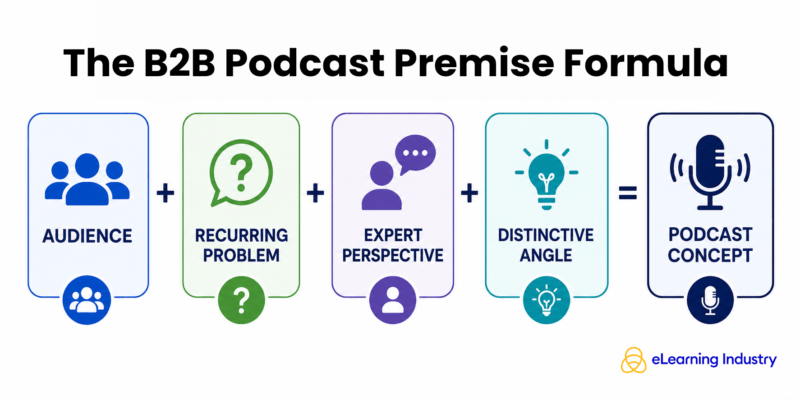
A strong B2B podcast needs more than an interesting subject. It needs a clear premise that gives people a reason to choose your show over the hundreds of similar conversations already available. Many podcasts fall into broad categories such as leadership, innovation, business growth, or industry trends. These topics may sound professional, but they rarely create a memorable identity.
Your premise should answer four questions:
- Who is this podcast for?
- What conversations happen here?
- Who gets invited to participate?
- Why can't listeners get these conversations elsewhere?
For example, our new podcast initiatives go beyond generic leadership discussions. The shows we have created explore the strategies, decisions, and lessons behind scaling successful companies, giving every episode a specific editorial lens. That makes the conversations more focused, relevant, and easier for the right audience to recognize.
A weak premise might be: "A podcast about HR technology."
A stronger version is: "Conversations with HR Tech founders about the strategic decisions behind scaling from product-market fit to enterprise growth."
That distinction matters when you learn how to create a business podcast. A focused premise also makes podcast distribution, podcast marketing, and how to promote a business podcast much easier because every channel communicates the same clear idea.
How To Start A Podcast: Choose The Right Format
There is no single best podcast format for B2B companies. Choose the model that matches your goals, resources, and audience expectations.
Interview Format
Best when you want to build relationships and expand your network.
- Guest relationships
- Diverse perspectives
- Authority transfer
Host-Led Expert Show
Put your expertise at the center of every episode. This works well for educational content and gives you strong editorial control while building executive visibility.
Co-Hosted Discussion
Two hosts can create natural chemistry and encourage debate.
- Recurring conversations
- Different viewpoints
- Stronger audience connection
Panel or Roundtable
Bring several experts together for industry discussions or special episodes. This format works particularly well when a corporate podcast needs multiple perspectives on a complex topic.
Narrative or Storytelling
A more production-intensive option for customer stories, investigations, and case studies.
Hybrid
Combine interviews with solo commentary, roundtables, or short explainers. This gives you flexibility while keeping the show varied without making production unnecessarily complicated.
Should You Start An Audio Podcast Or Video Podcast?
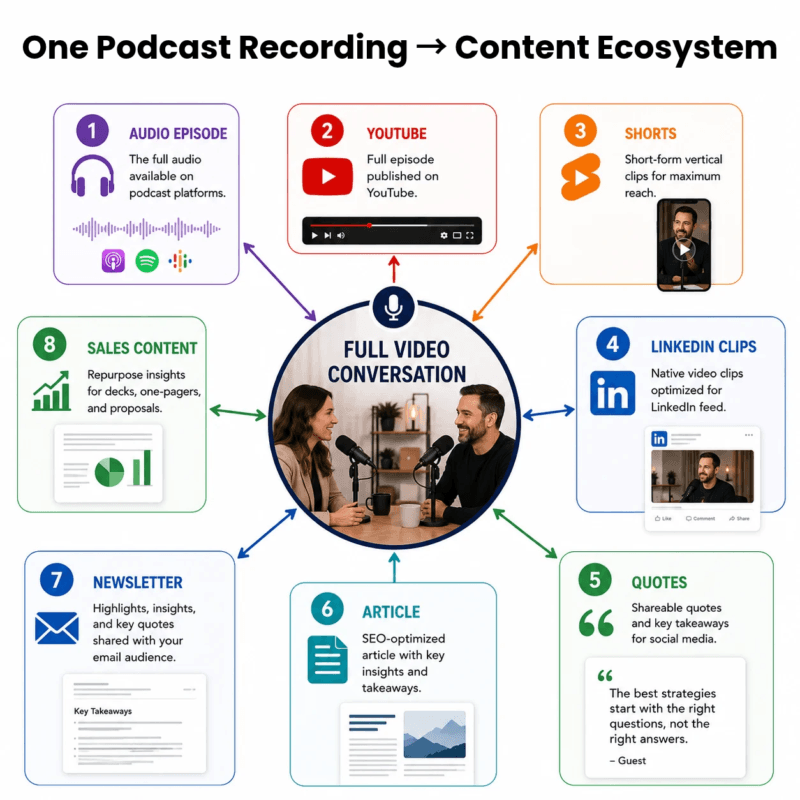
If you're learning how to start a podcast, consider video-first recording with audio distribution. For most B2B brands, this approach gives you more opportunities to reach your audience without creating separate content for every channel.
One recording can become a full YouTube episode, an audio podcast for Spotify and other platforms, short video clips, LinkedIn posts, quote graphics, YouTube Shorts, Reels, newsletter assets, and article embeds. You can also use the conversation to support sales and executive content.
The important distinction is that you are not really producing one podcast episode. You are creating a source asset for an entire content ecosystem. With the right podcast production workflow, a single conversation can fuel weeks of content, making your investment work harder across multiple channels.
How To Name And Brand Your Podcast
Your podcast name is often the first thing potential listeners see, so make it easy to understand and remember. It should reflect your premise without boxing the show into a narrow topic. Think about how the name will look on podcast platforms, YouTube, social profiles, and marketing materials as your show grows.
A strong B2B podcast strategy also needs a consistent visual and verbal identity. Build the basics before launch, including:
- Name and tagline
- Show description and cover artwork
- Intro and outro
- Video identity and thumbnail system
Choose a name that is memorable, distinctive, easy to pronounce, searchable, and available across key platforms. It should also be broad enough to support future topics. Avoid overly clever names, long titles, keyword stuffing, and temporary trends.
Your show description is where you can naturally include more explicit search terms. Treat the entire identity as part of your branded podcast strategy, rather than an isolated design exercise. Look at brand awareness campaign examples for inspiration, but make sure your podcast still feels specific to your audience.
Choose Your Episode Length And Publishing Cadence
There is no single ideal episode length for a B2B podcast. Choose based on the value of the conversation and the format you use. Short expert insights can work well at 10–20 minutes, focused executive interviews at 20–35 minutes, and deeper conversations at 35–60 minutes.
The key rule is simple: make the episode as long as the conversation remains valuable, and not as long as the calendar slot says it should be.
When you start a business podcast, prioritize a cadence your team can maintain. Weekly, biweekly, twice-monthly, and seasonal publishing can all work. For many B2B brands, two excellent episodes per month can outperform a weekly schedule that leads to burnout after three months.
A sustainable schedule also makes podcast distribution easier to manage and gives you more time to focus on quality, relationships, and subscriber growth.
How To Choose Your Podcast Host
The host shapes whether your show feels like corporate marketing, a genuine conversation, or expert thought leadership. For a B2B podcast, don't automatically choose the most senior executive. Choose the person who can create the best conversation.
Look for someone who can:
- Listen and ask thoughtful follow-up questions
- Challenge ideas respectfully
- Understand the market
- Keep conversations moving
- Make guests comfortable
- Express a clear point of view
- Avoid turning every answer into a sales pitch
Your podcast host could be a CEO, founder, CMO, subject-matter expert, journalist, editor, professional moderator, or rotating expert. The right person should also have enough time to prepare and participate consistently. Strong preparation improves podcast production and helps guests feel valued.
Ultimately, choose the person who can build meaningful conversations, strengthen relationships, and help accelerate business growth without making every episode feel like a sales pitch.
Build Your Guest Strategy
When you consider how to start a podcast, don't fill your calendar with famous names simply because they have large audiences. Build a guest portfolio that supports your business goals and gives listeners different perspectives.
Customers
- Strengthen relationships
- Showcase genuine success stories
- Encourage customer advocacy
- Support retention
Prospects
- Develop relationships with target accounts
- Gain valuable market insight
- Create meaningful account engagement
Industry Experts
- Add authority and credibility
- Introduce useful perspectives
- Explore industry challenges
Executives
- Bring strategic insights
- Appeal to senior decision-makers
Partners
- Encourage cross-promotion
- Strengthen your wider ecosystem
Creators and Analysts
- Expand audience reach
- Add third-party authority
If you're wondering how to find podcast guests, start with these categories rather than searching randomly. A sample portfolio might include 30% customers, 30% industry leaders, 20% strategic prospects, 10% analysts or experts, and 10% internal leaders. This is only a starting point. And remember that showing people why being a podcast guest is important always convinces people to join your show.
How To Start By Inviting Great Podcast Guests
Great outreach starts with relevance. Instead of sending a generic invitation, show potential podcast guests why their experience would make the conversation more useful for your audience.
A strong invitation should explain:
- Why you chose them
- Why the topic matters
- Who listens to the show
- What you want to discuss
- The approximate time commitment
- Recording format and distribution
- Previous episodes, if available
If you're researching how to find podcast guests, focus on the value of the conversation rather than simply asking someone to fill an episode slot. Your message should communicate, "Your perspective would make this conversation better," rather than, "Please help us create content."
Keep your outreach concise, personalized, and easy to respond to. Relevant media pitch examples can help you understand how to structure an engaging introduction, but your invitation should feel like a genuine one-to-one conversation.
Create An Editorial Calendar
Don't choose podcast topics one episode at a time. Instead, build recurring editorial pillars that give your show structure while leaving enough room to respond to new trends, challenges, and audience interests. A clear podcast content strategy also makes planning guests and episodes much easier.
Your pillars could include:
Growth
- Scaling revenue
- Enterprise sales
- Market expansion
- M&A
Leadership
- Hiring and culture
- Decision-making
- Founder evolution
Product
- AI and innovation
- Product-market fit
- Customer needs
Marketing
- Brand differentiation
- Demand generation campaigns
- GEO and category creation
Transformation
- Operating models
- Automation
- Business transformation
- Change management
Then create a balanced mix across the year rather than focusing heavily on one subject. Review your topics regularly and adjust them based on audience engagement, guest availability, and business priorities. You can also use a content calendar template guide to organize publishing dates, guests, topics, assets, and promotion.
Research And Prepare Each Episode
- Research the guest: Review their background, company, accomplishments, recent interviews, and public opinions.
- Define the theme: Decide what the audience should learn or understand by the end of the episode.
- Prepare core questions: Create 5–8 questions that guide the conversation without turning it into a script.
- Plan follow-ups: Identify areas where you can challenge ideas, request examples, or explore interesting answers further.
- Confirm boundaries: Note any topics the guest wants to avoid before recording.
- Prepare the closing question: End with a thoughtful question that gives the guest space to share a final insight.
- Review before recording: Check your notes, key facts, and episode objective as part of your podcast production workflow.
- Stay flexible: If you're learning how to start a podcast, remember that preparation should guide the conversation, not control every answer.
How To Start A Podcast: Build The Recording Setup
- Choose a good microphone: Clear audio should be your first priority, as poor sound can make even an excellent interview feel amateur.
- Find a quiet space: Reduce background noise and choose a clean, professional-looking background.
- Set up your camera and lighting: Use stable video, natural lighting where possible, and professional framing.
- Check your internet connection: A reliable connection helps avoid interruptions during remote interviews.
- Use headphones when appropriate: They can reduce echo and improve audio monitoring.
- Choose a recording platform and backup: Always have a backup recording option as part of your podcast production process.
- Keep it practical: When learning how to create a business podcast, you don't need a television studio. Focus on clear audio, stable video, and a professional presentation.
Build A Repeatable Podcast Production Workflow
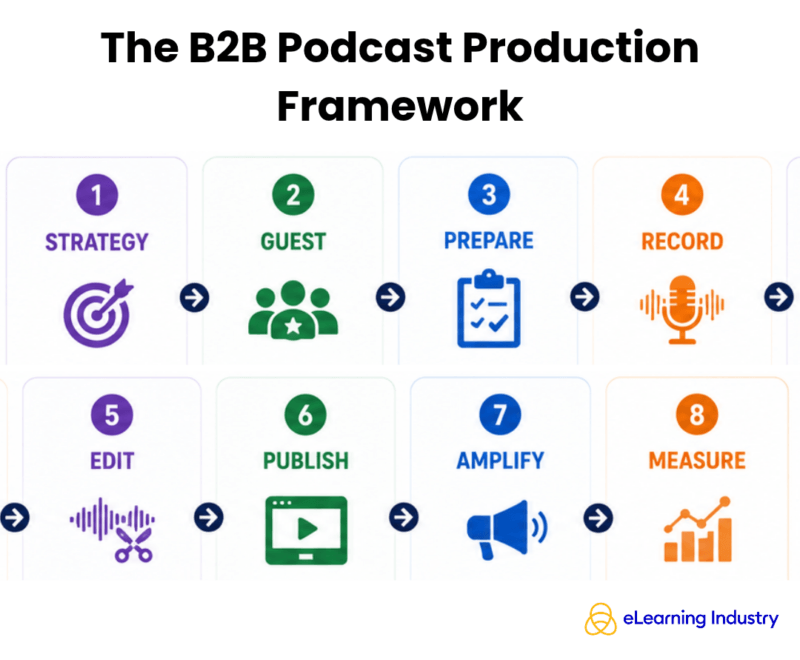
Pre-Production
Guest research → outreach → booking → brief → questions → technical check
Recording
Intro → conversation → CTA → outro → backup files
Post-Production
Audio cleanup → video editing → captions → clips → thumbnail → show notes → transcript
Publishing
YouTube → podcast platforms → website → article embed
Promotion
LinkedIn → newsletter → guest amplification → short video → internal links
Measurement
Views → watch time → audience quality → guest value → pipeline influence
How To Start A Podcast Using A Strong Intro And Outro
Your intro should quickly explain what the show is, who it serves, and why the audience should keep listening. Avoid a 45-second cinematic sequence before anyone speaks. A simple format works well: "Welcome to [Show], where [audience] learn [value proposition] from [type of guests]." Then introduce your guest and begin the conversation.
If you're learning how to start a podcast, keep the opening focused on value rather than unnecessary production. Strong podcast production should support the conversation, not delay it.
Your outro should include one clear CTA. Ask listeners to subscribe, follow, read related content, join your newsletter, or explore a relevant resource. Avoid listing seven different actions. A focused CTA can also support EEAT in SEO by directing audiences toward useful, relevant content.
Subscribe to our newsletter if you want to receive content suggestions and become part of an active eLearning community.
Publish Your Podcast Everywhere It Matters
Publishing your episode is only the beginning. Make it available wherever your audience already consumes content and follows industry conversations.
Your core distribution should include:
- YouTube
- Spotify and Apple Podcasts
- Your company website
- Your newsletter
Depending on your audience, you can also use other podcast directories, relevant communities, and partner newsletters. Follow email marketing best practices when sharing episodes so your newsletter provides context and value instead of simply announcing another link.
For B2B brands, YouTube deserves significant attention. Video episodes can appear in searches for guest names, business topics, and problem-based queries, creating additional discovery opportunities. A broader approach to how to promote a business podcast can also support subscriber growth by giving potential listeners multiple ways to discover and follow your show.
How To Start A Podcast Using SEO: How To Make Episodes Discoverable
Every episode can create another opportunity to appear in search results. Start with a descriptive title that combines a searchable topic, a compelling angle, and the guest. Avoid generic titles such as "Episode 17 With Jane Doe." Instead, use: "How to Scale an LMS From SMB to Enterprise With Jane Doe."
Optimize each episode with:
- A description covering the topic, guest, key questions, keywords, and related resources
- Clear chapters that help viewers navigate the conversation
- Show notes with useful context and links
- A usable transcript or edited written version
Create an indexable website page containing the video or audio, summary, key takeaways, guest bio, transcript, and relevant internal links. This expands your share of voice SEO by giving your brand more opportunities to appear around topics your audience actively searches for. The best podcast format for B2B companies can still underperform if potential listeners cannot discover individual episodes.
Podcasts, GEO, And AI Visibility
Make every episode easier to find by using clear, searchable titles. Combine the main topic, a compelling angle, and the guest's name. For example, "How to Scale an LMS From SMB to Enterprise With Jane Doe" is more useful than "Episode 17 With Jane Joe."
Write descriptions that summarize the topic, introduce the guest, highlight key questions, include relevant keywords, and link to related resources. Add clear chapters so listeners can navigate the conversation easily.
Publish a usable transcript or edited written version, then create an indexable website page with the video or audio, summary, takeaways, guest bio, transcript, and internal links. This supports both Generative Engine Optimization (GEO) and podcast distribution while strengthening your wider podcast marketing strategy.
The Podcast Content Repurposing Engine
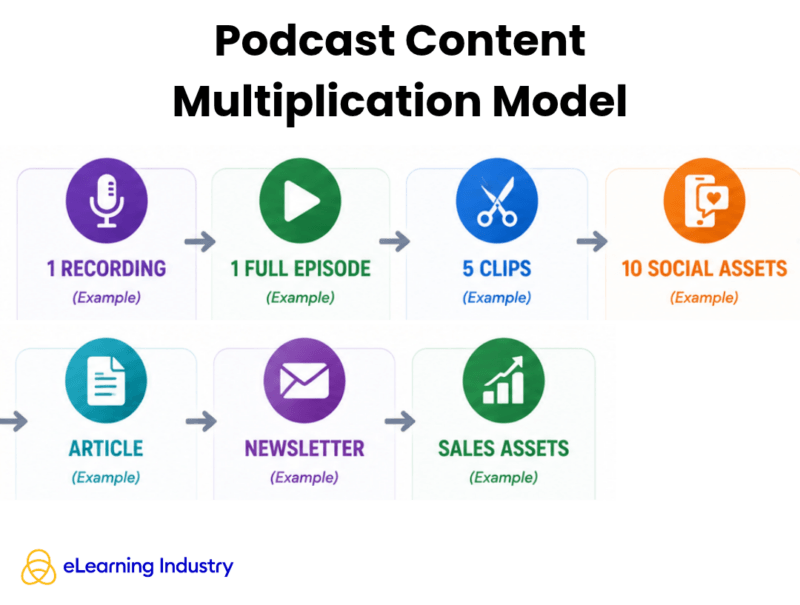
One 30-minute conversation can become a complete content library. The key is to plan content repurposing before recording, rather than treating it as an afterthought.
- Long-form: Full YouTube episode, Spotify episode, article, and transcript.
- Short-form: 3–8 video clips, YouTube Shorts, LinkedIn videos, quote posts, and carousels.
- Email: Newsletter summary, guest feature, and key insight.
- Sales: Relevant expert clips, customer proof, and account-based content.
- PR: Executive quotes, industry commentary, and media pitch angles.
- SEO: Supporting articles, FAQ answers, and internal links.
- Social: Key moments from podcast interviews adapted for different platforms.
- Planning: Identify reusable moments while recording to simplify editing later.
Ways To Start And Promote Each Podcast Episode
- Start before publication: Share a guest announcement, topic teaser, memorable quote, and short preview to create anticipation.
- Launch day: Publish the full episode alongside a newsletter, host post, guest post, and company post.
- Week 1: Share the first short clip and highlight one useful insight from the conversation.
- Week 2: Publish a second clip, quote, or carousel that introduces another takeaway.
- Week 3: Publish a related article and share a third clip to bring the conversation back into focus.
- Keep distributing: Don't use every asset on launch day. Spread content across several weeks to extend the episode's lifespan and support audience growth.
- Apply the strategy: If you're learning how to promote a business podcast, study IMC marketing examples to see how coordinated channels can reinforce one message.
How Podcasts Generate B2B Pipeline
A B2B podcast can influence revenue without producing a lead directly from an episode. The first path is simple: a listener discovers your show, visits your website, becomes a lead, and eventually enters an opportunity. But the bigger value often comes through relationships and repeated exposure.
A guest may become a stronger customer relationship, partner, or referral source. Meanwhile, a buyer who repeatedly sees your host sharing useful ideas may develop enough trust to consider your company when a need appears. An episode can also support demand generation when clips, articles, or insights keep prospects engaged throughout their buying journey.
For account-based marketing, inviting an executive from a target account can create a natural reason to start a relationship. Guests can also introduce you to other executives, partners, prospects, and speakers.
That makes B2B podcast marketing inherently nonlinear. Measure its influence on relationships, opportunities, and pipeline velocity, not just last-click conversions.
How To Measure B2B Podcast Success
- Audience: Track views, downloads, unique listeners, subscribers, returning viewers, watch time, and completion rates.
- Audience quality: Monitor job titles, industries, companies, geographic markets, and engagement from relevant decision-makers.
- Content performance: Identify your strongest topics, best-performing clips, search impressions, and organic discovery.
- Authority: Measure guest quality, executive visibility, speaking invitations, media mentions, backlinks, and Share of Voice.
- Relationships: Track customers featured, strategic accounts engaged, partnerships created, and guest referrals.
- Commercial impact: Monitor website visits, leads, influenced opportunities, sales mentions, pipeline, and revenue influence.
- Overall performance: Don't judge podcast ROI using audience size alone. When considering how to measure podcast ROI, connect audience quality, relationships, authority, and commercial outcomes to your original business objectives.
The CAST B2B Podcast Framework
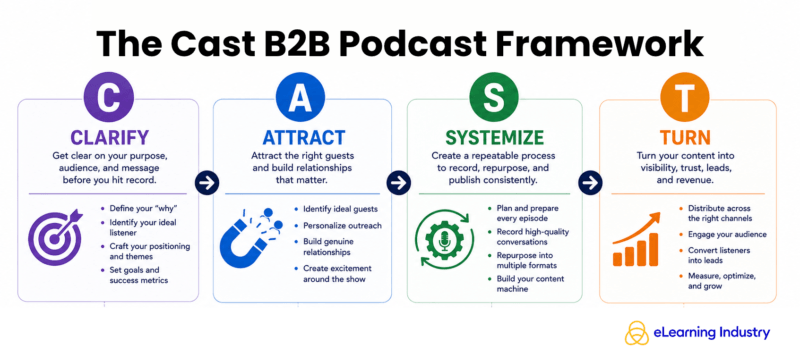
C — Clarify The Strategy
Start by defining your audience, purpose, premise, and business goals. Know who you want to reach and what you want each conversation to achieve before you record.
A — Attract Great Conversations
Choose relevant guests, develop strong topics, and research each person properly. Good preparation helps you ask better questions and create conversations people actually want to hear.
S — Systemize Production And Distribution
Build a repeatable workflow for recording, editing, publishing, promotion, and repurposing. A consistent system makes how to start a podcast less overwhelming and helps your team scale without sacrificing quality.
T — Turn Conversations Into Authority And Growth
Use every episode to strengthen relationships, develop thought leadership, and create reusable content. A focused branded podcast strategy can support audience growth, pipeline, and even online reputation management strategies.
Common B2B Podcast Mistakes
- Starting without a clear audience or differentiated premise.
- Choosing topics based only on what executives want to discuss.
- Turning every episode into a company sales pitch.
- Inviting only internal employees or chasing famous but irrelevant podcast guests.
- Preparing poorly or reading scripted questions instead of having a real conversation.
- Using poor audio or inconsistent publishing.
- Ignoring video and YouTube.
- Publishing episodes without a repurposing plan.
- Using generic episode titles that limit discovery.
- Failing to amplify guests after publication.
- Missing internal linking opportunities.
- Measuring downloads alone instead of audience quality and business impact.
- Expecting immediate pipeline from every episode.
- Stopping after six episodes before the show has time to develop.
- Launching too many shows at once.
- Treating thought leadership marketing as self-promotion rather than useful expertise.
- Starting a podcast for your business without defining what success actually means.
How To Start Your B2B Podcast: Launch Checklist
Before launching, make sure you have:
- Defined your audience and business objective.
- Established your premise, branded podcast name, and visual identity.
- Confirmed the host and episode format.
- Decided episode length and publishing cadence.
- Identified 20+ topics and created an initial guest list.
- Booked your first 3–5 guests.
- Tested your recording setup and produced the intro/outro.
- Configured podcast distribution channels, including YouTube.
- Created episode, thumbnail, and show-note templates.
- Documented your podcast content strategy, repurposing, and promotion workflows.
- Built a KPI dashboard.
- Prepared at least 2–3 episodes before the public launch.
Key Takeaway
A successful B2B podcast is not built by simply pressing record and publishing an episode. It starts with a clear audience, a distinctive premise, relevant guests, thoughtful preparation, and a sustainable system for production and distribution. When these pieces work together, the podcast becomes more than another marketing channel: it becomes a platform for meaningful industry conversations.
The strongest shows are designed around what the audience needs to understand, solve, or rethink. They give executives a credible space to share expertise, build relationships, and generate content that keeps working long after the original conversation ends.
If you are exploring how to start a podcast, focus less on chasing volume and more on building a repeatable engine. Choose the right podcast host, create conversations worth sharing, and measure success through audience quality, authority, relationships, and commercial influence. A thoughtful branded podcast strategy can turn one conversation into a source of visibility, trust, and growth.
eLearning Industry gives Learning Tech, HR Tech, EdTech, AI, and workplace-learning leaders opportunities to join industry conversations through podcasts, webinars, thought leadership, original research, and targeted content experiences reaching L&D, HR, and business decision-makers.
And for companies building their own podcast strategy, the opportunity goes beyond producing episodes: the strongest programs turn executive conversations into reusable thought leadership, stronger relationships, greater industry visibility, and long-term demand.
FAQStart by defining your audience and topic, choosing a format, recording and editing episodes, selecting a hosting platform, and creating a consistent publishing schedule.
Build the podcast around your target audience's challenges rather than your company. Define a clear theme, invite relevant experts, and connect episodes to broader marketing goals.
A B2B podcast is designed for a professional audience and typically covers industry trends, business challenges, leadership insights, or topics relevant to potential customers.
Costs can range from a few hundred dollars for a basic setup to several thousand for professional production, editing, video, and promotion.
At minimum, you need a good microphone, headphones, recording software, and a quiet recording environment. Video podcasts may also require a camera and lighting.
Both can work. Audio is simple and convenient, while video can increase engagement and provide more content for platforms such as YouTube and LinkedIn.
There is no fixed ideal length, but 20–45 minutes is common for B2B interviews and discussions. The episode should be as long as needed to deliver useful insights.
Consistency matters more than frequency. Weekly, biweekly, or monthly schedules can all work if you can maintain quality.
Look for industry experts, customers, executives, authors, analysts, and practitioners who have relevant expertise and a perspective valuable to your audience.
Send a concise, personalized invitation explaining the audience, topic, format, expected time commitment, and why their expertise would be valuable to listeners.
Promote episodes through LinkedIn, email newsletters, YouTube, your website, guest networks, short video clips, and other content channels.
Podcasts build awareness and trust over time, encouraging listeners to visit your website, subscribe to your content, engage with your brand, and eventually enter your sales pipeline.
Track downloads or views alongside business metrics such as website traffic, branded search, subscriber growth, engagement, leads, influenced pipeline, and customer acquisition.
Yes, when possible. YouTube can increase discoverability, support video consumption, and help individual episodes reach audiences through search and recommendations.
Yes. Episode pages, transcripts, show notes, and expert discussions can create indexable content that supports traditional search visibility and provides useful source material for AI-powered search and answer engines.
Preparing 3–5 episodes before launch is a practical approach. It gives listeners more content to explore and provides a buffer for maintaining a consistent publishing schedule.
