

What Does Successful Marketing Look Like Today?
Consumers and B2B buyers rarely experience a brand through one isolated channel. Today, a potential customer may see an advertisement, read an article, watch a product video, hear an executive speak on a podcast, receive an email, visit a website, check reviews, and eventually contact sales before making a decision. That is why marketers need to understand the value of integrated marketing communications examples and how leading brands create connected experiences across every interaction.
According to McKinsey, B2B buyers now use an average of ten channels when interacting with suppliers throughout their buying journey. This shift shows why brands can no longer treat each communication channel as a separate activity. Customers expect consistent messages, relevant content, and smooth transitions between every stage of their journey.
Integrated marketing communications (IMC) helps businesses bring advertising, public relations, content marketing, social media, email, and sales efforts together under one strategic direction. With a strong integrated communications strategy, brands create a unified experience while allowing each channel to serve a specific purpose.
The most successful campaigns do more than appear across multiple platforms. They connect creative ideas, audience insights, and communication channels to strengthen trust and recognition. Through cross-channel marketing, companies can deliver consistent messaging while adapting their approach to different audience behaviors. A well-planned full-funnel marketing strategy also helps brands guide customers from awareness to consideration and purchase.
In this guide, we will explore successful integrated marketing campaign examples and analyze how brands use message consistency, creative execution, and customer touchpoints to build memorable experiences.
Key Takeaways
- IMC aligns multiple marketing channels around one audience, campaign objective, and central message.
- Integration does not mean publishing identical content everywhere; each channel should play a specific role.
- Successful campaigns connect paid, owned, earned, shared, and sometimes experiential media.
- The best IMC examples create consistency without sacrificing channel relevance.
- B2B companies can apply the same principles through research, articles, webinars, podcasts, email, paid promotion, events, and sales enablement.
In This Guide, You Will Find...
- What Is Integrated Marketing Communications?
- What Makes An IMC Campaign Successful?
- How We Selected These IMC Examples
- Integrated Marketing Communications Examples
- What These IMC Examples Have In Common
- B2C vs. B2B Integrated Marketing Communications
- A B2B IMC Campaign Example For An LMS Or HR Tech Vendor
- How To Build An Integrated Marketing Communications Campaign
- How To Choose the Right IMC Channels
- How To Maintain Consistency Without Repeating Identical Content
- How To Measure IMC Performance
- Common Integrated Marketing Communications Mistakes
- AI, GEO, And The Future Of Integrated Marketing Communications
What Is Integrated Marketing Communications?
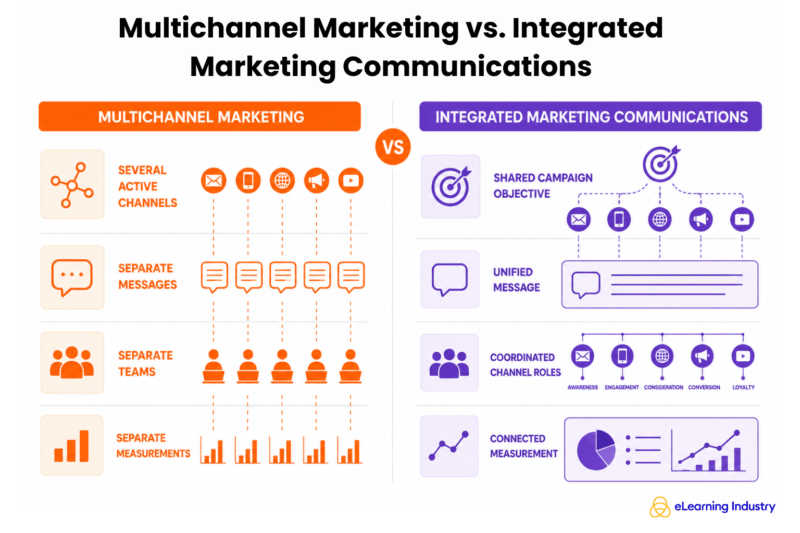
Instead of allowing different teams and channels to operate separately, IMC creates a unified experience where every interaction supports the same business goal. Many integrated marketing communications examples show how brands combine creativity, strategy, and customer insights to build stronger connections.
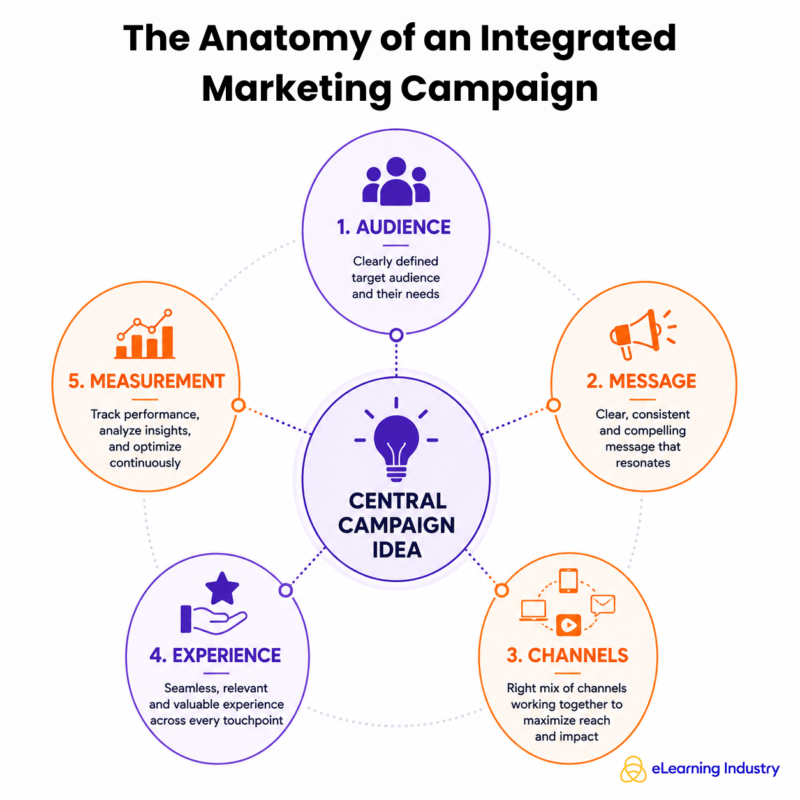
The core components of IMC include:
- One strategic objective: Every campaign needs a clear goal, such as increasing awareness, generating demand thought demand generation campaigns, improving engagement, or driving sales.
- One identifiable audience: Brands should understand who they want to reach, including their needs, challenges, behaviors, and expectations.
- One central campaign idea: A strong idea guides every communication effort and gives the campaign a recognizable identity.
- Consistent positioning and message: Every touchpoint should communicate the same brand promise and reinforce brand trust.
- Coordinated channel roles: Each platform should have a specific purpose within the broader marketing communications strategy.
- Shared creative system: Design, storytelling, tone, and visuals should create a consistent campaign experience.
- Connected measurement: Teams should evaluate results across channels to understand performance and customer behavior.
Modern IMC can involve:
- Advertising: Using paid media to promote campaigns and reach targeted audiences.
- Public relations: Building credibility through media coverage and external communication.
- Content marketing: Educating audiences with valuable resources and information.
- Social media: Engaging communities and encouraging conversations.
- Email marketing: Nurturing relationships through personalized newsletter placements.
- Events: Creating direct experiences with customers and prospects through press releases and event listings.
- Influencer or creator partnerships: Collaborating with trusted voices.
- Direct marketing: Delivering targeted messages to specific audiences.
- Sales enablement: Helping sales teams communicate value.
- Customer advocacy: Encouraging customers to share positive experiences.
- Product experience: Aligning the product journey with the overall brand message.
What Makes An IMC Campaign Successful?
1. Strategic Consistency
A strong IMC campaign connects every touchpoint to the same brand message and positioning. Whether customers see an ad, read content, or speak with sales, each interaction should reinforce the same idea. Successful integrated marketing campaign examples usually show how brands maintain clarity across different platforms.
2. Channel-Specific Execution
A central campaign idea should guide communication without forcing every channel to look identical. Each platform needs an approach that fits its audience and purpose. A marketing communications strategy works best when brands adapt creative assets while protecting the core message.
3. Audience Continuity
Successful campaigns remain relevant throughout the buyer journey by understanding customer needs at every stage. This creates a smoother customer experience and helps audiences build stronger connections with the brand.
4. Cross-Functional Coordination
Teams across brand, content, PR, demand generation, product, and sales should collaborate from one shared plan. This approach also supports B2B thought leadership efforts.
5. Measurable Business Impact
Strong campaigns connect creative performance with business outcomes, including awareness, engagement, demand, sales, retention, and brand equity while improving long-term brand growth overall.
How We Selected These Integrated Marketing Communications Examples
The selection criteria include:
- Clarity of the central idea: Each campaign needed a strong concept that audiences could easily understand and remember.
- Coordination across several channels: We considered how brands used different platforms together to support one campaign strategy.
- Message consistency: The strongest examples maintained a recognizable message across every customer touchpoint.
- Audience participation: Campaigns that encouraged interaction, sharing, or community involvement received stronger consideration.
- Longevity or cultural relevance: We looked at campaigns that created lasting impressions beyond a short promotional period.
- Ability to generate measurable attention or action: Successful campaigns showed clear results, whether through engagement, awareness, leads, or sales.
- Transferable lessons for modern marketers: Each example provides insights that teams can apply to their own communication efforts.
Do you want to stay updated regarding the latest eLearning news? Subscribe to our newsletter and never miss a beat!
Integrated Marketing Communications Examples
Example 1: Coca-Cola—Share a Coke
The campaign: Coca-Cola personalized its packaging by replacing traditional labels with customer names.
The central message: A global product can become a personal experience.
Channels involved: Packaging, TV, outdoor advertising, social media, retail activation, events, and digital personalization.
How the channels worked together: Packaging created participation, advertising built awareness, and social media encouraged customers to share stories.
Why the integration succeeded: The product became part of the communication strategy. It is one of the strongest integrated marketing communications examples because the campaign idea existed across advertising and customer experience.
What B2B marketers can learn: Build participation into the product or customer journey.
Example 2: Dove—Campaign for Real Beauty
The campaign: Dove challenged traditional beauty standards through a long-term confidence platform.
The central message: Beauty should create confidence rather than insecurity.
Channels involved: Television, print, outdoor, digital video, PR, research, and education.
How the channels worked together: Research supported the message, advertising created reach, and public discussion extended the campaign.
Why the integration succeeded: Dove connected purpose, storytelling, and evidence. It became one of the strongest brand communication examples because the idea remained consistent across channels.
What B2B marketers can learn: A clear point of view can become a lasting communication platform.
Example 3: Spotify—Wrapped
The campaign: Spotify transformed listening data into a personalized annual experience.
The central message: Data can become a story customers want to share.
Channels involved: App experience, email, social media, outdoor advertising, artists, and PR.
How the channels worked together: The product created personalized content, while social sharing expanded reach. This demonstrates effective cross-channel marketing where each channel supports the same customer narrative.
Why the integration succeeded: Spotify turned a product feature into a customer experience.
What B2B marketers can learn: Use customer data to create insights, reports, and personalized content.
Example 4: Nike—Just Do It
The campaign: Nike created a global platform connecting sport, identity, and determination.
The central message: Progress comes from action.
Channels involved: Video, athletes, sponsorships, outdoor, digital content, social media, products, and communities.
How the channels worked together: Every channel reinforced the same motivational idea across audiences.
Why the integration succeeded: The campaign maintained message consistency while adapting to new products and cultural moments.
What B2B marketers can learn: Strong messaging should support multiple products and audiences.
Example 5: Apple—Think Different
The campaign: Apple positioned itself around creativity and innovation.
The central message: Apple represents people who challenge convention.
Channels involved: TV, print, outdoor, PR, retail, product design, and leadership communication.
How the channels worked together: Advertising matched the company’s identity, while products reinforced the promise.
Why the integration succeeded: The message was supported by business behavior. It remains a valuable instance among case study examples of strategic positioning.
What B2B marketers can learn: Brand promises must be reflected in customer experience.
Example 6: Red Bull—Stratos
The campaign: Red Bull created a global event around Felix Baumgartner’s space jump.
The central message: Red Bull supports extraordinary achievement.
Channels involved: Live streaming, broadcast, PR, social media, sponsorship, and documentary content.
How the channels worked together: The event generated content across multiple platforms.
Why the integration succeeded: Red Bull created a media event instead of simply buying attention. These are powerful IMC examples because the experience itself became the communication.
What B2B marketers can learn: Events and research can become content engines.
Example 7: Old Spice—The Man Your Man Could Smell Like
The campaign: Old Spice refreshed its image through humor and digital interaction.
The central message: Personal care can be entertaining and culturally relevant.
Channels involved: TV, YouTube, social media, personalized videos, influencers, and PR.
How the channels worked together: Advertising created reach, while digital responses created participation.
Why the integration succeeded: The audience became part of the campaign story.
What B2B marketers can learn: Campaigns need both reach and engagement.
Example 8: Always—Like a Girl
The campaign: Always challenged negative stereotypes linked to the phrase “like a girl.”
The central message: Confidence should not be restricted by social expectations.
Channels involved: Film, digital video, social media, PR, influencers, education, and events.
How the channels worked together: Emotional storytelling encouraged discussion and participation.
Why the integration succeeded: The idea was simple, repeatable, and easy for audiences to support.
What B2B marketers can learn: The best campaigns create messages people want to share.
Example 9: Airbnb—Made Possible by Hosts
The campaign: Airbnb highlighted real hosts and customer experiences.
The central message: Human connection creates meaningful travel.
Channels involved: Customer stories, advertising, social media, PR, website, app content, and email.
How the channels worked together: Customer proof appeared across different communication channels.
Why the integration succeeded: The campaign matched the actual platform experience.
What B2B marketers can learn: Customer evidence should support marketing, sales, and product communication.
Example 10: HubSpot—Inbound Marketing
The campaign: HubSpot built a category around educational marketing.
The central message: Companies can attract customers through valuable content.
Channels involved: Articles, research, webinars, certifications, events, software, and community.
How the channels worked together: Education created demand, while software supported adoption.
Why the integration succeeded: HubSpot combined content, product, and education. It is one of the strongest integrated marketing communications examples with analysis because it helped create an entire business methodology.
What B2B marketers can learn: Thought leadership marketing can build authority and generate demand.
Example 11: Salesforce—Trailblazer Ecosystem
The campaign: Salesforce created a community around customer transformation.
The central message: Customers are innovators driving change.
Channels involved: Learning, events, customer stories, certifications, social media, partners, and executive communication.
How the channels worked together: Education and community strengthened adoption and advocacy.
Why the integration succeeded: Salesforce connected customer success with brand identity.
What B2B marketers can learn: Community can support acquisition, retention, and loyalty.
Example 12: Adobe—Creativity for All
The campaign: Adobe positioned creativity as accessible to everyone.
The central message: Anyone can create with the right tools.
Channels involved: Education, creators, tutorials, events, research, customer showcases, and advertising.
How the channels worked together: Learning resources and customer examples reinforced the brand promise.
Why the integration succeeded: Adobe combined inspiration with practical support. It demonstrates how audience touchpoints can strengthen brand relationships and how brand awareness campaign examples can extend beyond advertising.
What B2B marketers can learn: Education and customer proof strengthen trust and adoption.
| Campaign | Message Clarity | Channel Integration | Audience Participation | Brand Alignment | Experience Consistency | Business Longevity | Total Score |
| Coca-Cola | 5 | 5 | 5 | 5 | 5 | 5 | 30 |
| Spotify | 5 | 5 | 5 | 5 | 5 | 5 | 30 |
| Salesforce | 5 | 5 | 5 | 5 | 5 | 5 | 30 |
| Dove | 5 | 5 | 4 | 5 | 5 | 5 | 29 |
| Always | 5 | 5 | 5 | 5 | 5 | 4 | 29 |
| Nike | 5 | 5 | 4 | 5 | 5 | 5 | 29 |
| Adobe | 5 | 5 | 4 | 5 | 5 | 5 | 29 |
| HubSpot | 5 | 5 | 4 | 5 | 5 | 5 | 29 |
| Apple | 5 | 5 | 3 | 5 | 5 | 5 | 28 |
| Red Bull | 5 | 5 | 4 | 5 | 5 | 4 | 28 |
| Old Spice | 5 | 5 | 5 | 4 | 5 | 4 | 28 |
| Airbnb | 5 | 5 | 4 | 5 | 5 | 4 | 28 |
What These IMC Examples Have In Common
-
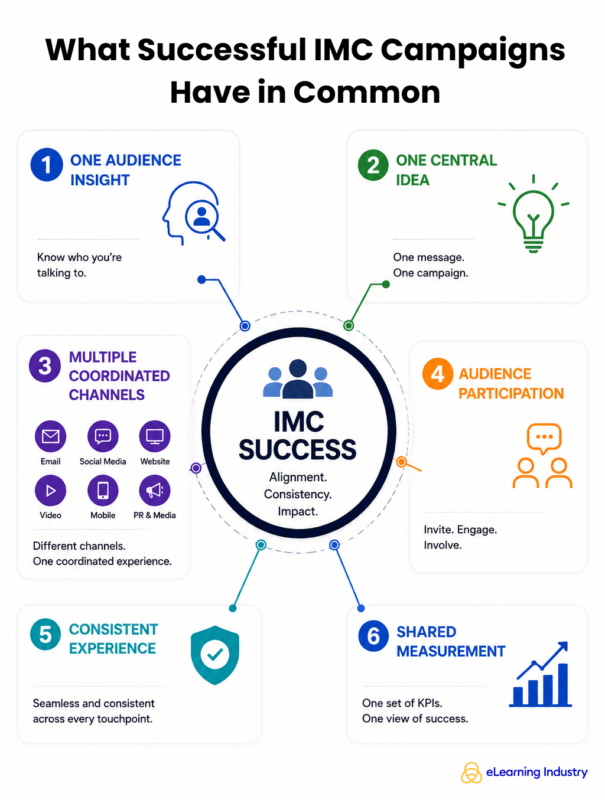
A Clear Organizing Idea
Successful campaigns start with one strong concept that guides every message, creative asset, and customer interaction. Strong examples of integrated marketing communications usually connect the brand purpose, campaign idea, and customer experience through one central theme.
-
Recognizable Message Architecture
The strongest brands create a communication framework that helps audiences quickly understand what the campaign represents and remember the main idea.
-
A Role For The Customer
Effective campaigns invite customers to participate through sharing, feedback, content creation, or personal experiences, turning audiences into active contributors.
-
Paid, Owned, Earned, And Shared Media
Leading multichannel marketing campaigns combine different media types so each channel supports the others and expands campaign reach.
-
Consistency Across The Buyer Journey
Every interaction, from initial awareness to customer retention, reinforces the same brand promise and creates a connected experience.
-
A Product Or Experience That Reinforces The Message
The campaign becomes stronger when customers see the same values reflected in the actual product, service, or brand experience.
-
Enough Flexibility For Adaptation
Successful campaigns maintain their core idea while adjusting for different markets, channels, customer personas, and business goals.
-
A Mechanism That Extends The Campaign Beyond The Original Media Buy
The best campaigns encourage ongoing conversations, customer sharing, and additional visibility through activities such as media pitch examples that help expand reach.
B2C Vs. B2B Integrated Marketing Communications
| Element | Typical B2C IMC | Typical B2B IMC |
| Buying cycle | Shorter | Longer |
| Decision-makers | Individual or household | Buying committee |
| Main emotional driver | Identity, aspiration, convenience | Trust, risk reduction, business impact |
| Core assets | Advertising, creators, promotions | Research, webinars, case studies, product education |
| Sales involvement | Often limited | Usually significant |
| Measurement | Reach, engagement, sales | Influence, pipeline, velocity, revenue |
-
Buying Cycle
B2C campaigns usually support faster decisions, while B2B campaigns often involve longer research periods, multiple stakeholders, and more detailed evaluation. Many integrated marketing communications examples show that B2B buyers need more education before they commit.
-
Decision-Makers
B2C communication often targets an individual or household, while B2B communication must address buying committees that include executives, managers, users, and finance teams.
-
Main Emotional Driver
B2C campaigns often focus on identity, aspiration, and convenience. B2B campaigns usually focus on trust, reducing risk, improving performance, and showing business impact.
-
Core Assets
B2C brands often rely on advertising, creators, promotions, and social content. B2B brands use research reports, webinars, case studies, product education, and product marketing tactics to support buyer decisions.
-
Sales Involvement
B2C campaigns often require limited sales support. B2B campaigns usually involve sales teams throughout the journey, making alignment between marketing and sales essential.
-
Measurement
B2C teams often track reach, engagement, and sales. B2B teams measure influence on pipeline, revenue, deal velocity, and long-term customer value.
-
B2B Integration May Include
Original research reports that build credibility, executive thought leadership, PR and media outreach, educational webinars, podcast appearances, and organic search content. Brands can also combine paid social distribution, email nurturing, case studies, sales enablement, retargeting, and directory or comparison-site visibility to create stronger cross-channel marketing.
-
Customer Journey Focus
B2B campaigns require consistent audience touchpoints across education, evaluation, and purchase stages. Teams should understand why be a podcast guest, how content supports buyers, and how each channel contributes to trust.
A B2B IMC Campaign Example For An LMS Or HR Tech Vendor
Campaign Theme
The Hidden Cost of Skills Gaps
An LMS or HR Tech vendor can build a campaign around a business challenge that directly affects HR leaders, L&D teams, and executives. The goal is to show how workforce skills gaps impact productivity, employee development, and business performance.
Central Asset
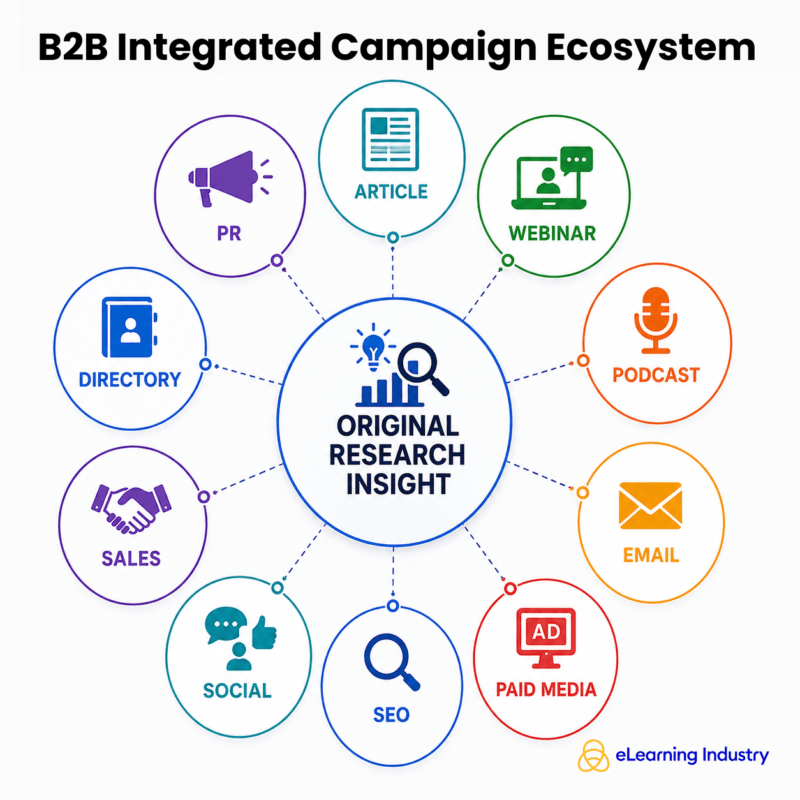
The campaign starts with an original research report that quantifies the operational and revenue impact of skills gaps. This report becomes the foundation of the integrated marketing communications strategy by giving every channel a shared source of data and insight.
Integrated Execution
- Research report: Establishes evidence and gives the audience a valuable resource for understanding the problem.
- PR campaign: Shares original findings with industry publications to increase credibility, visibility, and brand monitoring opportunities.
- Thought leadership articles: Explain the business implications of skills gaps and position company leaders as trusted advisors.
- Webinar: Helps HR and L&D professionals interpret the findings and apply the insights to their organizations.
- Podcast appearances: Build executive authority by discussing workforce challenges and practical solutions, while increasing share of voice SEO through additional online mentions.
- LinkedIn campaign: Distributes key statistics, executive commentary, and discussion points to professional audiences.
- SEO content: Targets problem-aware searches from buyers researching workforce development challenges.
- Email nurture: Delivers relevant insights based on audience roles, interests, and buying stages.
- Paid media: Promotes the report to target accounts and reaches decision-makers who may not discover the content organically.
- Sales enablement: Turns research findings into conversation starters for sales teams.
- Directory visibility: Places the solution where active buyers compare vendors and explore options.
- Case study: Shows how the platform helped a customer solve similar workforce challenges.
A campaign like this shows how to create an integrated marketing campaign because every asset supports the same narrative while addressing a different buyer need. Teams can use campaign measurement to evaluate engagement, pipeline influence, and revenue impact across each channel.
How To Build An Integrated Marketing Communications Campaign
A successful campaign starts with strategy, not channel selection. Before you choose platforms, define the audience, message, and role each activity will play. The UNIFY Framework helps marketing teams create connected campaigns that align communication, customer experience, and business goals.
U — Understand the Audience
Start by identifying who you want to reach and what influences their decisions. Focus on:
- Priority persona: Define the specific buyers, users, and stakeholders involved.
- Buying-stage needs: Understand what information they need at each stage of the journey.
- Core problem: Identify the challenge your campaign will address.
- Emotional and commercial motivations: Connect business outcomes with personal priorities such as confidence, efficiency, or career impact.
- Trusted information sources: Learn where your audience looks for answers, including industry publications, communities, events, and expert content.
N — Name the Central Idea
Develop one campaign proposition that guides every asset and interaction. Strong integrated marketing communications examples usually build around a message that is clear, differentiated, relevant, repeatable, and flexible enough to work across multiple channels.
I — Integrate the Channel Roles
Instead of asking, “Which channels should we use?” ask, “What role should each channel play?” For example:
- PR and media relations create third-party credibility.
- Research establishes evidence.
- Search captures existing demand.
- Social distributes ideas and conversations.
- Webinars provide education.
- Email nurtures relationships.
- Sales personalizes the argument.
Understanding what is a PR team helps marketers use these specialists effectively, from managing reputation to creating external visibility.
F — Form a Consistent Experience
Align every customer interaction, including:
- Message
- Visual identity
- Tone
- Evidence
- Offer
- Calls to action
- Landing pages
- Sales conversations
Y — Yield and Measure Business Impact
Track both channel performance and overall campaign results. Measure engagement, qualified opportunities, pipeline contribution, revenue influence, and customer response. For example, podcast marketing can support awareness goals while also contributing to executive credibility and audience growth.
How To Choose The Right IMC Channels
Awareness
At the awareness stage, focus on channels that introduce your brand and create visibility. Strong integrated marketing communications examples show that brands should select channels based on audience behavior, campaign objectives, message format, internal capabilities, budget, and attribution feasibility rather than trying to use every available platform. Advertising, PR, social media, sponsorships, and events help you reach new audiences, create recognition, and introduce the campaign message.
Authority And Consideration
During research and evaluation, buyers need evidence, education, and proof before making decisions. Research reports, articles, podcasts, webinars, case studies, and reviews help build trust and answer buyer questions. These channels support omnichannel marketing campaigns by creating connected learning experiences across different stages of the customer journey.
Conversion
Conversion channels help buyers move from interest to action. Landing pages, email campaigns, product demos, retargeting, sales enablement materials, and comparison or directory pages support decision-making by providing relevant information at the right moment. These activities should connect marketing efforts with sales conversations and create a smoother buying experience.
Retention And Advocacy
After purchase, focus on strengthening relationships and encouraging long-term engagement. Customer education, communities, user events, certifications, customer stories, and referral programs help increase loyalty. When companies align these activities with their brand strategy for growth, they create stronger customer relationships and turn successful experiences into future advocacy.
How To Maintain Consistency Without Repeating Identical Content
Message consistency means every marketing asset supports the same strategic idea, even if each channel presents it differently. Many integrated marketing communications examples succeed because they keep the core message stable while adapting the format to match the audience and platform.
Content duplication is different. It happens when you publish the same copy, visuals, or creative across every channel without considering how people consume information. That approach often reduces engagement and makes your communication feel repetitive.
Instead, adapt one insight into several formats. Turn a research finding into a press release for journalists, an executive article for CEOs, a webinar for practitioners, a LinkedIn chart, a short YouTube video, a sales presentation for prospects, and an email sequence for leads. Every piece should support the same narrative while serving a different purpose.
When you tailor the format instead of repeating the content, you create a stronger customer experience. You can also use feedback and social listening for B2B marketers to understand which messages resonate most and refine future campaigns without changing the core idea.
How To Measure Integrated Marketing Communication Performance
Campaign-Level Metrics
- Total qualified reach: Measure how many relevant buyers the campaign reached, not just total impressions.
- Message association: Track whether audiences connect the campaign with the intended brand message.
- Share of Voice: Compare your visibility against competitors.
- Branded search growth: Monitor increases in branded searches after campaign launches.
- Campaign engagement: Evaluate meaningful interactions across campaign assets.
- Buying-group engagement: Measure participation from multiple stakeholders within target accounts.
- Influenced pipeline, conversion rate, pipeline velocity, revenue, and customer acquisition cost.
Channel Contribution Metrics
- Earned media coverage
- Organic traffic
- Webinar registrations
- Email engagement
- Social amplification
- Paid media conversions
- Sales content usage
- Directory referrals
- Review engagement
Review these metrics together to understand how each channel supports your cross-channel marketing strategy instead of evaluating channels in isolation.
Integration Indicators
- Consistency of campaign messaging
- Cross-channel audience overlap
- Percentage of prospects touching multiple assets
- Movement from awareness to consideration
- Sales adoption of campaign narratives
- Reuse and longevity of campaign assets
Compare these indicators with campaign performance and relevant B2B marketing benchmarks. Modern measurement should combine marketing mix analysis with detailed campaign data instead of relying on a single user-level attribution model.</p></p>
Common Integrated Marketing Communications Mistakes
Many teams start by choosing the top digital marketing channels instead of defining the audience, campaign objective, and core message first. As a result, every activity feels disconnected, even if each channel performs well individually.
Another common mistake is treating IMC as publishing identical content everywhere. Successful integrated marketing communications examples adapt the format for each platform while keeping the same strategic narrative. Teams also weaken campaigns when they introduce too many unrelated messages or try to include every product feature in a single campaign.
Internal alignment matters just as much. Marketing, sales, and customer success should reinforce the same story instead of developing competing narratives. When departments communicate different priorities, buyers receive mixed signals throughout the customer experience.
Many organizations also focus heavily on visual consistency while overlooking strategic consistency. Matching colors, logos, and templates cannot compensate for inconsistent messaging or unclear positioning. Likewise, adding new channels without defining their specific role usually creates more complexity than value.
Measurement is another frequent challenge. Teams often evaluate every tactic separately instead of looking at combined campaign performance. They also confuse omnichannel delivery with true integration, even though they are different concepts. Finally, changing the campaign message too quickly prevents it from building recognition. The strongest brand communication examples remain consistent long enough for audiences to remember and trust them.
AI, GEO, And The Future Of Integrated Marketing Communications
AI is changing how marketing teams plan and execute campaigns. It can adapt content faster, create persona-specific variations, analyze campaign performance, test creative ideas, monitor media coverage, support predictive optimization, and personalize sales communication. These capabilities help teams scale execution more efficiently across multichannel marketing campaigns.
However, AI also creates new challenges. When different teams generate large volumes of content independently, brands can easily publish conflicting messages, inconsistent tones, or competing positioning. The strongest integrated marketing communications examples show that a clear strategy should guide every asset, regardless of whether people or AI create it. That framework keeps messaging consistent while allowing content to adapt for different audiences and channels.
AI is also changing how buyers discover companies. Beyond traditional search engines, people increasingly use AI Overviews, ChatGPT, Gemini, and Perplexity to research products and vendors. As discussions around GEO vs. SEO continue, marketers should focus on building authority signals that benefit both search engines and AI systems. Those signals include owned expertise, media coverage, executive commentary, original research, reviews, directory listings, and consistent entity associations. Together, they help human buyers and AI platforms understand what your company represents while reinforcing a clear and credible market position.
Key Takeaway
The strongest marketing campaigns do more than appear on multiple channels. They connect every activity to one clear idea that customers recognize throughout their journey. The integrated marketing campaign examples in this guide show that brands achieve better results when advertising, content, PR, email, events, and customer interactions all reinforce the same message.
Whether you market to consumers or businesses, the same principle applies. Build your strategy around your audience, assign a clear role to every channel, and measure how the entire campaign contributes to business outcomes. Many successful integrated marketing campaign examples also combine research, education, customer proof, and sales enablement to support buyers from awareness to purchase and beyond.
As AI continues to change marketing execution and discovery, consistent messaging will become even more valuable. Strong campaigns also strengthen credibility through reviews, media coverage, customer advocacy, and online reputation management strategies, creating signals that both people and AI platforms can trust.
Publishing more content does not automatically create a stronger brand. The greatest impact comes when research, thought leadership, PR, webinars, podcasts, paid promotion, directory visibility, email, and sales outreach reinforce one strategic narrative. eLearning Industry helps LMS, EdTech, HR Tech, AI, and learning solution providers build integrated visibility campaigns through original research, sponsored articles, webinars, podcasts, newsletters, directory exposure, top list opportunities, and targeted demand generation.
FAQIntegrated Marketing Communications (IMC) is a strategy that aligns all marketing channels and messages to create a consistent brand experience across platforms.
Examples include combining email campaigns, social media, content marketing, PR, advertising, events, and sales materials around one unified message.
Multichannel marketing uses multiple channels, while IMC ensures those channels work together with consistent messaging and shared goals.
Successful campaigns have clear objectives, consistent messaging, audience alignment, coordinated channels, and measurable performance tracking.
Common channels include websites, SEO, email, social media, paid advertising, PR, events, webinars, content marketing, and sales communication.
B2B companies use IMC to align thought leadership, demand generation, sales enablement, account-based marketing, and customer communications.
Companies can maintain consistency through clear brand guidelines, shared content strategies, centralized communication plans, and collaboration between teams.
Performance is measured through metrics such as brand awareness, engagement, website traffic, lead generation, conversion rates, and revenue impact.
IMC focuses on consistent messaging across channels, while omnichannel marketing focuses on creating a seamless customer experience across all touchpoints.
AI helps companies personalize messaging, automate content creation, analyze customer behavior, optimize campaigns, and improve coordination across channels.