




Reimagining Student Journeys Through An AI Lens
By 2026, university learning will no longer be judged by how many courses were taken or credits earned by the student, but by how effectively it scales job-ready skills. From where I sit—designing and managing EdTech platforms for noncredit online education, executive education (ExEd), and business-to-institution (B2I) learning—the economics of university learning are being fundamentally rewritten.
The catalyst is clear. AI is reshaping the job market faster than traditional degree cycles can respond. Corporate learning has already adapted, moving aggressively toward personalized, skills-based, and outcomes-driven learning. Universities and colleges are now following, not by reinventing everything internally, but by embedding industry-relevant eLearning ecosystems directly into academic curricula. This shift represents a new economic model for higher education—one that prioritizes skills velocity over content volume.
Why The Old University Learning Model Is Breaking
Historically, university eLearning investments focused on digitization: Learning Management Systems (LMSs), recorded lectures, and online course replicas. While this expanded access, it didn't necessarily improve employability.
In my work with higher education and executive education platforms, I repeatedly see the same challenge: curricula evolve slowly, while workforce skills evolve in months, not years. AI has accelerated this gap. Students may graduate with strong theoretical foundations but lack exposure to applied skills in analytics, AI-augmented decision-making, digital strategy, and modern operating models.
Corporate learning teams recognized this gap years ago. They redesigned learning around capability building, not course completion. Now, universities are adopting similar economics—especially through B2I and private cohort models.
The Rise Of B2I And Private Cohort Learning Inside Universities
One of the strongest uptrends I see heading into 2026 is the rise of private cohort learning embedded within degree programs. This is business-to-institution learning turned inward—where universities partner with external providers to integrate world-class online courses into formal curricula.
A compelling example is Chandigarh University's collaboration with Harvard Business School Online, where Harvard-designed business and management courses are embedded into students' academic journeys [1]. This model changes the economics entirely. Instead of building every capability internally, universities:
- Plug into globally relevant, continuously updated content.
- Offer students exposure to real-world frameworks used by executives.
- Improve graduate employability without extending degree duration.
From my experience designing similar ecosystems, this approach delivers immediate value to students while unlocking new revenue and differentiation opportunities for institutions.
AI As The Engine Of Personalized, Skills-Centric Learning
AI is not just a subject to be taught—it is the operating system of modern learning ecosystems. In corporate learning environments I've helped design, AI enables:
- Personalized learning paths based on role, aptitude, and career goals.
- Continuous skill diagnostics rather than one-time assessments.
- Real-time adaptation of content as job requirements change.
Universities are now applying these same principles. AI-powered learning ecosystems allow institutions to move beyond "one syllabus fits all" toward individualized skill progression, even at scale. As CIO research highlights, AI-driven learning ecosystems are becoming essential for workforce upskilling, not optional enhancements [2]. The economic implication is profound: universities can scale skills relevance, not just enrollment numbers.
Embedding AI Literacy For Job-Ready Graduates
In 2026, AI literacy will be as foundational as digital literacy was a decade ago. In my view, the competitive advantage for universities lies in embedding applied AI understanding across disciplines, not isolating it within computer science programs. When I work with academic and executive education leaders, we focus on a simple principle: "Every graduate should understand how AI changes decision-making, productivity, and value creation in their field." This doesn't mean turning every student into a data scientist. It means:
- Teaching how AI augments business, operations, marketing, and strategy.
- Building confidence in working alongside AI tools.
- Developing ethical and governance awareness.
By integrating AI-enabled eLearning courses from industry leaders into curricula, universities can ensure students graduate job-ready, not just degree-ready.
From Content Economics To Skills Economics
The new economics of university eLearning are not about producing more courses. They are about maximizing return on learning investment for students, institutions, and employers. From the platforms I've helped scale, the most successful models share three traits:
- External partnerships for continuously updated skills.
- Private cohort models aligned to institutional goals.
- AI-driven personalization to improve outcomes at scale.
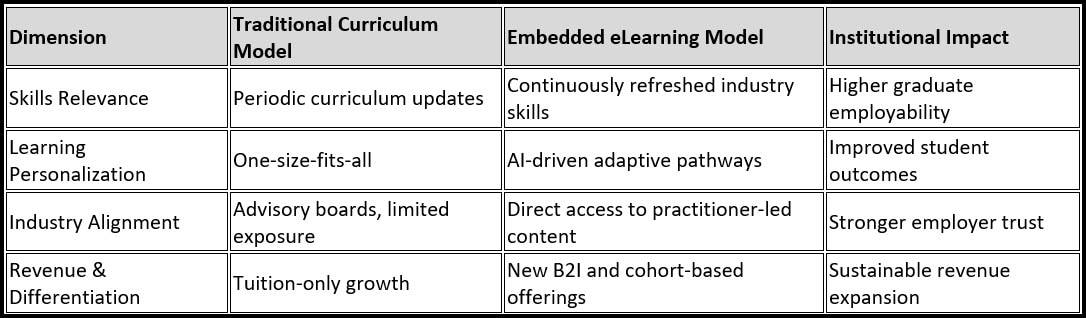
The table below summarizes the benefits I consistently observe when universities embed industry-aligned eLearning into their curricula.
What This Means For Universities Heading Into 2026
Universities that thrive in 2026 will not compete with corporate learning—they will learn from it. From my experience, the most forward-thinking institutions are already:
- Embedding executive-grade online courses into undergraduate and postgraduate programs.
- Treating eLearning platforms as revenue engines, not cost centers.
- Using AI to personalize learning journeys at institutional scale.
This shift does not dilute academic rigor. On the contrary, it enhances it by connecting theory with practice and preparing students for a labor market transformed by AI.
Conclusion: Scaling Skills Is The New Competitive Advantage
The future of university eLearning is not about who has the most content, the best LMS, or the largest online catalog. It is about who can scale relevant skills fastest and most effectively.
As someone deeply involved in building EdTech platforms for B2I, higher education, and executive education, I see 2026 as a turning point. Universities that embrace AI-powered, industry-embedded, skills-centric eLearning will deliver graduates who are confident, adaptable, and truly job-ready. That is the new economics of university eLearning—and it's already taking shape.
References:
[2] AI-powered learning ecosystems: A guide to workforce upskilling
Image Credits:
- The image within the body of the article was created/supplied by the author.