


 ChatGPT
 Perplexity
 Claude
 Grok
Grok
Adaptive Compliance Training
A consistent learning outcome does not always require an identical learning experience. Organizations can keep policies, expectations, and core content common while adapting scenarios, examples, practice, or support to better reflect different roles, regions, and levels of experience. The most practical approach is usually to keep a strong common spine and introduce variation only where it meaningfully improves relevance or application. Adaptive learning, in that sense, is less about building a different course for every learner and more about deciding where sameness is actually getting in the way.
The Course Doesn't Have To Be The Same For Everyone To Teach The Same Thing
There is an assumption built into a lot of corporate training that feels reasonable at first: if everyone is supposed to learn the same thing, everyone should take the same course. I can see why we do it. It is cleaner. Easier to administer. Easier to document. And in areas such as compliance, there is often a strong desire to be able to say that everyone received the same training.
But I think we sometimes confuse two different requirements. The learning outcome may need to be consistent. The learning experience does not always need to be identical. That distinction opens up a lot of possibilities.
Same Principle, Different Reality
Consider something like a code of conduct. The principle might apply to everyone in the organization. Everyone needs to understand conflicts of interest, respectful behaviour, information security, or appropriate use of company resources.
But the situations in which those principles show up can look very different depending on the learner. A people manager may encounter a conflict of interest when making a hiring decision. Someone in procurement may encounter it while evaluating a supplier. A frontline employee may face a completely different version of the same underlying issue.
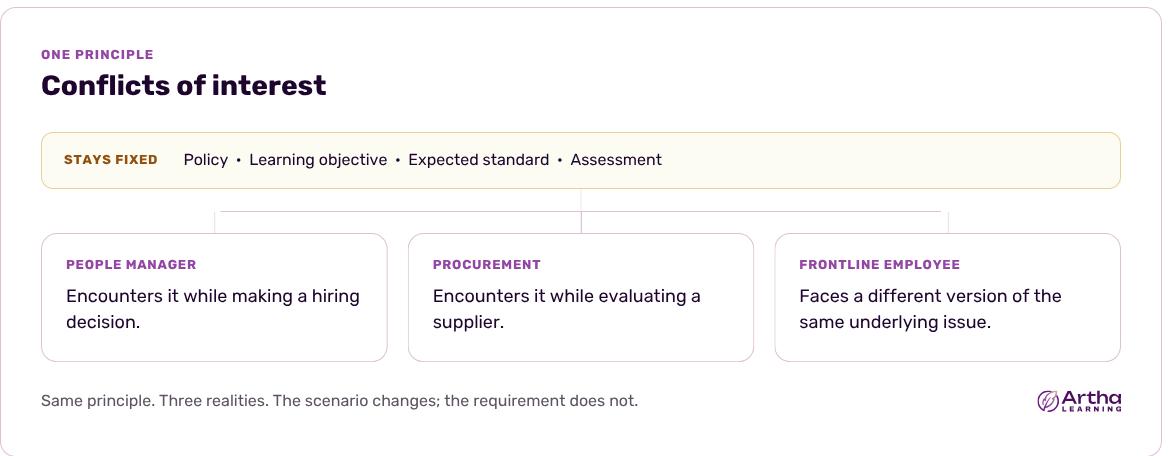
If all three learners receive exactly the same generic scenario, the training may technically cover the principle. But one or more of them may have to do extra mental work to translate it into their world. That is where adaptation becomes useful.
You can keep the principle, policy, and learning objective consistent while changing the example, scenario, decision, or practice activity around them. The learner is still learning the same thing. They are just seeing it through a context that makes sense to them.
Standardization Is Useful. Sameness Is Not Always Necessary.
I am not arguing against standardization. In fact, there are many things in a learning experience that probably should be standardized. The policy itself should not change depending on who is taking the course. Neither should the core expectation, legal requirement, or organizational position. But once those pieces are fixed, there is another question:
What needs to stay the same, and what would become more useful if it changed?
That is a much more practical way to think about adaptive learning. Suppose everyone needs to learn when confidential information can and cannot be shared. The core content might be common. The definition of confidential information is common. The relevant policy is common. The consequences of mishandling it may be common. But the practice could vary.
Someone in HR might work through a situation involving employee records. Someone in sales might encounter customer information. Someone in finance might deal with financial data.
We have not changed what people are expected to know or do. We have changed the route through which they practise applying it. That is not inconsistency. It is relevance.
Why Context Matters So Much In Practice
Information is relatively easy to standardize. Judgment is harder. If the learner simply needs to recall a fact, the context may not matter very much. If the learner needs to recognize a situation, weigh competing considerations, or decide what to do next, context starts to matter a lot more.
That is because the learner is not just remembering content. They are interpreting it. And interpretation depends on what the situation looks like. A generic scenario may still work, of course. But when the context is too far removed from the learner's actual work, part of the task becomes translation:
- "Okay, this example is about a customer, but what would that mean for my role?"
- "This situation involves a manager, but I don't manage anyone."
- "This example is based in another region. Does the same thing apply here?"
Sometimes that translation is easy. Sometimes it is useful. But sometimes we are simply introducing friction that adds nothing to the learning. If we already know the learner's role, region, experience level, or responsibilities, why not use that information where it genuinely improves relevance?
Adaptive Does Not Have To Mean Algorithmic
I think the term "adaptive learning" sometimes makes this sound more sophisticated than it needs to be. People hear adaptive learning and imagine a platform constantly analyzing learner behaviour and generating a completely unique course for each person. That is one version.
But adaptation can also be very simple. At the beginning of a course, you might ask learners to select their role. That choice determines which examples they see later.
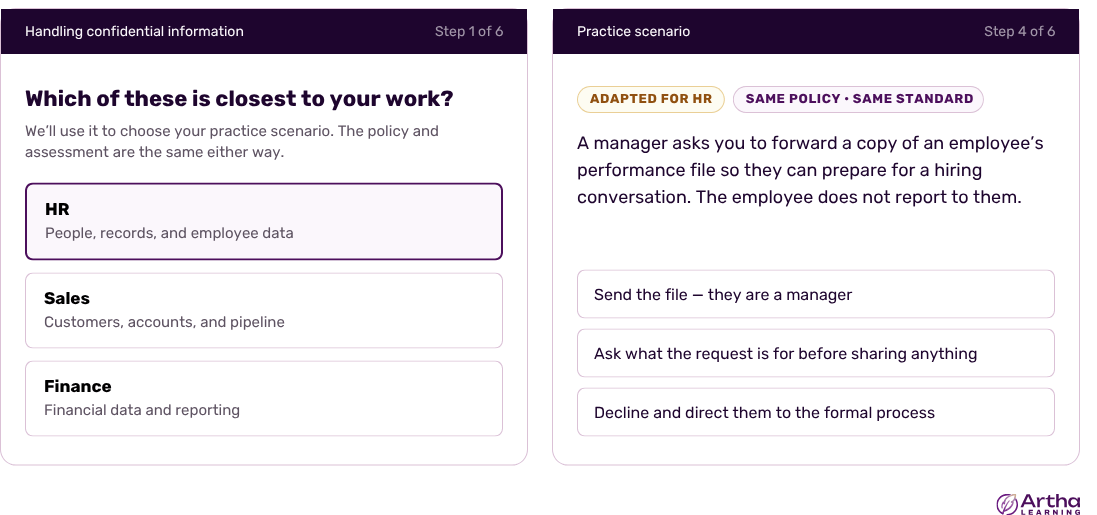
A learner in one region might receive a scenario based on the process used there, while another sees the version relevant to their location. A new manager might receive additional support or a more foundational scenario. An experienced manager might move directly into a more ambiguous decision.
The common spine of the course stays intact. Only the parts where context adds value change. That is often enough. The goal is not to create a different course for every learner. The goal is to identify the few places where "same for everyone" is making the learning less useful than it needs to be.
A Common Spine Makes Adaptation Manageable
There is an obvious practical objection here. If we start adapting everything by role, region, experience, department, language, and every other learner characteristic we can identify, the course quickly becomes impossible to manage. I agree.
The answer is not maximum personalization. It is selective adaptation. Think about the course as having a common spine.
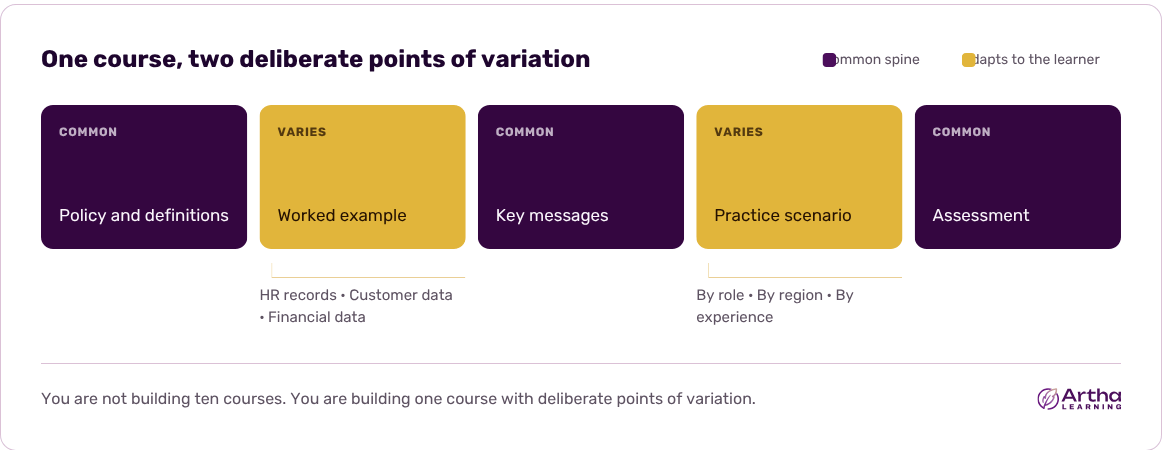
The core concepts stay the same. The learning objectives stay the same. The essential policy or process stays the same. The key messages stay the same.
Then ask where variation would actually improve the experience. Perhaps it is one scenario. Perhaps it is the examples. Perhaps learners can choose which case study they work through. Perhaps one audience needs a little more explanation before practising, while another can skip it. Perhaps the visuals should reflect a different workplace context.
This is a much more sustainable model because you are not building ten courses. You are building one course with deliberate points of variation. And those variation points should earn their place. If changing something does not improve relevance, challenge, comprehension, or application, I would probably keep it common.
Compliance Training Is A Particularly Interesting Case
Compliance training is where this tension becomes especially visible. Organizations often have good reasons for wanting consistency. They may need to demonstrate that a particular topic was covered, that learners received required information, or that everyone was trained against the same standard. But consistency in the requirement does not automatically mean every learner must receive the exact same example.
Imagine anti-bribery training in a global organization. Everyone may need to understand the same organizational expectation. But the actual situations learners encounter could differ significantly based on role or location.
A generic example might technically work for everyone. A role-relevant example could make the same principle much easier to recognize in practice. The key is to protect what must remain fixed.

If there is required wording, required policy content, required legal information, or a mandated assessment standard, keep it fixed. Then adapt around it.
That distinction is important because adaptive learning should not become an excuse to change the requirement itself. The point is to make application more relevant, not to create different standards for different people.
Where I Would Be Careful
There are limits. Not every difference between learners deserves a different path. If we adapt too aggressively, we create complexity without enough learning benefit.
There is also a risk that we make assumptions about people based on role or profile information that are not actually useful. Two people with the same job title may have very different experience. Someone labelled "experienced" may still need support in a particular area.
So adaptation should not mean silently deciding what learners need based on whatever data happens to be available. Sometimes the simplest approach is to let learners choose.
- "Which of these situations is closest to your work?"
- "Would you like a quick refresher or go directly to practice?"
- "Which role would you like to explore this from?"
That preserves relevance without pretending the system knows more about the learner than it does. And in some cases, the common experience may genuinely be the right choice. If everyone needs to see the same example because the example itself is important, there is no reason to personalize it simply because we can.
The Better Question
I think the useful question is not: "Should this course be adaptive?" That makes adaptive learning sound like a format decision. I would ask:
Where would sameness make this learning less useful?
Maybe nowhere. That is fine. But perhaps your sales team, managers, and operations staff are all taking the same course and encountering examples that only really make sense to one of them. Perhaps people in five countries are being shown one context because it was easier to build. Perhaps experienced employees are repeating practice they mastered years ago while newer employees need more support.
Those are design problems worth looking at. Adaptation gives us another way to solve them.
Consistency Should Protect The Goal, Not Flatten The Experience
There are good reasons to create consistency in learning. Organizations need common expectations. Learners need clarity. Policies cannot mean one thing for one group and something else for another. But I do not think consistency requires us to pretend everyone experiences work in the same way.
The job of learning design is not to make every screen identical. It is to help people understand, decide, and act when they encounter the real situation. Sometimes the best way to protect a common outcome is to let people practise it differently.
That is the distinction I would hold onto: standardize the principle, expectation, and outcome where they need to be standard. Adapt the context when doing so makes the learning more recognizable and useful. The course does not have to be the same for everyone to teach everyone the same thing.
Image Credits:
- The images/infographics within the body of this article were created/supplied by the author.