
 ChatGPT
 Perplexity
 Claude
 Grok
Grok
Customer Enablement: A Guide For Instructional Designers And L&D Leaders
Customer enablement is becoming a critical capability for organizations whose products and services are increasingly complex. As digital platforms grow more sophisticated, customers often need guidance to fully understand how to use them and achieve value quickly. This has created a growing demand for structured training that helps customers build confidence, develop skills, and navigate products effectively.
Traditionally, customers would contact support teams when problems appeared. Today, many organizations are moving toward a different approach. Instead of waiting for issues, they invest in customer service and customer support enablement, as well as broader learning initiatives that help customers succeed from the beginning.
This shift is where customer enablement comes in. At its core, customer enablement means equipping customers with the knowledge, resources, and guidance they need to achieve their goals with a product or service. It closely connects with customer success enablement, customer experience enablement, and even broader client enablement strategies that improve adoption and long-term engagement.
Because these initiatives rely heavily on learning design, Instructional Designers and L&D leaders are increasingly involved in building scalable customer education programs. Ultimately, customer enablement is a cross-functional capability that aligns learning, product adoption, and customer outcomes. In this guide, we further explore this concept and help you build a successful customer enablement strategy.
What Is Customer Enablement?
Customer enablement is the strategic process of helping customers gain the knowledge, skills, and resources they need to successfully use a product or service and achieve their goals. At its core, the meaning of customer enablement revolves around education: organizations proactively guide customers so they can confidently adopt, use, and expand their use of a solution.
In practice, customer enablement combines learning experiences, resources, and support systems that help customers reach value faster. Instead of leaving users to figure things out on their own, companies design structured learning pathways that help them understand both the product and the outcomes it enables. Typical client enablement initiatives include:
- Customer onboarding education
- Product training and tutorials
- Knowledge bases and help centers
- Customer learning programs or academies
- Guided support experiences inside the product
For L&D teams, customer enablement becomes clearer when viewed through an Instructional Design lens. It is about creating scalable learning experiences that support product adoption, reduce confusion, and help customers become more capable users over time.
Customer Enablement Vs. Customer Success Vs. Customer Support
Although these functions often work together, customer enablement, customer success, and customer support serve different purposes within the customer lifecycle. Understanding how they differ helps organizations design more effective customer education and experience strategies.
Aspect |
Customer Enablement |
Customer Success |
Customer Support |
Primary Focus |
Education and capability building. | Relationship management and outcomes. | Reactive problem resolution. |
Main Objective |
Help customers gain the knowledge and skills to use a product effectively. | Ensure customers achieve their desired business results. | Solve issues and technical problems. |
Approach |
Proactive learning and capability development. | Strategic guidance and customer relationship management. | Issue-based troubleshooting and assistance. |
Timing In Customer Journey |
Early and ongoing throughout product use. | Continuous engagement after onboarding. | When customers encounter problems. |
Typical Activities |
|
|
|
Teams Involved |
|
|
|
Long-Term Impact |
Improves product adoption and customer knowledge. | Drives retention, satisfaction, and expansion. | Restores functionality and resolves immediate issues. |
In practice, these functions increasingly overlap. Customer success enablement helps customer success teams scale education through structured learning resources. At the same time, customer support enablement and customer service enablement integrate training materials, documentation, and tutorials into support experiences.
Together, these approaches create a more proactive model where organizations not only solve problems but also help customers build the skills and confidence needed to use products successfully.
Why Customer Enablement Is Becoming A Strategic Priority
Increasing Product Complexity
Modern digital products, especially SaaS platforms, are becoming more powerful and more complex. New features, integrations, and customization options can make products highly valuable, but they also make them harder for customers to navigate without guidance. This is where customer enablement becomes essential. Instead of relying on support teams to solve issues after they appear, organizations invest in structured learning pathways that help users understand the product from the start. For Instructional Designers and L&D leaders, this means designing training experiences that guide customers toward meaningful product use and long-term success.
Self-Service Customer Expectations
Today's users prefer to solve problems independently before contacting support. Many customers actively search for tutorials, product academies, or learning hubs to understand how a solution works. As a result, companies are investing in resources such as customer enablement software, video tutorials, and self-paced learning portals. These initiatives support customer experience enablement by giving users the knowledge they need exactly when they need it.
The Link Between Learning And Retention
Effective customer success enablement programs help customers achieve real outcomes, not just teach them features. Well-designed learning resources, such as certification programs, product academies, and customer learning portals, improve product adoption and encourage deeper usage. When customers feel confident using a platform, they are more likely to expand their use cases and less likely to churn. In this way, strong client enablement strategies directly support retention and long-term business growth.
The Core Parts Of A Customer Enablement Strategy
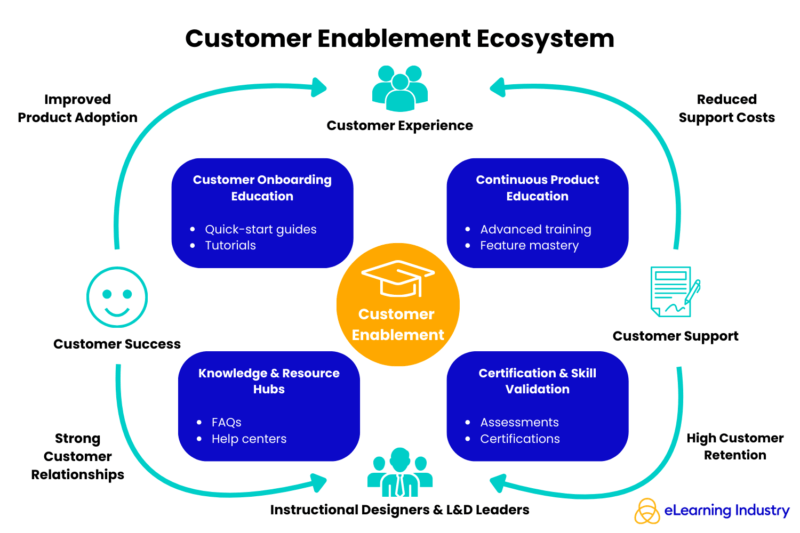
Organizations increasingly recognize that customer enablement requires more than a few tutorials or support articles. It involves a structured approach that helps customers gain the knowledge and confidence needed to use a product effectively. For L&D leaders and Instructional Designers, this means thinking about customer education as a strategic learning ecosystem, not just a support resource. A strong customer enablement strategy typically includes several interconnected components. Together, they create a framework that supports product adoption, improves the overall customer experience, and reduces the need for reactive support.
1. Customer Onboarding Education
Customer onboarding is often the first and most critical stage of customer enablement. At this point, users are learning the basics of a product and trying to understand how it fits into their workflows. Effective onboarding education focuses on three elements:
- Product fundamentals, so customers understand the core capabilities.
- Quick-start pathways that help users begin using the product quickly.
- First-value milestones, which guide customers toward their first meaningful success.
Instructional Design plays a key role here. Instead of overwhelming users with feature lists, Instructional Designers structure learning around real tasks and use cases. Short modules, guided walkthroughs, and scenario-based learning help customers achieve early wins. This approach supports customer success enablement because customers who reach value quickly are more likely to stay engaged with the product.
2. Continuous Product Education
Customer learning should not stop after onboarding. As products evolve and customers become more experienced, they often need deeper knowledge and advanced capabilities. Continuous education may include:
- Advanced tutorials that explore specific use cases.
- Feature deep dives that explain new functionality.
- Workflow training that shows how to apply the product in real situations.
This ongoing learning is an important part of customer experience enablement. When customers can easily expand their skills, they gain more value from the product and encounter fewer obstacles. In many organizations, this stage also supports customer service enablement by reducing repetitive support requests.
3. Knowledge And Resource Hubs
A well-designed customer enablement software environment often includes a centralized knowledge hub. These hubs provide resources that customers can access whenever they need help. Typical resources include:
- Product documentation
- Short video tutorials
- Microlearning modules
- Full customer academies
These hubs are evolving into broader client enablement ecosystems. Instead of static documentation libraries, organizations are building structured learning environments where customers can explore content, track progress, and continue developing their expertise.
4. Certification And Skill Validation
Many organizations now include certification programs as part of their customer enablement strategy. These programs may involve:
- Customer certifications
- Role-based training paths
- Structured learning journeys
Certification and validation help customers demonstrate their knowledge while building confidence in using the product. For organizations, this approach strengthens customer support enablement because knowledgeable customers are better equipped to solve problems independently and apply the product more effectively.
The Role Of Instructional Designers In Customer Enablement
As organizations invest more in customer enablement, the role of Instructional Designers is expanding beyond employee training. Today, many companies recognize that helping customers understand how to use a product effectively requires the same learning strategies used in internal training programs.
Instructional Designers bring structure, learning science, and scalability to client enablement initiatives. Instead of relying on scattered tutorials or documentation, they design intentional learning experiences that help customers build skills, gain confidence, and achieve outcomes with a product or service. This shift is why many companies are integrating learning professionals into customer success enablement, onboarding programs, and customer education teams.
Designing Scalable Customer Learning Experiences
One of the key contributions Instructional Designers make to customer enablement is the ability to design scalable learning experiences. Customers often need training at different stages of their journey, from onboarding to advanced product usage. Instructional Designers address this challenge through structured content strategies.
For example, modular course design allows organizations to create flexible learning paths where customers can access only the topics they need. Microlearning is also widely used in customer training, delivering short, focused lessons that address specific tasks or product capabilities.
Another effective approach is scenario-based learning, where customers learn through realistic situations that mirror their everyday challenges. These approaches help organizations deliver learning experiences that support customer experience enablement while remaining scalable across large user bases.
Structuring Learning Around Customer Outcomes
Effective customer enablement programs focus less on explaining product features and more on helping customers achieve real outcomes. Instructional Designers play a critical role in shifting training from feature-based instruction to outcome-based learning.
Instead of simply explaining how a tool works, well-designed learning experiences guide customers through workflows, real use cases, and practical problem-solving scenarios. This approach supports both customer support enablement and customer service enablement by helping users resolve issues independently and apply the product in meaningful ways.
By aligning learning content with the tasks customers are trying to accomplish, Instructional Designers help organizations deliver more impactful customer success enablement initiatives that drive adoption and long-term value.
Applying Learning Science To Customer Education
Instructional Designers also strengthen customer enablement strategies by applying proven learning science principles. For instance, spaced learning helps customers retain information by distributing learning activities over time rather than presenting everything during onboarding.
Another important principle is cognitive load reduction, which ensures that learning content remains clear and digestible. Complex product information can be overwhelming, so Instructional Designers structure content to help customers absorb it gradually.
Finally, interactive practice plays an important role in customer education. Hands-on activities, guided simulations, and real-world exercises allow customers to apply what they learn immediately.
Customer Enablement Software And Technology
Customer enablement programs rely on the right technology to scale learning, support product adoption, and improve the overall customer experience. This is why you need customer enablement software. These tools help organizations deliver structured education, guidance, and resources that allow customers to understand and use products more effectively. They also support a broader customer experience enablement strategy by connecting learning, product usage, and support resources in one ecosystem. Let's explore them.
Learning Management Systems For Customer Training
Many organizations use a customer-facing LMS as the foundation of their customer enablement strategy. Learning Management Systems allow companies to build structured customer academies where users can access onboarding courses, product tutorials, and certification programs. These platforms help Instructional Designers create learning journeys that guide customers from basic onboarding to advanced product use, strengthening customer success enablement and long-term adoption.
Digital Adoption Platforms
Digital adoption platforms support client enablement by delivering learning directly inside the product. They provide in-product guidance, interactive walkthroughs, and contextual tips that help users complete tasks without leaving the platform. This type of just-in-time learning reduces friction and strengthens both customer service enablement and product adoption.
Knowledge Bases And Support Platforms
Knowledge bases and support platforms are also essential for customer support enablement. They centralize documentation, tutorials, FAQ, and troubleshooting guides so customers can quickly find answers. When integrated with training programs and onboarding resources, these tools reinforce the meaning of customer enablement in practice: empowering customers with the knowledge they need to succeed independently.
How To Structure A Customer Enablement Team In Your Company
Thinking of creating a dedicated team to enable your customers? You're not alone. Organizations are increasingly treating customer enablement as a dedicated function rather than an add-on to support or sales. To do this effectively, many are creating specialized roles that focus on building and scaling customer learning programs. Some emerging roles that can be part of your dedicated team are the following:
- Customer Education Manager
This role typically involves overseeing the strategy and execution of all learning initiatives for customers. This role ensures that onboarding programs, tutorials, and academies align with business goals and customer outcomes. - Customer Enablement Lead
The employee in this role works closely with product and customer success teams to identify knowledge gaps and design targeted interventions. By connecting learning initiatives with customer adoption metrics, this role ensures customer success enablement efforts are effective and measurable. - Learning Experience Designer
This role involves applying Instructional Design expertise to create engaging, outcome-focused training content. From microlearning modules to certification programs, these designers ensure that customers gain the skills and confidence they need to succeed.
Together, these roles form a cross-functional enablement team that bridges learning, support, and customer success. By structuring teams around these roles, organizations can deliver consistent, proactive education that enhances product adoption, reduces support tickets, and strengthens long-term relationships.
Final Thoughts
Customer enablement is more than just training; it's a strategic shift from reacting to problems toward building proactive learning ecosystems. By investing in structured customer education, organizations can help users adopt products faster, lower support costs, and build stronger, long-term relationships. For learning leaders, this is a unique opportunity: customer enablement becomes a space where Instructional Design expertise directly influences business outcomes. Embracing this approach positions L&D professionals not just as educators but as strategic partners driving measurable impact across the organization.