




Rethinking Virtual Facilitation
As learning continues to expand across hybrid, digital, and face‑to‑face environments, one element remains central to effective facilitation: energy. While often described as intangible, energy is in fact a key mechanism through which participation, psychological safety, and engagement are formed. A structured comparison of facilitation dynamics shows that learning group energy behaves very differently in physical and virtual learning environments, with significant implications for how learning experiences should be designed.
Virtual learning has not reduced the importance of energy; instead, it has revealed how much of the energy in face‑to‑face settings is created organically by the physical environment itself. In contrast, virtual environments require facilitators to design, signal, and sustain energy intentionally.
How Learning Group Energy Behaves In Different Settings
Energy Transmission
In a face‑to‑face environment, energy circulates naturally through the room. Nonverbal cues, proximity, body language, and informal interactions shape the atmosphere without deliberate intervention. Momentum builds through spontaneous conversation, shared humour, and the subtle rhythm of group behaviour.
In virtual environments, this is not the case. Energy does not move on its own; it must be choreographed. Every moment depends on intentional design: clear prompts, structured interaction, planned engagement cycles, and the facilitator's ability to project presence through a screen. Without deliberate facilitation, virtual energy quickly plateaus or dissipates.
The Visibility Of Early Signals
In physical rooms, facilitators receive constant behavioral feedback. Leaning forward, nodding, side conversations, shifting posture, and laughter all provide clues about energy levels. These signals allow facilitators to adjust pacing and activities in real time.
In virtual spaces, early signals are more muted. Cameras may be off. Microphones remain muted. Visual information is limited to small windows, making subtle cues easy to miss. Facilitators must therefore interpret silence, inactivity, and pacing cues more analytically, rather than relying on instinctive observation.
Participation, Safety, And Social Dynamics
Participation Defaults
Face‑to‑face environments naturally encourage participation because being physically present increases social accountability. People can see one another's engagement, and this produces a gentle pressure to contribute.
Online, participation defaults shift dramatically. Without strong facilitation, learners can easily slip into passive observation. Virtual design must therefore embed participation into every segment, using tools like chat, polls, whiteboards, breakouts, and structured turn‑taking to ensure contribution.
Psychological Safety
In person, safety is often established through micro‑behaviours: eye contact, smiles, nods, side conversations before the session, and shared physical space. These cues build trust quickly.
Online, safety must be created through structure rather than proximity. Predictable patterns, clear instructions, low‑risk interactions, and well‑designed breakout experiences help learners feel secure enough to participate. Without this scaffolding, silence and hesitation are common.
Silence, Engagement, And Recovery
Interpreting Silence
Silence in a face‑to‑face room is usually a sign of reflection. Learners look down, think, or process information, and facilitators can see that the group is engaged internally.
Online, silence carries different meanings. It may indicate confusion, technical issues, disengagement, or hesitation. Facilitators must therefore treat silence as a cue to clarify, prompt, or adjust, rather than assuming reflective thinking.
Energy Recovery
Energy loss is easier to remedy in physical rooms. A quick stretch, a shift in seating, or a moment of humor can reset the atmosphere.
In virtual settings, recovery takes longer and requires more intentional techniques. Once energy drops, restructuring activities, increasing interaction, or re-establishing clarity is necessary. Prevention becomes more effective than recovery, making energy planning essential.
Implications For Facilitators
These differences demonstrate that virtual facilitation is not simply a matter of transferring face‑to‑face techniques onto a digital platform. It requires a distinct design mindset that treats learning group energy as a core design principle. Facilitators must:
- Intentionally create psychological safety through structure.
- Design regular participation into every activity.
- Interpret silence as diagnostic, not reflective.
- Adjust the timing and rhythm of sessions to prevent fatigue.
- Use technology as a tool for momentum.
- Amplify their energy to compensate for reduced cues.
- Plan for more frequent, shorter cycles of interaction.
In virtual environments, facilitators become architects of experience rather than interpreters of physical space.
The Way Forward For L&D
As hybrid learning becomes standard, facilitation capability must evolve accordingly. Understanding the different energy dynamics of face‑to‑face and virtual environments enables facilitators to select strategies that suit the medium, rather than attempting to replicate one environment within another.
Recognizing these differences empowers L&D professionals to create energizing, inclusive, and high‑impact learning experiences across all formats. The challenge is not choosing between face‑to‑face or virtual learning but understanding how energy flows differently in each—and designing accordingly.
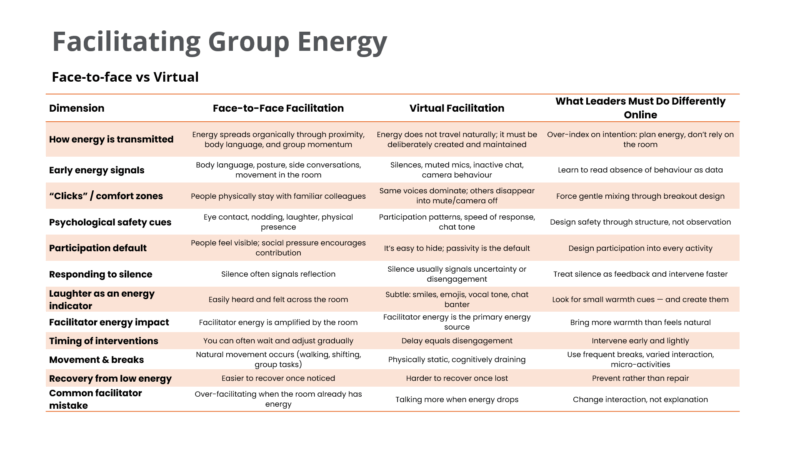
Image Credits:
- The table in the article was created/supplied by the author.