


Designing Online Courses That Truly Teach
One of the easiest ways to understand good teaching is to think back to a teacher you actually remember. Everybody has one. Maybe it was the teacher who made a boring subject come alive. Maybe they challenged you, pushed you harder than the others, or somehow made you feel like the material mattered. Chances are it was not just what they taught, but how they taught it.
A good teacher has a way of pulling people in. They read the room. They know when students are confused and when they are ready to move forward. They ask questions. They explain things three different ways if they have to. Sometimes they make learning harder in a good way—the kind of hard that makes you think instead of memorize. As the saying goes, they don't just hand you the fish, they teach you how to fish. That kind of teaching sticks with people.
Now think about a bad teacher. The experience is completely different. Maybe the material felt confusing even though it should not have been. Maybe they talked at the class instead of to the class. Maybe they never checked if students understood the lesson before moving on. You leave class frustrated, disconnected, or simply bored out of your mind. The difference between good and bad teaching usually has less to do with the subject itself and more to do with how the learning experience is designed and delivered. And that brings us to online courses that truly teach.
Can Online Courses Teach As Effectively As In-Person Classes?
Can online learning really teach as effectively as an in-person classroom? That question has been debated for years, especially as universities continue investing more heavily in digital education. To answer it, we first need to look at what makes a physical classroom work in the first place.
A traditional classroom is more than just a room with desks and a whiteboard. It is a physical and social environment. Students walk into a three-dimensional space filled with movement, sound, expectations, and interaction. The teacher speaks in real time. Students react in real time. There is eye contact, body language, side conversations, raised hands, and immediate feedback. If somebody looks confused, the teacher notices it. If a student is distracted, the social environment itself often pulls them back in.
In-person learning also creates a sense of presence. Students have to show up at a certain time. They are physically there, seated with others, focused on a shared experience. The classroom naturally creates structure and accountability. You cannot simply "click away" mentally the way you can online. In many ways, the environment itself helps support learning.
Online learning is a whole new ballgame.
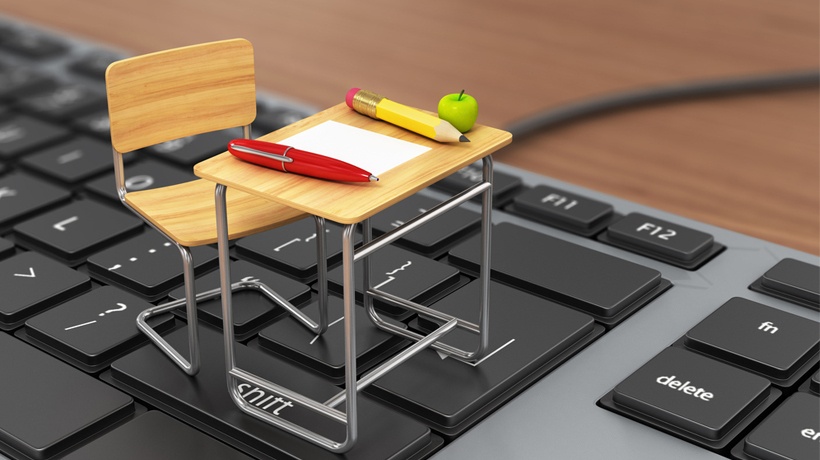
Instead of entering a classroom, the learner enters a website. Instead of sitting in a room with classmates, they sit alone looking at a two-dimensional screen. The desks, whiteboards, social interactions, and physical movement are gone. What remains are digital versions of learning materials: videos, assignments, discussion boards, readings, quizzes, and lectures. That immediately creates the first major hurdle for online learning: organization.
If the course is confusing to navigate, cluttered, or difficult to follow, students become frustrated before they even begin learning. In a classroom, a teacher can verbally guide students step by step. Online, the course itself has to act like the teacher. The layout, headings, navigation, instructions, and structure all become part of the teaching process. If students are hunting around the LMS trying to figure out where to click next, the course is already losing them. A messy online course is the digital equivalent of a teacher who cannot explain the lesson clearly.
Another hurdle is simply getting started. In a classroom, students mostly need to know one thing: when class begins. Online learning often requires students to first learn the mechanics of the system itself—how to use the LMS, where assignments are submitted, how discussions work, how modules are organized, how lectures are accessed, and what technology is required. If that process feels overwhelming, students can spend more energy figuring out the platform than learning the content. In other words, you can't learn to drive if you're still trying to figure out where the steering wheel is.
The Social Aspect
The social aspect is different too. A classroom is naturally interactive. Students whisper questions to classmates, react to discussions, and ask teachers for clarification in the moment. Online learning often lacks that immediacy. Students may post a question and wait hours—or even days—for a response. That delay can interrupt momentum and increase frustration. Learning becomes more isolated and self-directed.
Then there is the issue of motion and attention. Human beings are wired to notice movement. Good teachers use movement constantly without even thinking about it. They walk across the room, gesture with their hands, change tone and pacing, write on the board while explaining concepts, and use facial expressions to emphasize ideas. The classroom itself is alive with motion, and motion helps maintain attention.
Video can recreate some of this, but only if it is done well. Poor lighting, muffled sound, cluttered visuals, tiny writing, or flat delivery can make even good content feel lifeless. In a real classroom, students can naturally focus their eyes where they need to. On video, the creator has to intentionally guide attention. That takes planning, production quality, and Instructional Design.
Even something as simple as a whiteboard demonstrates an important difference between in-person and online learning. When a teacher writes on a board while speaking, students watch the concept unfold step by step in real time. The movement itself guides attention. The explanation feels focused and natural. There are fewer distractions because the learner is following one evolving idea.
PowerPoint slides, on the other hand, can sometimes overload the learner with too much information at once. Good online design must carefully manage visual hierarchy, pacing, signaling, and cognitive load. That can absolutely be done online, but it often requires more planning and production effort than many universities realize.
The Financial Aspect Of Creating Online Courses That Teach
And that leads to the big question: can universities realistically afford to create online experiences that truly compete with in-person teaching? The honest answer is: sometimes yes, sometimes no.
A high-quality online course is not just a professor uploading lecture notes and recording a few videos. Strong online learning often requires Instructional Designers, media specialists, editors, graphic designers, animators, accessibility experts, and LMS developers working together. That level of production can become expensive quickly, especially for universities managing hundreds or thousands of courses.
However, online learning also has advantages that traditional classrooms simply cannot match.
For one, online courses can use interactive learning tools that are difficult to create in a live classroom. Simulations, branching scenarios, interactive quizzes, explainer animations, and game-based learning can make abstract concepts easier to understand. A science lecture can include animated visualizations. A nursing course can simulate patient scenarios. A business course can use decision-making games. Done correctly, these tools move students from passive watching into active learning.
Online learning also allows students to revisit material repeatedly. In a classroom, if you miss an explanation, it is gone. Online, students can pause, rewind, replay, and review content at their own pace. For many learners, especially adult learners, that flexibility is invaluable.
Additionally, online learning can personalize experiences in ways traditional classrooms struggle to do. Adaptive learning systems, interactive pathways, and self-paced modules can allow students to spend more time where they struggle and move faster where they succeed.
How To Create Online Courses That Compete With In-Person Learning
So how can online courses teach well enough to compete with in-person learning?
First, online courses must be highly organized. The LMS should feel intuitive, clean, and easy to navigate. Good headings, visual hierarchy, and consistent structure are essential.
Second, video and audio quality matter far more than many people realize. Clear sound, proper lighting, readable visuals, and engaging presentation styles make a major difference in learner attention and retention.
Third, lectures and materials should connect closely with readings and assignments. Online learners often need stronger alignment and clearer connections between resources because they lack the constant real-time guidance of a classroom teacher.
Fourth, online courses should take advantage of what digital learning does best: interaction, simulations, scenario-based learning, animation, and learner engagement tools. If online courses simply imitate classroom lectures, they will always feel like a weaker version of the real thing. But when online learning uses the strengths of the medium, it can create entirely new forms of engagement.
Conclusion
In the end, the question may not be whether online learning can perfectly replace in-person learning. They are different experiences, and each has strengths and weaknesses. The real question is whether we can design online learning well enough that students still feel connected, engaged, challenged, and supported.
Can online learning be as good as in-person teaching? Yes—but only when universities stop treating online courses like digital filing cabinets and start treating them like carefully designed learning experiences. Good online learning does not happen by accident. It requires thoughtful structure, strong Instructional Design, engaging media, and an understanding of how people actually learn. A good teacher can make a classroom come alive. A good online course must do the same thing—only through a screen.