

 ChatGPT
 Perplexity
 Claude
 Grok
Workplace Thanksgiving Activities That Boost Team Building
Thanksgiving team-building activities can be more than just a way to pass the time before the holiday break. With a clear purpose, these activities help employees appreciate each other's contributions, share useful knowledge, reflect on their experiences, and build stronger working relationships.
Thanksgiving activities do not have to turn into formal training sessions, but they can also go beyond trivia, food, or simple gratitude exercises. Instead, organizations can use this time of year to pause and ask helpful questions. What did teams learn over the past year? Who helped others succeed? What knowledge should be shared more broadly? What skills should the organization continue to build on?
The Thanksgiving team-building activities below are built around these questions. You can adapt them for onsite, hybrid, or remote teams. They support reflection, employee recognition, peer learning, knowledge sharing, and stronger workplace connections.

What Are Thanksgiving Team-Building Activities?
Thanksgiving team-building activities are workplace exercises held during the Thanksgiving season to help employees connect, show appreciation, work together, reflect, and learn from one another.
Some team-building activities are mainly for fun. These can be Thanksgiving games, trivia contests, scavenger hunts, and office competitions that give employees a break and encourage casual interaction. Other activities focus more on building connections. These can include employee appreciation, team storytelling, volunteering, or gratitude exercises.
For L&D teams, there is also a third type of Thanksgiving activity: learning-centered. These use the holiday theme to help people share knowledge, reflect on experiences, recognize expertise, solve problems together, and set future development goals.
This does not mean every holiday event needs strict learning goals, though. Instead, when organizations invest in team building, they can design activities so that some benefits last beyond the event. After all, Thanksgiving team-building activities work best when they mix a fun seasonal experience with a clear team or learning goal. Let's explore them.
Why Should L&D Get Involved In Thanksgiving Team Building?
Thanksgiving team-building activities give L&D professionals a chance to build habits that help people keep learning year-round. Team building is usually seen as something for HR, internal communications, or managers to handle. However, the results organizations want from these activities, like collaboration, sharing knowledge, reflection, connection, and peer support, also shape how people learn at work.
Think about employee recognition. Usually, a gratitude exercise asks people to thank a coworker. An L&D-focused version can take it further by having employees share what they learned from that person. This way, the activity does more than just recognize someone's contribution. It also helps uncover informal experts, mentors, helpful behaviors, and examples of peer learning that might otherwise go unnoticed.
The same idea works for reflection. Teams can review past projects to celebrate wins and identify lessons, mistakes, and useful insights to bring into future work.
In the end, the holiday gives you the reason to gather, but good learning design is what makes the experience valuable in the long run.
How To Choose A Thanksgiving Team-Building Activity
When choosing Thanksgiving team-building activities, focus on what your team needs to achieve instead of just picking the most entertaining idea. Using a simple decision framework can make this process easier.
If You Want To... |
Consider... |
| Encourage reflection | The Learning Harvest |
| Increase peer recognition | What I Learned From You |
| Improve knowledge sharing | The Knowledge Potluck |
| Surface internal expertise | The Skills Gratitude Map |
| Build collaboration | A Thanksgiving Problem-Solving Challenge |
| Encourage peer learning | Teach Me In Five |
| Engage remote employees | A Thanksgiving Microlearning Challenge |
| Identify future development needs | Gratitude-To-Growth |
Leaders should consider five key questions before picking an activity.
- What result do we want? Connection, reflection, recognition, and learning are similar, but each one is different.
- How much time do we actually have? A short 15-minute reflection needs a different approach than a full 60-minute team workshop.
- Where will employees join in? Team-building activities for remote and hybrid teams should work just as well for people who aren't physically present.
- Does everyone need to join at the same time? Sometimes, a team spread across locations might get more out of an activity they can do on their own schedule instead of another required video call.
- What comes next after the activity? If you get helpful lessons, resources, or ideas, plan where to keep them and how employees can use them.
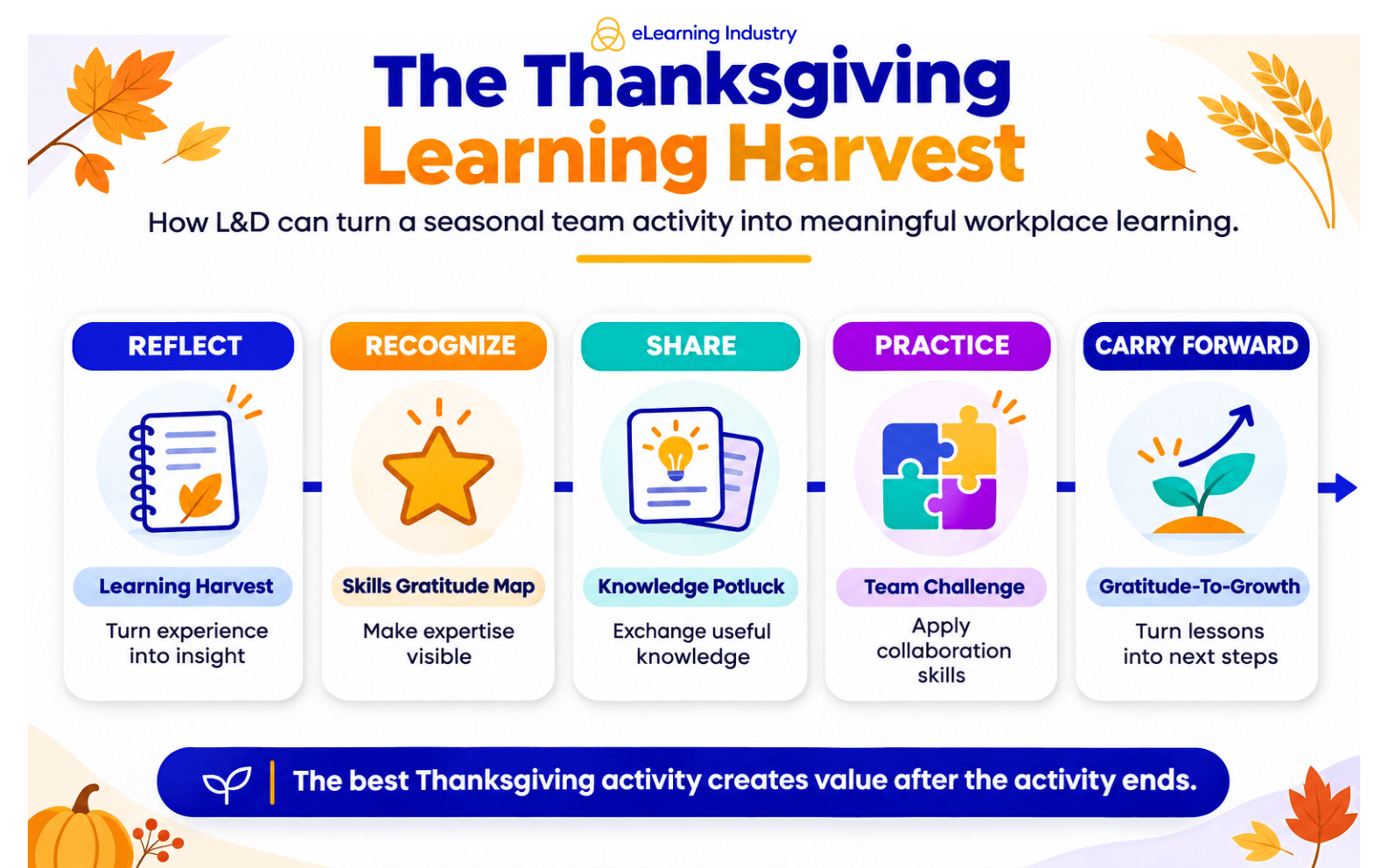
15 Thanksgiving Team-Building Activities L&D Teams Can Use
Thanksgiving team-building activities work best when they have a clear purpose, easy-to-follow instructions, and a direct link to how people learn or collaborate. Here are 15 ideas that offer more than the usual office celebration.
1. The Learning Harvest
Start with a Learning Harvest to help employees think about what the team should keep, change, and develop. Divide the exercise into three categories:
- Harvest: What produced meaningful results this year?
- Compost: What should we stop, rethink, or learn from?
- Seeds: What should we develop next?
Employees can first share their thoughts individually, then discuss them together as a group. This reflection exercise fits well with annual planning, turning year-end reviews into useful ideas for future priorities. L&D teams can also spot recurring themes to find development opportunities.
2. What I Learned From You
Thanksgiving team-building activities can make employee appreciation more meaningful by linking gratitude to learning. Ask each participant to recognize one colleague and complete the sentence:
"One thing I learned from you this year is..."
Ask for specific examples. For instance, rather than just calling someone "helpful," an employee could share how a colleague taught them to handle tough stakeholder conversations, organize projects more effectively, or use a specific tool. This activity highlights employees and shows how much informal learning happens at work.
3. The Knowledge Potluck
You can turn the familiar potluck into a peer learning activity for Thanksgiving team building. Instead of food, each employee brings one useful piece of knowledge to share. That contribution might be:
- A template
- A shortcut
- A useful AI prompt
- A checklist
- A framework
- A productivity technique
- A recommended resource
- A lesson from a recent project
Give everyone a few minutes to explain what they shared and why it matters. Afterward, gather all contributions in a shared space such as a knowledge hub, LMS, intranet, or team workspace. This way, the Thanksgiving activity provides a resource employees can continue to use.
4. Teach Me In Five
Thanksgiving team-building activities can encourage peer learning with short, five-minute teaching sessions. Invite employees to teach a practical skill or technique they think their colleagues would find helpful. For example, someone might demonstrate:
- An Excel shortcut
- A better way to structure an AI prompt
- An LMS workflow
- A presentation technique
- A project management trick
- A customer communication method
Keep the format short on purpose. Employees do not need to make formal presentations or act like professional instructors. This activity shows that valuable expertise already exists throughout the organization, which is a key part of collaborative learning.
5. The Skills Gratitude Map
Help your team spot the expertise employees use every day by creating a Skills Gratitude Map. Ask participants two questions:
- Who helped you accomplish something important this year?
- What capability did that person contribute?
As people share their answers, map the connections in a visual way. You may notice patterns. One person might often be recognized for technical skills, another for problem-solving, and someone else as an informal mentor across departments. For L&D leaders, these patterns can help spot potential subject-matter experts, peer coaches, mentors, and chances for knowledge sharing.
6. Create A Team Learning Recipe
You can use a seasonal recipe format to help teams look at why a project was successful. Ask teams to choose one accomplishment and describe its recipe. For example:
- Ingredients: People, skills, technology, resources, and information.
- Method: The process the team followed.
- Secret ingredient: The factor that made the biggest difference.
- What we would change: Lessons for next time.
This approach keeps the Thanksgiving theme fun and helps employees look at performance in a structured way.
Even more, it helps teams go beyond just saying "that project went well" to really understanding why it was successful.
7. Lessons From Our Mistakes
Your activities can also give employees a chance to appreciate lessons learned from mistakes, wrong assumptions, or experiments that did not work out. Ask each participant to share one setback and answer:
- What happened?
- What did I learn?
- What would I do differently now?
Leaders can make the activity feel safer by sharing first and avoiding examples that blame others. The goal is not to celebrate failure, but to show that reflection is part of learning. Mistakes can lead to useful knowledge when teams view them positively.
8. Build A Year-In-Learning Timeline
Thanksgiving team-building activities can help teams see how much learning has happened over the past year. Create a shared digital or physical timeline and ask employees to add their important learning moments. These might include:
- A new skill
- A completed course
- A major project
- A technology implementation
- A difficult challenge
- A useful lesson
- A new responsibility
- A process the team improved
When the timeline is finished, talk together about what stands out. Employees often see learning as just taking courses. A year-in-learning timeline shows that growth also comes from projects, teamwork, trying new things, coaching, and experience.
9. The Thanksgiving Problem-Solving Challenge
This can be an opportunity for hands-on learning when teams work together to solve real workplace problems. Create a scenario involving constraints such as:
- A limited budget
- Competing stakeholder priorities
- An unexpected deadline
- Incomplete information
- A resource shortage
Give small groups time to develop and share their solutions. The most important part comes after the activity. Lead a short discussion about how each team communicated, made decisions, set priorities, handled disagreements, and shared responsibilities. This reflection turns a team-building game into a valuable learning experience for everyone.
10. Peer Coaching Pairs
Thanksgiving team-building activities can help employees reflect on the past and plan for the future through simple peer coaching conversations. Pair participants and give them three questions:
- What capability did you strengthen this year?
- What capability would you like to develop next?
- What support would help you improve it?
Partners listen, ask questions, and help each other figure out their next steps. This activity is especially helpful before annual development planning. It encourages employees to identify their own learning needs rather than waiting for a manager or training team to do so.
11. The Gratitude-To-Growth Exercise
Thanksgiving team-building activities can link appreciation for past progress with future growth through a Gratitude-To-Growth exercise. Ask teams to complete two statements:
"I'm grateful that our team learned how to..."
and
"Next, we need to learn how to..."
The first statement helps teams recognize progress. The second moves the conversation toward growth. For example, a marketing team might appreciate that it learned how to use generative AI responsibly while recognizing that it still needs stronger skills for evaluating AI-generated information. The exercise is simple, but it helps move Thanksgiving reflection into future learning strategy.
12. A Thanksgiving Microlearning Challenge
You can adapt Thanksgiving team-building activities for distributed teams by running a short, asynchronous microlearning challenge. Set up five simple activities, one for each day. For instance:
- Day 1: Recognize
Thank someone who taught you something useful. - Day 2: Reflect
Share one lesson from the year. - Day 3: Share
Post one useful resource. - Day 4: Learn
Spend five minutes learning something from a colleague. - Day 5: Apply
Choose one lesson you will use in your work.
You can run the challenge using an LMS, LXP, Microsoft Teams, Slack, your intranet, or any other approved collaboration platform.
Since everyone participates on their own schedule, this approach works well across different time zones.
13. Virtual Learning Bingo
You can make virtual team-building games more relevant to development by changing what employees need to complete for Thanksgiving activities. Rather than using traditional Thanksgiving bingo squares, use prompts like these:
- Learned something from another department.
- Shared a useful resource.
- Asked someone for feedback.
- Applied something learned in training.
- Used AI to simplify a routine task.
- Helped a colleague solve a problem.
- Learned a new shortcut.
- Recognized someone's expertise.
Employees can fill out their bingo cards over several days rather than just during a single meeting. This activity keeps things playful while still connecting to workplace learning.
14. An AI-Assisted Knowledge Harvest
If your organization already has the right tools, policies, and governance, you can include generative AI in your Thanksgiving team-building activities. Invite employees to share nonconfidential lessons learned from recent projects. Then, use an approved AI tool to sort the responses into themes like:
- Skills employees are developing
- Common challenges
- Recurring process problems
- Successful practices
- Topics people want to understand better
The results can serve as a starting point for an L&D discussion. Make sure to follow your organization's AI policies and avoid entering confidential, sensitive, proprietary, or personally identifiable information into tools that aren't approved for those uses.
15. Give Back And Learn
Thanksgiving team building can involve volunteering or community service, which also gives everyone a chance to learn through experience. After the activity, take a few minutes to reflect together. Ask employees:
- What did we notice?
- What challenged our assumptions?
- Which skills did we use?
- How did we collaborate?
- What would we do differently next time?
The goal isn't to make volunteering feel like a training session. Instead, reflecting together helps employees think about new ways they may have communicated, worked together, made decisions, or solved problems.
How To Make Thanksgiving Activities Inclusive
When planning Thanksgiving team-building activities, remember that not everyone celebrates the holiday or connects with it in the same way. This is especially important for organizations with teams that are multinational, spread out, or culturally diverse.
- Begin by making participation optional when possible. Employees shouldn't feel pressured to share family traditions, religious beliefs, personal situations, or private experiences just to take part in a work activity.
- Also, don't assume that Thanksgiving holds cultural meaning for everyone.
- For global teams, try using a more universal theme that still fits the season, like reflection. Names like Learning Harvest, Gratitude and Growth Session, or Year-In-Learning Reflection let everyone join in without tying the activity to a specific holiday.
- Managers should also think about accessibility and different work setups. Hybrid team activities shouldn't end up giving people in the office a better experience than those working remotely.
- Finally, avoid historical reenactments, stereotypes, or Thanksgiving trivia that could be culturally insensitive.
Being inclusive doesn't mean you have to drop the seasonal theme. It just means creating an experience where everyone can join in respectfully and comfortably.
Conclusion
Thanksgiving team-building activities work best when they give employees something meaningful they can use even after the holiday. But not every Thanksgiving activity has to be formal training. Teams also need time to relax, celebrate, and connect without worrying about performance goals. Still, organizations can make better use of these moments by being more intentional. Thanksgiving can be more than just a yearly event. It can be an opportunity to support a learning culture that values reflection, knowledge sharing, appreciation, and ongoing growth.