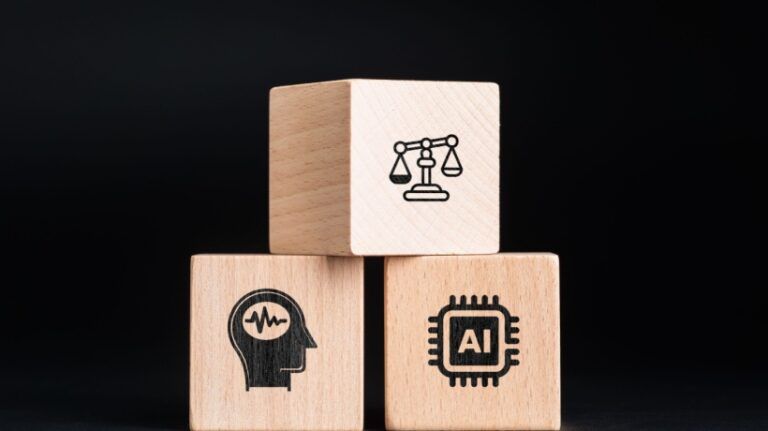





Why Business Acumen Still Matters
AI-driven career mapping is changing how organizations see talent, but not everything that counts can be coded. As organizations lean into skills-based hiring, internal mobility, and AI-supported progression, it is easy to see employees as collections of capabilities. Systems can now identify what people know, link those skills to job requirements, and even recommend the next step on a career path. It is efficient, scalable, and often accurate. Yet when work is reduced to lists of skills, something vital is lost: the connections between them, and the judgment that gives those connections meaning.
The Difference Judgment Makes
Skills describe what people can do. Judgment determines when, why, and how they choose to do it. That difference defines whether an action creates value or simply completes a task. Skills are essential for performance within a role. Judgment is what connects that performance to the business context around it. Good judgment reflects business acumen. It shows up when someone can weigh trade-offs, anticipate ripple effects across departments, and recognize how one decision reshapes the options available to others. In a skills-based world, that ability to connect decisions to results is what gives work its impact.
Two Models Of Impact
There are two ways to picture how value moves through an organization.
Model 1: Linear
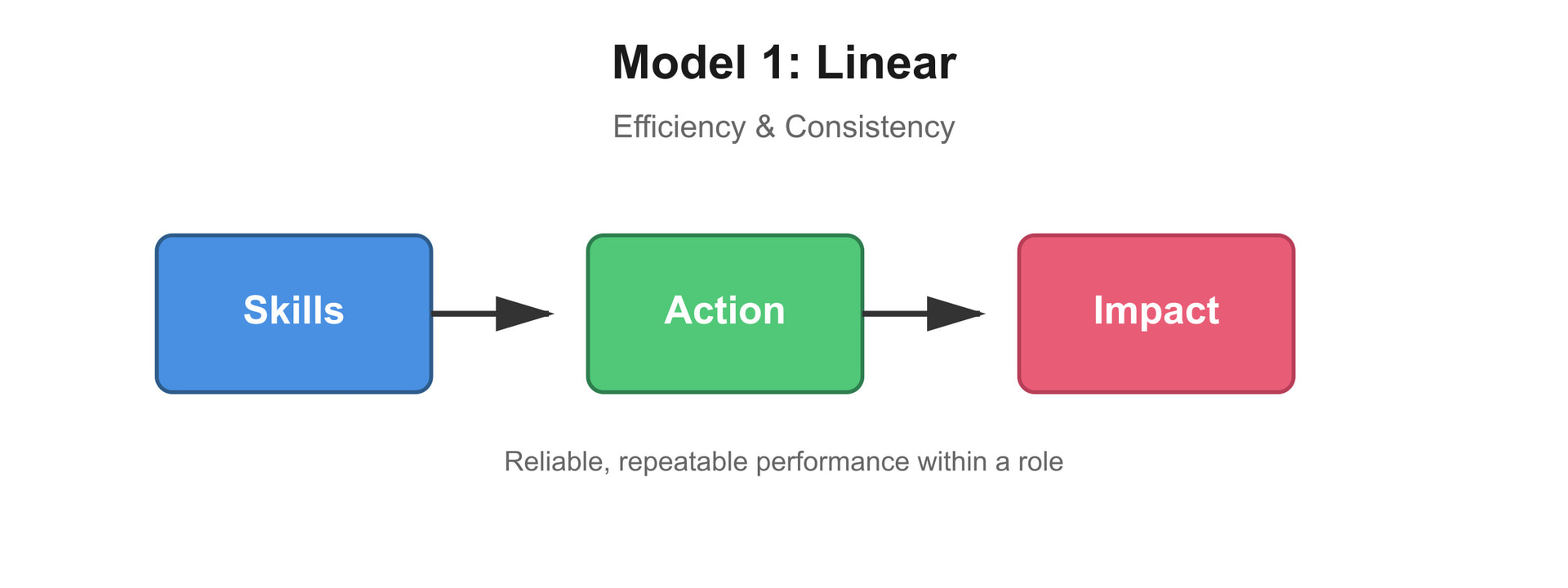
Image created by Claude (Anthropic AI) for Income|Outcome. (2025). "Model 1: Linear - Efficiency & Consistency." Digital illustration depicting the flow from Skills to Action to Impact.
Model 2: Contextual
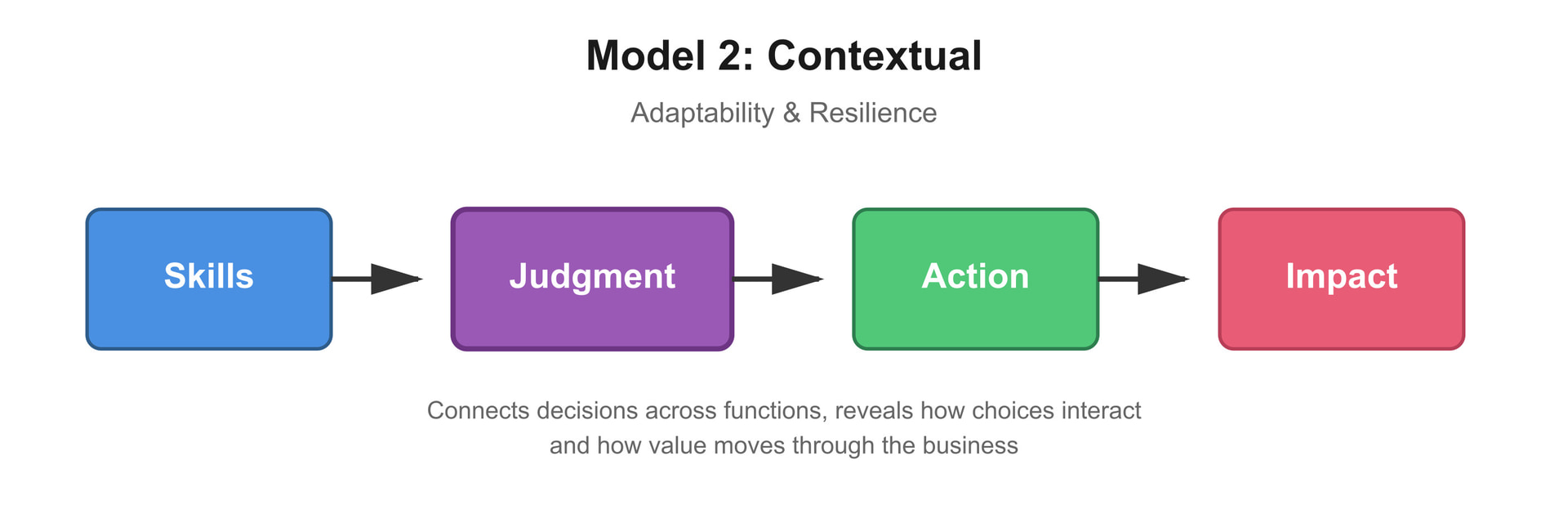
Image created by Claude (Anthropic AI) for Income|Outcome. (2025). "Model 2: Contextual - Adaptability & Resilience." Digital illustration depicting the flow from Skills through Judgment to Action and Impact.
Both models matter. The first creates consistency and efficiency. Skill-based systems support reliable, repeatable performance within a role. The second creates adaptability and resilience. Judgment-driven systems connect decisions across functions, revealing how choices interact and how value moves through the business. This is the shift that business acumen makes visible.
Building Better Judgment
Judgment does not come from data; it comes from decisions, measurement, and reflection. People build it by working through trade-offs, seeing consequences, and comparing results to expectations. Over time, that process turns information into insight. Research on recognition-primed decision-making shows that experts develop pattern recognition through exposure to meaningful variation: real consequences, changing conditions, and immediate feedback that sharpens instinct. Data may inform the decision, but experience teaches why it mattered.
That is why experience-based learning is so important. Simulations, scenario discussions, and project reviews give learners a safe way to test reasoning before the stakes are real. They recreate the complexity of business without the cost of mistakes. Each decision adds another layer of understanding, forming patterns that help people recognize cause and effect faster the next time they face uncertainty. However, research on intuitive expertise demonstrates that intuition becomes reliable only when feedback is valid and repeated.
The Role Of L&D
AI can map skills, but it cannot teach judgment. That remains the work of learning professionals. As organizations adopt skill-based progression frameworks, L&D's role is to design experiences that connect data to discernment. It is not enough to show people what skills they need next. They must also see how those skills interact, where trade-offs appear, and how outcomes shift when conditions change.
That means rethinking learning design. The goal is not simply to add modules to a learning path but to create opportunities for reflection and decision-making. Research on experiential learning demonstrates that experience alone does not create learning; people learn when they reflect, connecting action to outcome, and insight to application. Programs that use business simulations, case challenges, or structured debriefs help learners connect what they know to what they choose to do. Studies on reflective practice show that professionals improve not just what they know, but how they think, by questioning assumptions and adapting their mental models. This is where financial confidence, business thinking, and organizational awareness converge.
The payoff is visible in both directions. Learners gain confidence and clarity about how their choices affect results. Organizations gain people who can interpret data with context and act with purpose rather than compliance.
The Future Of Learning
AI will continue to map, sort, and personalize. Skill-based systems will keep expanding into career mobility and workforce planning. But the organizations that thrive will be the ones that balance precision with perspective—those that invest not only in what people can do but in how they think. In a world where AI can chart every possible path, judgment is what helps people choose the right one. And that is the part only learning can build.
References:
- Klein, G. 1998. Sources of Power: How People Make Decisions. MIT Press.
- Argyris, C., and D. Schön. 1978. Organizational Learning: A Theory of Action Perspective. Addison-Wesley.
Image Credits:
- The images within the body of the article were created/supplied by the author.

![eLearning Industry's Guest Author Article Showcase [December 2025]](https://cdn.elearningindustry.com/wp-content/uploads/2026/01/eLearning-Industrys-Guest-Author-Article-Showcase-December-2025.jpg)