

Marketing Intelligence vs. Marketing Research: A Breakdown
Marketing teams have access to more data than ever, but knowing what to do with it is another challenge. Understanding marketing intelligence vs. marketing research helps you turn information into better decisions instead of collecting data without a clear purpose. Supermetrics' Marketing Data Report found that marketers use 230% more data than in 2020, while 56% say they don't have enough time to analyze it thoroughly.
Marketing intelligence gives you an ongoing view of your market, competitors, customers, and business environment. It helps you spot emerging trends, track competitor activity, monitor customer feedback, and identify changes that could affect your strategy. For example, marketing intelligence examples include tracking competitor messaging, monitoring lead generation benchmarks, and reviewing CRM trends to understand how your market is changing.
Marketing research, on the other hand, focuses on answering a specific question or solving a defined problem. It may involve surveys, interviews, focus groups, or structured analysis to uncover why customers choose one solution over another. Useful marketing research examples include investigating why enterprise buyers select a competing learning management system or studying buyer behavior before launching a new product.
Although both approaches support informed decisions, they serve different purposes. Intelligence helps you understand what is happening over time, while research helps you investigate why something happens or test a particular assumption. Knowing when to use each and how to combine them helps your team prioritize the right questions, use resources effectively, and build a marketing strategy grounded in evidence.
Key Takeaways
- Marketing intelligence is generally continuous, while marketing research is typically project-based.
- Marketing intelligence monitors customers, competitors, market conditions, and internal performance.
- Marketing research investigates a specific question, hypothesis, audience, or business problem.
- Intelligence frequently relies on existing internal and external data, while research may generate new primary data through surveys, interviews, experiments, or focus groups.
- Marketing intelligence is useful for spotting changes and opportunities; marketing research is useful for understanding specific issues in greater depth.
- Neither replaces the other. Strong marketing teams use intelligence to identify important questions and research to investigate them.
In This Guide, You Will Find...
- Marketing Intelligence vs. Marketing Research: The Short Answer
- What Is Marketing Intelligence?
- What Is Marketing Research?
- 7 Key Differences Between Marketing Intelligence And Marketing Research
- Marketing Intelligence Examples
- Marketing Research Examples
- When Should You Use Marketing Intelligence?
- When Should You Use Marketing Research?
- In Which Instances Do You Need Both?
- How AI Is Changing Marketing Intelligence And Research
- Common Mistakes Companies Make
Marketing Intelligence vs. Marketing Research: The Short Answer
| Marketing Intelligence | Marketing Research | |
| Primary Purpose | Understand what's happening in the market | Answer a specific question |
| Nature | Continuous | Project-based |
| Scope | Broad | Focused |
| Time Frame | Ongoing | Defined |
| Data | Existing + ongoing data | Often newly collected data |
| Sources | CRM, competitors, reviews, social, search, market data | Surveys, interviews, focus groups, experiments |
| Output | Trends, alerts, dashboards, insights | Findings, conclusions, recommendations |
| Best For | Monitoring and strategic awareness | Investigating a decision/problem |
Marketing intelligence continuously monitors what’s happening in your market, customers, and competitors, and can help explain why trends occur. On the other hand, marketing research investigates a specific question in greater depth to help you make a decision. In short, intelligence provides ongoing insights, while research answers focused questions.
What Is Marketing Intelligence?
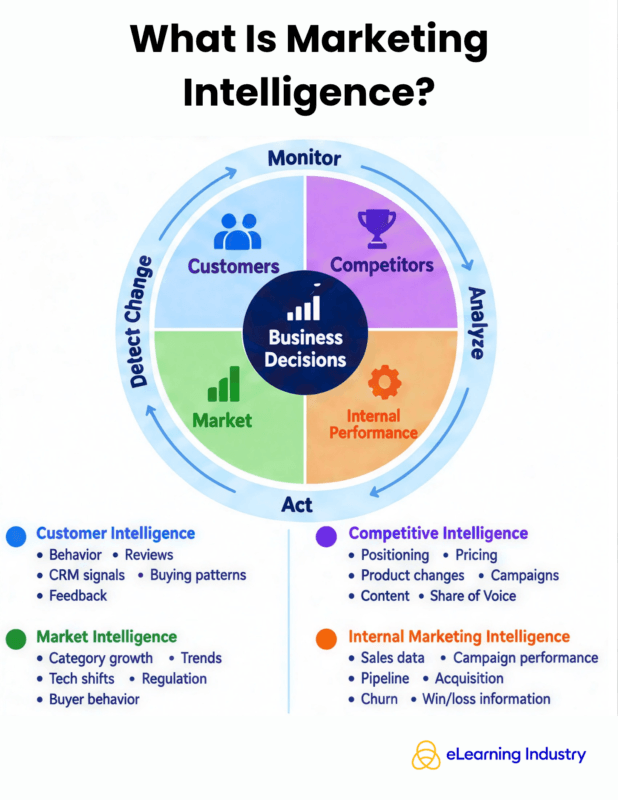
Marketing intelligence is the systematic, ongoing collection and analysis of information about customers, competitors, market conditions, and business performance to support marketing and strategic decisions. For companies investing in marketing intelligence for B2B, this process helps identify market changes, understand buyer behavior, and make informed decisions before competitors gain an advantage.
1. Customer Intelligence
- Customer behavior: Understand how buyers research and evaluate solutions.
- Reviews and feedback: Identify customer needs, concerns, and satisfaction levels.
- CRM signals and buying patterns: Track engagement, purchase intent, and recurring customer needs.
2. Competitive Intelligence
- Competitor positioning and pricing: Understand how competing solutions attract buyers.
- Product changes and campaigns: Monitor new features, promotions, and messaging.
- Share of Voice SEO: Measure how often your brand appears in industry conversations. Tools that support social listening for B2B marketers can help you track these mentions.
3. Market Intelligence
- Category growth and market share: Assess market opportunities and competitors' positions.
- Market trends and technology shifts: Identify emerging needs, including AI adoption.
- Regulation and buyer behavior: Understand changes that influence purchasing decisions.
4. Internal Marketing Intelligence
- Sales and pipeline data: Identify lead quality and conversion trends.
- Campaign performance and acquisition: Evaluate which activities generate results.
- Churn and win/loss information: Discover why customers leave or choose your solution.
Marketing intelligence works like a radar system that continuously tracks changes. Understanding when to use marketing intelligence helps you respond to emerging opportunities and risks before they affect your business results.
What Is Marketing Research?
Marketing research is the structured collection and analysis of data designed to answer a defined marketing question, test a hypothesis, understand an audience, or support a specific decision. Unlike ongoing marketing intelligence, it focuses on a particular challenge and helps you gather evidence before making a decision. Understanding marketing intelligence vs. marketing research helps you choose the right approach for your goals.
Common marketing research examples include deciding whether to enter another country's market, finding out why prospects abandon your demo process, testing positioning with Chief Learning Officers (CLOs), and identifying barriers to AI adoption among HR leaders.
Quantitative Research
Quantitative methods measure patterns, compare responses, and identify trends using numerical data.
- Surveys: Measure buyer preferences, satisfaction, or brand awareness.
- Polls: Collect quick feedback on a focused question.
- Experiments: Test different messages, offers, or pricing models.
- Structured datasets: Analyze measurable customer and market behaviors.
Qualitative Research
Qualitative methods explore motivations, opinions, and experiences in greater depth.
- Interviews: Understand buyer challenges and decision-making.
- Focus groups: Compare reactions to ideas or positioning.
- Customer conversations: Discover needs that surveys may miss.
- Observational research: Examine how people interact with products or processes.
Primary and Secondary Research
- Primary research: Collect new data for a specific question through surveys, interviews, experiments, or feedback on customer reviews.
- Secondary research: Analyze existing industry studies, analyst reports, government data, academic research, and competitor information.
Both approaches can support data-driven growth.
7 Key Differences Between Marketing Intelligence And Marketing Research
| Difference | Marketing Intelligence | Marketing Research |
| Purpose | Maintain market awareness | Answer a defined question |
| Scope | Broad | Narrower |
| Frequence | Continuous | Periodic/project-based |
| Trigger | Always operating | Business question/problem |
| Data | Often aggregates many existing streams | Often collects purpose-specific data |
| Output | Trends, signals, dashboards | Findings and recommendations |
| Decision Use | Strategic monitoring | Specific decision support |
The answer to what is the difference between marketing intelligence and marketing research depends on how you use the information, not just where it comes from. The same data can support both activities. For example, you might monitor customer reviews continuously to track changes in brand sentiment as part of your marketing intelligence process. However, if you analyze those reviews to understand why buyers distrust a specific product feature, you’re conducting marketing research. The source stays the same, but the purpose, scope, and analysis differ based on the question you need to answer.
Marketing Intelligence Examples
Example 1: Monitoring Competitor Positioning
A learning tech vendor tracks competitors’ new features, pricing, messaging, content, PPC activity, and product launches to detect changes in category positioning. The goal is to understand how competitors are evolving, not simply copy their strategies. These marketing intelligence examples help teams spot gaps and adjust their positioning.
Example 2: Monitoring Buyer Conversations
A B2B software company analyzes reviews, social discussions, online communities, search behavior, and sales feedback to identify changing buyer priorities. Customer intelligence helps teams uncover emerging needs, while online reputation monitoring reveals how perceptions of the brand change over time.
Example 3: Tracking Share of Voice
A SaaS marketing team monitors how frequently its brand appears compared with competitors across search, media, social platforms, and industry conversations. These insights reveal visibility gaps and help teams assess brand presence.
You can learn more about what is share of voice and how you can strengthen it.
Example 4: Monitoring Market Trends
An LMS provider continuously tracks developments in AI, skills, learning analytics, customer education, compliance, and extended enterprise. These types of marketing intelligence help teams recognize emerging opportunities and adapt to shifting buyer priorities. A marketing intelligence system can consolidate these signals to make trends easier to identify.
Example 5: Win/Loss Intelligence
A B2B sales team combines CRM data and sales feedback to understand why deals are won or lost, which competitors appear most often, and which pricing objections or missing features repeatedly stall deals.
Marketing Research Examples
Example 1: Buyer Survey
A learning tech company surveys 500 L&D leaders to understand AI adoption priorities, current challenges, and planned investments. The team compares responses across company sizes and industries to identify patterns and determine which needs deserve attention. These findings help marketers prioritize campaigns and refine their messaging based on buyer preferences rather than assumptions.
Example 2: Customer Interviews
A B2B software company interviews customers to understand why onboarding is underperforming. Researchers ask about confusing steps, unmet expectations, and barriers to product adoption. By identifying recurring problems, the team can recommend specific improvements to onboarding materials, customer support, or product workflows.
Example 3: Brand Perception Study
A SaaS company investigates how buyers perceive its brand compared with competitors. Researchers explore trust, product quality, pricing, and perceived expertise through surveys or interviews. Unlike ongoing competitor analysis, this project focuses on answering a defined question about brand perception and identifying where buyers see meaningful differences.
Example 4: Concept And Messaging Testing
Before launching a new product, a marketing team tests three positioning statements with target buyers. Participants evaluate each option for clarity, relevance, and credibility. The results help the team choose messaging that communicates the product’s value and addresses customer priorities. This focused approach supports marketing intelligence vs. marketing research decisions by showing how a specific research question differs from continuous market monitoring.
Example 5: Market Entry Study
An EdTech provider investigates whether sufficient demand exists in a new country or market segment. Researchers assess buyer needs, purchasing barriers, local competitors, and willingness to pay. They may also compare findings with B2B lead generation benchmarks to evaluate potential acquisition performance.
These examples of marketing research show how targeted studies answer specific questions and help B2B teams make informed decisions.
When Should You Use Marketing Intelligence?
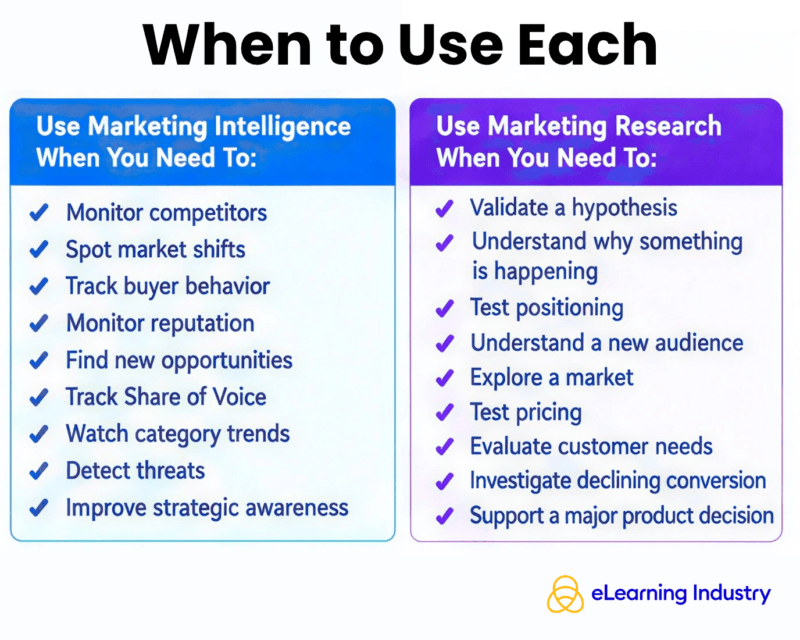
Knowing when to use marketing intelligence comes down to whether you need an ongoing view of your market rather than an answer to one specific question. Use it to monitor competitors, track changing buyer behavior, watch category trends, and spot emerging opportunities before they become obvious to everyone else.
Marketing intelligence also helps you monitor brand reputation, track Share of Voice, and detect potential threats. For example, if several learning tech competitors begin positioning their platforms around skills intelligence, that shift could signal a broader change in buyer priorities. Tracking these developments over time helps your team respond strategically instead of reacting to individual announcements.
Understanding how companies use marketing intelligence starts with connecting signals from different sources. Your team might combine competitor website updates, social discussions, sales feedback, and CRM data to identify recurring patterns. Together, these insights can reveal which customer concerns are growing, which competitors are gaining visibility, and where your messaging may need to evolve.
A market intelligence report can summarize these findings for marketing, sales, and leadership teams, helping everyone work from a shared understanding of the market. So, monitoring competitor messaging, product launches, and industry conversations over several months can help you determine whether this is an isolated trend or a wider market shift. That ongoing awareness gives your team time to evaluate opportunities, adjust positioning, and prepare for changes in buyer expectations.
When Should You Use Marketing Research?
Knowing when to use marketing research starts with identifying a specific question your team needs to answer. Use research when you want to validate a hypothesis, understand why something is happening, test positioning, explore a new audience, or evaluate customer needs before making a major decision.
Marketing research is especially useful when conversion rates decline, buyers respond poorly to a campaign, or your team needs evidence before changing product features or pricing. Rather than relying on assumptions, you collect relevant data to understand the problem and evaluate possible solutions.
Quantitative research is one of the methods you may use. It helps you measure preferences, behaviors, and patterns across a larger group. For example, you could survey enterprise L&D leaders to determine which skills-intelligence capabilities matter most to them. The results can help you prioritize features, compare audience segments, and identify common preferences.
On the other hand, qualitative research helps you explore the reasons behind those preferences. Interviews with enterprise buyers might reveal that customers value skills-gap analysis more than detailed reporting because they need to connect learning investments to workforce planning.
Additionally, research helps you evaluate a new market, test pricing options, assess brand perception, and investigate declining conversion rates. If your team is preparing a communications campaign, research can uncover audience concerns and inform relevant public relations examples, such as customer stories or expert commentary that address those concerns.
The key distinction in marketing research vs. market intelligence is the purpose of the activity. If you need to understand whether competitors are increasingly promoting skills intelligence, ongoing monitoring can reveal the trend. If you need to determine which capabilities enterprise buyers value most, a focused research study can answer that specific question.
In Which Instances Do You Need Both?
Marketing intelligence and marketing research work best as a continuous cycle. Intelligence helps you spot changes in the market, research investigates why those changes are happening, and your team uses the findings to make informed decisions. You then monitor the results to understand whether your strategy is working.
Step 1: Intelligence Identifies The Signal
Your ongoing monitoring reveals that competitor mentions around “AI coaching” have doubled across industry discussions, social platforms, and marketing content. This signals a possible shift in buyer interest, but it doesn’t explain what is driving the change or whether it represents a genuine opportunity.
Step 2: Research Investigates The Question
Your team conducts interviews and surveys with L&D leaders to understand their growing interest in AI coaching. Are they looking to personalize learning, reduce coaching costs, or scale employee development? Research helps you distinguish between assumptions and actual buyer priorities, giving you clearer evidence to guide your response.
Step 3: Strategy Responds
With these findings, your team can refine product positioning, prioritize relevant features, develop educational content, and plan targeted campaigns. The goal is to connect market signals with buyer needs rather than react to competitor activity alone. This combination supports better decision intelligence across marketing, sales, and product teams.
Step 4: Intelligence Monitors The Result
After implementing your strategy, continue tracking buyer conversations, competitor activity, Share of Voice, high-intent leads, and market response. You can also monitor brand perception and apply online reputation management strategies if customer discussions reveal emerging concerns.
These signals show whether your changes are gaining traction and where further investigation may be useful. If buyer interest shifts again, the cycle begins anew, helping your team adapt as market conditions evolve.
How AI Is Changing Marketing Intelligence And Research
AI helps your marketing intelligence system process signals that would take teams hours to review manually. It can analyze large volumes of customer reviews, detect recurring themes, monitor competitor activity, summarize media coverage, and identify shifts in sentiment. It can also flag unusual changes in website traffic, campaign performance, or buyer behavior that deserve further investigation.
For B2B teams, AI can process sales conversations to surface recurring objections, feature requests, and competitor mentions. These insights can support win/loss analysis and help marketing, sales, and product teams understand changing buyer priorities. However, teams still need to check the original sources and determine whether a detected pattern has practical significance.
AI For Marketing Research
AI can speed up marketing research by analyzing interview transcripts, clustering qualitative responses, summarizing open-ended survey answers, and exploring large datasets. It can also help researchers review secondary sources and generate hypotheses for further testing.
For example, an EdTech company investigating declining demo conversions could use AI to group interview feedback and identify common concerns about implementation time. Researchers would then need to assess those findings against the original responses and other evidence before recommending changes.
Where AI Falls Short
AI-generated insights are only as useful as the evidence behind them. Biased samples, outdated sources, poorly designed questions, or incomplete data can produce misleading conclusions, even when the analysis looks convincing.
Teams must still define clear research questions, select representative samples, use reliable sources, apply methodological rigor, and interpret findings in context. Human review and verification are essential, particularly when conclusions inform business strategy or public-facing content. AI workflows should support expert judgment, not replace it.
Common Mistakes Companies Make
- Treating competitor monitoring as the entirety of marketing intelligence while overlooking customers, industry shifts, and internal data.
- Confusing dashboards with intelligence instead of interpreting what metrics mean for decisions.
- Collecting data without defining the decision it should support.
- Running surveys when existing intelligence already answers the question.
- Making strategic decisions from tiny, unrepresentative samples.
- Confusing correlation with causation and assuming one factor caused another.
- Relying on a single source instead of validating findings across multiple sources.
- Ignoring insights from sales and customer service teams.
- Tracking competitors but not customer needs or changing market trends.
- Using outdated research or irrelevant B2B marketing benchmarks.
- Blindly trusting AI summaries without checking the original evidence.
- Confusing marketing research vs. market intelligence and failing to integrate research findings into ongoing monitoring.
Conclusion
Understanding marketing intelligence vs. marketing research helps you make better decisions with the data you already have and the questions you still need to answer. Marketing intelligence gives you an ongoing view of customers, competitors, and market changes, while marketing research helps you investigate specific challenges, test assumptions, and understand buyer motivations.
Both approaches play an important role in B2B marketing. Reviewing market intelligence examples in business can show you how to monitor competitor positioning, track buyer conversations, and identify emerging opportunities. Meanwhile, examples of marketing research demonstrate how surveys, interviews, and focused studies can uncover the reasons behind buyer behavior and guide product positioning, messaging, and campaign planning.
The strongest marketing teams connect these activities. They use ongoing insights to identify meaningful questions, research to investigate them, and continued monitoring to evaluate results. They also validate their sources, involve sales and customer service teams, and use online reputation management strategies to respond to changing customer perceptions.
Want to understand what L&D buyers actually think? eLearning Industry's audience and research capabilities can help brands turn market questions into original industry insights, and those insights into authority, content, and demand.
FAQsMarketing intelligence involves continuously monitoring market trends, competitors, customers, and industry developments. Marketing research is a more focused process of collecting and analyzing data to answer a specific business question or solve a particular marketing problem.
A company regularly tracks competitors’ pricing, product launches, customer reviews, and social media activity to identify market opportunities and anticipate changes in customer preferences.
A company surveys 500 potential customers to understand their preferences for a new product, assess purchase intent, and determine which features would influence buying decisions.
Market research and marketing intelligence are closely related but distinct activities. Research can contribute valuable insights to a company's broader marketing intelligence, which also draws on ongoing monitoring, internal data, and external market information.
A company should use marketing research when it needs specific answers to questions such as why customers choose a competitor, how much they would pay for a product, or whether a new campaign will resonate with its audience. Marketing intelligence is better suited to continuously tracking market conditions and identifying emerging opportunities or threats.
Yes. Marketing intelligence helps companies identify trends and potential problems, while marketing research investigates particular questions in greater depth. Combining both gives decision-makers a broader understanding of the market and stronger evidence for strategic planning.
