



The B2B Buyer Journey Is Complex. Let's Simplify It.
A company decides it needs a new learning management system (LMS). The L&D Director begins researching platforms, while an HR leader asks an AI assistant for recommendations. IT checks integrations and security, procurement looks for pricing, and the CFO wants to know whether the investment will deliver value. The CEO needs confidence that the platform can support the company’s growth. They are all involved in one B2B buyer journey, but each person approaches the decision with different priorities, questions, and concerns.
That complexity is reflected in Forrester’s business-buying research. A typical buying decision involves 13 internal stakeholders and nine external influencers. With so many perspectives involved, the B2B software buying process rarely follows a predictable path.
Buyers move between search engines, AI assistants, software directories, reviews, vendor websites, and conversations with peers as they assess their options. Understanding how AI is changing the B2B buyer journey matters, as does knowing where buyers look for credible evidence and reassurance.
In this guide, we will explore how software buyers discover, compare, and choose vendors, and what marketing teams can do to earn visibility and trust at every step, beyond relying on B2B lead generation benchmarks alone.
Key Takeaways:
- The B2B buyer journey describes how organizations identify needs, research solutions, evaluate vendors, build consensus, and make purchasing decisions.
- B2B buying journeys are rarely linear, particularly when multiple stakeholders are involved.
- Software buyers may use search engines, AI assistants, industry publications, directories, reviews, peer recommendations, and vendor websites during their research.
- Different stakeholders evaluate different risks, including cost, implementation, usability, security, integrations, and business impact.
- Vendor visibility matters before buyers contact sales, but visibility alone doesn't guarantee consideration or selection.
- Independent evidence, relevant customer reviews, product comparisons, and transparent information can help buyers evaluate vendors.
- Effective B2B marketing should support buyer decisions across multiple touchpoints rather than focus exclusively on lead generation.
- Measuring buyer-journey performance requires combining engagement, consideration, pipeline, and customer insights.
In This Guide, You Will Find...
- What Is the B2B Buyer Journey?
- The 6 Stages Of The B2B Software Buyer Journey
- Where Do B2B Software Buyers Discover Vendors In 2027?
- How AI Is Changing Things
- How B2B Buyers Compare Software Vendors
- The Role Of Buying Committees In B2B Software Decisions
- How B2B Marketers Can Influence Each Stage Of The Buyer Journey
- Step To Map Your B2B Buyer Journey
- How To Measure B2B Buyer Journey Performance
- Common B2B Buyer Journey Mistakes
What Is the B2B Buyer Journey?
The B2B buyer journey is the process organizations follow to recognize a business need, research potential solutions, evaluate vendors, align internal stakeholders, and make a purchasing decision. Unlike many consumer purchases, business software investments often involve several decision-makers, different priorities, longer evaluation periods, financial justification, implementation requirements, and organizational risk.
For example, when a company considers purchasing an LMS, the L&D Director may prioritize learning experiences, while IT focuses on integrations and security. Finance, meanwhile, wants to understand the total cost of ownership and expected return on investment. Each stakeholder evaluates the same product from a different perspective, making the B2B SaaS buyer journey more complex.
It's also important to distinguish the buyer journey from the sales funnel. The buyer journey describes how potential customers research their options and make decisions. The sales funnel, on the other hand, shows how vendors track and manage commercial opportunities. Although these processes overlap, they don't always move at the same pace.
A prospect may spend weeks researching solutions, reading reviews, and conducting a vendor comparison without ever appearing in your CRM. Similarly, a new lead doesn't automatically indicate strong buyer intent or purchasing readiness. Understanding these differences helps marketing teams recognize how to influence B2B buying decisions and develop strategies that go beyond traditional B2B marketing benchmarks.
The 6 Stages Of The B2B Software Buyer Journey
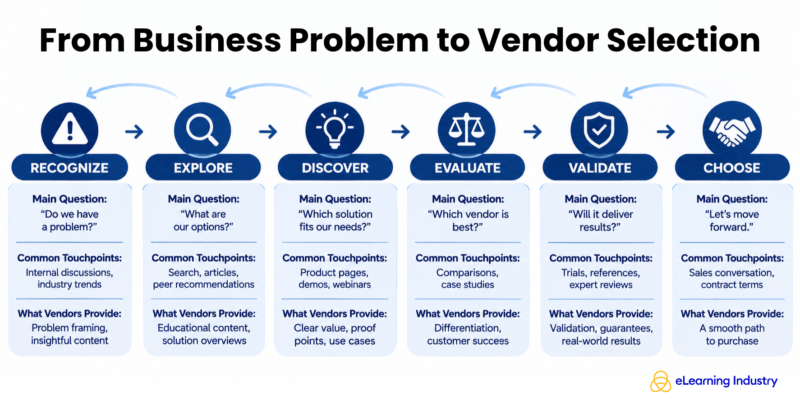
1. Problem Recognition
Every purchase starts with a business need or challenge. An organization may realize that its existing software no longer supports its operations or growth. However, identifying a problem does not mean the company is ready to buy. Stakeholders first need to understand what causes the issue and how it affects performance.
For example, an L&D team may find that its current LMS supports employee training but cannot deliver learning experiences to external customers and partners.
Buyer question: What problem are we trying to solve?
Marketing opportunity: Publish educational content that helps potential customers recognize common challenges. Industry research, practical guides, and expert insights can help buyers understand the impact of an outdated platform and identify new business needs.
2. Solution Exploration
After defining the problem, buyers investigate ways to address it. They may not know which software category or approach will work best, so they compare possible solutions and consider whether they can adapt their existing technology.
For example, a company improving customer education may extend its existing LMS, purchase a dedicated customer education platform, or implement a new learning management system.
Buyer question: What solutions are available?
Marketing opportunity: Create educational guides, category explainers, webinars, independent research, and comparison content to empower your B2B buyer journey. Explain the differences between software categories and show which business needs each approach can address.
3. Vendor Discovery And Shortlisting
Once buyers understand the available approaches, they look for providers that could meet their requirements. They may discover vendors through search engines, AI assistants, software directories, customer reviews, industry publications, and professional recommendations.
For example, an L&D team researching customer education platforms may find LMS providers through Google or AI recommendations, then review directories, customer feedback, and independent industry coverage before creating a shortlist.
Buyer question: Which vendors might meet our requirements?
Marketing opportunity: Build visibility across the channels buyers use during research. Invest in SEO, AI discovery, category content, software directories, and industry coverage. Expert contributions and media outreach can introduce your brand to new audiences. Research and examples of earned media can help your team build credibility beyond your website.
4. Vendor Evaluation
After creating a shortlist, buyers examine each product in greater detail. They compare capabilities, integrations, pricing, scalability, usability, support, and compatibility with existing systems. General marketing claims are rarely enough.
For example, a company evaluating LMS platforms may compare reporting dashboards, HR system integrations, customization, security, and support. It may also request demonstrations to see how each platform works.
Buyer question: Which option best fits our needs?
Marketing opportunity: Provide product comparisons, customer reviews, case studies, feature documentation, transparent pricing, and demonstrations. Explain your competitive advantages while giving buyers enough detail to assess the product. Use online reputation monitoring to identify recurring customer concerns and understand how people perceive your brand.
5. Internal Validation And Consensus
A vendor that performs well during evaluation must still earn support across the organization. The B2B buying committee decision process involves stakeholders with different responsibilities and concerns. The decision-making unit may include representatives from L&D, HR, IT, finance, legal, procurement, and senior leadership.
For example, the L&D Director may favor an LMS because of its learning capabilities, while IT reviews security and integrations. Finance assesses total cost of ownership, and senior leaders want evidence that the investment supports business goals. A serious concern can send the company back to its shortlist or delay the purchase.
Buyer question: Can we justify this decision and manage the risks?
Marketing opportunity: Provide ROI frameworks, implementation guides, security documentation, customer stories, and business case templates. Make information easy to share internally, so your main contact can explain the product's value and address concerns before they become barriers.
6. Vendor Selection And Purchase
The final stage begins when the organization has assessed its options, aligned key stakeholders, and chosen a preferred provider. However, the decision may still depend on a proof of concept, customer references, commercial negotiations, and final procurement checks. Buyers need confidence that the vendor can meet requirements and support a successful rollout.
For example, an LMS buying committee may select a platform after testing key features, confirming integrations, reviewing implementation timelines, and agreeing on pricing.
Buyer question: Are we confident enough to proceed?
Marketing opportunity: Support the decision with product trials, proof-of-concept opportunities, customer references, implementation plans, and clear commercial information. Explain contract terms, onboarding, and available support.
Marketing's contribution can continue after purchase. By tracking engagement across relevant touchpoints, your team can understand which activities support conversions and improve revenue attribution.
Where Do B2B Software Buyers Discover Vendors In 2027?
| Discovery Channel | How Buyers Use It | Opportunity for B2B Vendors |
| Google Search | Research problems, categories, and solutions | SEO and high-intent content |
| AI Assistants | Explore options, summarize information, and compare products | AI visibility, accurate product information, credible content |
| Software Directories | Discover and filter relevant vendors | Complete profiles and relevant category presence |
| Industry Top Lists | Identify potential solutions | Independent editorial recognition |
| Customer Reviews | Evaluate customer experiences and potential risks | Authentic reviews and customer advocacy |
| Industry Publications | Understand trends, vendors, and market developments | Thought leadership, research, and earned media |
| Peer Recommendations | Learn from other professionals' experiences | Customer relationships and advocacy |
| Vendor Websites | Validate capabilities, pricing, and differentiation | Clear product information and conversion experiences |
| Webinars, Events, and Podcasts | Explore expertise and solutions in greater depth | Executive visibility and expert-led content |
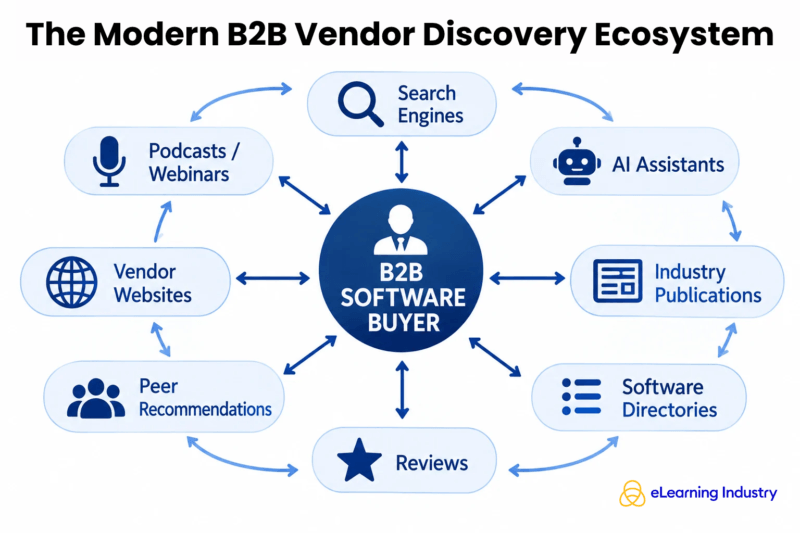
B2B software buyers discover vendors across multiple channels as they research solutions and build confidence in their options. Search engines, AI assistants, industry publications, software directories, customer reviews, professional communities, and peer recommendations can all introduce a provider. Your website and sales team remain important, but they are only part of the discovery ecosystem.
These B2B buyer journey touchpoints don't follow a fixed sequence. A buyer might see an AI recommendation, read an industry article, check a software directory, explore customer reviews, visit a vendor's website, and eventually request a demo. Another buyer may start with a colleague's recommendation or a comparison site. Repeated exposure can build familiarity, but it doesn't automatically put a vendor on the shortlist.
This distinction matters when you assess B2B buying behavior. Discovery creates awareness. Consideration begins when buyers actively investigate whether a provider fits their needs. They look for evidence of relevant capabilities, industry experience, customer satisfaction, and credibility.
For marketing teams, the goal is to understand where potential buyers look for information and what they need at each point. SEO, AI visibility, industry contributions, directory profiles, and customer reviews can strengthen your presence across those channels. Social listening for B2B marketers can also reveal which platforms, topics, competitors, and customer concerns shape conversations in your category.
How AI Is Changing Things
AI tools are changing how buyers research software, discover vendors, and compare potential solutions. As how AI is changing the B2B buyer journey becomes clearer, vendors need to understand how buyers use these tools, and where AI-generated information needs further validation.
AI-Assisted Vendor Discovery And Research
Buyers can ask AI assistants questions such as which LMS platforms support customer education, what features an enterprise LMS needs, or how several vendors compare. AI-assisted research helps them explore unfamiliar categories, summarize complex topics, and develop initial evaluation criteria.
However, faster research doesn't necessarily mean faster purchasing decisions. Buyers still need to verify recommendations, assess product fit, and secure agreement from internal stakeholders.
More Ways To Compare Vendors
AI tools can organize requirements, summarize product information, and generate preliminary comparison tables. These outputs can make early evaluation easier, but they may omit relevant vendors, contain inaccuracies, or draw on incomplete information. Buyers should check important claims against vendor documentation, customer feedback, and independent research.
New Visibility Challenges For Vendors
Software providers need to consider how accurately AI tools represent their products. Clear positioning and accessible, consistent information across trusted sources can help.
Marketing priorities include:
- Product positioning: Explain capabilities, use cases, and differentiators clearly.
- Content visibility: Invest in SEO and GEO, including SEO for AI search engines.
- External credibility: Build independent coverage, customer reviews, and industry authority.
- Performance tracking: Monitor brand mentions and share of voice SEO across relevant discovery channels.
AI may change how buyers gather information, but it doesn't remove the need for trust, validation, and human decision-making. Vendors still need credible evidence that helps buying teams make confident choices.
How B2B Buyers Compare Software Vendors
| Evaluation Factor | What Buyers Want to Know |
| Product capabilities | Does the software meet our requirements? |
| Industry suitability | Does the vendor understand our business? |
| Integrations | Will it work with our existing systems? |
| Implementation | How difficult will deployment be? |
| Usability | Will employees and administrators adopt it? |
| Pricing and TCO | What will the solution actually cost? |
| Security and compliance | Does it meet organizational requirements? |
| Scalability | Can it support future growth? |
| Customer support | What happens when we need help? |
| Customer evidence | Have similar organizations succeeded with it? |
| Vendor credibility | Can we trust the provider? |
After discovering potential providers, buyers move into a more detailed stage of the B2B buyer journey. They assess whether each solution is suitable for their needs, credible, affordable, and practical to implement. Understanding how software buyers choose vendors means looking beyond feature lists to the business concerns behind each decision.
- LMS administrators may prioritize usability, reporting, and ease of managing learning programs.
- IT Directors often examine security, integrations, scalability, and technical requirements.
- CFOs focus on total cost of ownership, implementation costs, and expected return on investment.
- CEOs consider strategic fit, business impact, and long-term value.
Vendors need to address these concerns without creating inconsistent positioning. Product documentation, pricing information, customer stories, and tailored demonstrations help stakeholders assess value from their own perspectives. Reviews and brand sentiment also influence confidence by showing how customers experience the product in practice. Clear, consistent evidence makes it easier for the buying team to compare options and agree on a preferred provider.
The Role Of Buying Committees In B2B Software Decisions
| Stakeholder | Primary Concern | Information They Need |
| L&D Director | Learning effectiveness | Capabilities, reporting, learner experience |
| HR Leader | Workforce development | Business use cases and organizational impact |
| IT Director | Technical compatibility | Integrations, security, implementation |
| CFO | Financial justification | Pricing, TCO, ROI |
| Procurement | Commercial risk | Contracts, vendor assessment |
| CEO / Executive Sponsor | Strategic value | Business outcomes and scalability |
The B2B buying committee decision process often involves several people assessing an LMS purchase from different perspectives. For example, an L&D Director may champion a new platform to improve employee training, while IT checks security and integrations. Finance reviews costs and expected returns, and senior leadership considers strategic value.
Not every buying committee includes all these roles, and responsibilities vary by organization. In smaller companies, one person may cover several areas, while enterprise purchases often involve more departments and approval stages.
Winning over one enthusiastic buyer isn't always enough, though. Vendors need to support stakeholder alignment with clear business cases, ROI resources, technical documentation, and relevant customer evidence. B2B thought leadership can also help internal champions explain the problem and build confidence in the proposed solution across the organization.
How B2B Marketers Can Influence Each Stage Of The Buyer Journey
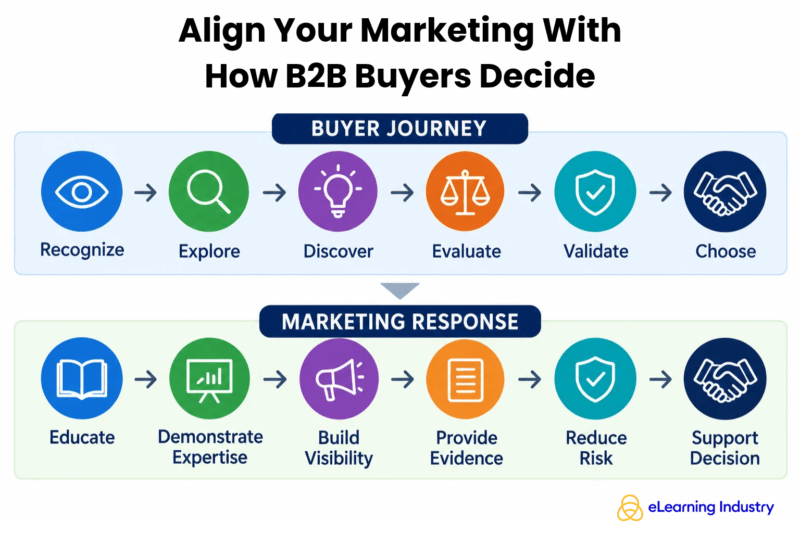
1. Build Visibility Before Buyers Contact Sales
During problem recognition and solution exploration, buyers need useful information, not sales pitches. Invest in educational articles, research, podcasts, webinars, and thought leadership marketing to explain industry challenges and possible solutions. Strong demand generation starts before prospects are ready to request a demo.
2. Increase Visibility During Vendor Discovery
When buyers begin identifying providers, make your brand easy to find across search engines, AI platforms, software directories, and industry publications. An effective earned media strategy can extend visibility beyond your website, while consistent positioning helps build brand authority. Monitor relevant buying signals, including branded searches, directory engagement, and referral traffic.
3. Build Trust During Vendor Evaluation
Buyers need evidence to compare their options. Provide detailed product information, comparison guides, customer reviews, case studies, and demonstrations. Apply online reputation management strategies to understand customer feedback, address recurring concerns, and strengthen credibility.
4. Reduce Risk During Internal Validation
Help internal champions justify their preferred solution. ROI resources, implementation guides, security documentation, integration details, and customer references give stakeholders evidence they can share with colleagues.
5. Support Confident Vendor Selection
Make the final decision easier with accessible pricing information, proof-of-concept opportunities, clear onboarding expectations, and responsive sales support.
Three Strategic Principles
Visibility: Be present throughout the B2B buyer journey, not only when prospects are ready to convert.
Credibility: Combine vendor content with independent customer and industry evidence.
Decision support: Understanding how to influence B2B buying decisions means helping every stakeholder assess value, manage risk, and move forward with confidence.
Steps To Map Your B2B Buyer Journey
1. Identify Your Buying Personas
Start by identifying the decision-makers, influencers, and end users involved in a purchase. For an LMS vendor, this might include L&D leaders, IT teams, finance managers, and employees who use the platform.
2. Map Their Questions
Document what each stakeholder needs to know at different stages of the B2B buyer journey. Consider their priorities, concerns, evaluation criteria, and reasons for delaying a decision.
3. Identify Key Touchpoints
Use B2B customer journey mapping to track where buyers discover and evaluate vendors. Include search engines, AI assistants, software directories, reviews, vendor websites, sales conversations, and peer recommendations.
4. Find Friction And Information Gaps
Look for questions your content doesn't answer, missing product information, and recurring objections. Ask where buyers struggle, abandon their research, or request clarification. Customer interviews, win/loss analysis, and sales feedback can reveal these gaps.
5. Improve And Measure The Journey
Prioritize improvements using behavioral data, buyer feedback, conversion rates, and commercial outcomes. Compare performance with relevant lead generation benchmarks, but don't rely on industry averages alone. For example, a brand awareness campaign may increase visibility without immediately generating demo requests.
How To Measure B2B Buyer Journey Performance
Discovery And Brand Awareness
Measure how easily buyers find your brand through organic search visibility, relevant AI mentions, referral traffic, branded searches, share of voice, and industry mentions. These metrics show whether your brand appears during early research.
Engagement And Consideration
Track content engagement, returning visitors, webinar participation, comparison-page visits, software directory interactions, and review engagement. These indicators help you understand whether buyers are exploring your solutions and considering your brand during the B2B buyer journey.
Conversion And Sales Progression
Monitor qualified inquiries, demo requests, opportunities created, opportunity conversion rates, and sales-cycle duration. These measures connect marketing activity with commercial progress and help reveal how software buyers choose vendors.
Business Impact
Evaluate pipeline contribution, revenue, customer acquisition costs, and customer acquisition performance. Include sales enablement insights to understand which resources help move opportunities forward. Media monitoring can also reveal brand mentions and conversations that website analytics may miss.
Look Beyond Last-Click Attribution
Not every touchpoint is easy to attribute. A buyer might discover your vendor through an AI-generated response, read an industry article later, and eventually visit your website directly before requesting a demo.
That doesn't make measurement pointless. Combine analytics, CRM data, customer interviews, sales feedback, and self-reported discovery sources. No single attribution model captures the entire decision process, but multiple forms of evidence provide a more realistic picture of marketing's influence.
Common B2B Buyer Journey Mistakes
- Treating the journey as a linear funnel: Assuming every buyer moves through the same stages in the same order.
- Assuming all buyers behave alike: Overlooking differences in company needs, priorities, and purchasing processes.
- Focusing only on lead generation: Neglecting early-stage education, discovery, and vendor evaluation.
- Ignoring other stakeholders: Creating content for one contact while overlooking IT, finance, and senior leadership.
- Investing only in bottom-funnel content: Missing opportunities to influence buyers during initial research and solution exploration.
- Neglecting independent credibility: Overlooking customer reviews, industry publications, and third-party coverage.
- Relying only on website analytics: Missing discovery and research activity across external channels.
- Overlooking AI-assisted research: Failing to consider how AI tools influence the B2B SaaS buyer journey.
- Making vendor comparisons difficult: Hiding pricing, product details, integrations, or implementation information.
- Depending on last-click attribution: Underestimating the combined influence of multiple marketing touchpoints.
Avoiding these mistakes helps marketers understand B2B buying behavior more accurately. It also highlights the difference between marketing intelligence vs. marketing research when gathering and interpreting buyer insights.
Conclusion
The B2B buying journey rarely follows a straight line. Buyers move between search engines, AI assistants, directories, reviews, industry publications, vendor websites, and conversations with colleagues as they explore options and assess risk. Every interaction can shape perception, even without a direct inquiry.
For vendors, understanding how B2B buyers make purchasing decisions means looking beyond the conversion. You need to be visible when organizations first recognize a challenge, provide useful information as they explore solutions, and offer credible evidence when they compare providers. Pay attention to buyer intent, but don't assume that a click or form submission tells you the whole story.
Lead nurturing strategies should support the questions buyers have at each stage. That means making product details, customer experiences, pricing, implementation requirements, and business value easy to find and share. It also means listening to customers, learning from sales conversations, and adapting your approach as buying needs change over time. Activities such as social media training can help teams communicate consistently and participate in industry conversations.
Through targeted content, industry directories, reviews, editorial opportunities, webinars, podcasts, and demand-generation campaigns, brands can connect with relevant audiences at different stages of the decision-making process. Explore eLearning Industry's marketing solutions.
FAQsThe B2B buyer journey is the process an organization follows to identify a business need, research potential solutions, evaluate vendors, make a purchasing decision, and assess the results of that decision. It often involves multiple stakeholders and extended evaluation periods.
A six-stage framework typically includes:
-
Awareness: A business recognizes a challenge, need, or opportunity.
-
Consideration: Buyers research possible solutions and explore available approaches.
-
Discovery: They identify potential vendors, products, or service providers.
-
Evaluation: Stakeholders compare features, pricing, capabilities, reviews, and implementation requirements.
-
Decision: The organization selects a vendor, negotiates terms, and completes the purchase.
-
Post-purchase: The business implements the solution, measures results, and evaluates ongoing value.
B2B purchases typically involve greater organizational complexity than consumer purchases. Several stakeholders, such as department heads, procurement teams, IT specialists, and executives, may influence the decision. Buyers must also consider budgets, security, integrations, compliance, implementation, and long-term return on investment.
B2C purchases are generally more individual-driven and may involve shorter decision-making processes, lower costs, and fewer formal requirements.
B2B software buyers use multiple sources to identify and evaluate vendors, including:
-
Search engines: Find solutions, comparisons, and educational resources.
-
AI tools: Explore options, summarize information, and identify potential providers.
-
Software directories: Browse categories and compare available platforms.
-
Review websites: Evaluate customer experiences, ratings, and product feedback.
-
Industry publications: Discover vendors through articles, reports, and expert insights.
-
Recommendations: Seek advice from colleagues, professional networks, and industry peers.
AI tools are making business research faster by helping buyers discover vendors, summarize product information, compare capabilities, and identify potential solutions. Buyers can use AI assistants to explore complex topics and narrow down options before contacting sales teams.
However, AI-generated information still requires validation. Buyers need to verify product claims, pricing, security requirements, customer reviews, and vendor capabilities through reliable sources, demonstrations, and direct conversations.
Marketers can improve the buyer journey by making useful information accessible at every stage. Key priorities include:
-
Increase visibility: Optimize websites and content for search engines, AI discovery, and relevant industry platforms.
-
Provide relevant information: Publish guides, comparisons, case studies, and product explanations that address buyer questions.
-
Build trust: Showcase customer testimonials, independent reviews, expert insights, and measurable results.
-
Address stakeholder needs: Create resources for executives, procurement teams, IT departments, and end users.
-
Reduce friction: Simplify navigation, clarify pricing and product details, offer useful demonstrations, and make it easy to contact sales.
