


 ChatGPT
 Perplexity
 Claude
 Grok
Grok
Why Responsible AI Use Requires More Than Rules
AI adoption is accelerating across industries, and Learning and Development (L&D) teams and educators across K-12 and higher education are racing to design training and instruction that help employees and students use new tools effectively. This is meaningful and important work. Addressing one overlooked but critical distinction, however, can help guide how curricula and training programs are designed. In supporting AI upskilling and coaching AI use, it is essential to distinguish between ethics and integrity. While closely related, they are not the same. By explicitly addressing this distinction, educators can better prepare learners to develop the mindsets and behaviors needed to use AI responsibly and successfully.
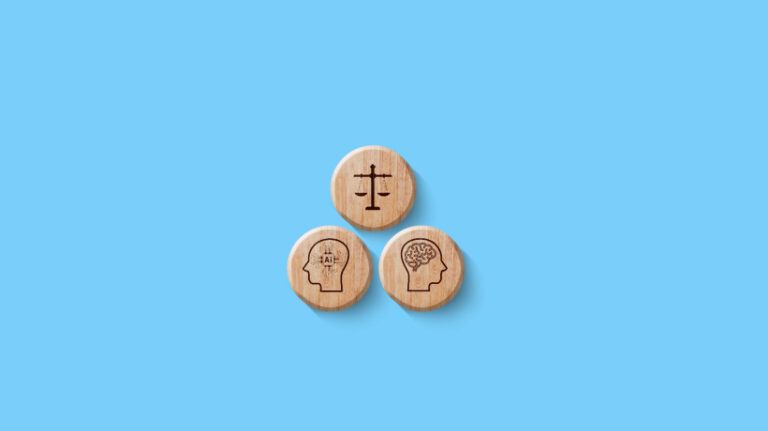
Many organizations and institutions launch AI ethics modules or units that introduce principles such as fairness, transparency, privacy, and responsible use. An ethic is a set of moral principles or values that guide how individuals or groups think, decide, and act. Teaching ethics helps AI users grapple with questions about what is "right" and "wrong" in human-AI interaction, and why those distinctions matter.
However, the study of ethics alone does not teach learners how to behave with integrity when interacting with AI systems in real-world contexts. Where ethics outlines what is right, integrity reflects the commitment to live by those principles with honesty and consistency. This distinction becomes mission-critical as organizations increasingly rely on AI-generated content, recommendations, predictions, and insights. Without integrity, even ethical systems can be misused. Without ethics, integrity has no compass.
In this article...
- Ethics Vs. Integrity: A Practical Distinction For L&D And Educators
- Transparency Regarding AI Use
- How To Teach Ethics And Integrity
Ethics Vs. Integrity: A Practical Distinction For L&D And Educators
Ethics
Ethics refers to the standards, policies, and principles that govern responsible AI use, including:
- Data privacy requirements
- Guidelines around transparency and disclosure
- Expectations for verifying accuracy
- Bias detection and mitigation
- Rules for fair and equitable use
Ethics provides employees and students with the rules to follow when engaging with AI. For example, while copy-pasting sensitive customer, employee, or student information into a Large Language Model (LLM) for data processing, performance evaluation, or grading can save time, failing to remove identifying information can result in privacy violations. There are also ongoing discussions across fields about whether inputting others' work into AI systems raises copyright concerns. In addition, AI-generated reports are subject to error, posing risks not only to users themselves but also to anyone affected by their decisions and evaluations.
AI ethics instruction is often comparable to compliance training in the workplace or introductory policies and procedures instruction in K-12 and higher education. These approaches typically focus on establishing shared definitions, expectations, and guiding frameworks. As a result, learners may leave these experiences able to define ethical AI use, yet still lack the behavioral fluency needed to apply those principles consistently in practice. This is where integrity becomes essential.
Integrity
Integrity refers to the daily habits, decisions, and actions individuals take when interacting with AI tools, including in instructional contexts such as live tutoring, where AI can support learning without replacing human judgment. AI users who demonstrate integrity independently verify outputs, double-check sources, avoid blind trust, and take responsibility for errors. These are habits worth cultivating.
Developing integrity requires scenario-based practice. Educators and trainers might pose questions such as:
- What would you do if an AI output seemed useful but questionable?
- Which response to this example of AI use demonstrates integrity?
- Where does AI introduce risk in this workflow, study session, or assignment?
Individuals who develop integrity around AI use behave responsibly even when they believe their work will not be challenged. Actions that demonstrate integrity include:
- Choosing not to copy and paste AI outputs without verification.
- Being honest about the extent of AI involvement in one's work.
- Reporting harmful or biased outputs.
- Avoiding overreliance on AI for decisions requiring human judgment.
- Respecting confidentiality even when AI tools make shortcuts tempting.
Ethics can be taught directly. Integrity develops over time and is shaped by experience, culture, and practice. Understanding this distinction is essential for determining the kinds of learning experiences L&D professionals, curriculum designers, and educators must design to truly support learners.
Transparency Regarding AI Use
Most organizations now expect employees and students to disclose when they use AI. Without integrity-driven behaviors, individuals may underreport AI assistance, conceal errors, or pass off AI-generated work as their own. L&D professionals and educators must set ethical expectations for transparency and then create conditions that encourage learners to practice it.
Learners must feel psychologically safe to disclose when and how they use AI, where outputs are inaccurate, and where they remain unsure how to verify results. Psychological safety is strengthened when expectations for transparency are made explicit rather than left implicit. One practical way to do this is by providing sample disclosure statements, such as:
- AI was used during brainstorming and ideation; the final work reflects the author's original thinking.
- AI was used to support preliminary research and question generation; all sources were independently located and verified by the author.
- AI was used to summarize source material; all summaries were cross-checked against original sources by the author.
- AI was used to draft sections based on original notes and data; all outputs were verified and revised by the author.
- AI was used for editing and revision; all ideas are the author's own.
- AI was used to provide feedback suggestions; final revisions reflect the author's judgment and decisions.
- AI was used to generate presentation slides based on the author's original content and was edited for accuracy and clarity.
In all cases, the author remains responsible for the content. Integrity around AI use can only exist where transparency is expected and supported. When disclosures are normalized, employers, instructors, and reviewers can better evaluate whether learning objectives have been met and determine when follow-up is needed.
As AI becomes more prevalent in workplaces and classrooms, addressing ethics and integrity requires not only clear policies but also the removal of stigma around honest reporting of AI use. In the spirit of transparency, I disclose here that ChatGPT was used during the brainstorming process for this article and to support editing and revision. The ideas and arguments presented are my own.
How To Teach Ethics And Integrity
1. Embed Ethics And Integrity Into Skills Maps And Competency Frameworks
L&D teams and educators should embed AI ethics and integrity directly into skills maps and competency frameworks, labeling them as explicit competencies within modules, lessons, and assessments. When these terms appear in learning objectives, activity descriptions, and evaluation criteria, they are far more likely to be taught, practiced, and assessed rather than treated as background principles.
2. Differentiate Ethical Principles From Integrity Behaviors
Learners should practice distinguishing ethical principles (e.g., AI outputs must be verified) from integrity behaviors (e.g., cross-checking summaries against source documents). Simple activities such as sorting, matching, and scenario labeling help solidify this distinction.
3. Design Micro-Practice Moments
In addition to dedicated instruction on AI ethics and integrity, L&D teams and educators can strengthen learning by embedding short, repeated practice moments throughout existing learning experiences. These can be woven into onboarding programs, leadership pathways, compliance refreshers, and project-based learning, as well as classroom routines and early coursework in K-12 and higher education. Micro-practice moments might include asking learners to revise a biased AI-generated response, identify privacy or accuracy risks introduced through AI use, or pause to check sources before relying on an AI-generated output. By integrating these moments into regular instruction and work processes, ethics becomes something learners understand, and integrity becomes something they enact. Over time, these small but consistent interventions help integrity develop as a habit rather than a one-time lesson.
4. Build Training Scenarios
Scenarios help learners connect ethics to action across work and learning contexts. For example, consider a situation in which an AI assistant summarizes a collaborative project, discussion, or written assignment but minimizes or misrepresents the contributions of a team member or student, a risk that can disproportionately affect individuals from marginalized groups. Learners can identify the ethical principles involved and determine what integrity-driven actions should follow.
5. Incorporate Reflection Questions
Regular reflection helps learners examine their AI use, recognize when convenience tempts them to skip verification, and build stronger habits of critical evaluation. Reflection also encourages learners to consider how assumptions shape their interpretation of AI outputs. L&D professionals and educators can prompt this reflection with targeted questions that surface judgment, responsibility, and risk.
- Which parts of this AI-generated content did I verify, revise, or reject, and why?
- What evidence did I use to confirm or challenge the accuracy of this output?
- What risks, ethical, practical, or human, could arise if this output were used as is?
- Who could be affected by errors, omissions, or bias in this output?
- If I were accountable for the consequences of this output, what would I change before sharing or submitting it?
Together, these questions help learners slow down, surface risk, and practice integrity-driven decision making in real contexts, and they align with a broader framework of five core questions that help AI users verify outputs, surface assumptions, and retain agency.
Conclusion
As generative AI accelerates, organizations and institutions of learning must provide instruction that addresses both ethics and integrity. Ethics establishes the rules for responsible use. Integrity ensures those rules are applied consistently in practice.
Together, ethics and integrity form the foundation of responsible AI use. Educators across workplace learning, K-12, and higher education are uniquely positioned to equip learners not only with AI tools but with the judgment to use them well.

![Ethical Intelligence In Learning: A Strategic Guide For Responsible L&D [eBook Launch]](https://cdn.elearningindustry.com/wp-content/uploads/2025/07/Ethical-Intelligence-A-Strategic-Guide-For-Responsible-LD.png)