




And What eLearning Designers Must Do Next
Generative AI is no longer an experimental tool. It's embedded in everyday work. Employees are using AI to draft emails, summarize reports, create documentation, explain policies, prepare presentations, and respond to customer inquiries. But what does this shift actually mean for eLearning professionals?
A large-scale study from Microsoft Research offers useful clarity. In Working with AI: Measuring the Applicability of Generative AI to Occupations (Tomlinson, Jaffe, Wang, Counts, and Suri, 2025), researchers analyzed 200,000 anonymized conversations with Microsoft Copilot and mapped them to real-world work activities using the O*NET framework. Rather than predicting future disruption, the study examined how AI is already being used successfully in workplace tasks. The findings reveal important implications for the use of generative AI in workplace learning that Instructional Designers, L&D managers, and digital learning teams should heed.
1. AI Is Most Effective In Information-Based Work
The study found that AI performs best in activities involving:
- Writing and editing content.
- Explaining procedures or technical details.
- Teaching or clarifying concepts.
- Gathering and organizing information.
- Communicating with customers or stakeholders.
- Preparing instructional or informational materials.
In short, AI excels at information work—the creation, processing, and communication of information.
Here's why this matters for eLearning: Almost every job includes information tasks. Even operational or frontline roles require documentation, reporting, communication, scheduling, or compliance explanations. AI's applicability isn't limited to technical roles. It cuts across industries. This means AI capability development should not be siloed in IT training. It must become part of core learning strategy.
2. The Real Skill Shift Isn't Technical—It's Cognitive
One of the most useful distinctions in the research separates two types of AI impact:
- AI assisting employees (augmentation)
- AI performing parts of the task itself (delegation)
Some roles will use AI as a productivity partner. Others will delegate specific components of their work to AI systems. For eLearning professionals, this distinction changes how courses should be designed. Most current AI training focuses on:
- Tool walkthroughs.
- Prompt tips.
- Feature explanations.
But the research suggests that's not enough. What employees actually need is support in:
- Deciding when to use AI.
- Evaluating AI outputs.
- Detecting incomplete or inaccurate responses.
- Managing risks and escalation.
In other words, we need to train judgment, not just usage, for generative AI in workplace learning.
3. Completion Rates Don't Prove AI Readiness
The researchers measured AI impact based on:
- Task completion success.
- Scope of AI capability within work activities.
- Real-world applicability across occupations.
They did not measure how many people "completed training." For eLearning teams, this is a wake-up call. If your AI initiative success metrics include:
- Course completion rates.
- Satisfaction scores.
- Log-in frequency.
You may be measuring engagement, not impact. More meaningful indicators include:
- Improved decision quality.
- Reduced rework.
- Faster turnaround with maintained accuracy.
- Better escalation decisions.
- Improved documentation clarity.
AI changes how work is done. Learning metrics must reflect changes in work performance.
4. Why Foundational Knowledge Still Matters
The study suggests AI may help democratize access to expertise. When used effectively, AI can help employees perform tasks previously reserved for specialists. However, this benefit only materializes when users can critically evaluate AI output. Without foundational knowledge, employees may:
- Accept inaccurate responses.
- Miss contextual nuances.
- Fail to detect hallucinations.
- Apply guidance incorrectly.
This creates a new Instructional Design priority: Blend AI skills with domain knowledge reinforcement. AI capability training should include:
- Validation frameworks.
- Error-detection checklists.
- Risk awareness prompts.
- Reflective decision questions.
The goal is confidence with calibration—not blind trust.
5. Where AI Currently Struggles (And Why That Matters)
The research also found lower AI effectiveness in:
- Physical or manual tasks.
- Highly contextual or complex decision-making.
- Certain analytical tasks.
This reinforces an important design principle: AI should be framed as a support tool, not a replacement for professional judgment. Your training should help learners understand:
- The boundaries of AI.
- Situations requiring human oversight.
- When escalation is necessary.
- How to combine AI output with contextual insight.
This prevents overreliance and builds responsible usage habits.
Practical Implications For eLearning Professionals
So how should learning teams respond? Here are five actionable shifts.
1. Design Role-Specific AI Learning Paths
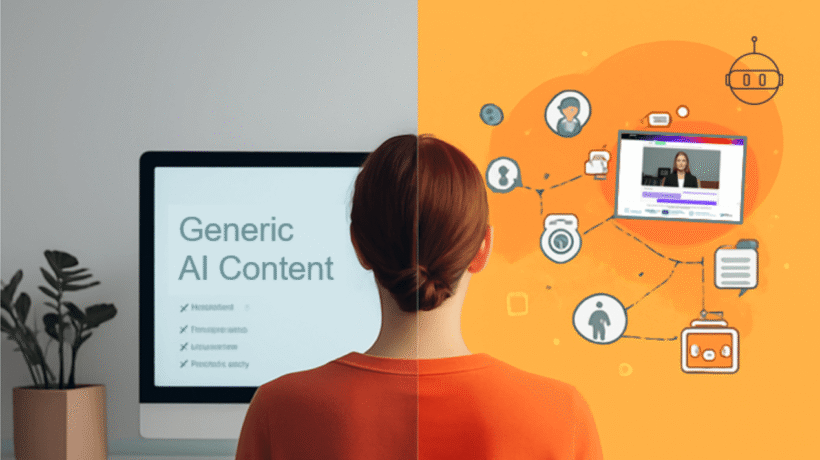
Avoid generic AI awareness courses. Instead:
- Identify high-frequency information tasks per role.
- Map where AI meaningfully overlaps.
- Build targeted learning modules for those moments.
For example:
- Sales teams → AI-assisted proposal drafting + validation
- HR teams → AI-assisted policy communication + compliance checks
- Operations → AI-supported documentation + reporting clarity
The relevance of the generative AI use case in workplace learning increases its adoption.
2. Use Scenario-Based eLearning Instead Of Passive Modules
AI capability cannot be mastered through slides alone. Integrate:
- Branching scenarios.
- Decision-based simulations.
- Risk assessment exercises.
- Output evaluation activities.
Ask learners to review AI-generated content and decide:
- Is this accurate?
- What's missing?
- What risk does this introduce?
- Would you escalate?
This builds applied competence.
3. Embed AI Into Performance Support, Not Just Courses
AI itself can act as:
- An on-demand explainer.
- A writing assistant.
- A feedback partner.
- A summarization tool.
Rather than isolating AI into training sessions, integrate it into workflow..For example:
- Provide prompt libraries inside LMS platforms.
- Offer AI-assisted practice environments.
- Use AI to generate adaptive feedback.
This supports learning in the flow of work.
4. Update Competency Frameworks
Traditional competency models rarely include:
- AI collaboration skills.
- Prompt refinement capability.
- Output validation.
- Risk calibration.
These must be embedded into modern digital literacy frameworks. AI fluency is becoming part of professional capability.
5. Redefine The Role Of Instructional Designers
Here's the uncomfortable reality: AI can already draft course outlines, write objectives, generate quiz questions, and summarize SME interviews. If Instructional Design remains focused only on content production, its value will diminish. The opportunity lies in:
- Performance diagnosis.
- Workflow alignment.
- Simulation design.
- Behavioral measurement.
- Human-AI interaction design.
The strategic value of L&D increases when we move from content creation to performance engineering.
Final Thoughts
The Microsoft Research study doesn't predict that AI will eliminate jobs. Instead, it shows where AI overlaps with real work activities today. That overlap is significant—and growing.
For eLearning professionals, the question is no longer whether to teach AI skills. The real question is: Are we designing learning that improves human judgment in AI-augmented work?
Because the organizations that thrive will not be the ones that deploy the most AI tools. They will be the ones that train their people to use AI thoughtfully, critically, and strategically. And that starts with how we design learning now.