




Rethinking AI's Role In Workplace Learning
Artificial Intelligence is transforming workplace learning at remarkable speed.
Today, courses, quizzes, and training materials can be created faster than ever. What once took days or weeks can now be produced in minutes. For many organisations, this feels like a breakthrough. It promises efficiency, scale, and lower production time.
But speed is not the real challenge.
The real question is this:
Are we truly improving learning with AI, or simply producing more of it?
This is one of the most important questions facing Learning and Development teams today. Because while AI has extraordinary potential, much of its current use in workplace learning is focused on the wrong objective. In many cases, it is being used to accelerate content production, not to improve learning quality.
That may look like progress on the surface. But it can also create a deeper problem: more content, without better capability.
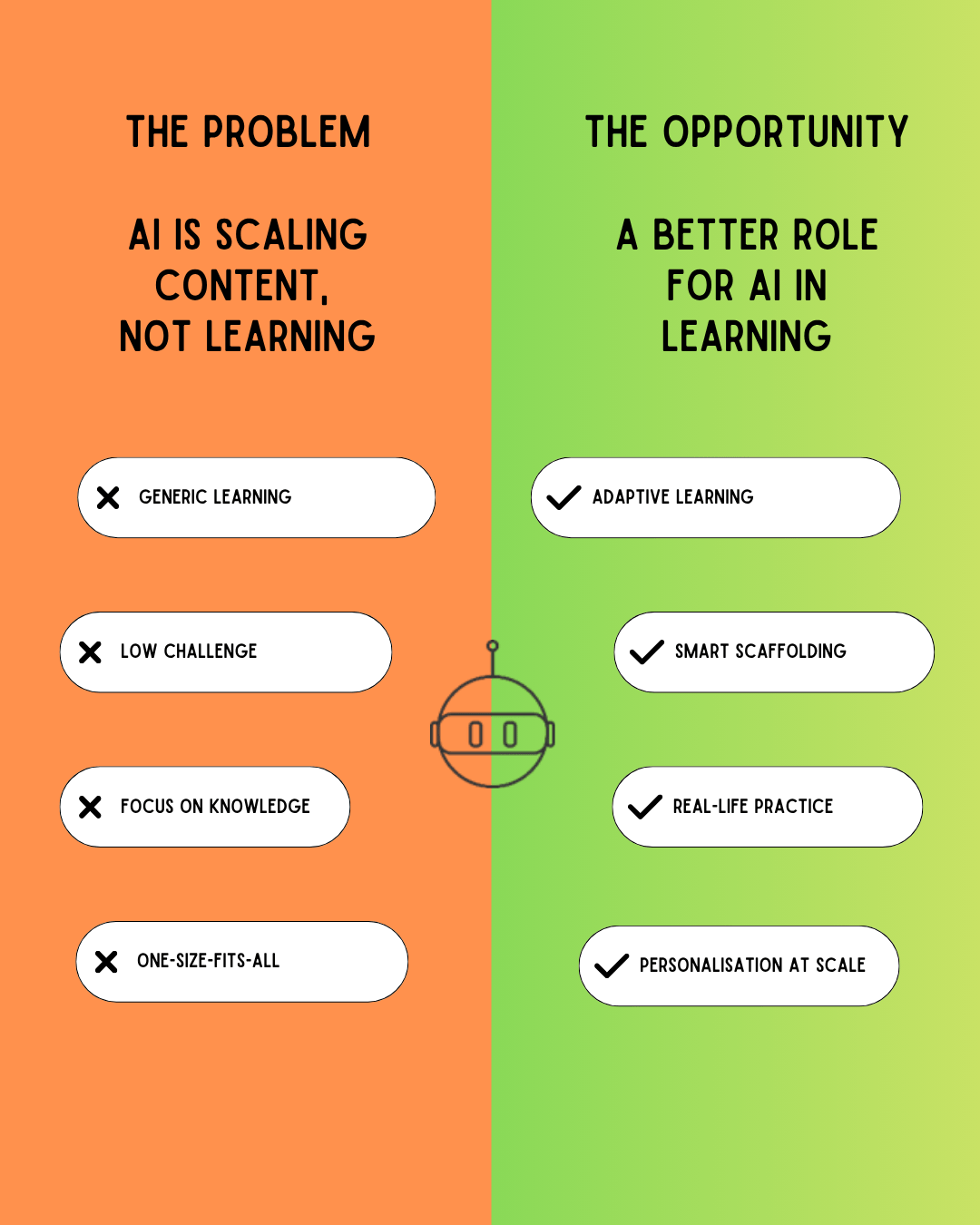
Image by Human Asset
The Problem: AI Is Often Scaling Content, Not Learning
Many organisations have already started using AI in corporate training. However, most are using it in a very similar way. They use it to generate content faster.
The result is often:
- More slides
- More modules
- More quizzes
- More learning assets in less time
At first glance, this sounds positive. Teams can produce more learning material and respond quickly to business needs. But quantity is not the same as quality, and speed is not the same as impact.
When AI is used mainly to generate content, several risks begin to emerge.
1. Learning Becomes Generic
AI-generated content can easily become repetitive, broad, and disconnected from the learner's real context. The same type of material gets reused across different roles, teams, and business situations, often without meaningful adaptation.
2. Learners Are Not Challenged Enough, And Critical Thinking May Weaken
When learning is designed for speed rather than depth, it can become too easy. Learners may skim content, complete predictable quizzes, and move on without truly developing the skill. At the same time, instant AI answers and ready-made responses can encourage cognitive offloading and overreliance on AI.
3. AI-Generated Knowledge Content Keeps The Focus On Information, Not Skills
When AI is used mainly to generate theory, summaries, or explanations, learning often remains focused on knowledge delivery rather than skill development. Learners may receive more information, but not enough opportunities to practise, apply judgement, or build real capability in realistic situations.
4. One-Size-Fits-All Learning Remains Unchanged
Even though AI is involved, many learning experiences remain static. Everyone sees the same content, follows the same path, and answers the same questions. This is not true personalisation. It is simply faster production of the same old model.
For all these reasons, organisations need to pause and ask a more strategic question. Are we using AI to scale better learning, or simply to scale more content?
The Opportunity: A Better Role For AI In Workplace Learning
Despite these risks, the opportunity is enormous. AI can help with the following.
1. Adaptive Learning That Responds To Progress
AI can also support adaptive learning, where the experience changes dynamically based on the learner's responses. This means the learner is neither bored by content that is too easy nor overwhelmed by content that is too difficult.
Adaptive learning makes it possible to challenge learners at the right level and support progression over time.
2. Scaffolding That Strengthens Development
Effective learning often requires support at the right moment. AI can help provide that support through scaffolding, guiding learners when needed and reducing assistance as they become more capable.
This mirrors a strong pedagogical principle: support should help the learner grow, not replace the learner's effort.
3. Real-Life Practice With Real-Time Open-Ended Feedback, Not Just Content Consumption
Perhaps the biggest opportunity lies in practice-based learning.
Real skills are developed through action, reflection, feedback, and repetition. AI can make this far more scalable by enabling interactive practice, simulations, scenarios, and intelligent feedback.
That is where workplace learning starts to become truly meaningful.
4. Personalisation At Scale
Not all learners start from the same point. They have different backgrounds, different needs, different roles, and different levels of confidence. AI can help create learning experiences that take these differences into account.
Instead of delivering the same material to everyone, AI can support more personalised pathways based on role, competency level, learner behaviour, or performance.
From Content To Capability Building
For many years, workplace learning has been dominated by a content-delivery model. Courses were designed to transfer knowledge efficiently. Information came first. Practice, if it existed at all, came later.
But modern organisations increasingly need more than knowledge transfer. They need people who can apply judgement, communicate effectively, handle complexity, and perform in real situations. That requires a shift from content to capability.
This is exactly where AI can help. Here are a few examples of what that can look like in practice.
1. Adaptive Quizzes That Become Part Of Learning
Traditional quizzes usually treat all learners the same. Everyone gets the same questions, regardless of performance.
With adaptive quizzes, the experience becomes more intelligent. The system can:
- Adjust question difficulty based on learner responses
- Reinforce weaker areas automatically
- Use grading rubrics for more meaningful evaluation
- Provide immediate and targeted feedback
This turns assessment into a learning mechanism, not just a checkpoint.
2. Open-Ended Scenarios With Coaching Personas
One of the biggest limitations of traditional eLearning is that it often reduces complex decisions to multiple-choice answers. AI makes it possible to move beyond that.
In open-ended scenarios, learners respond in their own words. They engage with realistic situations, explain their reasoning, and receive structured open-ended feedback. This is especially valuable for interpersonal and professional skills such as leadership, feedback, interviewing, customer communication, sales, and coaching.
The feedback itself can also take different forms through coaching personas. For example:
- A Socratic persona can challenge assumptions through questions
- A supportive coach can encourage reflection
- A performance-oriented coach can focus on clarity, structure, and outcome
This makes learning more demanding, but also more developmental.
3. Real-Time Voice-To-Voice Simulation Practice
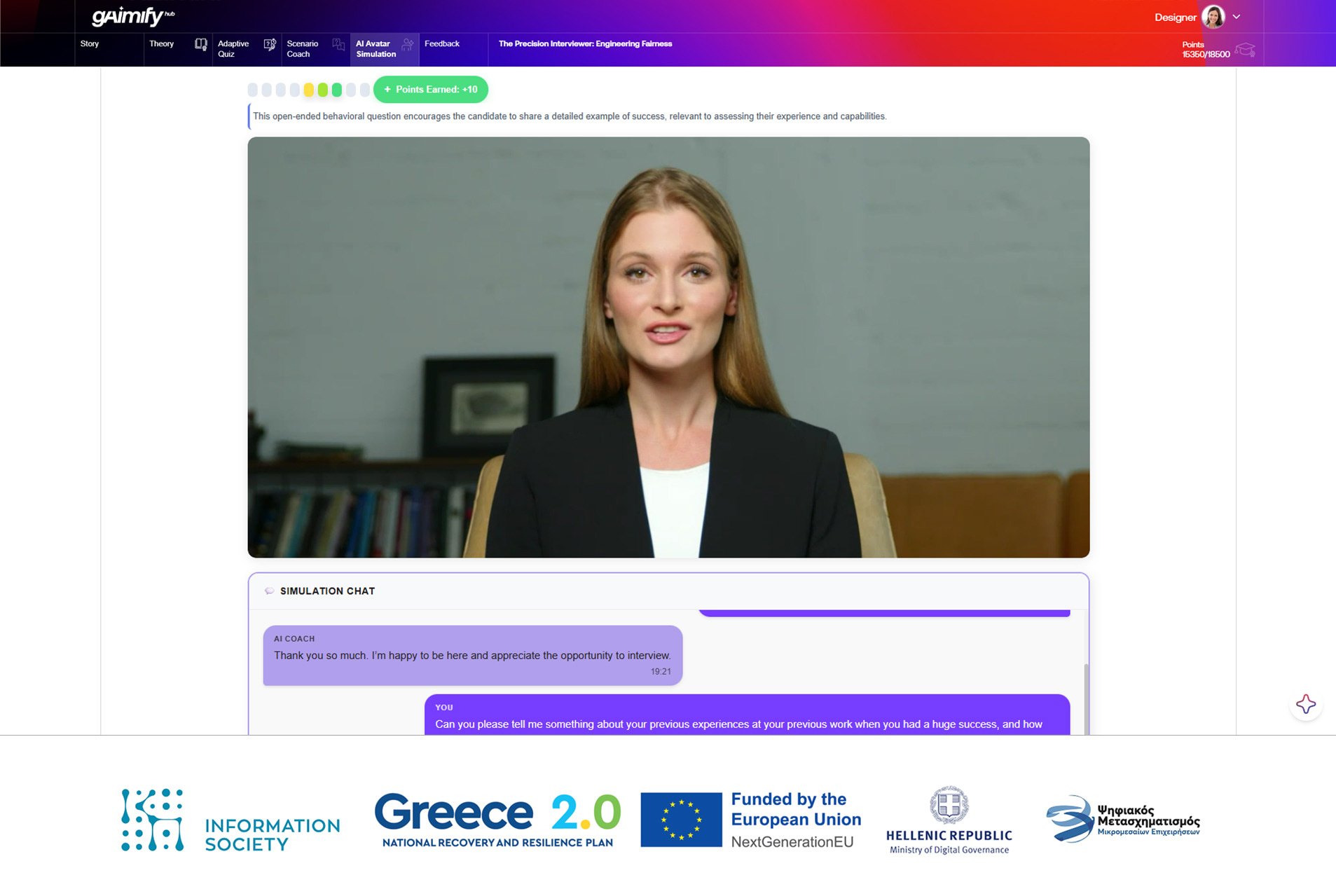
Image by Human Asset
One of the most powerful emerging applications is voice-based simulation with AI avatars.
Learners can practise conversations in real time, using natural speech. They can rehearse challenging workplace situations such as:
- Onboarding
- Interviewing a candidate
- Giving difficult feedback
- Handling a customer complaint
- Coaching a team member
These simulations create a safe environment for practice while still feeling realistic and demanding. Learners can improve communication, decision-making, tone, and confidence through repetition and qualitative real-time feedback.
This is a major step forward from passive digital learning.
4. Knowledge Mentor Support In The Flow Of Learning
Instead of leaving learners alone with static content, AI can provide an intelligent support layer through a Knowledge Mentor or assistant chatbot, even within SCORM packages with inSCORM AI technology.
This can help learners:
- Ask questions in real time
- Clarify difficult concepts
- Get examples or explanations
- Return to relevant sections of theory when needed
This kind of support can improve understanding without interrupting the flow of learning.
5. Customised Learning Journeys Built Around Organisational And Role Needs
One of the most important opportunities AI creates is the ability to design learning experiences that are far more relevant to the organisation and the learner.
AI can help shape a course around:
- The organisation's industry and context
- Its vision, mission, and values
- The target role and competency requirements
- The real challenges learners face in their day-to-day work
At the same time, this customisation can be combined with storytelling and gamification to create a more engaging and motivating experience. Rather than moving through disconnected screens of theory, learners can progress through a story-driven journey that gives context and purpose to the learning.
Human-Centred AI Must Remain Central
As AI becomes more integrated into workplace learning, one principle becomes critical: human-centred design.
AI should help make learning more relevant, more responsive, and more effective. That means:
- AI should support thinking, not replace it
- AI should guide effort, not eliminate challenge
- AI should enhance design, not remove human responsibility
This is why human-in-the-loop approaches are so important.
In a strong AI-enabled learning ecosystem, humans still review, refine, and approve what matters. They ensure alignment with the organisation's goals, the learner's context, and sound pedagogical practice.
Towards More Meaningful Learning Experiences
The future of AI in workplace learning is not about producing more content. It is about creating better learning experiences. Experiences that are:
- Personalised to the learner
- Adaptive to performance and progress
- Grounded in realistic practice
- Supported by intelligent feedback
- Designed to build capability, not just complete modules
This is the direction that many organisations are now beginning to explore. It is also the philosophy behind platforms such as gAImify Hub.
Conclusion
AI is already reshaping workplace learning. The question is not whether it will play a role. The question is what kind of role it will play.
We can use AI to generate more content, faster than ever before. Or we can use AI to create more impactful learning experiences through personalisation, adaptive learning, and real-life practice. The difference is profound.
Because the real goal of learning is not information delivery. It is capability development. And that requires more than speed. It requires thoughtful design, meaningful challenge, intelligent support, and a strong human-centred philosophy.
For organisations that want to move in that direction, AI should not simply make learning content production easier. It should help make learning better.
For more information on this approach, see here.