



 ChatGPT
 Perplexity
 Claude
 Grok
Compliance Training: One Rule, Many Machines
A conveyor jams ten minutes before the end of a shift. Clearing it by hand takes thirty seconds; locking it out takes ten minutes. Everyone on the line did their lockout training this year, and everyone knows which choice is faster.
Swap the conveyor for an infusion pump, a loan application or a deep fryer, and you'll recognize the problem. One rule covers dozens of machines, sites or products, each a little different and each changing whenever the operation does. And someone, usually a compliance or operations manager, has to track who was trained on which version, every year.
Most compliance training covers the rule and leaves the rest to a binder. Turning policy documents into compliance training that lasts means planning for the differences and the changes from the start.
The Rule Is Shared. Your Machines Aren't.
Take, for example, OSHA's Control of Hazardous Energy standard, better known as lockout/tagout. It covers the millions of US workers who service machines, it's third on OSHA's list of most-cited standards [1], and it's about 4,500 words of legal text.
The standard lists what every lockout procedure must cover, from shutdown to verifying the energy is off, but it can't tell you which valve to close on a specific machine, say press 4 in your plant. So it requires you to write procedures for your own machines, and each procedure changes when a machine is replaced, moved or modified.
Every industry has this split. A hospital has one infection control policy and a different setup on every unit. A bank has one anti-money-laundering policy and different checks for every product. Generic training covers the shared rule, but incidents happen in the local details.
Here's where each of the usual options breaks:
- Buy an off-the-shelf course: you get the standard, often under $50 a seat, but it has never seen your machines.
- Build it in an authoring tool: you get your own procedures, but every equipment change is a rebuild.
- Build it yourself with an AI coding tool: you get exactly what you want, once, but every change is a new coding session.
- Toolbox talks and sign-in sheets: you get proof people attended, but no sign of what they understood.
AI has made the custom options cheaper to start. It hasn't made them easier to keep current.

How Do You Turn Policy Documents Into Compliance Training?
Build one core course from the shared rule, and a short module for each machine, site or product from its own procedure. Turn each rule into a scenario with a tempting wrong answer, and test decisions instead of recall. Keep every module linked to the document it came from, so a change updates one module and retrains only the people it affects.
1. Split The Shared Rule From The Local Procedure
Build the core once, from the standard: the six steps of every lockout (prepare, shut down, isolate, apply locks, release stored energy, verify) and the rules for whose lock comes off when. Keep machine details out of the core, or every machine change touches it.
Then build a short module for each machine from its own procedure: its energy sources, where to isolate each one, and how to check it's dead. Ten minutes on press 4 will teach your technicians more than an hour on lockout in general.
The standard also splits your audience into three groups:
- Authorized employees perform lockouts and need the full procedure.
- Affected employees run the machine and need to know the procedure’s purpose and use.
- Everyone else nearby needs to know never to restart locked equipment.
2. Generate Each Module From Its Own Procedure
Whatever you draft with (ChatGPT, an authoring tool, or a tool that turns documents into courses like Claro), give each module only its own procedure and ask for every statement to point back to a line in it. When an AI fills a gap with general best practice, a step from one machine ends up on another.
My co-founder Einav Itamar, who led the Voice ML group at Snap, puts it simply: a model fills gaps with what's typical, and a policy matters most where it isn't typical.
Practical tip: before you generate anything, add a photo of each isolation point to the procedure. The module can only show what the procedure contains.
3. Turn Each Rule Into A Scenario With A Tempting Wrong Answer
Back to the jam. The operator can reach in while the belt is stopped, hit the emergency stop first, or lock out the conveyor.
The emergency stop is the tempting wrong answer, because it feels safe. But the standard says push buttons and selector switches don't isolate energy, and anyone can reset a stop button. Whether this jam can be cleared without a full lockout depends on the conveyor's procedure, since the standard exempts minor servicing only when it's routine, repetitive and integral to production, with other effective protection. A good scenario makes your learner check that procedure, then shows what follows each choice.
4. Sync What Learners See With What They Hear
At Symbolab, where I spent years building step-by-step explanations for more than 400 million learners, I learned that the answer doesn't teach; the steps do. Researchers call this the worked-example effect [2]. In lockout, the steps are physical. When the narrator says "close the hydraulic supply valve," that valve should light up on screen at that moment. In Claro, the visuals are timed to the narration.
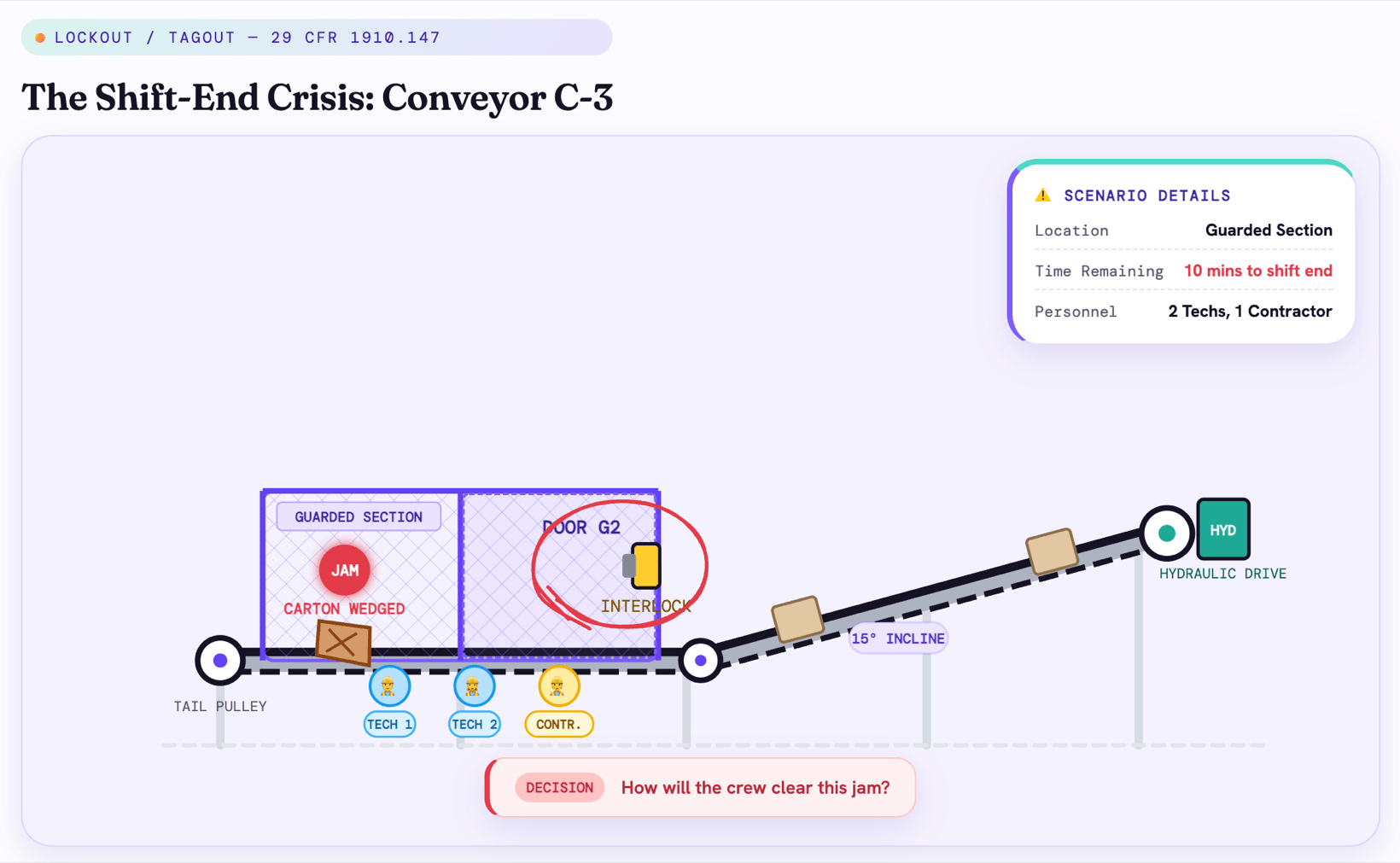
The jam scenario from the lockout lesson, built in Claro.
5. Assess Decisions, Not Recall
"Which paragraph covers group lockout?" tests whether someone remembers the document. "Two maintenance techs and a contractor are working on the same press. Whose locks go on, and who takes them off?" tests what they'll actually do. Set the pass mark on scenarios: mastery, not completion.
Keep Compliance Training Current When Operations Change
The standard lists when training goes stale. You need to retrain when:
- Someone's job assignment changes
- Equipment or processes change in a way that adds a hazard
- A procedure changes
- An inspection finds people not following it
That only works if every module knows where it came from. When press 4 gets a new hydraulic unit, update its procedure, regenerate its module, have the procedure's owner check it, and assign it only to the people who work on press 4. In Claro, you can regenerate one lesson without touching the rest of the course, so one changed machine means one lesson to review.
Manage Training As A Yearly Cycle
At least once a year, you inspect each procedure in use and review each authorized employee's responsibilities with them. You also have to certify that training "has been accomplished and is being kept up to date," with names and dates.
Work with that cycle:
- Before the inspection, assign each person the modules for the machines they work on.
- Where the inspection finds a skipped step, retrain that crew on that machine, not the whole plant.
- Make the scenario most people got wrong next year's focus.
- Keep records by version: who passed which module, built from which revision of the procedure.
A completion record proves someone finished, not what they'd do at the conveyor. Claro courses export to SCORM and xAPI, so your LMS receives each scenario answer, and whether it was right, along with the completion.
What Still Needs A Human
AI drafts well but slips in the details. When we tested this on a real policy, the draft quoted a clause the policy doesn't contain. In lockout, check:
- Conditions. Drop one condition from the minor servicing exemption and the course allows what the standard forbids.
- Vague words. If someone's lock must come off while they're away, the employer must make "all reasonable efforts" to tell them. A course that says "call twice" is inventing policy.
- Scope. Contractors bring their own lockout procedures, which both employers must share, and about half the states run their own OSHA-approved plans.
Have each procedure's owner play its scenarios and confirm the "right" answer is right for that machine.
What A Course Can't Replace
No course replaces hands-on practice. OSHA has said online training alone doesn't meet its requirements [3], so a supervisor still needs to watch each person lock out the real machine.
What Happens At The Next Jam
A sign-in sheet can't tell you what someone will do at the next jam. A scenario they've already practiced gives you a much better chance. I built a short lockout course from the OSHA standard and a procedure for a fictional conveyor, so you can try the jam yourself.
References:
[1] Top 10 Most Frequently Cited Standards
[2] Learning from examples: Instructional principles from the worked examples research
[3] Electronic worker training records