


 ChatGPT
 Perplexity
 Claude
 Grok
Why Employee Learning Is Moving Beyond The Screen
An internal company podcast offers organizations a new way to deliver employee learning without making people attend another meeting, webinar, or online course. As work spreads across different systems, devices, and locations, L&D teams need learning formats that fit more easily into the workday. Audio can help fill these gaps. Employees can listen to expert talks, onboarding content, leadership insights, product updates, and short learning episodes while commuting, traveling, or doing tasks that do not need their full attention.
However, starting a podcast just because it is popular probably will not lead to real learning. It is more helpful to ask whether audio can better solve a specific knowledge, access, or performance problem than a course, document, meeting, or video.
What Is An Internal Company Podcast?
An internal company podcast is a private audio program made for employees or a select group within an organization. While public podcasts aim to reach customers or boost brand awareness, internal podcasts focus on sharing content with people inside the company.

This difference is important because internal podcasts often share information that isn't meant for the public. Episodes might cover leadership talks, updates on operations, interviews with experts, product details, training, customer feedback, or lessons from company projects.
Companies have a few options for sharing private podcasts with employees. Depending on the tools they use, employees might listen through private RSS feeds, secure podcast platforms, mobile apps, the company intranet, or links in an LMS or employee portal.
The format of internal podcasts can vary widely. Some companies create polished interview series, while others prefer short five-minute learning sessions or casual chats with experienced team members.
Internal Company Podcast Vs. Corporate Podcast Vs. Public Podcast
An internal company podcast differs from a broader corporate podcast in its audience, how people access it, and what it's for. Sometimes people use the term "corporate podcast" to refer to any business podcast, which can be confusing.
An internal corporate podcast is usually just for employees and focuses on a specific business need inside the company. In contrast, a public corporate podcast might be made for customers, potential clients, partners, or people in the industry.
Podcast Type |
Primary Audience |
Access |
Typical Purpose |
Internal company podcast |
Employees | Private | Learning, communication, enablement |
Internal corporate podcast |
Employees | Private | Organizational updates, knowledge sharing |
Public corporate podcast |
External audience | Public | Thought leadership, marketing, brand awareness |
Employee podcast |
Employees | Usually private | Engagement, development, workplace stories |
Public learning podcast |
General audience | Public | Education and audience building |
Why Internal Podcasts Are Becoming Relevant To L&D
An internal company podcast is helpful for L&D when audio can solve a learning or knowledge-sharing problem better than a digital course, document, or meeting.
Break From Screens
Employees already spend much of their day switching between email, collaboration tools, meetings, dashboards, LMS platforms, and other digital tools. Adding another screen-based activity isn't always the best way to help people learn.
Flexibility
Podcast-based learning offers more flexibility. For example, a manager can listen to a leadership talk while commuting. A salesperson might hear a product update before meeting a customer. A new hire could listen to interviews with company leaders during their first weeks.
Sharing Knowledge
Audio is also great for sharing knowledge that's hard to put into writing. Experienced employees often have valuable insights, like how they make tough decisions, what they've learned from mistakes, why certain processes exist, or how they handle unusual situations. A podcast lets these experts explain their thinking in detail, rather than just reducing their knowledge to bullet points.
Helpful For Consistent Learning
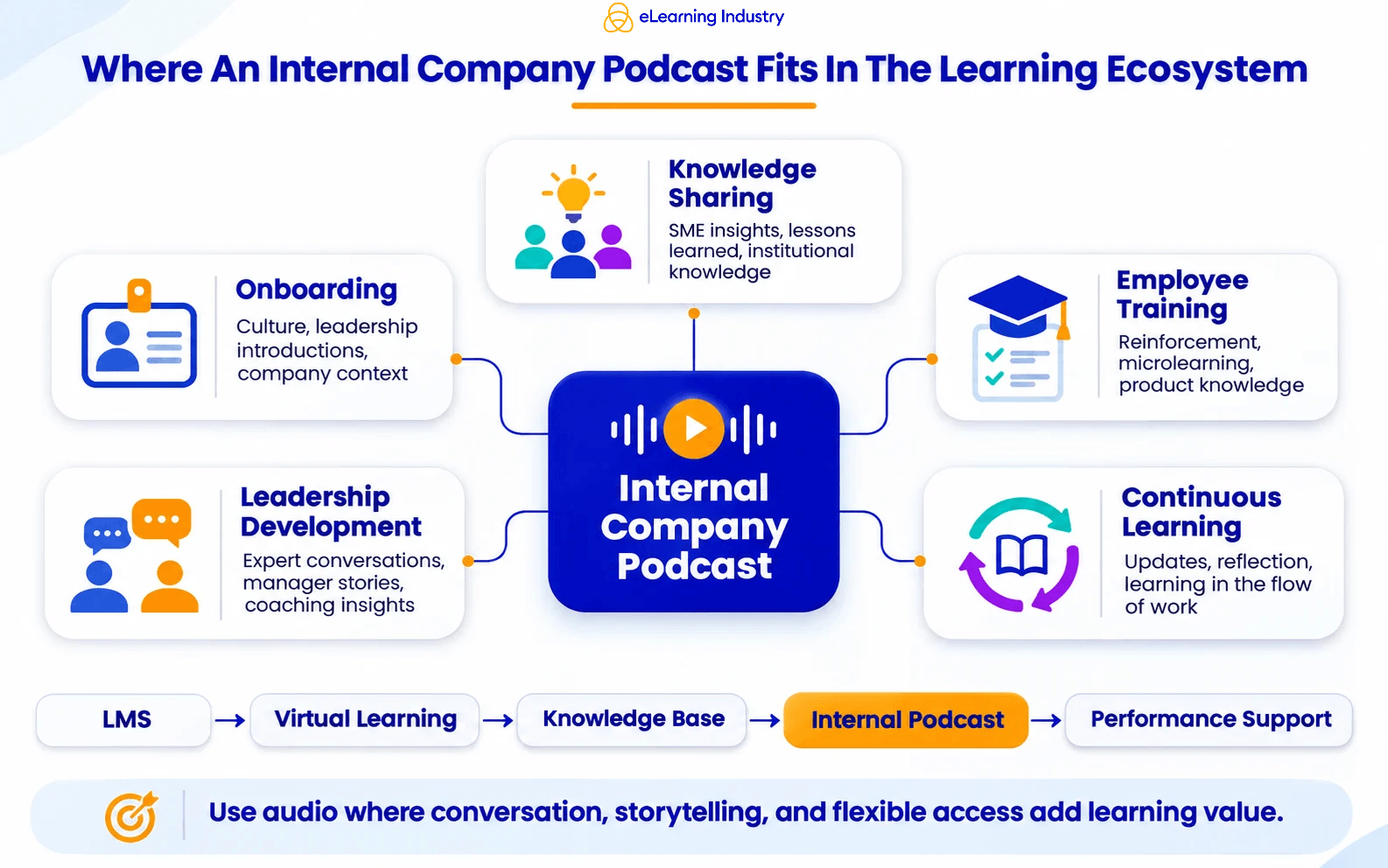
For distributed, remote, or frontline teams, podcasts can offer another entry point to the organization's learning system. Still, podcasts should work alongside existing learning tools, not automatically replace them. An LMS, a knowledge base, a virtual classroom, and a podcast each have their own strengths.
7 L&D Use Cases For An Internal Company Podcast
An internal company podcast is most effective when L&D uses audio in situations where explanation, storytelling, conversation, or easy access truly help.
1. Employee Onboarding
An internal company podcast can help new employees learn about the organization in ways that go beyond onboarding slides and policy documents. Episodes could cover company history, customer needs, different departments, leadership priorities, workplace culture, or why certain processes exist. This can make onboarding feel more relevant and personal.
2. Employee Training And Microlearning
By offering short, focused episodes that build on what employees already know, you can help your staffers grow. Training podcasts might include product knowledge, customer scenarios, communication tips, compliance reminders, leadership skills, or process updates. But audio shouldn't replace formal instruction. It works best for reinforcing learning, giving explanations, sharing examples, and encouraging reflection.
3. Leadership Development
A podcast can help everyone in the organization access leadership knowledge. L&D teams can interview experienced managers, executives, coaches, or outside experts about tough conversations, decision-making, team performance, change, and other leadership topics. Rather than sharing these insights in a single workshop, the organization builds a resource that people can use again and again.
4. Subject Matter Expert Knowledge Transfer
Organizations can save valuable expertise before it's lost. This is especially helpful when experienced specialists are about to retire, change roles, or have knowledge that hasn't been written down. Interviews can cover not only what experts do, but also how they think, mistakes they've seen, and what new employees should know.
5. Change Management
An internal company podcast can help with change by giving leaders and project teams a way to explain what's changing, why it matters, and what employees need to do differently. Audio can also make change communication feel more like a conversation. Instead of just sending another announcement, organizations can answer employees' questions, discuss challenges, and explain the reasons behind decisions.
6. Sales And Product Enablement
Keep sales and customer-facing teams up to date without requiring many live meetings. Episodes could share product updates, common customer objections, sales stories, competitive insights, or interviews with product specialists. Since employees can listen whenever they want, this format is especially helpful for teams that travel a lot.
7. Continuous Learning And Learning Culture
Use podcasts to build a regular habit of learning. Rather than seeing development as something that only happens in formal training, organizations can use regular sessions to keep ideas, reflection, and knowledge sharing going throughout the year. Over time, the podcast can become part of a bigger culture in which employees hear from colleagues, learn from internal experts, and discover new perspectives.
When A Private Podcast For Employees Is—and Is Not—The Right Learning Format
Choose an internal company podcast when it helps meet your learning goals, not just because employees like listening to podcasts. Audio works especially well when employees need to hear:
- Expert perspectives
- Stories and examples
- Leadership discussions
- Context behind decisions
- Short explanations
- Learning reinforcement
- Interviews and conversations
- Updates that do not require visual demonstration
A private podcast is not the best choice if employees need to follow complex steps, look at detailed visuals, use software, practice a simulation, or show their skills. For instance, a podcast episode can explain why a cybersecurity process is important, but employees might still need a visual guide to learn how to do the task. In the same way, a podcast can introduce a leadership model, but employees may still need practice, coaching, reflection, and feedback to change their behavior.
This difference matters because listening is something you do, but learning is what you achieve.
So, audio should be just one part of your learning plan, not the whole plan.
How To Create An Internal Company Podcast For Learning
Before picking microphones, software, hosts, or episode formats, start your internal company podcast by identifying a clear business or learning problem.
Step 1: Define The Learning Or Performance Need
Begin by asking what needs to change.
- What do employees need to know, understand, or do differently?
- Why isn't the current approach enough?
- Could audio help with access, understanding, reinforcement, or sharing knowledge?
If you can't answer these questions clearly, the podcast might just be a content idea, not a real learning solution.
Step 2: Identify The Audience
Employees have different listening situations and needs.
- Podcasts for new hires might need structured onboarding episodes.
- Frontline teams may prefer short, mobile-friendly updates.
- Managers could get more from in-depth discussions about real workplace situations.
Knowing your audience makes it much easier to decide on tone, format, length, and how to share the podcast.
Step 3: Choose The Right Format
Internal podcasts don't all have to sound the same. You can use formats like:
- Subject Matter Expert interviews
- Leadership Q&As
- Short learning briefings
- Scenario-based episodes
- Coaching conversations
- Panel discussions
- Narrative stories
- Employee interviews
Pick the format that best fits what employees need to learn, not just what sounds like a typical public podcast.
Step 4: Determine Episode Length And Cadence
There's no single ideal length for a podcast episode. A five-minute episode might be perfect for a product update or quick reminder. A 20-minute expert discussion could work better for topics that need more detail. The same goes for how often you publish. Consistency is important, but don't create content just to stick to a weekly schedule.
Step 5: Build Learning Around The Episode
Podcast episodes are more effective when they connect to other parts of the learning experience. For example, an episode might be paired with:
- A job aid
- A checklist
- A reflection prompt
- A team discussion
- An LMS activity
- A knowledge check
- A practical assignment
This way, the audio becomes part of a bigger learning journey, not just a stand-alone piece of content.
Step 6: Run A Pilot
Before rolling out a company-wide program, test your idea with a specific audience and use case. A small pilot helps L&D see whether employees listen, whether the format fits their work, and whether the content adds real value. It's much easier to improve a six-episode pilot than to redo an expensive company-wide program after it's launched.
Listen and learn.
Tune in to our podcasts for practical insights, inspiring conversations, and ideas you can put to work.
Choosing Private Podcast Hosting For Companies
A company podcast with information meant only for employees needs different hosting and access controls than a public podcast on open platforms. This means choosing a private podcast host is both a technology and a governance decision for companies. L&D leaders might need to work with IT, information security, HR, legal, and procurement teams, depending on how sensitive the content is and the company's setup. Key features to look for include:
- User authentication
- Single sign-on
- Role-based access
- Individual employee access management
- Private RSS feeds
- Easy removal of former employees
- Data privacy and security controls
- Mobile access
- Analytics
- Transcripts
- Accessibility features
- LMS or intranet integration
- Multilingual capabilities
- Content approval workflows
Usability is important too. If employees have to go through a complicated setup each time they want to listen, they're less likely to use the podcast. But making access simple shouldn't come at the cost of security. The goal is to find a platform that allows authorized employees to reach content easily while giving the organization sufficient control over who can access sensitive information.
How To Design An Employee Podcast For Learning, Not Just Listening
A company podcast helps employees learn when each episode is planned with clear goals about what people should understand, remember, or use in their work.
- Start by focusing each episode. Rather than covering too many topics at once, pick one main learning goal for each episode.
- Use conversation when it helps. Podcasts work best when experts talk about real situations, explain their choices, share mistakes, or tell stories that make complex ideas easier to grasp.
- Make each episode easy to follow. Let employees know the topic, why it matters, and what to listen for. At the end, sum up the main point and, if it fits, suggest an action they can take.
- This could mean trying out a new technique, discussing the idea with a manager, checking a list, doing another learning activity, or considering how the topic fits their job.
- Employee podcasts should be easy to access. Providing transcripts helps people who like to read, need to find specific details, work in environments where listening is hard, or need different formats.
In the end, good learning design does not start with the question, "What should we record?" It starts with the question, "What should employees be able to do differently after this experience?"
Have Something Worth Sharing? Join Our Podcasts!
Have insights, experiences, or fresh perspectives on L&D, EdTech, or leadership? We'd love to hear from you! Become a guest on eLearning Industry Podcasts, share your expertise with a global audience, and connect with professionals who care about the future of learning.
Conclusion
An internal company podcast can support employee learning through conversations, stories, knowledge sharing, onboarding, leadership development, and screen-free reinforcement. It can also preserve expertise that might otherwise remain within teams or with experienced employees. Audio isn't right for every goal, though; some skills require practice, visuals, assessment, coaching, or hands-on experience. So, instead of asking if podcasts should replace current learning formats, L&D leaders should look for places where audio offers something unique. With clear audiences, goals, technology, security, and success measures, an internal podcast can strengthen your learning program.