
 ChatGPT
 Perplexity
 Claude
 Grok
Grok
What Is Procedural Knowledge?
Procedural knowledge means being able to perform tasks and use skills effectively in real-life situations. Simply put, it is about "knowing how" to do something, not just knowing facts. When people ask, "What is procedural knowledge?", the answer is found in the steps and actions taken to complete a process, solve a problem, or do a task the right way.
In cognitive science, procedural knowledge is closely linked to developing skills and building long-term memory. People usually gain this kind of knowledge through practice, repetition, and experience. With time, many tasks become automatic and need little conscious thought. For example, an experienced trainer leading a workshop or an Instructional Designer creating a learning module might do many steps without having to think about each one.
Procedural knowledge also covers the methods, techniques, and steps people use to reach certain goals. That is why these skills are so important in the workplace, where employees need to use what they know every day. As people gain experience, they build a better understanding of these processes, which helps them adapt and work more efficiently.
Unlike explicit knowledge, which focuses on facts and information that can be easily explained, procedural knowledge is about doing and taking action. It is important to understand this difference because being successful at work means both knowing what to do and knowing how to do it well.
Procedural knowledge is important at work because it deals with how people get things done, not just what they know. To see why this matters for Learning and Development, it helps to compare it with declarative knowledge, which is another key type used in training.
Declarative Knowledge Vs. Procedural Knowledge
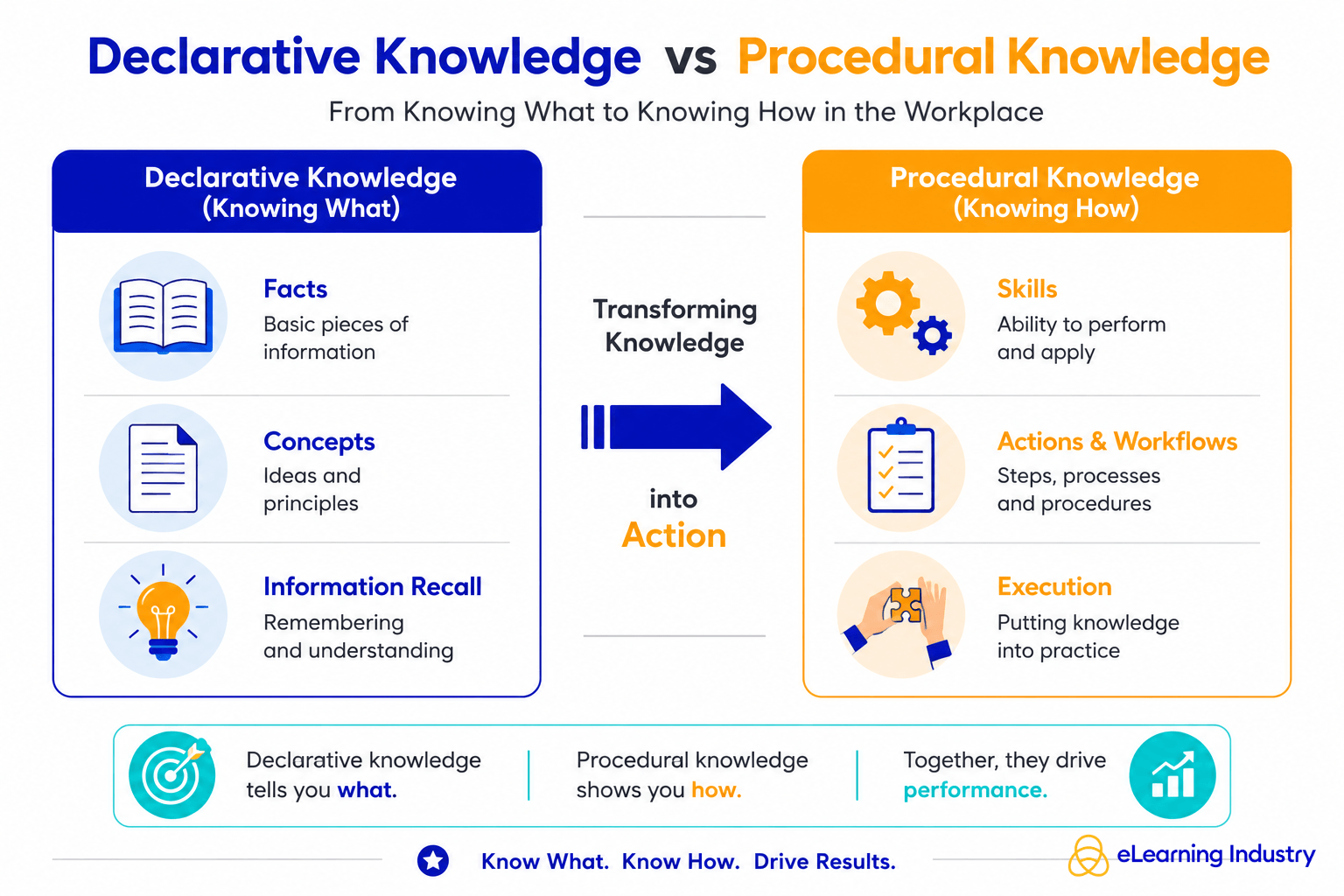
The declarative knowledge definition refers to knowledge of facts, concepts, rules, and information. Simply put, it is "knowing what." For instance, an employee might know the company's compliance policies, product features, or customer service standards. This kind of knowledge can usually be explained, written down, or recalled when needed.
Procedural knowledge, on the other hand, is about "knowing how" to do something. Examples include running a performance review, using software, solving a customer problem, or following a safety rule.
Differences Between Declarative And Procedural Knowledge
The main difference between declarative and procedural knowledge is how they are used. Declarative knowledge is about information and understanding, while procedural knowledge is about taking action and getting things done. This difference also shows up in how we remember things. Declarative knowledge uses explicit memory, so people can recall and explain it. Procedural knowledge depends more on implicit memory, which lets people do tasks automatically after enough practice.
The ways people learn this type of knowledge are different, too. Declarative learning usually means reading, watching, listening, or studying ideas. Procedural learning needs practice, repetition, feedback, simulations, and real-world use. Because of this, the ways we test them are also different. Declarative knowledge is often checked with quizzes, tests, or knowledge checks. Procedural knowledge is better measured through demonstrations, simulations, observations, or performance-based tests.
Importance Of The Two Types Of Knowledge
Talking about procedural and declarative knowledge matters a lot for Instructional Designers, since both are needed for good workplace learning. Employees need to understand ideas and information before they can use them on the job. In short, both types of knowledge help people become skilled and perform well.
The link between procedural and declarative learning is also increasingly important in technology and Artificial Intelligence. In AI, people often talk about the difference between systems that store facts and those that execute processes or follow rules. This is similar to how people learn and work. For organizations, knowing the difference helps them design learning that goes beyond mere memorization and leads to real results at work.
Procedural Learning And How It Works
Procedural knowledge grows through procedural learning, meaning the process by which people learn how to perform tasks and use skills in real-life situations. Declarative knowledge is about knowing facts or concepts, while procedural learning is about knowing how to do things. Simply put, procedural learning means gaining skills and processes through practice and experience.
One way to see the difference between declarative and procedural learning is to compare reading instructions with actually doing a task. For example, an employee might know the steps for onboarding a customer (declarative knowledge), but procedural learning helps them carry out those steps during real customer interactions. This difference shows why understanding both types of knowledge matters in workplace learning.
A typical procedural learning example is when employees are trained to use new software. At first, they carefully follow instructions and think about each step. With practice, though, they start to perform the tasks automatically, without much thought. This shift to automatic action is called automaticity and is a key sign of procedural learning.
Building procedural skills relies on repetition, practice, and feedback. Practicing helps people improve, and feedback lets them fix mistakes and get better. Over time, employees become more efficient, accurate, and confident in their work. This approach helps people build skills that last and leads to more consistent performance across teams. Instead of just remembering steps, learners develop habits they can use in real work situations.
One key result of procedural learning is the development of procedural thinking, which means adopting a mindset focused on following steps, working systematically, and achieving steady results. For Instructional Designers, encouraging this way of thinking is important because workplace success depends not just on what employees know, but also on how well they use that knowledge.
Examples Of Procedural Knowledge In The Workplace
Procedural knowledge helps employees do their jobs correctly and efficiently in real work situations. While declarative knowledge is about what someone knows, procedural knowledge is about how they use that knowledge to get things done. In the workplace, people usually build this kind of knowledge through practice, repetition, and hands-on experience.
Sales Team Example
Common procedural knowledge examples can be found across nearly every business function. For instance, sales teams follow software usage workflows when updating customer records in a CRM system. Learning and Development teams follow set procedures in their LMS to create, assign, and track training. Employees also use procedural knowledge when they report workplace incidents or handle sensitive data according to company rules.
Customer Onboarding Example
Customer onboarding is another example of how procedural learning is important. For example, a customer success representative might need to schedule a kickoff meeting, set up the account, provide training, and then do follow-up reviews in a certain order. In the same way, troubleshooting steps require employees to find problems, try solutions, and record what happens, all in a set sequence.
Procedural Knowledge In Education And Training Design
Procedural knowledge is important in education and training design because it helps learners use what they know in real situations. Declarative knowledge covers facts and concepts, but procedural knowledge is what teaches people how to perform tasks and follow steps well. In the workplace, it is not enough to know what to do; employees also need to know how to do it correctly and reliably.
How To Support Procedural Knowledge
Instructional Designers teach procedural learning by guiding learners through a clear process. Usually, this starts with helping learners understand important concepts, rules, or steps. Good training uses support and practice to move from knowing facts to performing tasks. This step-by-step approach helps learners feel more confident and less overwhelmed. There are different ways to support procedural learning:
- Simulations let learners practice tasks in safe, realistic settings.
- Scenario-based learning puts learners in real-life situations where they need to make choices and use procedures.
- Microlearning breaks down complex tasks into smaller lessons, making them easier to remember and use. Guided practice gives learners step-by-step help before they try tasks on their own.
- Repetition and reinforcement also matter. People build procedural skills by practicing, getting feedback, and making corrections. With practice, actions become automatic, which improves understanding and performance. Research shows that doing something many times helps turn effort into smooth, efficient action.
Today, many companies use digital learning platforms, support tools, and adaptive experiences to help employees learn procedures. These tools make it easier to practice and remember important processes. Instructional Designers need to understand procedural knowledge to create training that helps people move from knowing to doing. In the end, good training turns information into action and helps employees use what they learn at work.
In modern workplace learning, knowledge only becomes valuable when it is transformed into consistent action. Procedural knowledge is what turns understanding into performance, and performance into business impact.
-Christopher Pappas, CEO and founder of eLearning Industry
Procedural Vs. Declarative Knowledge In AI And Modern Systems
Procedural knowledge is gaining importance in AI and modern learning systems because it concerns how tasks are performed, not just what information is known. Declarative knowledge covers facts and concepts, while procedural knowledge includes the steps and actions needed to complete a task. You can see this difference in AI as well. Declarative knowledge is stored in databases and knowledge graphs that answer questions about what something is. On the other hand, procedural knowledge helps AI follow logic, run workflows, automate tasks, and make decisions. Simply put, declarative systems know facts, while procedural systems know what to do with those facts.
The relationship mirrors human learning models. Employees typically begin with declarative learning, acquiring facts and concepts before progressing to procedural learning, where they apply knowledge through practice. Over time, this develops into consistent performance and stronger procedural skills.
For L&D leaders, understanding the distinction between declarative and procedural knowledge is becoming increasingly relevant as organizations adopt AI-enabled training systems. Modern platforms can deliver information but also guide employees through workflows, simulations, and real-world tasks. As a result, effective workplace learning increasingly depends on combining declarative and procedural knowledge to improve both knowledge retention and job performance.
Key Takeaways For Instructional Designers
Instructional Designers should focus on procedural knowledge, since employees need to know how to do their jobs correctly, not just remember information. Declarative knowledge gives learners the facts, concepts, and principles they need, but procedural learning helps them use that knowledge in real situations.
So, the best training programs combine both types of knowledge to support understanding and practical skills. Instructional Designers should focus on helping people perform tasks, not just remember information. Rather than relying mostly on quizzes that test memory, training should give learners opportunities to practice skills in real-life situations. Practice, feedback, and repetition help turn knowledge into reliable workplace habits.
Workflow simulations are particularly valuable because they mirror the actual processes employees encounter on the job. These activities strengthen procedural understanding and allow learners to develop confidence before applying new skills in the workplace. Equally important is establishing measurable skill outcomes that assess whether learners can perform required tasks successfully.
By emphasizing real-world application over theory, organizations can strengthen both procedural knowledge and process knowledge. This approach helps employees move beyond understanding what procedural knowledge is and toward demonstrating procedural skills that directly improve performance, productivity, and business results.
Conclusion
L&D leaders and Instructional Designers aim to build real skills, not just share information. Good learning programs mix basic knowledge with chances to practice, get feedback, and apply what's learned. This is why procedural knowledge is needed. When employees can do their jobs with confidence, companies benefit from better productivity, higher quality, and stronger results. In the end, organizations succeed when people put knowledge into action. As workplace learning changes, skill-based learning systems will become even more important for helping employees build the abilities they need to adapt, perform, and grow.