


Simulation Vs. Scenario: Which Works Better?
Simulation-based learning and scenario-based learning have emerged as two of the most impactful strategies in corporate training, each capable of driving performance in different ways. As organizations invest in smarter, more engaging learning ecosystems—from bespoke content development to microlearning solutions, onboarding solutions, and localization solutions—understanding the distinction between these two approaches becomes crucial for building a capable, high-performing workforce.
What Is Simulation-Based Learning?
Simulation-based learning provides higher fidelity than scenario-based learning because it closely mirrors real-world systems, tools, or environments. In this context, fidelity refers to how accurately the training experience replicates actual workplace conditions, such as the interface of a CRM platform, the steps required to operate laboratory equipment, or the workflow of a manufacturing line.
Unlike scenario-based learning, which centers on decision points—moments where learners choose how to respond to a situation—simulations focus on procedural execution. That means learners practice carrying out the complete workflow itself, such as completing all steps of an equipment calibration or navigating every stage of a software process.
For example:
- A scenario may ask a customer service agent, "How would you respond if a client challenged the billing amount?"
- A simulation would require the same agent to navigate the billing software and complete the entire adjustment process accurately.
When Do Simulations Work Best?
Simulations are the optimal choice for procedural mastery because they allow learners to perform the exact steps required in the real task, in the correct sequence, with immediate feedback. This repeated, hands-on practice is essential when accuracy, timing, or correct execution directly affects job performance. They are especially effective in talent transformation initiatives that require employees to master new systems or adapt to digital workflows at scale.
Simulations are ideal for:
- Systems training
Navigating complex CRM software, inventory management systems, or ERP systems. - Technical or equipment operation
Practicing step-by-step processes such as repairing machinery, operating specialized tools, or performing a lab procedure. - High-risk environments
Replicating settings like factory floors or trading systems where real-world error is costly or dangerous.
What Is Scenario-Based Learning?
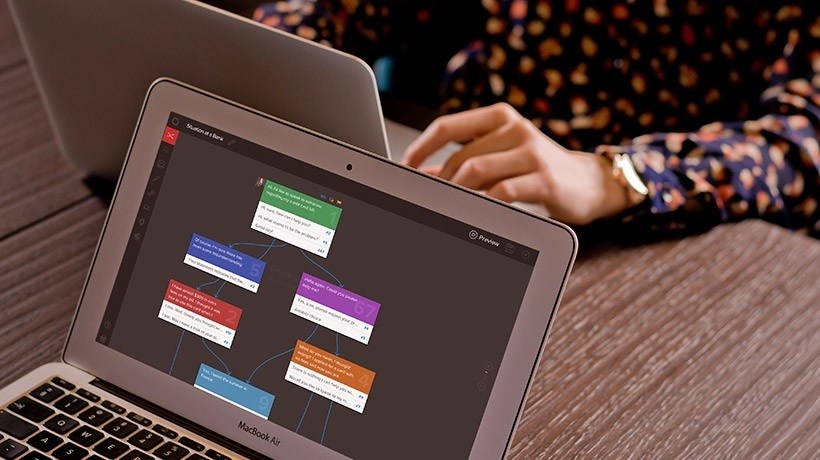
Scenario-based learning (SBL) places learners directly into realistic, complex work situations that require them to make critical, branching decisions. This method is fundamentally about applying knowledge, not just memorizing it.
In the context of content development, SBL's importance lies in its ability to bridge the gap between abstract concepts and practical application. SBL fosters critical thinking by presenting learners with a narrative and forcing them to navigate the consequences of their choices.
When Should You Use Scenarios?
Scenarios work best when the learning objective centers on judgment, communication, and applying soft skills. They are frequently used in microlearning, where quick, focused modules walk learners through real workplace dilemmas.
Scenarios are ideal for:
- Soft skills and interpersonal communication
Conducting performance reviews, resolving conflict, or managing stakeholder conversations. - Compliance and ethics
Presenting gray-area situations where correct responses rely on policies and ethical reasoning. - Sales and service
Practicing customer interactions where emotional intelligence and flexible decision making are crucial.
Additionally, scenario-based learning is highly scalable and easily adapted into localization solutions, making it ideal for global workforces requiring culturally relevant learning content.
Simulation Vs. Scenario: The Core Difference
The key differences between simulation and scenario-based learning revolve around their primary focus, the skills they develop, and the technology used for delivery.
Core Focus And Learning Objective
The fundamental distinction lies in the question each methodology is designed to answer:
- Simulations answer the question, "How do I perform this task?"
Their objective is process/system mastery and practice. They focus on replicating a procedure and building muscle memory—the "how to" of a task. - Scenarios answer the question, "How should I respond in this situation?"
They're chiefly concerned with decision making and consequences. Their objective is to apply knowledge and practice judgment—to address the "what if" moments in the workplace.
Skills Developed
While both simulation and scenario-based learning improve overall performance, they target different skillsets:
- Simulations focus on technical proficiency.
They recreate actual systems or environments, allowing learners to practice procedures, identify errors, and correct mistakes in a safe, controlled space. - Scenarios focus on cognitive skills such as reasoning, evaluation, and interpersonal judgment.
Learners navigate complex choices and human situations rather than operating a machine or system.
Complexity And Technology Usage
High-fidelity simulations recreate actual interfaces, environments, and tools—often using VR or advanced software. Scenarios rely more on storytelling, branching logic, and accessible formats such as short videos, interactive dialogues, or microlearning modules, making them flexible for onboarding solutions and rapid global deployment through localization.
In summary: A scenario asks, "What would you say in this situation?" While a simulation asks, "Can you successfully execute all 15 steps of this procedure in order?"
How To Decide: Aligning Learning With Performance
Deciding which strategy drives better performance depends on your learning objective. The superior method is the one that perfectly aligns with the required behavioral change.
To decide which to pick, analyze the desired outcome:
1. Analyze The Skills Gap
Is the performance issue rooted in a failure to make the right judgment (e.g., handling conflict)? Choose scenarios. Is it a failure to correctly execute a procedure (e.g., using a new system)? Choose simulations.
2. Determine Required Fidelity
If the training involves a physical tool or complex software that must be operated exactly, high fidelity is required. Choose simulations. If the learning involves dialogue or ethical choice where a simple video interaction suffices, a lower fidelity scenario is sufficient. Choose scenarios.
3. Consider Cost And Time
Simulations are typically more intensive and costly to develop, especially when replicating complex systems. If a scenario can achieve the learning objective effectively, it is often the more efficient choice because scenarios require less technical development, fewer graphics or system replicas, and simpler branching structures compared to high-fidelity simulations. This makes them faster and more cost-effective to produce while still delivering strong behavioral outcomes.
Conclusion
The learning experience that truly improves performance depends on the specific gap you're trying to close. Simulations address procedural precision, while scenarios strengthen judgment and communication. Both are essential parts of a modern, high-impact learning strategy, especially when combined with custom content development and scalable solutions that support long-term workforce capability across roles and regions.
If your organization is exploring new ways to elevate learning effectiveness, consider assessing your workforce's skills gaps and selecting the approach—simulation, scenario-based learning, or a blended model—that best mirrors real-world performance needs. A well-aligned strategy can accelerate talent transformation and deliver measurable business impact.