
 ChatGPT
 Perplexity
 Claude
 Grok
How Can L&D Teams Facilitate Learning And Growth Through Everyday Work?
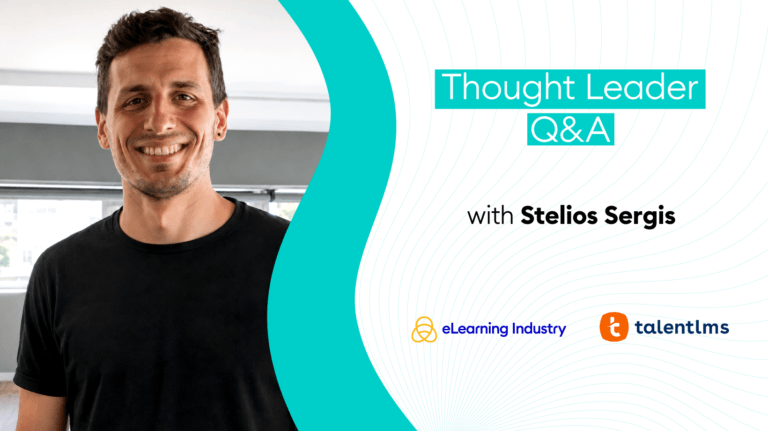
Stelios Sergis is a Learning & Development leader with 15 years in the tech sector. At Epignosis (parent company of TalentLMS), he leads Talent Growth, building scalable programs for driving talent development and leadership empowerment. His expertise includes learning experience design, talent development process architecture, and culture initiatives on inclusion and allyship. His background is in Computer Science, and he also holds an MSc and PhD in Educational Technologies.
In this Q&A, Stelios Sergis explores why formal training needs ongoing reinforcement, how employee goals and manager input shape learning opportunities, and how AI can support the process along the way.
Most organizations already invest in formal training, yet capability still lags behind the pace of change. Why isn't structured training enough on its own to keep pace with modern business needs?
I think one of the biggest misconceptions about learning is that once we've delivered training, learning has happened. But the forgetting curve reminds us how quickly knowledge fades without training reinforcement. And even remembering something doesn't mean we can apply it. It takes repeated practice, feedback, and real-world application before a new skill becomes embedded in our natural way of thinking, making decisions, and working.

TalentLMS's 2026 Learning Debt report found that 41% of employees feel their role has evolved faster than their company's ability to train them. To me, that highlights a fundamental truth: People need to adapt and learn in the flow of work, often faster than traditional training cycles can accommodate. So this introduces two challenges: How do we focus formal training on the core areas that drive the most impact, and how do we capture the knowledge employees create in the field and feed it back into the organization?
Not everything needs to become a course. Formal training should build the essential foundations, while everyday work, mentoring, coaching, and peer learning provide opportunities to practice and reinforce them. At the same time, employees are constantly discovering better ways of doing things, and we need to make sure that knowledge doesn't stay with the individual. For me, that's where L&D can make a real difference: Connecting formal learning with real-world experience and turning individual discoveries into shared organizational capability.
Ask most professionals where they learned their job, and they'll reference a stretch assignment or a high-stakes task rather than a training module. If that's where real growth happens, how must L&D shift its strategy?
I think this tells us something important about how people actually learn. Most of us didn't become good at our jobs by simply attending training. We learned by trying things, making mistakes, asking questions, receiving feedback, and trying again. And that's true whether the starting point is formal training, mentoring, coaching, or learning from an experienced colleague. All of these are valuable, but knowledge only really sticks when we have opportunities to apply it repeatedly, reflect on the results, and gradually turn it into part of how we work.
For me, this means L&D needs to shift from being primarily a provider of training to becoming an enabler of continuous learning. We need to create the conditions for people to learn in the flow of work, connect them with the right expertise, and make it easier to practice and receive feedback. But there's another dimension to this: When employees learn through their work, they don't just develop existing skills. They often create new knowledge by solving problems, discovering better processes, or finding approaches that others could benefit from.
As TalentLMS highlights in its discussion of learning debt, there's an opportunity to turn individual workarounds and discoveries into shared organizational capability. And I think this is a critical responsibility for L&D. We need to make knowledge flow in both directions: From the organization to employees, but also from employees back into the organization. Whether through peer learning, mentoring, project retrospectives, or shared knowledge bases, the goal is to help people learn from their work, learn from each other, and make sure valuable knowledge doesn't get lost along the way.
On one side you have an employee's career aspirations; on the other, the work already on the roadmap. How can L&D and managers effectively connect the two?
I believe one of the greatest opportunities for employee development is already there, in the work that needs to get done. Every project, new responsibility, or business challenge can become a learning opportunity. But simply assigning someone a challenging task doesn't automatically mean we're helping them grow. Development requires repeated practice, guidance, and feedback. Someone who wants to develop leadership skills, for example, won't necessarily become a confident leader after managing one project or by being left to cope completely on their own. They need opportunities to apply those skills in different situations, learn from their experiences, receive feedback, and keep improving.
This is where managers play a crucial role. They understand the business context, know what work is coming up, and can connect those opportunities with what employees want to develop. That starts with meaningful conversations about career aspirations, strengths, and skill gaps. From there, managers can intentionally allocate responsibilities that support both business needs and individual growth. Mentoring and coaching can accelerate that development, but again, the learning needs to continue beyond the conversation, through practice and regular feedback.
And I think there's an opportunity to make this valuable beyond the individual. When someone takes on a new challenge, they often discover things others could learn from too. Why not make reflection and knowledge sharing a natural part of the process? A simple project retrospective can generate insights that help the entire team. For me, the ideal outcome is when individual development and organizational learning reinforce each other. Employees grow through meaningful work, and the organization becomes more capable as a result of what they learn.
Many organizations treat an employee's development as the manager's job. However, you advocate for a model where the employee owns their growth, and the manager acts as a co-pilot. What does this division of ownership look like in daily practice?
I think employees need to take ownership of their development, but that doesn't mean they should be left to figure everything out on their own. I often compare this relationship to working with a personal trainer. A trainer helps you define goals, creates a plan, provides guidance, removes obstacles where possible, and holds you accountable. But here's the thing: If you don't show up at the gym, consistently put in the effort, and do the exercises, there's only so much your trainer can do. And even if you show up once or twice, you won't see lasting results. Making progress requires consistency, repetition, and effort.
Employee development works in much the same way. The employee needs to show up, seek opportunities, practice, and be open to feedback. The manager provides guidance and support, but they also bring something incredibly valuable: An understanding of the business context and knowledge of the work the team needs to deliver. That puts them in a unique position to allocate tasks and responsibilities that support both business priorities and individual growth. Someone wanting to develop stakeholder management skills, for example, could be involved in a cross-functional project. That's a development opportunity created through actual work, not an additional learning activity.
Of course, assigning the task is only the beginning. Just like a good personal trainer, a good manager observes, provides feedback, recognizes progress, and helps the employee improve through repeated practice. They also create an environment where people feel safe asking questions and learning from mistakes. L&D's role is to equip managers to be better coaches and provide the resources that support this partnership. Ultimately, the employee owns the effort, while the manager brings the business context, the right opportunities, and the guidance needed to turn that effort into lasting growth.
Where does AI genuinely add value in helping employees identify their strengths and skill gaps?
AI has enormous potential to make learning more personalized, accessible, and relevant. The holy grail of "personalized learning" has never been so close, within the grasp of every professional and with tools that anyone can utilize.
One area where I see particular value is self-awareness. People don't always recognize their own strengths, especially the things that come naturally to them. In a workshop I run, for example, people receive a short description of how they come across at work, and the reaction is often, "I didn't know that about myself, but it's true." Some discover they're naturally the person who steps in, takes ownership, and gets things done, but they've never really identified that as a strength. An AI learning assistant can help people recognize these patterns, reflect on their experiences, and explore potential areas for development.
But I think its value goes far beyond identifying skill gaps. AI can become a learning companion that helps people practice and reinforce knowledge in the flow of work. We know that knowledge fades without reinforcement, and AI can make repeated practice much more accessible. Someone could use it to prepare for a difficult conversation, explore different approaches to a problem, or practice a new skill. And even further, AI can detect subtle insights directly from our work (e.g., our emails, messages, deliverables) and identify evidence of our mastery, helping us keep track of how we progress. That's how knowledge gradually becomes part of how we operate.
And there's another opportunity I find particularly exciting: Organizational knowledge. Employees continuously create valuable knowledge through their work, but much of it remains undocumented or difficult to access. AI could help capture lessons from projects, synthesize expertise, and make that collective knowledge available when people need it. Of course, this requires human validation and appropriate safeguards around privacy and accuracy. And it doesn't replace mentoring, coaching, or learning from colleagues. For me, AI's real potential isn't just helping individuals learn faster. It's helping organizations learn collectively, by making knowledge easier to capture, access, apply, and reinforce.
When evaluating the success of learning initiatives, what evidence of growth should L&D and managers look for, and what should they stop counting?
A mindset shift is probably needed on what we consider evidence of learning. We've traditionally focused on course completions, attendance, and assessment scores. And while those metrics have their place, they don't necessarily tell us whether someone has developed a skill. Someone can complete a course and pass an assessment, but what happens two weeks or two months later? Do they still remember what they learned? Can they apply it? The forgetting curve reminds us that knowledge fades without reinforcement. For me, the strongest evidence of learning isn't what someone knows immediately after training, but what they can consistently do differently as a result.
That means looking at sustained behavioral change. Are employees becoming more independent? Are they solving problems more effectively, making better decisions, or applying new approaches consistently? Has the learning become part of how they naturally work? But we should also look beyond individual development. Are teams sharing what they've learned? Are we capturing solutions and avoiding the need to solve the same problems repeatedly? And are those insights feeding back into our training programs and organizational knowledge? These are also meaningful indicators of learning effectiveness.
We also need to pay attention to whether people feel comfortable asking for help. TalentLMS's 2026 Learning Debt research found that 47% of employees have stayed quiet when struggling with a task, while 28% say their manager doesn't know how often they struggle with the skills their role requires. That's concerning because when employees hide their struggles, we lose important signals about where knowledge gaps exist. Those signals should inform where we invest in training and support. Ultimately, successful L&D isn't about how much knowledge we've delivered. It's about how effectively that knowledge is retained, applied, reinforced, and shared to build lasting organizational capability.
Wrapping Up
A big thank you to Stelios Sergis for discussing with us how important it is for L&D teams to promote learning and growth within the workplace by realizing and emphasizing that training and development are different and require distinct steps. If you are interested in learning more about effective employee training, make sure to read this article from Epignosis on the learning debt, which touches on the hidden cost of learning slowly in a fast-paced work environment.