
 ChatGPT
 Perplexity
 Claude
 Grok
How Can Lean L&D Teams Connect Learning To The Rest Of The Business?
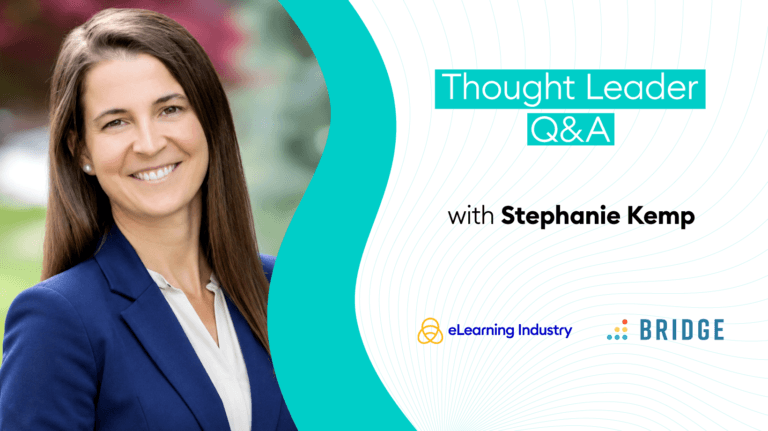
Stephanie Kemp, a leader in the EdTech and B2B SaaS sector, is currently serving as the VP of Client Management at Bridge. With a career path that includes roles in public education, retail management, and enterprise account leadership, she is passionate about using data to drive business decisions and believes that tool and process enablement are the backbone of successful teams. With a master's degree in Curriculum and Instruction from the University of Colorado, as well as certifications from Stanford University, Stephanie is an expert voice in all things Learning and Development.
Today, we are discussing with Stephanie Kemp the best ways for lean L&D and HR teams to bring their learning goals to life and reach maximum success despite their limited numbers and resources.
Despite their small size, lean L&D teams are constantly expected to deliver big results with limited resources. What is the key mindset or operational shift that separates the teams that drive strategic impact from those that are just keeping up?
Ten years of teaching middle and high school English taught me that good teachers don't rebuild the lesson plan from scratch every year. They build a solid foundation, so their energy can go into what's next: reworking the unit that fell flat, trying something new, reaching the student who's falling behind. Systems aren't "set it and forget it." They're the backbone that frees you up to iterate and innovate.
Lean L&D teams are no different. The ones that thrive invest up front in templates, automations, and repeatable workflows. The ones that struggle aren't lazy (far from it). They're just rebuilding the same enrollment process or compliance report every quarter, which leaves no time for the strategic, creative work they're best at and actually want to be doing.
The best lean teams also act like internal consultants. When I was a manager at lululemon, salespeople were called educators. The job wasn't to sell. It was knowledge transfer, so customers could make the best choices for themselves. Strong L&D teams work the same way. They talk to stakeholders across the organization, find out what matters most, then work backward from that end goal.
And they use data to make decisions, not just to report on activity. Completion rates tell you who clicked through a course. They don't tell you whether a new manager is running better one-on-ones or whether a frontline team is making fewer errors. The teams that put learning data next to performance data are the ones leadership listens to.
This matters even more now that AI is in the mix. Teams with clean workflows and connected data can put AI to work right away. Teams still buried in manual work can't, so the gap keeps widening. If you want to start small, we put together 4 Practical Ways AI Can Help Your L&D Team.
Learning tech often sits isolated from HR systems, skills data, and performance conversations. What does a truly connected learning ecosystem look like in practice, and how does it directly impact business outcomes?
In practice, a connected learning ecosystem means a manager can see what their direct report is working toward, which skills they're building, and what training they've completed. A skills gap flagged in a performance review automatically points to a relevant course or development opportunity.
Here's why that matters. L&D and HR teams only earn a seat at the table when training can be tied to outcomes. When learning, skills, and performance live in separate tools, you can report on activity. You can't prove impact.
It's a bit like tracking how often you go to the gym without ever checking whether you got stronger. Showing up matters, but it isn't the goal.
That's the thinking behind Bridge LMS. We built it to help lean teams connect the dots between learning, skills, and performance.
Between tool fatigue and tight budgets, lean teams are reaching a breaking point. What practical steps can they use to streamline training workflows without sacrificing learning quality?
The problem?
Most teams don't know where their time is actually going. They feel the drag, but they can't point to the cause. So start there:
- Map one workflow end-to-end. Pick something you run often, like new hire onboarding or annual compliance training. Write down every step and every tool. The bottlenecks usually jump out quickly.
- Automate the repeatable work first. Enrollments based on role or location, due date reminders and manager notifications are good places to start.
- Support your admins. If the people running the system can't use it confidently, every workflow slows down. Invest in admin training and documentation.
Consolidation can feel daunting, so we put together HR Tech Stack Consolidation: A Practical Blueprint to walk teams through it step by step.
Looking ahead to strategic planning for 2027, how can L&D leaders cut through the noise to identify which skill gaps require the most attention right now?
Start with the end goal, not the skills list. Any teacher will recognize this as backward design: decide what people need to be able to do, then plan the learning to get them there.
Sit down with leaders and ask what the organization is trying to accomplish next year. Is it entering a new market? Rolling out new technology? Growing the next layer of managers? Then ask which skills those goals depend on.
Once you know which skills matter, you need an honest view of where your people stand today. That's where many teams get stuck, because skills data is scattered across job descriptions, performance reviews, and managers' notes. A few ways to get a clearer picture:
- Build a skills framework for critical roles first. Focus on the roles that drive your 2027 priorities.
- Combine self-assessments with manager input. Each one has blind spots on its own. Together, they give you a much more reliable baseline.
- Use performance conversations as a data source. Recurring themes in check-ins and reviews often point to the gaps that matter most.
This is exactly what Bridge Talent Suite was designed for. It helps lean teams map workforce skills, close critical gaps, and build clear career paths, all tied to learning and performance.
If a lean L&D team can make only one high-impact change this quarter to better align learning with business strategy, what should it be?
Bring managers into every learning program.
That's it. That's the change.
Managers are the link between what people learn and how they work. Yet in many organizations, managers have no idea what training their team is taking. So how can they connect it to the work that matters?
Choose one program running this quarter and give managers three things: visibility into who's enrolled and who's finished, a short summary of what the training covers, and a few templated questions to ask in their next one-on-one.
Something as simple as "Where could you use what you learned this month over the next month?" turns a completed course into real progress toward the organization's overarching goals.
Wrapping Up
A big thank you to Stephanie Kemp for sharing her valuable insights on how to help lean L&D and HR teams thrive in spite of their challenges. Are you planning your 2027 L&D strategy? If so, make sure to check out how Bridge LMS helps lean teams spot skill gaps, streamline training workflows, and tie learning to business results, all in one platform.


