

AI Business Models Can Make Or Break A Company
AI business models are shaping how companies turn artificial intelligence into real revenue. Investors and founders now focus less on what AI can do and more on how it earns money. According to McKinsey, generative AI could add $2.6 trillion to $4.4 trillion annually to the global economy across use cases.
That growth pushes companies to rethink AI monetization models early in their strategy. Some teams prioritize enterprise deals, while others focus on usage-based pricing or platform distribution. At the center of this shift sits a simple question: how do AI companies make money? The answer depends on how they package value, control infrastructure, and scale customer adoption.
Many companies still rely on subscriptions because they offer predictable recurring revenue and easier forecasting. However, AI products often blend subscriptions with usage fees or hybrid pricing to match real compute costs. The strongest models align pricing with customer value and system demand rather than static plans.
Founders and investors use these models to evaluate scalability, margins, and long-term defensibility. When you understand how revenue flows through AI systems, you can spot which companies grow through efficiency and which depend on heavy spending. This clarity helps you compare startups beyond product features and focus on business strength. As AI adoption accelerates, the winners will design models that balance growth, cost, and customer value from day one. That approach creates a durable advantage in highly competitive AI markets today now.
Key Takeaways
- AI companies monetize through subscriptions, APIs, services, marketplaces, and licensing.
- Each business model has different growth, scalability, and profitability characteristics.
- SaaS and usage-based models dominate many AI categories.
- The best model depends on customer needs, adoption patterns, and competitive positioning.
In This Guide, You Will Find...
- Why Business Models Matter More Than Technology
- The AI Business Model Landscape
- AI SaaS Model
- Usage-Based AI Model
- AI API Business Model
- Enterprise AI Licensing Model
- AI Consulting & Services Model
- AI Marketplace Model
- AI Infrastructure Model
- Which AI Business Models Scale Best?
- Hybrid Models: Where The Market Is Heading
- Lessons From Leading AI Companies
- How Visibility Supports AI Business Growth
- What Learning Tech Companies Can Learn
| Business Model | Revenue Source | Scalability | Best For |
| AI SaaS Model | Monthly/annual subscriptions | High | End-user applications, productivity tools |
| Usage-Based AI Model | Pay-per-use (tokens, calls, compute time) | Very high | Flexible demand services, variable workloads |
| AI API Business Model | Per API call / usage tiers | Very high | Developers, platform integrations |
| Enterprise AI Licensing Model | Large contracts, licenses, seat-based deals | Medium–High | Large organizations, regulated industries |
| AI Consulting & Services Model | Project fees, retainers, hourly billing | Low–Medium | Custom solutions, early-stage AI adoption |
| AI Marketplace Model | Commission on transactions or model/tool listings | High | Model hubs, datasets, plug-in ecosystems |
| AI Infrastructure Model | Compute usage, hosting, GPU/cloud services | Very high | Foundational AI providers, scaling training/inference |
Why Business Models Matter More Than Technology
AI business models matter more than technology because you can copy features, but you cannot easily copy how a company makes money. In today’s market, many AI tools look similar on the surface. You see the same interfaces, similar outputs, and overlapping use cases. However, the companies that win long term design stronger revenue systems that support scale and profitability from day one.
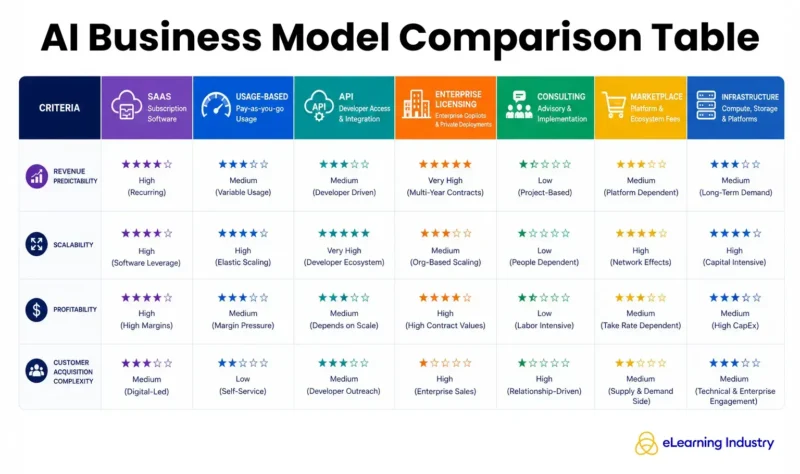
Scalability sits at the center of this difference. A strong generative AI business model allows a company to grow usage without letting costs spiral out of control. At the same time, weaker models struggle when compute costs rise faster than revenue. This gap becomes even clearer when you look at enterprise software, where buyers expect reliability, predictable pricing, and long-term contracts. Companies that fail to align their model with these expectations often lose momentum even if their product performs well.
Profitability, retention, and competitive advantage all connect back to structure. Strong AI business models improve retention by embedding products into daily workflows, making switching costs higher over time. They also attract AI investments because investors look for predictable growth and efficient unit economics. When you step back, you see a clear pattern: technology may get attention, but business design determines survival in a crowded AI market.
The AI Business Model Landscape
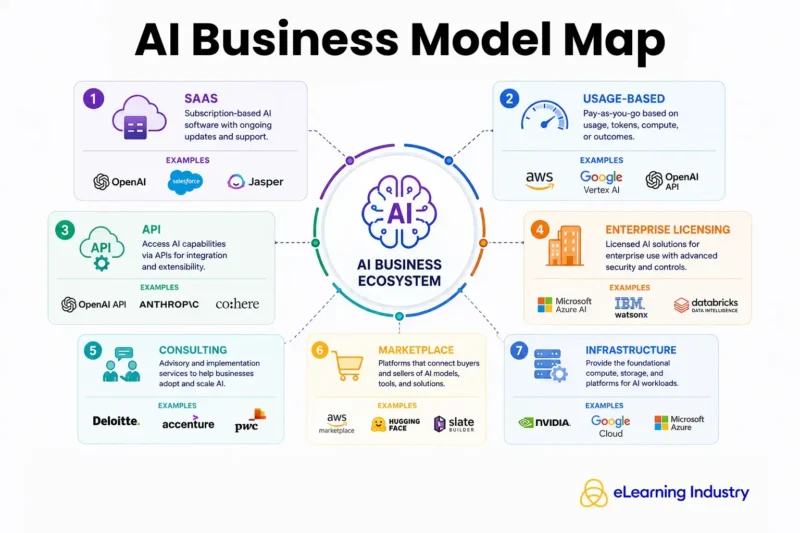
The AI business model landscape includes several distinct approaches that shape how companies build, deliver, and monetize products. When you look at leading AI company business models, you quickly see that most fall into a few core categories, even if they combine elements from multiple models. Each one defines how value moves from product to customer and how revenue flows back into the business.
Below, we break down the most common structures shaping modern AI revenue models.
-
SaaS
Software-as-a-service remains one of the most familiar models. Companies package AI features into subscription plans and charge recurring fees. This approach works well when users need consistent access and predictable costs.
-
Usage-Based
Usage-based models charge customers based on how much they consume. This structure aligns cost with value and works especially well for compute-heavy AI products where demand fluctuates.
-
APIs
APIs let developers integrate AI capabilities directly into their own products. Companies monetize through request volume or compute usage, making APIs a core driver of scalable distribution.
-
Enterprise Licensing
In this model, companies sell large-scale contracts to organizations that want full access, control, or customization. Licensing often includes long-term agreements and supports stable revenue streams.
-
Consulting
AI consulting blends services with product delivery. Many firms offer implementation, training, and customization support. AI consulting helps companies monetize expertise while supporting early product adoption.
-
Marketplaces
Marketplaces connect buyers and sellers of AI tools, models, or data. They earn revenue through transaction fees or commissions while enabling ecosystem growth.
AI SaaS Model
The AI SaaS business model focuses on delivering AI-powered software through recurring subscriptions. Instead of selling a one-time product, companies package AI capabilities into tools that users access on a monthly or annual basis. You often see this model in everyday AI business model examples such as copilots, productivity assistants, and content generation platforms that integrate directly into workflows.
-
Examples
AI SaaS products include AI copilots that support writing, coding, or decision-making. You also find productivity tools that automate tasks like scheduling, summarizing, or data analysis. Content generation platforms use AI to help users create text, images, or marketing assets faster and at scale. These tools often sit at the center of AI in operations, where teams rely on them to improve efficiency across daily workflows.
-
Revenue
Most companies rely on monthly subscriptions or annual plans. This structure gives users flexibility while helping companies forecast revenue more accurately. It also encourages long-term adoption since users tend to stay once the tool becomes part of their workflow.
-
Advantages
The biggest advantage of this model is predictable revenue. Companies can plan growth with more confidence, and investors can evaluate stability more easily. Strong retention also plays a key role, especially when users integrate AI tools into daily processes.
-
Challenges
However, competition remains intense. Many AI SaaS products offer similar features, which leads to pricing pressure and higher customer acquisition costs. As a result, companies must continuously improve their product experience to stay relevant and maintain market share.
Usage-Based AI Model
The usage-based AI model charges customers based on how much they actually use the product. Instead of paying a fixed fee, users pay for tokens, API calls, or compute resources. This approach reflects how modern AI company business models adapt to real-time demand and infrastructure costs.
-
Examples
Common examples include token pricing systems where users pay per word processed or generated. API-based models charge per request, making them popular among developers building on top of AI platforms. Compute consumption models go even further by billing based on processing power, storage, or model complexity. You often see this structure in companies that use AI today for large-scale applications like automation, analytics, or personalization.
-
Revenue
This model depends heavily on usage-based pricing, which directly links cost to customer activity. Unlike subscription models that rely on fixed fees, revenue fluctuates based on demand patterns. This creates strong alignment between product value and customer behavior, especially when usage increases over time. While it can generate significant recurring revenue at scale, it also requires careful infrastructure planning.
-
Advantages
The biggest advantage is scalability with customer value. As customers use more services, revenue grows naturally without needing to constantly adjust pricing tiers. This makes the model attractive for high-growth AI platforms.
-
Challenges
However, forecasting revenue becomes more difficult. Since usage can vary widely, companies face uncertainty in financial planning and resource allocation. This makes long-term budgeting and stability more complex compared to fixed subscription models.
AI API Business Model
The AI API business model focuses on giving developers direct access to AI capabilities through programmable interfaces. Instead of building full applications, companies expose core functionality through APIs, allowing others to integrate AI into their own products. This approach plays a central role in modern AI revenue models, especially for platforms that want to scale beyond a single end-user product.
-
Examples
You typically see this model in model providers that offer access to large language models, vision systems, or speech tools. Infrastructure layers also rely heavily on APIs to distribute compute power and model access across different applications. Many AI startup monetization strategies now start with APIs because they allow fast distribution without building a full frontend product.
-
Revenue
Companies usually charge based on usage, such as per request, token, or compute unit. This creates a flexible system where costs scale with demand. Leading AI companies often combine API access with enterprise agreements to stabilize revenue while keeping developer access open.
-
Advantages
The biggest advantage is developer adoption. When you make APIs easy to access, you lower friction and encourage rapid integration. This naturally leads to ecosystem growth as more products build on top of your technology, expanding reach far beyond your own platform.
-
Challenges
However, commoditization remains a major risk. When multiple providers offer similar capabilities, price becomes the main differentiator. This puts pressure on margins and forces companies to continuously innovate at the model and infrastructure level.
Enterprise AI Licensing Model
The enterprise AI licensing model focuses on selling AI solutions directly to large organizations through customized agreements. Instead of targeting individual users, companies provide advanced AI capabilities that meet specific business requirements. This approach has become a key part of AI company business models because organizations often need security, customization, and dedicated support before adopting new technology.
-
Examples
Enterprise copilots are one of the most common examples of this model. Companies use these tools to support employees with tasks like research, reporting, communication, and decision-making. Private deployments also play an important role, allowing organizations to run AI systems within their own environments while maintaining greater control over data and compliance. Similar to traditional enterprise software, these solutions focus on reliability and long-term partnerships.
-
Revenue
Companies usually generate revenue through large contracts that include implementation, support, and ongoing access. These agreements can create some of the most profitable AI business models because a small number of enterprise customers can generate significant income.
-
Advantages
The biggest advantage is high contract value. Enterprise deals often provide stronger revenue predictability and deeper customer relationships. They also create opportunities for expansion as organizations add more AI capabilities over time.
-
Challenges
However, long sales cycles remain a major challenge. Enterprise buyers often involve multiple decision-makers, security reviews, and budget approvals. As a result, companies need patience, strong positioning, and a clear brand strategy for growth to succeed in competitive markets.
AI Consulting & Services Model
The AI consulting and services model helps organizations adopt artificial intelligence through expert guidance, implementation support, and customized solutions. Instead of selling a standalone product, companies provide knowledge and hands-on assistance to help businesses identify opportunities and integrate AI into their operations. This AI business model works well for companies that want to monetize expertise while helping customers navigate complex AI adoption decisions.
-
Examples
AI implementation projects help organizations introduce AI tools, automate workflows, and connect new systems with existing technology. AI strategy consulting focuses on identifying where AI can create the most value, from improving customer experiences to increasing internal efficiency. Transformation projects take a broader approach by helping companies redesign processes and build long-term AI capabilities.
-
Revenue
This model generates revenue through project-based fees, consulting packages, and ongoing support agreements. Unlike software models, companies often receive payment upfront, which creates immediate revenue opportunities. However, they must continuously find new projects to maintain growth.
-
Advantages
The biggest advantage is fast monetization. Companies can start generating income without building complex products or large customer bases. Consulting also helps businesses develop deeper market knowledge and understand customer challenges.
-
Challenges
The main limitation is scalability. Since services often depend on human expertise, growth can require hiring more specialists. Unlike software businesses that benefit from platform economics, consulting companies usually face higher operational costs as demand increases.
AI Marketplace Model
The AI marketplace model connects buyers and sellers within a shared ecosystem where users can discover, purchase, or access AI solutions. Instead of creating every tool internally, companies build a platform where multiple providers contribute products, services, or specialized capabilities. This approach shows another way of understanding how AI companies make money, as revenue often comes from transactions, commissions, or platform fees.
-
Examples
Model marketplaces allow users to access different AI models from various providers in one place. AI agent marketplaces follow a similar structure by connecting users with specialized AI agents designed for specific tasks, industries, or workflows. These platforms support the growth of an AI platform business model by creating an environment where developers, businesses, and customers can interact.
-
Revenue
Marketplace companies typically generate income by taking a percentage of transactions or charging providers for visibility, access, or premium features. As more participants join, the platform can create additional revenue opportunities while expanding its overall value.
-
Advantages
The biggest advantage is network effects. More sellers attract more buyers, while more buyers encourage additional sellers to participate. This cycle can help marketplaces grow quickly and become valuable industry hubs.
-
Challenges
However, marketplace liquidity remains a major challenge. A platform needs enough quality providers and active customers to create consistent activity. Without strong participation on both sides, users may struggle to find valuable solutions, limiting growth and long-term success.
AI Infrastructure Model
The AI infrastructure model focuses on the underlying technology that powers artificial intelligence products. Instead of building applications for end users, companies provide the computing resources, hardware, and platforms that other AI businesses depend on. This model supports the wider AI ecosystem by supplying the foundation needed to train, run, and scale advanced systems.
-
Examples
Compute providers offer the processing power required for AI workloads, while chip companies create the hardware that enables faster model performance. AI platforms also provide development environments, tools, and resources that help businesses build new applications. Companies such as NVIDIA and CoreWeave have become important players in this space by supporting the growing demand for AI infrastructure.
-
Revenue
Infrastructure companies often generate income through usage fees, long-term contracts, and enterprise agreements. Some providers also create recurring revenue by offering ongoing access to computing resources and specialized services. Their pricing approach depends heavily on demand, capacity, and customer requirements.
-
Advantages
The biggest advantage is foundational demand. As more companies adopt AI, they need reliable infrastructure to support their products. This creates long-term opportunities across different sectors.
-
Challenges
However, this model requires significant investment in hardware, data centers, and technical development. Companies must carefully manage costs while adapting their AI pricing strategies to market changes. Building infrastructure at scale can become especially challenging as AI growth accelerates and technology evolves.
Do you want to stay updated regarding the latest eLearning news? Subscribe to our newsletter and never miss a beat!
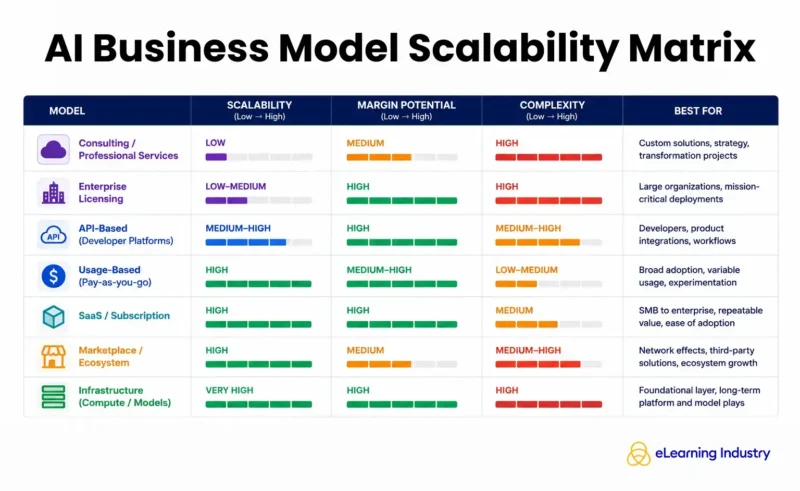
Which AI Business Models Scale Best?
-
SaaS Model
Scalability: High
Margin Potential: High
Complexity: Medium
SaaS models scale efficiently because companies can serve many users through one platform. After development, adding customers usually requires fewer resources, making this model attractive for long-term growth and profitability.
-
Usage-Based Model
Scalability: Very High
Margin Potential: Medium to High
Complexity: Medium
Usage-based models grow alongside customer demand. They work especially well when customers increase their consumption over time. However, companies must control infrastructure costs to protect margins.
-
API Model
Scalability: Very High
Margin Potential: High
Complexity: High
APIs create large distribution opportunities by allowing developers to build AI features into their own products. However, maintaining performance, reliability, and security becomes more complex as adoption increases.
-
Enterprise Model
Scalability: Medium
Margin Potential: Very High
Complexity: High
Enterprise solutions generate large contracts and strong customer relationships. However, customization needs and longer sales cycles can slow expansion.
-
Services Model
Scalability: Low to Medium
Margin Potential: Medium
Complexity: High
Services can generate revenue quickly but depend heavily on skilled teams. Compared with SaaS or AI business models built around automation, service-based growth requires more human resources.
Hybrid Models: Where The Market Is Heading
Many successful AI companies are moving beyond a single revenue approach and combining multiple models to create stronger businesses. A hybrid structure allows companies to serve different customer needs while balancing growth, profitability, and flexibility. Instead of relying on one income stream, businesses can build a more resilient strategy that adapts as customer expectations and market conditions change.
A common approach combines SaaS products with usage pricing, consulting services, and enterprise licensing. A company may offer a core software platform with subscription plans while charging additional fees for higher usage, customization, or professional support. This creates a more flexible AI platform business model because customers can choose the level of service that fits their needs.
Hybrid businesses can also improve customer retention by becoming more connected to daily workflows. Subscription products create recurring revenue, while consulting and enterprise agreements open new opportunities for expansion. This combination allows companies to serve both smaller teams and large organizations without limiting their growth potential.
The future may belong to hybrid AI businesses. Many of the hottest AI startups already combine different approaches to increase adoption and build sustainable growth. Companies that balance scalable products with personalized solutions will have stronger opportunities as the AI market continues to develop.
Lessons From Leading AI Companies
1. OpenAI
- OpenAI shows how a company can combine consumer products, enterprise solutions, and developer access into one ecosystem. Its business model includes subscriptions for individual users, business plans, and access for developers through its platform.
- The company demonstrates the value of building multiple revenue streams instead of depending on a single product. This approach creates flexibility as customer needs change.
- OpenAI’s strategy highlights how AI business model examples often combine technology, distribution, and partnerships to accelerate adoption.
2. Anthropic
- Anthropic focuses heavily on enterprise customers and developers through its AI models and business partnerships.
- Its approach emphasizes safety, reliability, and integration, which appeals to organizations that need dependable AI systems.
- The company shows how trust and product positioning can influence monetization decisions in a competitive market.
3. Microsoft
- Microsoft uses AI to strengthen its existing ecosystem by integrating AI features into widely adopted products.
- By adding AI capabilities across productivity tools and enterprise software, the company increases customer value while encouraging long-term adoption.
- Its strategy shows how established companies can use existing distribution channels to scale AI faster.
4. NVIDIA
- NVIDIA built a powerful position by providing the infrastructure behind many AI applications. Its chips and computing platforms support companies across industries.
- The company demonstrates how infrastructure can become one of the strongest AI revenue models when demand grows across an entire market.
5. Google
- Google combines AI research, cloud infrastructure, advertising, and consumer products to create a broad ecosystem.
- Among the biggest AI companies, Google shows how a diversified approach can create competitive advantages by connecting multiple business areas.
How Visibility Supports AI Business Growth
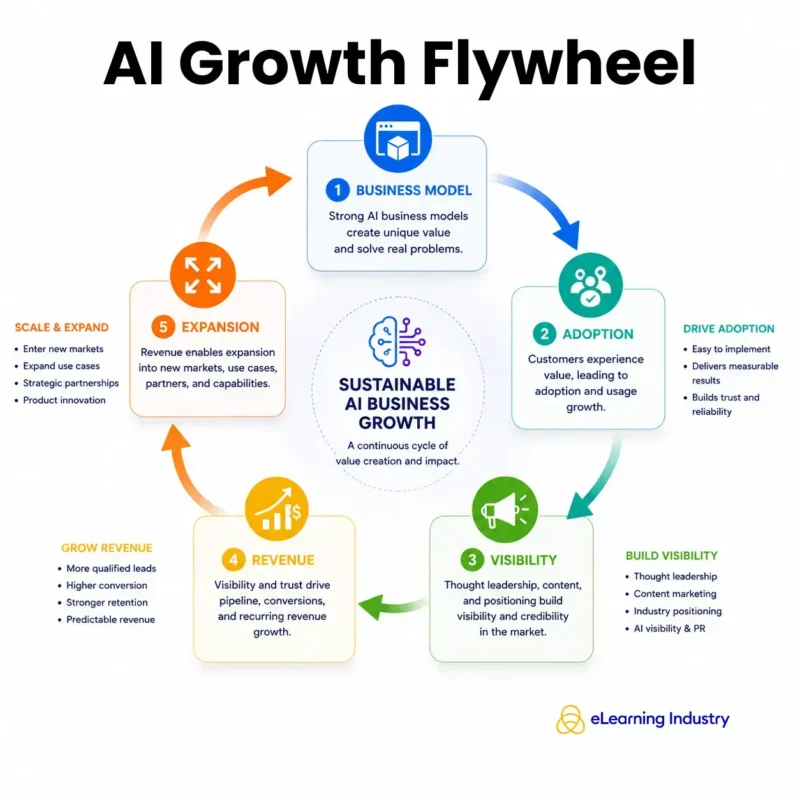
A strong business model can create the foundation for growth, but companies still need visibility to attract customers, partners, and investors. In the AI market, trust plays a major role because buyers want to understand not only what a product does but also why they should choose one provider over another.
Thought leadership helps companies build credibility by sharing insights, research, and practical knowledge. Through content marketing, businesses can explain complex topics, showcase expertise, and create stronger relationships with their target audiences. B2B thought leadership allows companies to position themselves as trusted voices rather than simply another AI vendor.
Industry positioning also influences adoption. When leaders share their perspectives through articles, interviews, and discussions, they increase brand recognition and make it easier for potential customers to discover their solutions. This is one reason many executives explore opportunities like why be a podcast guest when building authority in competitive markets.
Strong AI visibility supports AI startup monetization strategies by helping companies reach the right audiences. Even advanced AI monetization models need awareness and trust to succeed. The companies that combine strong products with consistent visibility have a better chance of turning interest into long-term business growth.
What Learning Tech Companies Can Learn
AI companies are changing more than technology. They are changing the way businesses create value, package solutions, and generate revenue. Understanding how AI companies make money can help LMS vendors, HR tech providers, and learning platforms discover new opportunities.
-
Monetize Outcomes, Not Features
Buyers do not purchase AI simply because it exists. They want faster course creation, better productivity, improved skills development, and measurable business results.
Recent research reinforces the need to monetize AI around outcomes rather than novelty. According to eLearning Industry's report, only 3% of L&D buyers say they are willing to pay significantly more for AI capabilities, while 42% tie their willingness to pay to proven use cases and outcomes. With no dominant AI pricing model yet established in learning technology, vendors may find it increasingly difficult to justify premium pricing for AI features without demonstrating measurable business impact.
-
Create Premium AI Tiers
Learning companies can use AI to support higher-value plans, enterprise upgrades, and advanced features such as AI coaching, content creation, and analytics.
Monetization strategy also depends on choosing the right AI capabilities to monetize. Our research reveals a notable expectation gap in learning technology: 65% of L&D buyers value personalized learning paths, yet only 44% of vendors are investing in them. Meanwhile, 70% of vendors are investing in AI-generated content, compared with 48% of buyers who consider it a top priority. For LMS and HR tech providers, this suggests that the strongest premium AI opportunities may come from aligning paid capabilities more closely with buyer demand rather than simply monetizing the features that are easiest to scale.
-
Experiment With New Revenue Streams
Usage-based pricing and an AI services business model can help companies monetize advanced capabilities while managing infrastructure costs. Similar to platform economics used by tech giants today, businesses can combine software, services, and expertise.
-
Build Complete AI Ecosystems
The strongest companies combine technology with education, support, consulting, and community. Learning providers can create new categories through AI course builders, assessment tools, coaching assistants, and skills intelligence platforms.

Key Takeaway
AI business models will continue to evolve as artificial intelligence becomes a core part of more industries. While technology creates new opportunities, the companies that succeed will be the ones that build sustainable strategies around customer value, revenue, and adoption. The best AI business models combine strong products with scalable monetization approaches that support long-term growth.
Whether a company uses SaaS, subscriptions, usage-based pricing, enterprise solutions, or services, the goal remains the same: deliver measurable value that customers are willing to pay for. Successful AI company business models often combine multiple revenue streams to improve scalability, retention, and profitability. For learning technology companies, HR platforms, and AI vendors, these lessons show that adding AI features is only the beginning. A strong AI strategy for business requires understanding customer needs, creating clear value, and building a model that supports sustainable expansion.
Whether you're launching AI-powered learning experiences, intelligent HR tools, AI assistants, analytics platforms, or automation capabilities, visibility plays a critical role in adoption and growth. eLearning Industry helps AI vendors, LMS providers, and HR tech companies showcase their solutions through thought leadership, sponsored content, webinars, research, directory visibility, podcast opportunities, and targeted lead generation campaigns, connecting them with decision-makers actively exploring AI-powered technologies.
FAQThe most common models include SaaS subscriptions, API-based access, usage-based pricing, enterprise licensing, and AI-as-a-Service platforms.
AI startups typically monetize through subscription plans, pay-per-use APIs, enterprise contracts, custom AI solutions, and premium feature upgrades.
Enterprise-focused SaaS and API-based models tend to be the most profitable due to high contract values, recurring revenue, and scalable infrastructure.
It’s a model where customers are billed based on consumption, such as number of API calls, tokens processed, images generated, or computing time used.
Some are highly profitable, especially established enterprise AI firms, while many startups operate at a loss initially as they invest heavily in growth and infrastructure.